
See the full interview at: https://youtu.be/U2X8TvVbv0E
Bambi CEO Nirav Chheda interviews Ed Bandas and Michelle McCullough on the game-changing new NEMT "stretcher-chair" from Travrsa by Broda. Learn more about it at:
https://travrsa.com/5-reasons-to-use-the-travrsa-lt-transport-wheelchair-vs-a-stretcher/
Nirav:
Hello welcome to NEMT expert talks. I'm here with Ed Bandas and Michelle McCullough, they are with Broda, which, as many of you know, has been around for four decades, building wheelchair products for the NEMT and medical industry. Ed is a regional sales manager at Broda, and Michelle is a marketing manager. Thank you both for being with me. Would both of you like to do a quick intro of yourself?
Michelle:
So my name is Michelle. I work on the marketing team for Travrsa and Broda as well, our job is to make sure we can get the word out to as many operators as possible at the benefits of this awesome product.
Ed:
And I've been with Broda now for about three years, and I've been in the medical industry for a long time. And one of the things that I've really enjoyed about working on this project for the new Travrsa chair, as well as working with Broda is being able to see the end user and the effect that our chairs have on their lives, you know, so for example, one of the things that we had talked about before we went on the air, is how we took one of these chairs, and did a demo for a patient in a state veterans home. And we were able to put him in this chair and take him outside. And that was the first time he had seen daylight in two years, which is incredibly important, because it wasn't just the fact that he saw daylight, they were now able to take him to meet all of his doctor's appointments and help him get healthier, which before because of his large size was not able to get transported anywhere and had to wait for healthcare to come to him. So that's just one example of why I just love doing this every day.
Michelle
It is so uplifting to see just patients breaking barriers that are so common, and overcoming all sorts of health obstacles to be able to access, like Ed said, the care that they need, the people that they need to see, possibly family wise, the places that they'd like to go where they were previously unable. Our transport products help with that immensely in a way that is so easy to use.
Nirav:
And that's an incredible story about this guy being able to go outside for the first time in two years
Ed:
Right? Yeah, that's the big deal.
Nirav:
All right. I'm excited to dive into this chair and talk about its impact. You guys have listed out some of the key things here. You want to just run through them?
Ed:
Yeah, absolutely. And in fact, it's interesting because we can almost separate these out into two categories. One of our operators called it the hard ROI, and then the soft ROI. The hard ROI is obviously reducing the workload, reducing workers comp injuries, reducing injuries to the patient themselves, and a much safer crash tested ride. And then the soft ROI actually is not just the improved safety, but the return on investment, which specifically means the operators can charge a higher price. And at the same time, facilities demand this as a pull through even more. For example, anecdotally, what we understand from people who use Broda chairs and Travrsa chairs is that the reportable incidents, the things that count against the facilities and the operators, with CMS actually reduced down to almost zero, which means nobody's getting dinged retroactively on reimbursement, which also creates a pull through demand from the facilities requesting transport in this kind of a chair. So that would be like the soft ROI. We can't point to it. Other than once the operator starts using a Broda, he notices that it keeps getting requested both by the facilities by the nurses by the patients themselves and it becomes a pull through demand, which of course increases the revenue to the operator itself.
Nirav:
Good to know. So there's one, I guess, maybe more tangible and direct ROI that I want to dig into, which is that this basically turns into a stretcher and you only need one person to operate it. With a normal stretcher you need two people, it's typically the driver and the attendant. But with this, one person can put a passenger into this wheelchair, and then essentially have it turned into a stretcher whenever it needs to be turned into a stretcher, and then just turn it into a wheelchair. So one person can move that passenger around. Like, I feel like that's probably a big, you know, sort of selling point to NEMT companies is like, Hey, you don't have to spend as much on having, you know, more manual labor – we can eliminate the attendant and still have a stretcher. Right?
Ed:
Absolutely. In fact, that's that is the immediate ROI to the operator is having their labor cost cut in half just by using this chair. The other thing that we're hearing from the operators who are experienced in this is that the stretcher rides, about 90% of them didn't need to be a stretcher to begin with, you know, stretchers are obviously required in certain situations, bariatric patients, you know, they're quadriplegic or present some other complex diagnosis. But 90% of the stretcher rides were only stretcher rides, because either the patient didn't have their own wheelchair, or from a comfort perspective, they just needed more flexibility than sitting in one of those. You know, fold up wheelchairs, it's basically 90 degrees, you know, the seat and the legs and things like that. Imagine if you were getting released from a hospital postoperatively on hip surgery or knee surgery. And you had to wait around for a stretcher, which means waiting around for an ambulance ride, which is the most expensive ride out there. And usually they don't want to do non emergency medical transports. And you have to wait till the middle of the night before they can finally move you back to a facility. Man, it is so much easier and so much more in demand by the operators who use the Broda chairs and the Travrsa chairs, just to come pick them up at their convenience, they're always available and it's easy to load a patient in a stretcher mode, and then put the center of gravity down low again, by having them sitting even if it's in a tilted position or reclined position. And make it super comfortable for them. Does that make sense?
Nirav:
So basically, NEMT companies who previously couldn't take certain rides, because you know, they don't have a stretcher and the facility or whoever is saying this is a stretcher ride – they buy one of these Travrsa by Broda products, and now it's a wheelchair essentially. But they can do stretcher ride, because it can easily just turn into a stretcher whenever it needs to.
Ed:
Yeah, I’ll give you a perfect example. One of the operators who purchased this chair, he was one of the first ones on board down here in Texas. As soon as we did the demonstration with our demo chair, he immediately wrote a check for the demo chair, turn to his marketing person and says, As of this moment, we now accept transports for CT. And I said, What difference did that make? And he said half the time, they have to turn down patients going to CT scans, because there's no way to bring the patient up to the level of a table that is fixed and won't go down. Now they can put this person in this chair, raise it up to the level of the table, and then stretch it out as a stretcher and move the patient easily across to the table. I didn't even know that was a problem. And all of a sudden it opened up a brand new market in his area of Texas that we didn't know existed. So you know, those are the things that we're finding our operators telling us with the improvements that we made with this particular chair. So because this chair itself is actually it's really an interesting collection of everything that all of the operators over the last 20 years have been telling us. Man we wish this chair would do this, we wish it would go up and down. We wish it had a higher weight capacity. We wish we actually combined every one of those things that we could think of and put it in this chair, quick release arms, you know, for example, being able to go all the way up, you know, almost 12 inches in a flat, stretcher like manner to be able to do safe transports and transfers. If you had to move somebody from a bed that won't come down, the typical way is put the person in some kind of a sling and lift them into a chair for patients with dementia or with some kind of issues with their bones and joints. That's not only scary, it can be painful. Now it's easier if the chair can raise up to their bed, do a safe transfer across without ever having to put them in a sling and risk dropping them, and then be able to put them back in a seated position for transport. There's just so many applications of this particular chair, especially when it comes to hospital discharges, long distance transports and specialized transports. This chair is able to do it where stretchers can't and standard wheelchairs can't.
Nirav:
This was finally released in September of this year?
Ed:
And it was actually just a little bit before then in August. I think you saw the first ones.
Nirav:
I did. So I can personally attest to how comfortable this chair is because we were hanging out at the NEMTAC conference where you had this chair and I got to test out being in it when it was a wheelchair and then getting turned into a stretcher. That was a fun time.
Michelle:
It’s comfortable the whole way. I mean, you can take it from wheelchair to stretcher and back again without having to move the passenger out of the wheelchair. And it is just totally so much more comfortable and more dignified of an experience. I have only had one stretcher ride in my life, I was a teenager gotten a ski accident. And they strapped me into that thing. And it felt horrible. I was carsick the whole ride. It just felt strange. But with this, you can take somebody who doesn't have any risks from sitting upright and just bring their back right up. So they can see in front of them. They can take in their surroundings, they can process what's happening, and be comfortable the whole ride. It's great.
Nirav:
And it's actually pretty quick to do. Because when I was sitting in this chair at the conference, like I think it was you Ed, and you turned it into a stretcher, like within a matter of how many seconds?
Ed:
About two seconds.
Nirav:
Yeah, there we go. And then brought it back down to a wheelchair and I was in it. And I was very comfortable and admittedly having a pretty fun ride. So let me ask the practical question for a lot of the NEMT owners and operators in the audience. If they're interested in learning more about the Travrsa LT Transport Wheelchair, who should they reach out to? What's the best way to get in touch and learn about the product and the pricing and how they can get it?
Michelle:
You can absolutely reach out to us, we've got a Contact Us form on our website, you can fill that out, you can call the number on our site, and our team will hook you up with whatever you need, whether it's a demonstration, a webinar, whether you need training for your team, we can help you with that. We are here for whatever you need to get started. Because it really is the simplest and easiest way to boost your revenue, possibly in markets you've never tried before, while avoiding all the pitfalls of safety operability of a stretcher, because so many people ask us, is there any sort of power component to this wheelchair? And they're thinking, Is there a button that causes it to raise and lower? What about my operators who may not be as physically strong? Are they going to be able to manage this wheelchair? And the answer is 100%. Absolutely. We have a super easy super ergonomic design of this wheelchair. When you go to recline the wheelchair to put it into stretcher mode, all you have to do is squeeze a handle and lower. It doesn't matter how heavy the patient is. We have weighted gas cylinders that counter at that weight. So even somebody like me, I don't count myself physically strong at all, I can easily pull somebody down into that reclined position and back up again, easily squeeze the handle down into tilt and back up again. When you're ready to raise the height of the wheelchair, it's a simple flip pump, you flipped on the pump and you press with your foot, the chair raises up half inch at a time until you get to the height that you want. Ready to lower it down again, press and hold the other button with your foot and it lowers it's so easy, it could not be more effort free. And I think operators are really going to latch on to this because drivers can be hard to train. And this chair really is the simplest possible solution to what could be a vastly more complex and more expensive and harder to maintain chair. So the benefit is certainly it's easy to use, easy to maintain pretty foolproof, and we've got great training resources to get your driver started.
Ed:
As a side note, the first two chairs, I actually sold the first two chairs by the way and they went to a state veterans home and the reason we sold it is people already knew Broda. What they wanted to see is, could one of their small female operators operate this chair with one of the big guys in it. And they actually put the biggest guy in there, my boss and I were thinking, this is gonna be a challenge. And we were on carpet of things, you know, on top of everything else, the administrator of the facility was just sitting there just watching. And all of a sudden, the attendant just started pushing the big guy in the chair, just had to get it started. And all of a sudden, she's like, Yeah, there's nothing wrong with this, this is fine. They ordered to right there. It's interesting, because one of the other ROIs that I think the operators realize is that, especially if they've been using stretchers exclusively with two attendants every time they have to roll even for a non emergency medical transport is not just the ROI of having one attendant, it's also the ROI of having a chair that cost about 1/3, as much as a well equipped stretcher that they're using, all of a sudden, they realize we can buy three of these chairs for the price of one of those stretchers, cut our labor in half. Now we're moving three times as many people assuming they have the vehicles to do it, which they already did. And it takes up the slack of the lack of demand for their stretchers in some cases. So this is a great way for them to expand their business at the same time, another segment may be coming down a little bit.
Michelle:
You can also talk about the time savings because as the Bambi folks know, your dispatchers are trying to make all the trips happen, you're trying to fit in all these pieces of the puzzle, to be the most efficient as possible to take on that last minute trip. And you know, the driver availability is everything. If your drivers can load faster, and load faster in a way that's safe for the patient and comfortable at the same time, you're gonna have a lot more space over time for a lot more trips, meaning a lot more revenue, meaning a lot higher patient satisfaction. So it just builds and builds and builds.
Ed:
In fact, I did a presentation not long ago, where there's three partners, one partner said, Absolutely, we got to have this chair right now two partners are like, Ah, I don't know, man, I don't know. So they brought in one of their attendants, their operator, and driver. And they said, Okay, you try it out. So we did all kinds of configurations and pushing it in and out of vans and all these demonstrations. And the partners who are sitting on the fence ask this operator, Hey, so assuming we put 450 pounds in this chair, would you rather have this chair? Or would you rather have the stretcher we've been using? Because there were a pure stretcher company? And the attendant said, this chair. Why? Because it's safer, it's easier to use. Okay, so what if we just put 200 pounds in this chair? Now, which one? Would you rather use? This chair – that would make it even easier and safer. Okay, you know, that's to those partners didn't want to hear that answer, because they had just purchased stretchers. And now one of their partners is we gotta move to this as fast as we can, because they're not getting the stretcher calls they thought they were gonna get. So it's trying to get those guys to get off of that high center. It's going to be tough, but they know they have to do it eventually. Or, you know, keep slogging it out in the in that particular niche that they're currently in.
Michelle:
And eventually the industry is going to catch up to them. Because the bigger companies, the industry trends that are going to be adopting this solution. It's a no brainer. It's safer. It's more cost effective. It shows nothing but dollar signs for the owners.
Ed:
Yeah. Once they find that niche, I mean, just ask any current Broda user. Isn’t that how you found out about Broda, is they were asking you to include a broader charge and a drop down menu or something like that.
Nirav:
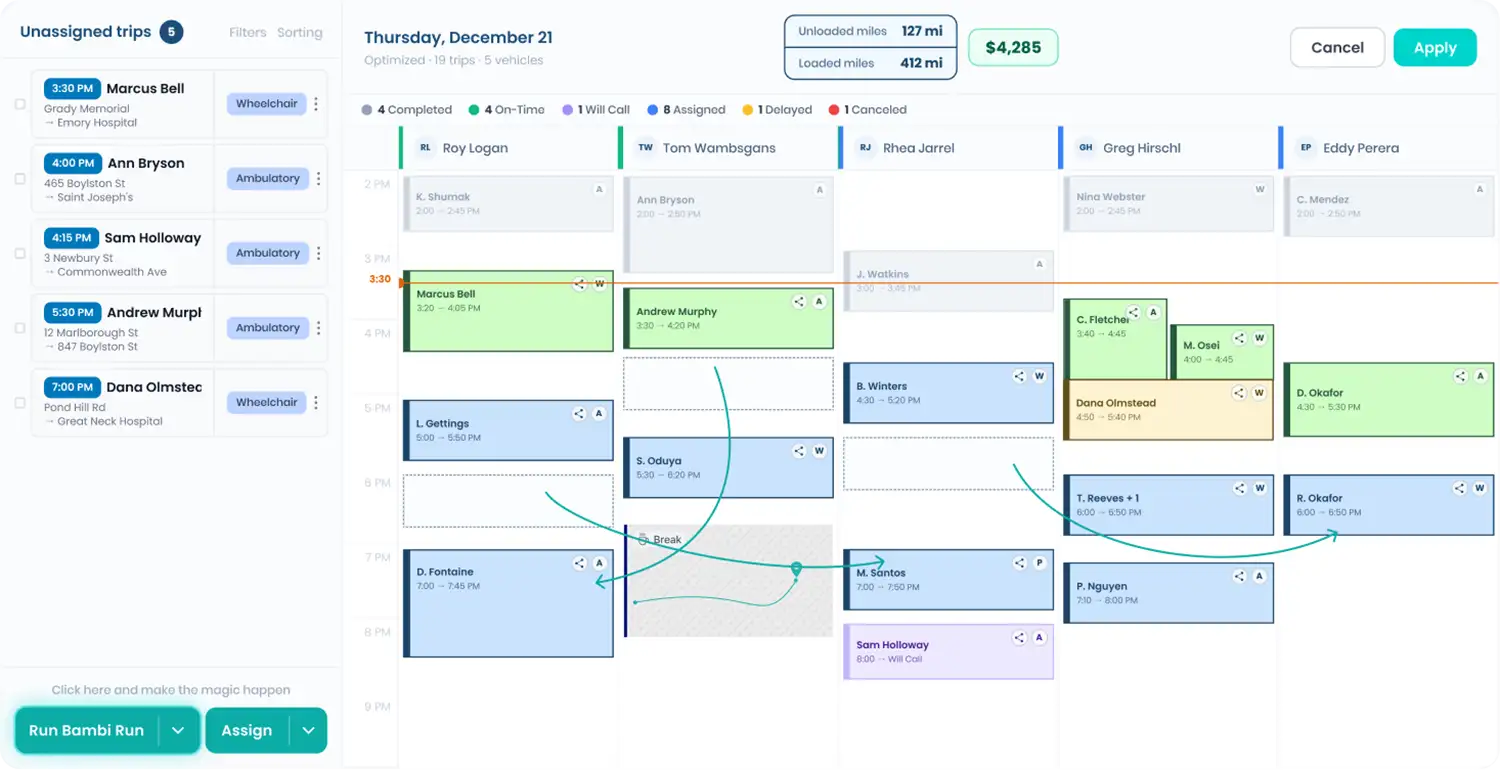
Yeah, one of our customers, we have a system for optimizing schedules where you know, you click Run Bambi Run, and all the trips are assigned to all of the drivers and vehicles. Yeah, one of the ways that that works is if a passenger requires a certain type of chair like a Gerri chair or a Broda chair, you know, that has to match the trip, requires that chair, the vehicle has that capacity. So we had we built that into Bambi sort of vehicle capacity configurations, like this vehicle has capacity for a Broda chair and they asked for us to include it.
Michelle:
Question for you, Nirav. Do you find that operators are having to send their drivers back to home base to switch out equipment, say this is a structure trip, but I only have the basic transport wheelchair, now I have to do a transport wheelchair trip, but there's already a stretcher in my vehicle. I can get that out there before I can get the, or you got to switch vehicles or whatever that takes time. You've got to flip the vehicle in between and get it down to detailing if they do that every trip and then you know you're wasting time. But with the Travrsa LT, you can do the transport wheelchair trip and pivot directly to a trip. That would have been a stretcher. You have no turn time. You don't have to go back to dispatch, you can just go.
Nirav:
Yeah, so much easier. That's huge. That's a game changer.
Michelle:
It is. It is and it's fun to be right on the leading edge of this disrupter, you know,
so great. Our Vice President of Marketing, put it perfectly. It's like you just dream about being part of a disrupter when you're in marketing. And then here it is, it's so much fun. But no, I do think that patients are going to start to demand this. The big fish in the sea are going to be adopting it and I think it's just going to be pulled through to where it becomes the industry standard. I really think it will.
Ed:
Anybody who's in any empty operator and I say it's 1/3 of the cost of a stretcher will immediately go like “hmm” 😊
Michelle:
Run Bambi Run!
Ed:
Run Bambi Run!