
By Nick H., Head of Marketing at Bambi · September 28, 2026 · 7 min read
If you run a non-emergency medical transportation (NEMT) company, you've lost a contract to someone who bid a few dollars less per trip. The invoice is the only number anyone compares, so the invoice wins. But the per-trip rate is the smallest cost in the transaction. The expensive part shows up later: a missed dialysis session, a hospital readmission, an incident report, or a lawsuit that asks who picked the provider and why.
This article is for providers who want to stop competing on rate alone. It covers where the hidden costs actually land, what a recent Supreme Court ruling signals about selecting transportation providers on price, and how to build the documentation that lets a broker, facility, or health plan justify paying you more.
The rate is the only cost anyone sees
Per-trip price is easy to compare, so it becomes the whole decision. Everything else is harder to see because it gets billed to someone else:
- The health plan pays for the missed appointment. A late or no-show pickup for a dialysis patient isn't a transportation problem. It's a medical one, and it gets expensive fast.
- The facility pays in staff time. Every late ride means a coordinator on the phone, a rescheduled slot, and a patient waiting in the lobby.
- The broker pays in complaints and audits. Grievances, incident reports, and credentialing gaps land on the broker's desk, not the provider's.
- Everyone pays when something goes wrong on the road. An under-insured, under-trained operator is cheap right up until the claim.
None of those costs appear on the trip invoice. That's the whole problem.
What reliable transportation is actually worth
The numbers on the medical side dwarf the numbers on the transportation side.
- About 5.8 million Americans delayed medical care in a single year because they lacked transportation, according to a 2020 study in the American Journal of Public Health (Wolfe, McDonald & Holmes).
- Missed appointments cost the U.S. healthcare system an estimated $150 billion a year, a figure the Medical Transportation Access Coalition cites from industry estimates.
- A 2018 return-on-investment study from the Medical Transportation Access Coalition found NEMT averted about $3,423 per member per month in medical costs for dialysis patients and about $792 for diabetic wound care patients, net of the cost of the ride.
Put those next to a per-trip rate difference of a few dollars and the math isn't close. Saving $5 a trip means nothing if the cheaper provider misses one dialysis run a month for a single member. That's why recurring medical trips are the clearest place to make this case. (More on that in why recurring dialysis rides can't be late.)
The legal backdrop just shifted
In May 2026, the U.S. Supreme Court decided Montgomery v. Caribe Transport II, LLC. The Court held unanimously that negligent-selection claims against a broker, meaning claims that the broker was careless in choosing who hauled the load, fall within the safety exception to the federal law that usually preempts state claims against brokers (the Federal Aviation Administration Authorization Act, or FAAAA). In plain terms: a broker who picks a carrier carelessly can be sued under state negligence law, and federal preemption doesn't automatically shield that decision.
Two honest caveats before anyone repeats this in a sales call:
- It's a freight case. The dispute involved a trucking accident, not medical transportation. Whether and how it applies to a given NEMT broker depends on the broker's structure, its Medicaid contract, and state law. Nobody should tell a broker "you're now liable." That's a question for their lawyers, not for your pitch deck.
- The direction still matters. The Court treated "who did you pick, and how carefully?" as a safety question with real legal weight. Any organization that assigns rides to transportation providers now has more reason to show its selection wasn't based on price alone.
That second point is your opening. When the people choosing providers need to defend their choices, the provider who can hand them a clean file becomes the safe pick, not just the expensive one.
This article describes a court decision for general information. It isn't legal advice.
How to prove your total cost is lower
"We're higher quality" is a claim every provider makes. The ones who win on quality prove it with records a buyer can put in a file. Build these five:
1. On-time performance, measured the same way every month
Pick a definition (for example, pickup within the scheduled window) and report it monthly. A number with a consistent definition beats an impressive number nobody can check. If you don't track it yet, start with how to monitor and improve on-time performance.
2. Missed-trip and no-show records, with reasons
Separate provider-caused misses from rider no-shows and cancellations. That split is what tells a broker whether you're the problem or the rider is. It also shows you handle the hard cases instead of hiding them.
3. Driver credentialing that's current, not just complete
Background checks, license checks, and required training, each with a date and an expiration. A credential file that was complete two years ago is a liability file today.
4. Vehicle inspection and maintenance logs
Dated inspections, repair records, and wheelchair securement checks. Our guide on wheelchair accessibility and compliance covers what inspectors look for.
5. Incident and complaint history, including how you resolved it
A provider with zero recorded incidents usually has a recording problem, not a perfect record. What a buyer wants is a short list, a documented response, and evidence the same thing didn't happen twice.
Turn the file into a pitch
Once you have the records, use them. Three places they earn money:
- Rate conversations with brokers. Lead with your file, not your rate. "Here's our on-time rate, our credential status, and our incident history for the last 12 months" moves the conversation off price. Pair it with the tactics in how to negotiate with your NEMT broker.
- Facility and private-pay contracts. Dialysis centers, senior living communities, and hospitals feel missed rides directly. They'll often pay for reliability they can see.
- Insurance renewals. Clean driver and incident records are the same evidence underwriters want. See how to lower NEMT insurance costs.
Where software fits
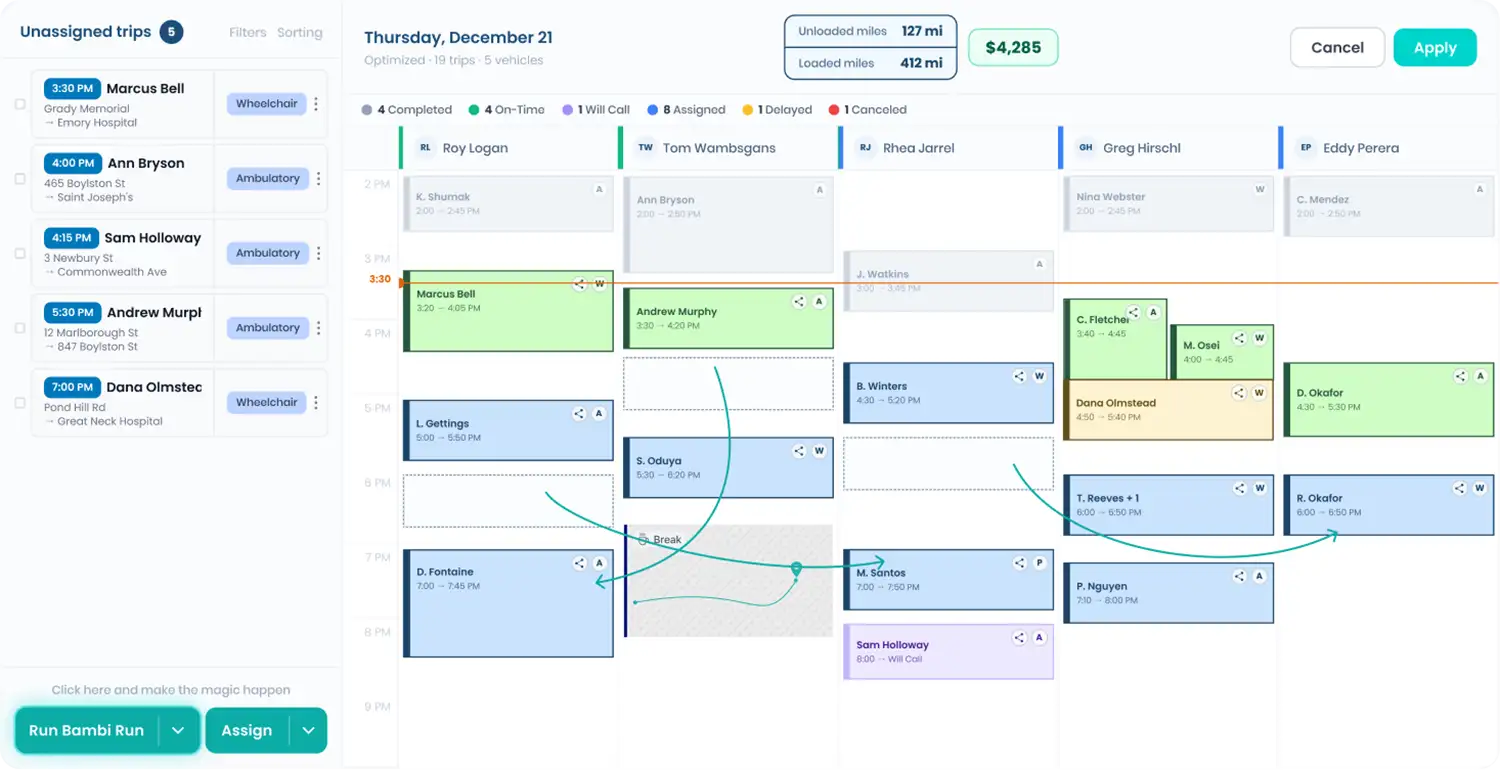
You can build all five records in spreadsheets. Most providers who try don't keep it up, because the data lives in five places and nobody owns the monthly report. Dispatch software that logs pickup times, trip outcomes, and driver and vehicle records as part of the daily work turns the file into a byproduct instead of a project. That's the approach Bambi takes: the records a buyer asks for come from the same system your dispatchers already use.
The bottom line
You won't win every contract against the lowest bid. You can win the ones where the buyer has to defend the decision, and after Montgomery, more buyers are thinking about exactly that. The provider who can prove total cost wins on the file, not the rate.
Sources
- Supreme Court of the United States, Montgomery v. Caribe Transport II, LLC, No. 24-1238 (May 14, 2026).
- Crowell & Moring, Supreme Court holds freight brokers accountable for negligent carrier selection.
- Dan Reid, The Transportation Alliance, The cheapest trip is rarely the lowest cost (Aug 6, 2026).
- Wolfe, McDonald & Holmes, "Transportation Barriers to Health Care in the United States," American Journal of Public Health 110(6): 815–822 (2020).
- Medical Transportation Access Coalition, NEMT return-on-investment study (2018).