
By Nick Hoffmeyer, Head of Marketing at Bambi · September 28, 2026 · 9 min read
Reviewed by Howard F. Berkowitz, a non-emergency medical transportation and paratransit expert with 30+ years in the industry (H&S Consulting).
NEMT company owners typically take home $400 to $1,200 in net profit per vehicle per month, or roughly $3,000 to $60,000+ a month depending on fleet size, once you account for driver pay, fuel, insurance, and overhead. Margins usually land between 8% and 20%, driven mostly by utilization and payer mix, not trip volume alone.
How Much Does an NEMT Business Make Per Month?
An NEMT business typically nets $400 to $1,200 in profit per vehicle per month after every real cost is paid, which is different from the $3,600 to $6,500 in gross revenue a vehicle can generate. Revenue and profit get confused constantly in this industry, and it's the reason two owners running the same number of vehicles can report wildly different take-home pay.
Gross revenue per vehicle depends on trip mix, rates, and trip volume. We cover that math in detail in our NEMT revenue per vehicle deep dive, so we won't repeat it here. This post picks up where that one leaves off: what's actually left over once payroll, fuel, insurance, and software are paid, and what an owner can realistically expect to pay themselves.
Monthly Economics Per Vehicle
This table shows the typical path from gross revenue to net profit for one well-utilized NEMT vehicle. Check every row against your own state's rates, insurance quotes, and driver pay before using these numbers to plan a hire or a lease.
- Gross revenue: Typical monthly range (per vehicle): $3,600–$6,500; Notes: Depends on trip volume, trip mix, and payer rates; see the revenue-per-vehicle breakdown for how this number is built
- Driver pay: Typical monthly range (per vehicle): $2,800–$4,200; Notes: Largest single cost; varies by hourly vs. per-trip pay structure
- Fuel and maintenance: Typical monthly range (per vehicle): $400–$700; Notes: Higher for stretcher and wheelchair vans; rises with deadhead miles
- Commercial auto and liability insurance (allocated): Typical monthly range (per vehicle): $500–$1,250; Notes: Wide range by state, vehicle class, and claims history, so check locally
- Dispatch and scheduling software: Typical monthly range (per vehicle): $69; Notes: Flat per-vehicle pricing, like Bambi's, is easier to plan around than per-seat tiers
- Overhead allocation (admin, dispatcher, office, billing): Typical monthly range (per vehicle): $300–$600; Notes: Shrinks per vehicle as fleet size grows
- Net profit per vehicle: Typical monthly range (per vehicle): $400–$1,200; Notes: Before owner draw or reinvestment decisions
Two things move that bottom line more than any other line item: how many billable trips each vehicle actually runs, and how much of the "gross revenue" figure gets eaten by deadhead miles and no-shows before it ever reaches the bank.
NEMT Owner Take-Home Pay by Fleet Size
Owner take-home isn't just net profit divided across vehicles. A one- or two-vehicle owner who drives their own routes is also paying themselves a driver's wage, which shows up differently than a 40-vehicle owner drawing a distribution from managers who run day-to-day dispatch. Here's how that typically shakes out.
- 1–2 vehicles (owner-operator, drives routes): Typical monthly owner take-home: $3,000–$6,000; Typical annual range: $36,000–$72,000; Notes: Includes driver wage plus thin owner profit; most of the "take-home" is really driver pay
- 3–9 vehicles: Typical monthly owner take-home: $4,000–$10,000; Typical annual range: $48,000–$120,000; Notes: Owner usually shifts from driving to dispatching and billing
- 10–25 vehicles: Typical monthly owner take-home: $8,000–$25,000; Typical annual range: $96,000–$300,000; Notes: Requires a dispatcher and often a billing hire; margin quality starts to matter more than raw size
- 26–50 vehicles: Typical monthly owner take-home: $20,000–$60,000+; Typical annual range: $240,000–$720,000+; Notes: Wide range; broker mix and utilization discipline separate the top and bottom of this range
These are planning ranges based on typical industry cost structures, not a guarantee of income for any specific operator. Check it against your own P&L before making a hiring or financing decision.
What Drives NEMT Profitability?
NEMT profitability comes down to three levers an owner actually controls: how full each vehicle's schedule is, which payers make up your trip mix, and how much windshield time is wasted between paid trips. Fleet size matters less than how well these three are managed.
Utilization
Utilization, the number of billable trips a vehicle runs in a working day, is the single biggest swing factor in NEMT profit. A vehicle running 4 trips a day and one running 9 trips a day carry nearly identical fixed costs (insurance, software, the driver's base hours), so almost every additional trip above break-even drops straight to profit. This is why owners obsess over scheduling density more than headcount.
Payer Mix
Payer mix, the blend of Medicaid broker trips, private pay, and facility contracts a fleet runs, sets your average net revenue per trip before you've driven a single mile. Medicaid broker rates (through Modivcare, MTM, Alivi, and similar brokers) are typically lower per trip but offer volume and predictability. Private pay and direct facility contracts often pay more per trip but take more work to win and keep. Fleets with an all-broker mix and thin margins usually need higher utilization to hit the same profit as a fleet with a healthier private-pay blend.
Deadhead Reduction
Deadhead miles, the empty miles a vehicle drives between drop-off and its next pickup, quietly erase profit that never shows up as a line item on a P&L. A driver burning 30 unpaid minutes and several miles of fuel between trips is running a shift that looks full on paper but isn't. Smarter trip clustering and route optimization shrink deadhead time without adding a single vehicle to the fleet, which is one of the fastest ways to move a fleet's margin from the low end of these ranges toward the high end. More on measuring it in deadhead miles in NEMT.
FAQ
How much profit does an NEMT company make per vehicle per month? Typically $400 to $1,200 in net profit per vehicle per month, after driver pay, fuel, insurance, and overhead are paid. This is well below the vehicle's gross revenue of $3,600 to $6,500, since most of that revenue goes to real operating costs.
What is a good profit margin for an NEMT business? Most well-run NEMT fleets run 8% to 20% net margins. Fleets on the low end usually have weak utilization or an all-broker payer mix, while fleets on the high end typically combine strong utilization with a healthier private-pay or facility-contract blend.
How much do NEMT business owners pay themselves? It ranges widely by fleet size, from roughly $3,000 to $6,000 a month for a one- or two-vehicle owner-operator up to $20,000 to $60,000+ a month for a well-run 26 to 50 vehicle fleet. Check it against your own numbers before planning around any figure.
Does fleet size alone determine NEMT profitability? No. Utilization, payer mix, and deadhead reduction usually matter more than raw fleet size. A tightly run 8-vehicle fleet can out-earn a loosely run 20-vehicle fleet.
What's the biggest factor in NEMT profit besides trip volume? Deadhead miles and payer mix typically matter as much as trip count. A vehicle can look "busy" on the schedule while still losing money to empty miles and low-paying trips.
Is NEMT still a profitable business to start in 2026? It can be, for owners who plan realistic utilization and payer mix from day one rather than assuming trip volume alone will carry the business. Read our NEMT business plan template and example before you finalize a fleet size or funding request.
Fewer Headaches, More Revenue Starts With Utilization
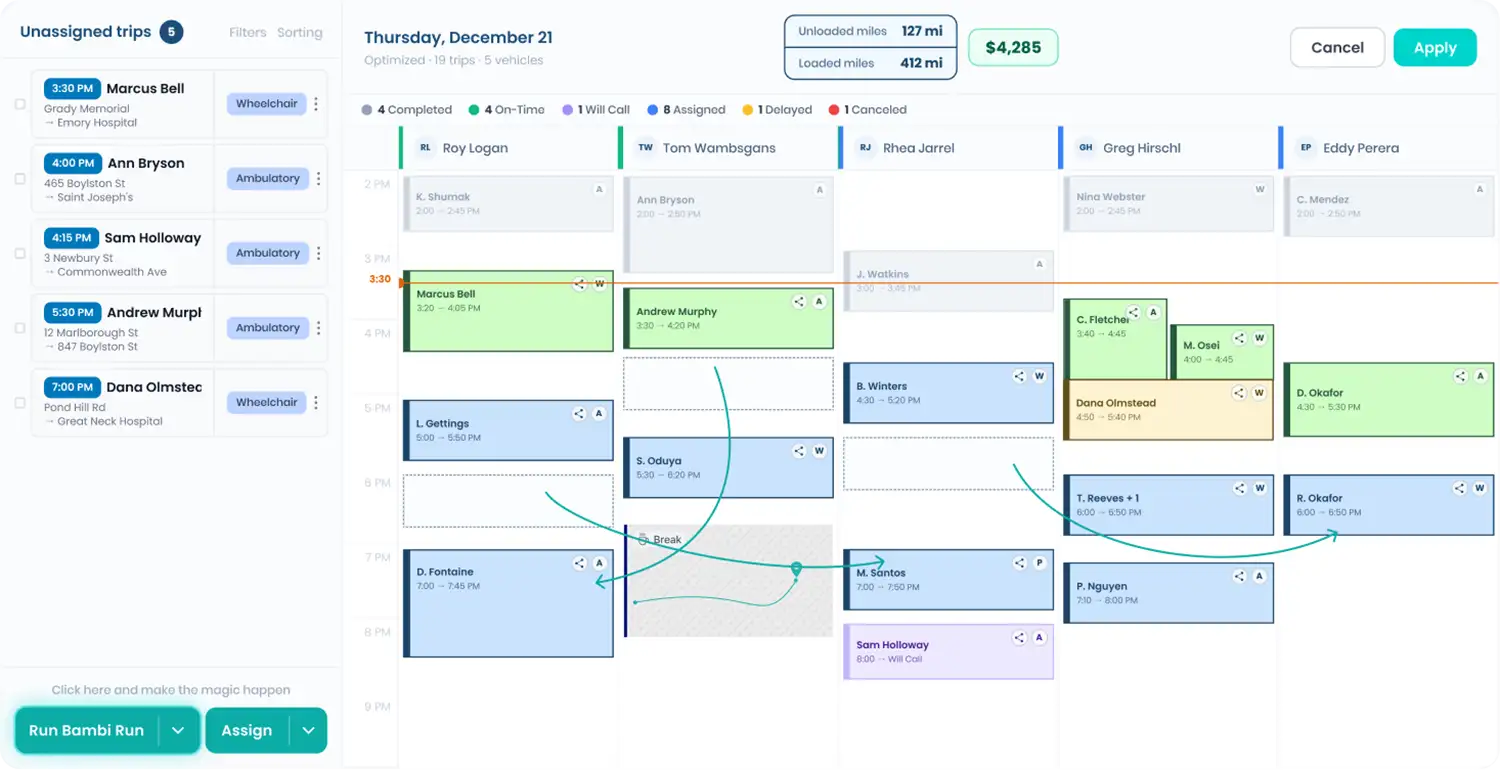
You can't control Medicaid broker rates, but you can control how full each vehicle's day is and how many empty miles it drives to get there. That's the gap between the low end and the high end of every range in this post. Run Bambi Run assigns and clusters trips with one click to cut deadhead time, and trip merging keeps vehicles running back-to-back instead of half-empty. Bambi runs $69 per vehicle per month, flat, no contracts, no onboarding fees. See pricing.
Before you build next year's numbers around any of this, read how we calculate insurance costs by provider and the fleet math in our NEMT revenue per vehicle deep dive, then map it all against the NEMT business plan template or start from our guide to starting an NEMT business.
About the author: Nick Hoffmeyer is Head of Marketing at Bambi, the AI-powered dispatch and scheduling platform for non-emergency medical transportation (NEMT) providers. He leads Bambi's growth, SEO, and content strategy and works with NEMT owner-operators every day on the systems that help fleets run more trips with less stress. Connect with Nick on LinkedIn.