

Welcome to the Washington, DC edition of Bambi Knows Best, our guide to launching a non-emergency medical transportation (NEMT) business in the nation's capital. DC is the smallest service area in this entire series, 61 square miles, and we would argue the most misunderstood. Nearly every guide you will find about starting NEMT in DC gets the basic structure wrong. We are going to fix that in the first five minutes.
Here is the short version, and it is worth reading twice. DC's Medicaid transportation broker does not serve most of DC Medicaid. Roughly 253,000 residents are enrolled in Medicaid, and about 220,000 of them are in a managed care plan. Those members are explicitly carved out of the broker contract. The broker covers fee-for-service members and Intellectual and Developmental Disabilities waiver beneficiaries, a bit over 34,000 people. If you build your whole business plan around the state broker, you have just addressed roughly one rider in seven.
The second thing to know: the agency that licenses your vehicles is not a DC agency at all. It is the Washington Metropolitan Area Transit Commission, an interstate compact body created by Congress and shared with Maryland and Virginia. DC has no state public utility commission for passenger carriers. This changes your insurance floor, your application process, and your timeline.
And the third: there is a broker transition happening on October 1, 2026. Verida takes over from MTM. If you are reading this in the summer of 2026, the network build-out window is open right now.
This guide covers the market, the business setup, the regulations, funding, fleet, team and technology. Same seven steps as every other chapter, with the DC specifics that actually matter. Let's get into it.
Part 1: Researching the Washington, DC NEMT Market
Part 2: Developing a Business Plan and Registering Your Business in DC
Part 3: Understanding DC Regulations and Obtaining Insurance
Part 4: Securing Financing in DC
Part 5: Building Your NEMT Fleet in DC
Part 6: Recruiting and Training Your NEMT Team
Part 7: Utilizing Advanced Technology Solutions
This is the Washington, DC chapter of Bambi's complete guide to starting a NEMT business, covering the seven steps that apply everywhere plus a guide for all 50 states.
In This Guide
- Part 1: Market Overview
- Part 2: Business Plan
- Part 3: Regulations
- Part 4: Funding
- Part 5: Fleet Essentials
- Part 6: How to Assemble Your NEMT Dream Team in DC
- Part 7: Embrace the Tech
Part 1: Market Overview
1 | Understand who actually buys transportation in DC
This is the section that will save you the most money, so we are putting it first instead of burying it under a list of competitors.
DC Medicaid runs two completely separate transportation worlds, and they do not talk to each other.
- The broker world (small). The Department of Health Care Finance contracts one transportation broker to serve fee-for-service members and IDD waiver beneficiaries. Per DHCF's own contract documents, that is roughly 40,000 to 50,000 FFS members in any given month and about 1,900 IDD beneficiaries. The contract states in plain language that members enrolled in or assigned to a managed care organization shall not be eligible for services under it. Qualified Medicare Beneficiaries and CHIP children are also excluded.
- The managed care world (large). About 220,000 DC Medicaid members are in an MCO, and each plan arranges its own transportation. That is a separate sales conversation with each plan, and it is where the volume is.
If you take one thing from this guide, take that. The broker is the easier door to knock on, but it is the smaller room.
2 | Know the brokers, and the change coming October 1
As of today the FFS broker is MTM, under DHCF contract CW89317. That contract's final option period runs through September 30, 2026, deliberately lined up with the end of the District's fiscal year.
On October 1, 2026, Verida takes over under contract CW135340. This is not a rumor. The Mayor transmitted the contract to the Council on June 25, 2026, and it was deemed approved on July 6, 2026 when the ten-day review period passed without a resolution. The base year is not-to-exceed $34,010,636, with four option years after it.
- Verida is not a newcomer here. It already operates in DC today, serving Health Services for Children with Special Needs, the CASSIP plan. Verida was previously named Southeastrans; the rebrand took effect in 2022, so older documents naming Southeastrans mean the same company.
- The network build-out window is now. The contract requires readiness assessments within 90 days of award, operational readiness testing about five weeks before go-live, and a demonstrated provider network, meaning executed provider agreements, vehicles, drivers and attendants, before Verida can start. If you want to be in that first network, mid-2026 is when that gets decided, not September.
- The FFS reservation number has not changed yet. Members currently call MTM at 866-796-0601. Verida's published DC line, 866-991-5433, is the HSCSN line. The contract requires the outgoing broker to hand toll-free numbers back to DHCF, so continuity is plausible. But nothing has been announced, and as of late July 2026 DHCF had published no transition notice to members or providers.
3 | Know the managed care plans, because this is where the volume is
DC's Medicaid managed care roster is smaller than most people think, and it has changed recently. The current plans for DC Healthy Families, the Integrated Care Program and the Alliance are AmeriHealth Caritas DC, MedStar Family Choice DC and Wellpoint DC. Children in CASSIP are served by HSCSN.
A note on a name you will still see in old articles: CareFirst BlueCross BlueShield Community Health Plan DC is not a current DC Medicaid MCO. If a guide lists it, that guide has not been updated in years.
Per DHCF's January 2026 enrollment data, the plan split runs roughly: AmeriHealth Caritas about 98,000 members, MedStar Family Choice about 52,000, Wellpoint about 49,000, a UnitedHealthcare D-SNP about 16,000, HSCSN about 5,000, and roughly 33,000 in fee-for-service.
One live caveat we could not confirm: local reporting in July 2026 indicated Wellpoint DC is exiting the DC Medicaid market with members moving to AmeriHealth Caritas. We could not find a DHCF notice confirming it, so we are flagging it rather than stating it. If you are planning around Wellpoint, call DHCF before you do.
Each plan runs its own transportation line: AmeriHealth Caritas at 1-800-315-3485, MedStar Family Choice at 866-201-9974, Wellpoint at 888-828-1081, and HSCSN through Verida at 866-991-5433.
4 | Assess demand
DC's contract documents include historical trip volumes, which is unusually transparent and worth studying. In fiscal 2023 the broker program handled roughly 208,000 ambulatory van trip legs, 34,000 wheelchair van legs and 5,900 stretcher van legs, plus about 25,000 MetroAccess trips, 9,800 fare cards and 8,600 mileage reimbursements.
Compare that to fiscal 2017, when ambulatory van legs ran over 761,000 and stretcher legs only about 2,000. Ambulatory volume fell by roughly three quarters while stretcher volume nearly tripled. That is what a population moving into managed care looks like: what remains in fee-for-service is smaller, older and higher-acuity. The FFS book is not a general-population book. It is a high-acuity book. Price and equip accordingly.
Also worth noting: fiscal 2023 logged over 74,000 beneficiary cancellations. Cancellation and no-show handling is not a footnote in DC, it is a core operational cost.
5 | Key facts about DC's NEMT system
- NEMT Model: single broker for fee-for-service and IDD waiver only, with each managed care plan arranging its own transportation separately. There is no single citywide answer.
- Administering agency: the Department of Health Care Finance (DHCF), the District's single state Medicaid agency.
- Operating authority for providers: a Certificate of Authority from the Washington Metropolitan Area Transit Commission (WMATC), plus active DC Medicaid provider enrollment. See Part 3, this is the part guides get wrong.
- Broker payment model: capitated. The Verida contract prices FFS at $38.87 per beneficiary per month and IDD at $446.87 per beneficiary per month. You are not paid on that basis, but knowing your broker is capitated tells you a lot about how it will manage utilisation.
- Medicaid enrollment: approximately 253,000 as of January 2026, out of a District population of about 694,000. Note that DHCF flags recent months as preliminary and undercounted, and that January 2026 reflects an eligibility reduction to 138% of the federal poverty level for childless adults and some caretakers.
- Land area: 61 square miles. Your licensed territory is a small city; your dispatch territory is a four-jurisdiction metro region.
6 | Getting paid
Who pays you depends entirely on which world the trip came from. A fee-for-service or IDD trip is authorised and paid through the broker under a Transportation Provider Service Agreement. A managed care trip is paid by whatever vendor that specific plan uses. Establish which one you are in before you quote a rate, because they are different contracts with different terms.
One DC-specific opportunity that is genuinely unusual: the Verida contract carries a 35% subcontracting set-aside, worth $11,996,910, because Verida itself is not a certified local, small or disadvantaged business enterprise. If you are a DC-certified CBE, that is a real, quantified, contractually obligated opening. Most states offer nothing this concrete.
Ready for the next step? Head to Part 2 for business setup, or jump around using the table of contents above.
Part 2: Business Plan
DC is a city-state, which means every agency you deal with is a city agency and there is no county layer to worry about. That simplifies some things and complicates others. Here is the sequence.
1 | Choose a business structure
Sole proprietorship, partnership, LLC or corporation. The usual menu, with the usual tradeoffs on liability and tax treatment. Given that you will be carrying medically fragile passengers under a $1.5 million minimum liability requirement, most operators land on an LLC or corporation. Talk to a DC-licensed attorney or accountant before you file.
2 | Register the entity
Register with the DC Department of Licensing and Consumer Protection (DLCP). You will also need corporate registration and a tax registration before your business licence can issue.
3 | Get an EIN
Free from the IRS, and required for payroll, banking and tax filings.
4 | Get a DC business licence, and note the prerequisites
DLCP issues the Basic Business Licence through mybusiness.dc.gov. The General Business category runs $49 for six months, $99 for two years or $198 for four years. The prerequisites catch people out: you need a Certificate of Occupancy or a Home Occupation Permit, corporate registration, tax registration, and a Clean Hands certificate confirming you owe the District nothing over $100.
A caveat we will be straight about: we could not confirm from a DC source whether General Business is the exactly correct endorsement category for an NEMT operator specifically. Call DLCP and ask before you pay for four years.
5 | Enrol as a DC Medicaid provider
This one is not optional and it is not last. The broker contract requires the broker to build its network from providers already actively enrolled in DC Medicaid. Enrolment is the prerequisite, not the follow-up.
DC Medicaid provider enrolment runs through the DC Provider Data Management System at dcpdms.com, administered by Maximus. The provider enrolment line is (844) 218-9700. Separately, note that DHCF changed its fiscal agent to Gainwell Technologies effective March 2, 2026, with a new provider portal at medicaid.dc.gov. If you find instructions referencing the old system, they are stale.
We could not verify the step-by-step transportation provider enrolment requirements, meaning provider type code, required attachments, screening level and revalidation cycle, from a public page. Call Maximus and get it from the source rather than from a blog, including this one.
Continue to Part 3 for the regulatory picture, which is where DC gets genuinely unusual.
Part 3: Regulations
If you read only one section of this guide, make it this one. DC's regulatory structure is different from every state in this series, and the most commonly repeated advice about it is wrong.
1 | The trap: DFHV does not license NEMT vehicles
The DC Department of For-Hire Vehicles has a page on its website titled NEMT. A great many articles cite it as the licensing authority for Medicaid non-emergency medical transportation. It is a completely different programme. DFHV's NEMT is a partnership with DC Fire and EMS in which rides are booked through the FEMS Nurse Triage Line to divert low-acuity 911 calls. It is free to riders, requires no registration, and has nothing to do with DC Medicaid.
DFHV's actual regulatory remit, under D.C. Code § 50-301.07, is taxicabs, limousines, sedans and private vehicles-for-hire. Its licence categories are taxi company, taxi association, independent taxi operator, driver licensing, H-Tag, and non-District limousine permits. There is no medical transportation or wheelchair van category.
Evidence points strongly to a DC Medicaid NEMT provider needing no DFHV licence at all, though no DC source states that affirmatively. What we can state affirmatively is what the Medicaid contract requires, and it does not name DFHV.
2 | The real regulator: WMATC
Your operating authority comes from the Washington Metropolitan Area Transit Commission, an interstate compact agency established by Congress and shared between DC, Maryland and Virginia. Its commissioners are appointed by the Governors of Maryland and Virginia and the Mayor of DC. DC has no state public utility commission for passenger carriers; WMATC is it.
The DHCF broker contract is explicit. It requires the broker to select transportation providers licensed and certified by WMATC, requires each vehicle record to show the provider active in the WMATC database with a certificate of compliance, and requires a Certificate of Authority showing the provider has registered its insurance carrier with WMATC.
Application specifics: WMATC charges $300 to obtain a certificate, whether restricted or unrestricted, and $150 for temporary authority. A restricted certificate covers vehicles carrying 15 persons or fewer, which describes most NEMT vans. You will need proof of good standing for a corporation or LLC dated within six months, trade name registration if applicable, a compliant insurance filing and a signed verification.
3 | Insurance: the number that surprises people
WMATC's minimums are set by certificate type, not by vehicle size:
- Restricted certificate (15 passengers or fewer): $1.5 million combined single limit.
- Unrestricted certificate: $5 million combined single limit, for all vehicles regardless of actual size.
That $1.5 million floor on a wheelchair van is far above what most states require, and the DHCF contract mirrors it exactly, additionally requiring a policy declarations page naming the broker as secondary insured. One more filing detail worth knowing before you waste a week: WMATC accepts only its own Certificate of Insurance and Policy Endorsement form. ACORD certificates and Form E filings are not accepted.
You may also encounter D.C. Code § 50-301.29c, which sets a $1 million per-occurrence floor during prearranged rides. That statute governs private vehicles-for-hire, the rideshare category, not NEMT vans. Do not budget to it.
4 | Driver and vehicle standards
These come from the broker contract and are what you will be held to under a provider agreement:
- Drivers must be at least 21 with a valid DC, Maryland or Virginia licence not suspended or revoked in the past five years.
- Criminal background checks under 42 CFR 455.450 and 17 DCMR Chapter 85, including FBI checks, before service and updated annually. A long list of disqualifying convictions applies over a seven-year lookback, and any felony conviction during the contract period is disqualifying.
- Three-year driving records from DC, Maryland and Virginia police. Three or more moving violations or accidents in seven years disqualifies; two in any twelve-month period removes a driver from service.
- First Aid and CPR certification for every driver and attendant. Note the contract is explicit that this is at the driver's own cost. The broker is not required to provide or pay for it.
- Drug screening with a negative result before service and random screening at least quarterly thereafter. The broker provides and pays for these.
- Maximum vehicle age of 10 years, measured from release date. Vehicles over ten years old cannot be used. Budget your fleet replacement cycle around this.
- Wheelchair vans need a power lift with manual backup, secure floor mounts, shoulder strap capability and four floor straps. Drivers must have documented securement training.
- Two-way communication in every vehicle. Radio or cell, pagers explicitly not acceptable. Plus two stocked first aid kits and exterior and interior signage showing the vehicle licence number and the broker's contact numbers.
On certifications: the contract requires documented wheelchair securement training but does not name PASS or any other specific curriculum. If a guide tells you DC mandates PASS certification, we could find no basis for that.
5 | Crossing state lines, which in DC is most of the job
Here is a wrinkle worth planning around. WMATC's jurisdiction, the Metropolitan District, covers DC, Arlington, Fairfax and Loudoun counties, the cities of Alexandria, Falls Church and Fairfax, and Montgomery and Prince George's counties in Maryland.
But the broker contract's covered destination area is the full Washington Metropolitan Statistical Area, which is considerably bigger: it adds Prince William, Stafford, Fauquier, Culpeper, Spotsylvania, Clarke, Warren and King George counties, the cities of Manassas, Manassas Park and Fredericksburg, Charles, Frederick and Calvert counties in Maryland, and Berkeley and Jefferson counties in West Virginia.
So a covered trip can end somewhere WMATC authority does not reach. Maryland's Public Service Commission describes WMATC authority as additional to Maryland authority rather than a substitute for it. We could not verify exactly what additional authority those outer-county trips require, and we are not going to invent an answer. Ask WMATC and the relevant state before you accept those trips.
Also note what DC will and will not cover. Out-of-District medical trips are covered, including for members temporarily recuperating in the metro area, a parent travelling to a hospitalised child regardless of that parent's own eligibility, and travel to Medicaid fair hearings. Not covered: providers outside the metro area, and Baltimore city or county unless the specialty care genuinely is not available closer.
On to Part 4 and funding.
Part 4: Funding
DC has a decent small-business support ecosystem, and one funding angle that is close to unique.
1 | The subcontracting set-aside
We mentioned this in Part 1 but it belongs here too, because it is effectively a funding channel. The incoming broker contract obligates 35% subcontracting, $11,996,910, and DHCF's contracting officer has already certified the plan as meeting the Department of Small and Local Business Development requirement. Getting certified as a DC Certified Business Enterprise through DSLBD puts you inside that requirement rather than outside it. For a new operator, CBE certification is probably the single highest-leverage piece of paperwork available in this market.
2 | Small business loans
The US Small Business Administration 7(a) and 504 programmes cover vehicle purchases, equipment and working capital. The DC Small Business Development Center can help you structure an application, and local banks and credit unions frequently participate.
3 | District programmes
DSLBD runs grant and technical assistance programmes for small and certified businesses. The Department of Employment Services offers wage subsidy and training programmes that can offset the cost of hiring and training drivers, which in this business is a real line item once you factor in First Aid, CPR and background checks.
4 | Grants and networking
Federal opportunities are listed on Grants.gov, and health-access and transportation-equity grants sometimes fit NEMT well. Beyond that, DC's advantage is density: the plans, the agency, the broker and the hospital systems are all within a few miles of each other. Showing up in person is more feasible here than in any other market in this series.
Part 5 covers the fleet.
Part 5: Fleet Essentials
A DC fleet has a specific shape, driven by the acuity mix and the vehicle age rule.
1 | Match the fleet to the actual book
Remember the volume shift: fee-for-service in DC skews high-acuity. Wheelchair-accessible and stretcher-capable capacity matters more here, proportionally, than in a state where the broker also handles routine managed care trips. If you are entering through the broker door, weight your fleet accordingly.
2 | Respect the ten-year rule
The contract caps vehicle age at ten years from release date, full stop. A cheap twelve-year-old van is not a bargain, it is an unusable asset. Build your acquisition and replacement schedule around that ceiling from day one.
3 | Equip to the contract, not to the minimum
Power lift with manual backup, secure floor mounts, shoulder straps, four floor straps, two stocked first aid kits, two-way radio or cell in every vehicle, and compliant interior and exterior signage including your vehicle licence number and the broker's numbers. Inspection must meet both the requirements of the state of registration and DC Code Title 50 inspection requirements.
4 | Plan for the geography, which is small and slow
Sixty-one square miles sounds easy until you try to cross the city at 4pm. DC's constraint is not distance, it is time variance and curb access. Downtown hospital campuses and clinic loading zones are genuinely difficult, and a schedule built on optimistic drive times will fall apart. Build slack into your dispatch windows and treat parking as a planning problem, not a driver problem.
Part 6 is about your team.
Part 6: How to Assemble Your NEMT Dream Team in DC
1 | Hire for the credential burden, not just the driving
DC's driver requirements are heavier than most states: 21 or older, clean multi-state driving record, FBI-level background check renewed annually, First Aid and CPR at the driver's own expense, and quarterly random drug screening. That is a real barrier to entry for candidates, and it means your recruiting funnel needs to be wider than you would expect and your onboarding timeline longer.
The First Aid and CPR cost point is worth thinking about strategically. The contract says the broker need not pay for it. It does not say you cannot. Covering certification is a cheap, concrete differentiator in a tight driver market.
2 | Train for a three-jurisdiction service area
Your drivers will routinely cross into Maryland and Virginia in a single shift. Train for all three jurisdictions' traffic rules, and make sure everyone carries the right documentation. Add securement training with documented sign-off, since the contract requires the documentation and not just the skill.
3 | Language access is a legal requirement here
The DC Language Access Act applies, and the broker contract requires multilingual support and TTY relay. If you are building a customer-facing function, plan for it as a compliance requirement rather than a nice-to-have.
4 | Build a culture worth staying for
Driver turnover is the quiet killer in this business, and in DC the replacement cost is higher because of the credentialing burden. Recognise good work, pay on time, and listen. A driver who stays three years instead of six months is worth more than any routing optimisation you will ever buy.
Finally, Part 7 on technology.
Part 7: Embrace the Tech
You have made it. Now let's talk about the tooling that keeps a DC operation from falling over.
Why software matters more in a dense market
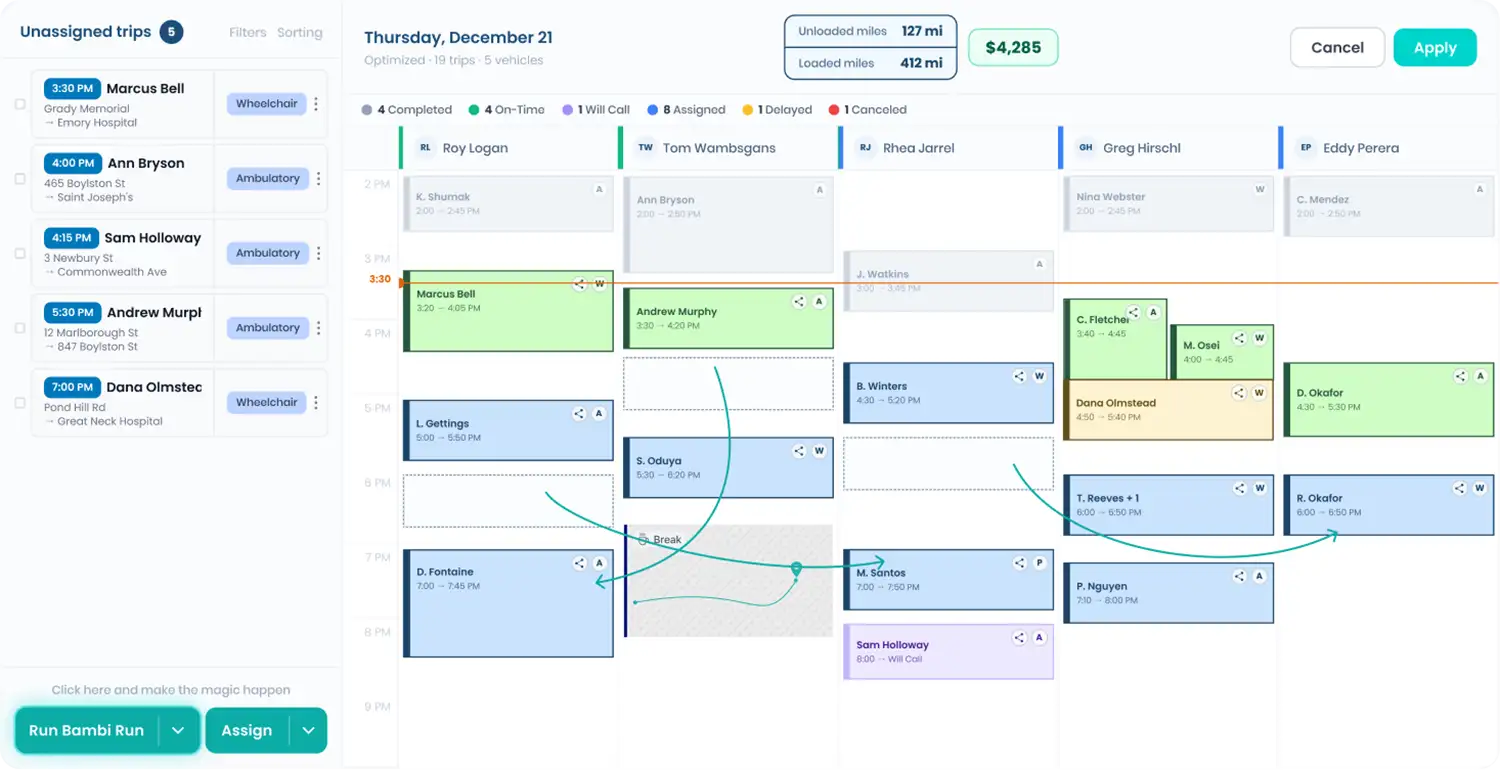
In a rural state, routing software saves fuel. In DC, it saves your on-time performance, which is the metric your broker and plan contracts are actually measured on. Short trips, unpredictable traffic, difficult curb access and a high cancellation rate all compound. Manual dispatch does not survive that combination past a handful of vehicles.
Look for automated scheduling and dispatch, real-time GPS tracking, care coordination that keeps drivers, riders and facilities in sync, and clean digital documentation for billing. In a capitated broker environment, your ability to document what happened on every trip is your ability to get paid for it.
Get started with Bambi
Our aiNEMT software handles scheduling, dispatching, care coordination and real-time tracking, so you can spend your attention on the parts of this business that actually need a human, like working out which of DC's three managed care plans is worth your next phone call. Get in touch for a demo and we will walk you through it.
Here's to building something genuinely useful in the District. Sixty-one square miles, a quarter million Medicaid members, and a broker transition creating an opening right now. That is a good place to start.