
By Nick Hoffmeyer, Head of Marketing at Bambi · September 28, 2026 · 11 min read
Reviewed by Howard F. Berkowitz, a non-emergency medical transportation and paratransit expert with 30+ years in the industry (H&S Consulting).
A NEMT business plan is the section-by-section document that lays out your services, market, fleet, staffing, broker strategy, and financials before you spend a dollar. It's what a lender, a Medicaid broker, or your own gut check wants to see. Below is a free, fillable non-emergency medical transportation (NEMT) business plan template plus a real example you can adapt this week.
What Is a NEMT Business Plan, and Why Do You Need One?
A NEMT business plan is a written roadmap that proves your non-emergency medical transportation company can find riders, run trips safely, and make money doing it. You need one for three practical reasons: banks and SBA lenders require one for financing, brokers like Modivcare, MTM, or Alivi expect operational detail during credentialing, and you need a real number for how many vehicles cover your bills before you sign a lease.
Skip the plan and you're guessing at fleet size, driver pay, and how long your cash lasts. Write it, and you've already made your first month's decisions on paper instead of on the road.
How Do You Write a NEMT Business Plan?
You write a NEMT business plan by working through eleven sections in order, each one answering a question a lender or broker will ask anyway. Copy the outline below, fill in the blanks in brackets, and you'll have a complete draft in an afternoon.
1. Executive Summary
One page, written last, read first. State your company name, service area, vehicle types, and the one sentence that explains why you'll win trips.
Fill in: "[Company name] provides [ambulatory / wheelchair / stretcher] NEMT trips across [county/metro] for [Medicaid members / private pay / dialysis patients], starting with [#] vehicles and targeting [#] trips per vehicle per day by month [#]."
2. Company Description & Service Area
Name your entity structure (LLC is standard), ownership, and the exact counties or ZIP codes you'll cover. Brokers assign territory by service area, so be specific, not "the region."
Fill in: "[Company name] is a [state]-registered [entity type] serving [list counties/ZIPs]. Founded by [name(s)], with [#] years of combined [dispatch/driving/healthcare] experience."
3. Services Offered
List every trip type you'll run: ambulatory (walking patients), wheelchair, and stretcher, plus any specialty work like dialysis routes or same-day will-call trips. Stretcher and wheelchair vehicles cost more and bill higher, so separate them clearly.
Fill in: "We offer [ambulatory / wheelchair / stretcher] transport for [dialysis / oncology / general medical / discharge] trips, scheduled [same-day / standing order / will-call]."
4. Market Analysis
Show you understand demand: population 65+ in your service area, number of dialysis clinics and hospitals, and which brokers or Medicaid managed care plans control referrals there. Name your realistic competition, without disparaging any competitor by name in the finished document you send to a lender.
Fill in: "[Service area] has [#] residents 65+, [#] dialysis centers, and [#] hospital discharge points. [Broker name] manages Medicaid NEMT dispatch for the region."
5. Operations Plan
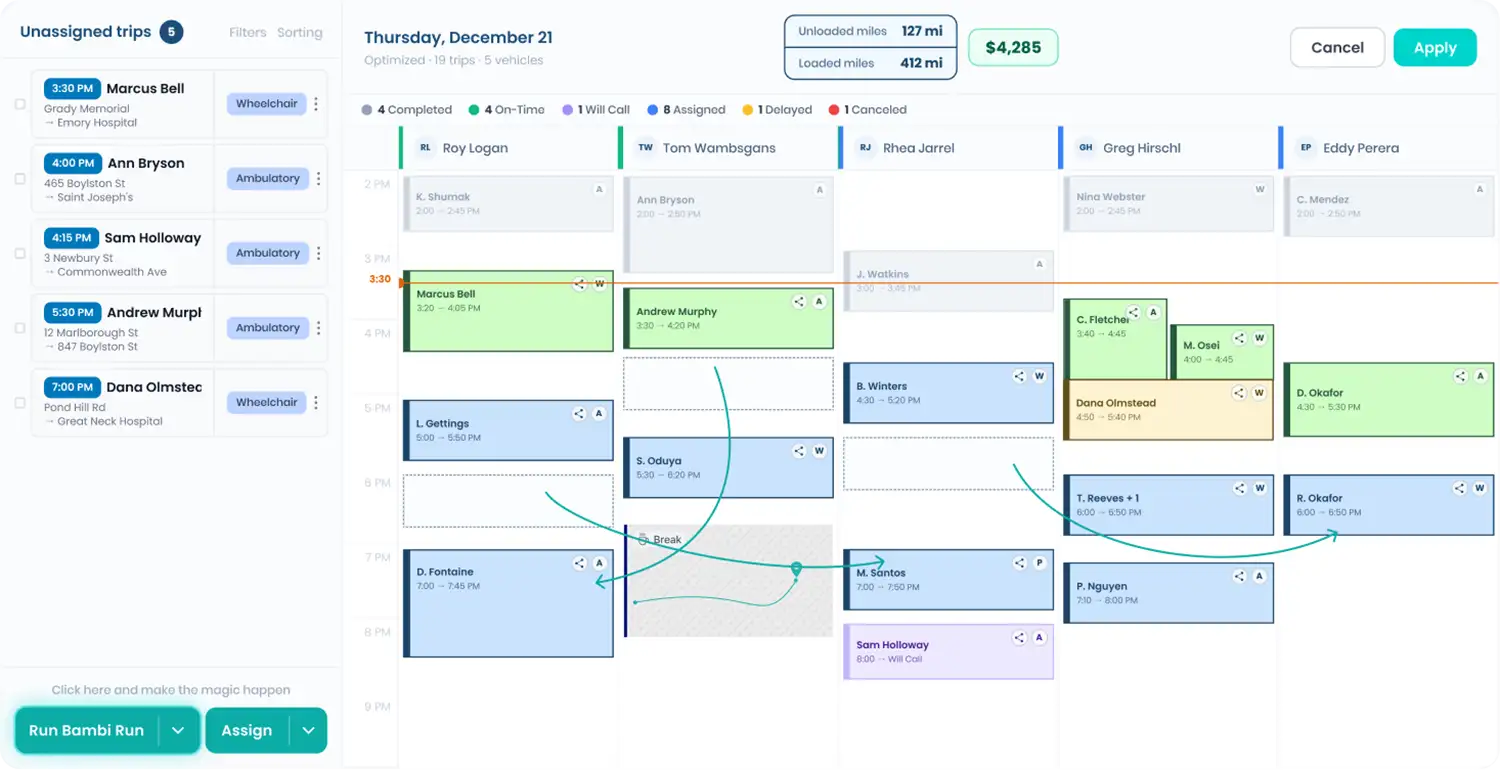
Describe your dispatch and scheduling process end to end: how a trip comes in, how it's assigned, how the driver confirms pickup, and how you handle a no-show or late cancellation. This is the section where naming your dispatch software matters, since a manual whiteboard doesn't scale past a couple of vehicles.
Fill in: "Trips are booked via [broker portal / facility phone / online request], assigned through [dispatch method], confirmed by driver [#] minutes before pickup."
6. Fleet Plan
List each vehicle by type, age, capacity, and whether it's owned, financed, or leased. Note ADA lift/ramp equipment for wheelchair and stretcher units.
Fill in: "[#] ambulatory sedans/minivans, [#] wheelchair vans with [ramp/lift], [#] stretcher vans, average age [#] years, [owned/financed/leased]."
7. Staffing Plan
Cover drivers, dispatchers, and billing staff, plus required credentials (CPR/First Aid, defensive driving, background check, drug screen) and how many trips each driver-vehicle pair can realistically run per day.
Fill in: "[#] drivers, [#] dispatchers, [#] billing staff. Drivers hold [credential list]. Target [#] trips per vehicle per day."
8. Marketing & Broker Strategy
Explain how you'll actually get trips: broker credentialing applications, direct hospital discharge planner relationships, dialysis clinic outreach, and any private-pay marketing. Brokers are your biggest referral channel, so name which ones you're pursuing and your credentialing timeline. Our guide on how to win NEMT contracts walks through each path.
Fill in: "Applying for credentialing with [broker names] by [date]. Direct outreach to [#] hospitals and [#] dialysis clinics in month [#]."
9. Financial Plan
This is the section lenders read twice: startup costs, revenue per vehicle, operating costs, and your break-even point. Use the cost table and break-even formula below rather than a single made-up number.
10. Funding Request
If you're seeking a loan or investment, state the amount, exactly what it covers (vehicles, working capital, insurance deposit), and your proposed repayment terms or equity offer.
Fill in: "Requesting $[amount] to fund [#] vehicles, [#] months working capital, and licensing/insurance startup costs. Repayment over [#] years at [rate, if known]."
11. Compliance & Licensing
List the licenses and registrations your state and any brokers require: business license, NEMT operating permit or CON if your state requires one, vehicle inspections, driver background checks, and insurance minimums. Check every specific requirement against your state's Medicaid agency before filing, since these vary by state and change without much notice.
NEMT Startup Costs Table
Real numbers beat guesses. These are typical planning ranges for a small NEMT operation; your state, vehicle age, and insurance history will move them. Check current figures against local vendors and your state insurance department before you finalize your plan.
- Ambulatory vehicle (used minivan/sedan): Typical range (per vehicle, unless noted): $8,000–$20,000; Notes: Wheelchair-accessible conversion adds cost
- Wheelchair-accessible van (used, converted): Typical range (per vehicle, unless noted): $25,000–$45,000; Notes: A new converted minivan can top $85,000 at manufacturer list price
- Stretcher van: Typical range (per vehicle, unless noted): $35,000–$60,000; Notes: Higher insurance tier
- Commercial auto + general liability insurance (annual, first year): Typical range (per vehicle, unless noted): $6,000–$15,000; Notes: New operators often pay more until claims history builds
- Business license, permits, state NEMT registration: Typical range (per vehicle, unless noted): $200–$2,000 (one-time); Notes: Check your state's exact fee schedule
- Driver background checks, drug screening, DOT physicals: Typical range (per vehicle, unless noted): $150–$400 per driver; Notes: Recurring annually
- Dispatch/scheduling software: Typical range (per vehicle, unless noted): $69–$150/month per vehicle; Notes: Compare flat per-vehicle pricing to per-seat pricing
- Broker credentialing/application fees: Typical range (per vehicle, unless noted): $0–$500 per broker; Notes: Varies by broker and state
- Marketing and website: Typical range (per vehicle, unless noted): $500–$3,000 (startup); Notes: Higher if building broker outreach materials
- Working capital reserve (3 months): Typical range (per vehicle, unless noted): Varies by fleet size; Notes: Covers payroll and fuel before broker payments arrive
NEMT Business Plan Example
Here's a short example so you can see the outline in action. Ridgeline NEMT is a hypothetical three-vehicle operator; swap in your own numbers.
Executive Summary (example): "Ridgeline NEMT provides ambulatory and wheelchair-accessible NEMT trips across Greene County, serving Medicaid managed care members and dialysis patients. Starting with two ambulatory sedans and one wheelchair van, Ridgeline targets 8 trips per vehicle per day by month six, reaching break-even in month four."
Financial snapshot (example):
- 3 vehicles, average 6 trips/vehicle/day at $28 average net revenue per trip
- Monthly revenue per vehicle: roughly $3,600–$5,000 depending on trip mix (see our NEMT revenue per vehicle deep dive for how that number is built)
- Fixed monthly costs (insurance, software, one dispatcher): $4,200
- Variable cost per trip (fuel, maintenance reserve): $6
How Do You Calculate Break-Even for an NEMT Fleet?
You calculate NEMT break-even by dividing your fixed monthly costs by the net revenue per trip after variable costs. The formula: Break-even trips = Fixed costs ÷ (Revenue per trip − Variable cost per trip).
Using Ridgeline's numbers: $4,200 ÷ ($28 − $6) = 191 trips per month across the fleet, or roughly 64 trips per vehicle per month (about 3 trips per vehicle per day at 21 working days). Run your own numbers before you commit to a lease or a loan payment; this is the single calculation most first-time NEMT owners skip.
FAQ
How long should a NEMT business plan be? Most run 10-15 pages including the cost table and financial projections. Lenders and brokers want substance, not length. A tight, accurate plan beats a padded one every time.
Do I need a business plan to get approved by a NEMT broker? Brokers like Modivcare and MTM typically require an operational and insurance questionnaire rather than a formal business plan, but the same information (fleet, staffing, service area) is what they ask for. Confirm each broker's current credentialing checklist directly.
How much does it cost to start a NEMT business? Costs vary widely by fleet size, vehicle type, and state. A single used ambulatory vehicle, insurance, and licensing can start around $15,000, while a new wheelchair van alone can top $85,000. Add a few months of working capital, then get local quotes.
Can I use a generic small business plan template for NEMT? You can start from a generic template, but a generic one misses fleet, broker, and compliance sections lenders expect to see for transportation businesses. Use the eleven-section outline above instead.
What financial ratios do lenders look for in an NEMT business plan? Lenders typically want to see your break-even point, revenue per vehicle, and a debt service coverage ratio above 1.25. Show your math, don't just state a conclusion.
Is a NEMT business plan different from an ambulance or EMS business plan? Yes. NEMT plans focus on non-emergency, scheduled trips, broker contracts, and Medicaid billing rather than 911 response, emergency staffing, or advanced life support equipment.
Fewer Headaches, More Revenue Once Your Plan Is Live
Writing the plan is the easy part. Running it without burning out is the real test, and that's where fleets lean on software instead of a whiteboard. Once your fleet plan turns into real vehicles, Run Bambi Run assigns trips with one click and Get Paid keeps claims moving so your revenue-per-vehicle math actually shows up in the bank. Bambi runs $69 per vehicle per month, flat, no contracts. See pricing.
About the author: Nick Hoffmeyer is Head of Marketing at Bambi, the AI-powered dispatch and scheduling platform for non-emergency medical transportation (NEMT) providers. He leads Bambi's growth, SEO, and content strategy and works with NEMT owner-operators every day on the systems that help fleets run more trips with less stress. Connect with Nick on LinkedIn.