
By Nick H., Head of Marketing at Bambi · September 28, 2026 · 6 min read
Deadhead miles are the miles your vehicle drives with nobody in it: from the garage to the first pickup, from a drop-off to the next pickup, and back to base at the end of the day. In most non-emergency medical transportation (NEMT) contracts, you get paid for loaded miles, the ones with a rider on board. The empty miles are yours to eat.
That makes deadhead one of the biggest hidden costs in an NEMT business, and one of the least measured. Here's how to see it, what it costs, and what to do about it.
Why deadhead hits NEMT harder than other transportation
NEMT trips have three features that pile up empty miles:
- Riders are spread out. Members live across a whole service area, often rural, and facilities cluster in town. The van drives out empty to get almost every rider.
- Appointments don't line up. A dialysis chair at 6 a.m., a clinic visit at 10:15, a discharge "sometime after lunch." Gaps between trips often mean driving back to base or across town empty.
- Broker trips arrive in batches you didn't design. You accept what's offered, where it's offered. A trip that looks profitable on its own can cost you 20 empty miles to reach.
What an empty mile actually costs
Start with your own numbers if you have them. If you don't, use a published benchmark as a floor. The IRS standard business mileage rate, which is meant to cover the full cost of operating a vehicle including fuel, maintenance, insurance and depreciation, is 76 cents per mile for business miles driven from July 1, 2026. That rate is built for ordinary cars. A wheelchair van or stretcher vehicle costs more per mile to run, and you're paying a driver for every one of those minutes too.
The math adds up fast. A vehicle that deadheads 60 miles a day at even 76 cents a mile burns about $45 a day in vehicle cost alone, before driver wages. Over roughly 22 working days, that's close to $1,000 a month per vehicle in miles nobody pays for. Your real number could be higher or lower. The point is that most operators have never calculated it.
The IRS rate is a tax figure, used here only as a cost benchmark. It isn't a rate you can bill.
How to measure your deadhead ratio
The number to track is your deadhead ratio: empty miles divided by total miles.
- Get total miles per vehicle per day. Odometer readings at start and end of shift, or GPS mileage from your dispatch or telematics system.
- Get loaded miles. Sum the pickup-to-drop-off distance for every completed trip. If you bill by the mile, this is roughly your billed mileage.
- Subtract and divide. (Total miles − loaded miles) ÷ total miles = deadhead ratio.
- Track it weekly, by vehicle and by driver. One van that always runs the rural route will look worse than the rest. That's useful information, not a performance problem.
Once you have a baseline, every decision below becomes measurable instead of a gut call.
Five ways to cut deadhead miles
1. Chain trips instead of scheduling them one at a time
The biggest lever is sequencing: making each drop-off land near the next pickup. That's scheduling, not driving faster. If you're still building routes by hand, start with our guide to NEMT route optimization.
2. Look at the empty leg before you accept a trip
Before accepting a broker trip, check where your nearest vehicle will be at that time, not where your garage is. A $40 trip that costs 25 empty miles each way can lose money. Build a simple rule: if the empty miles to reach a trip exceed a set share of its loaded miles, it needs a second look.
3. Stage vehicles where the demand is
If most of your morning trips start on one side of town, the first van out shouldn't park on the other side overnight. Some operators let drivers take vehicles home when they live near the first pickup cluster. Check your insurance policy before you do this.
4. Fill the gaps with trips that fit
Midday gaps are where vans drive home empty. Facility contracts, private-pay riders, and standing orders for recurring appointments can fill those gaps on routes you're already driving. That's also how you get more out of each vehicle; see how to optimize NEMT vehicle utilization.
5. Price for it where you can
You can't always bill deadhead, but you can account for it:
- Private pay: set a base fee that covers the trip to the rider, or add a charge for pickups outside your core service area.
- Facility contracts: negotiate a minimum per trip or a zone-based rate so outlying pickups aren't a loss.
- Broker work: you usually can't change the fee schedule, but your deadhead data tells you which counties and trip types are worth accepting. It's also a real fact to bring into a conversation about rates. See how to negotiate with your NEMT broker.
Where software fits
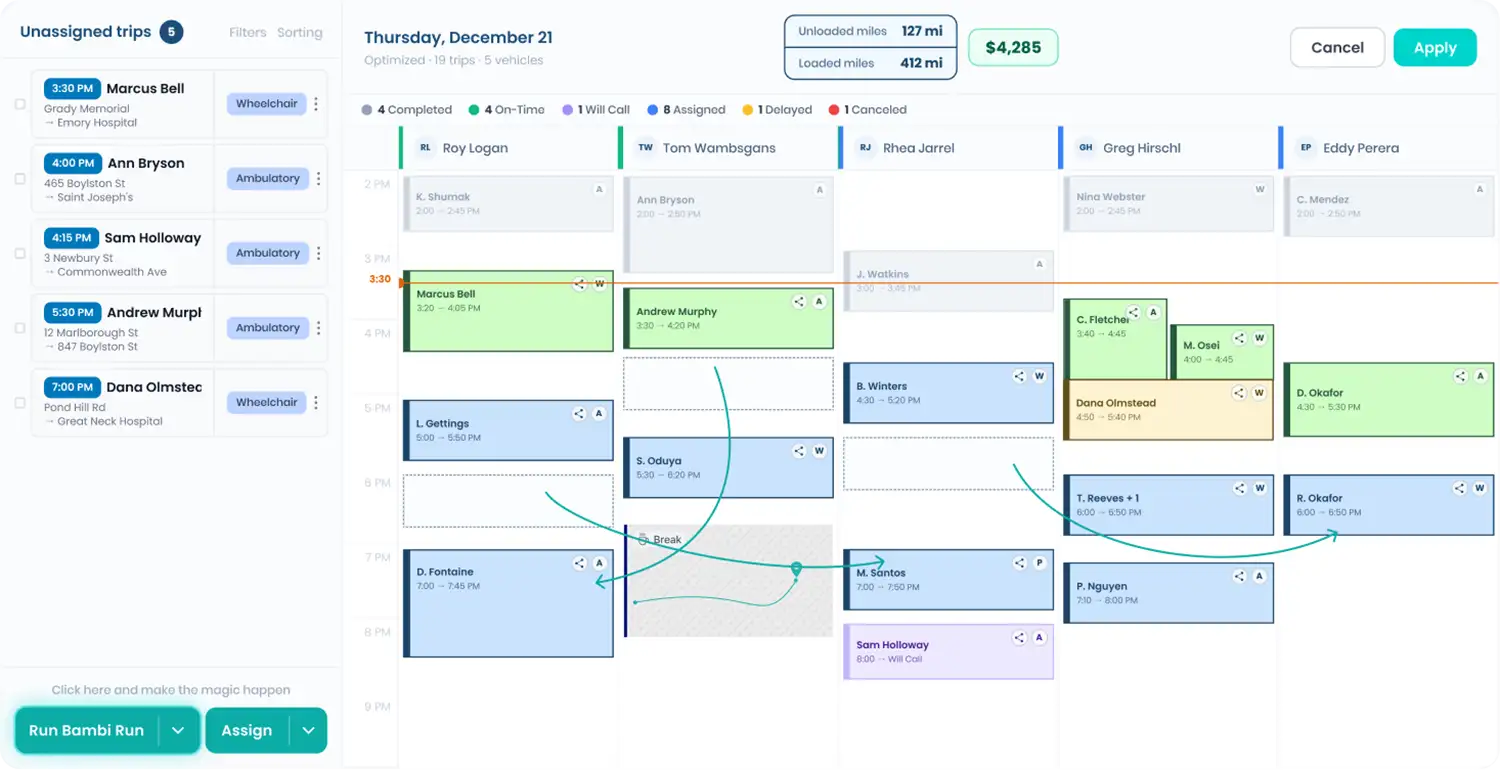
You can calculate deadhead in a spreadsheet, but it's tedious enough that most operators do it once and stop. Dispatch software that tracks vehicle location and trip mileage, and sequences trips automatically, does two jobs at once: it cuts the empty miles, and it shows you the ratio without anyone building a report. That's what Bambi is built to do, with one-click scheduling that sequences the day's trips across your fleet.
The bottom line
Every NEMT operator pays for deadhead. The ones who measure it decide which trips to take, where to park, and what to charge. The ones who don't just wonder why a full schedule isn't making money.
Sources
- Internal Revenue Service, Standard mileage rates (2026 business rate: 72.5 cents Jan 1 – Jun 30; 76 cents Jul 1 – Dec 31).