
By Nick Hoffmeyer, Head of Marketing at Bambi · September 28, 2026 · 9 min read
For most for-profit non-emergency medical transportation (NEMT) companies, funding comes from loans and self-funding, not grants. The federal grant program closest to NEMT, FTA Section 5310, flows through states and regional designated recipients to nonprofits and public agencies, not to for-profit startups. If you're launching or growing a for-profit NEMT company, your real paths are SBA loans, equipment financing, broker cash flow, and bootstrapping with private-pay trips.
Are There Real Grants for NEMT Providers?
A few exist, but almost none of them are written for a for-profit NEMT startup. Grant dollars in transportation are built to flow through nonprofits, area agencies on aging, tribal governments, and public transit authorities, not through single-owner LLCs buying their first wheelchair van.
That doesn't mean grants are irrelevant to you. If you partner with a nonprofit senior center, a dialysis clinic, or a Council on Aging that already receives grant funding, that grant money often pays for the trips, not your business directly, through a purchase-of-service contract. Understanding how the grant money moves helps you find the partnerships worth chasing instead of chasing a grant application you'll never qualify for. If you haven't mapped out the rest of your launch yet, our pillar guide to starting an NEMT business covers licensing, vehicles, and staffing alongside funding.
Be skeptical of anyone selling a list of "free NEMT startup grants." Most of what circulates online is repackaged information about SBA loans, crowdfunding, or general small-business grant directories that have nothing to do with medical transportation specifically.
What Is FTA Section 5310, and Who Actually Qualifies?
FTA Section 5310, the Enhanced Mobility of Seniors and Individuals with Disabilities program, is the closest thing to a real federal NEMT grant, and it's still not built for for-profit companies. The Federal Transit Administration apportions 5310 funds to states and to "designated recipients" in large urbanized areas, who then pass money down to subrecipients: private nonprofit organizations, state or local government authorities, and operators of public transportation (the last group only for certain "nontraditional" projects). FTA's program page even lists non-emergency medical transportation among eligible traditional projects, but the money reaches it through those eligible organizations.
A private for-profit NEMT company that doesn't operate public transportation isn't on that list, so it usually can't apply directly. Some for-profit operators still touch 5310 money indirectly, by contracting with a nonprofit or transit agency that received the funds and needs a transportation provider to actually run the trips. If that's your path, the nonprofit holds the grant and you're a vendor under it, which means their compliance and reporting rules become your rules too.
5310 funds can cover vehicles, wheelchair lifts and ramps, mobility management, and both traditional and "nontraditional" services like volunteer driver programs and same-day accessible trips. The federal share can't exceed 80% of project costs for capital and planning or 50% for operating assistance, with the recipient covering the local match. Application cycles and scoring are set by each state or designated recipient, so confirm the current round with them before you plan around it.
State and Local Transit Grants
State departments of transportation run the 5310 selection process for small urban and rural areas, while the designated recipient (often the regional transit agency or metropolitan planning organization) runs it in large urbanized areas. Some states also fund their own senior or disability transportation programs. These vary widely on timelines, match requirements, and whether a for-profit contractor can be named on the application.
Two other federal programs come up in rural NEMT conversations, with the same catch. FTA Section 5311 (Formula Grants for Rural Areas) funds public transportation in areas under 50,000 people through states and tribes, who pass it to local governments, nonprofits, and operators of public transportation or intercity bus service. The USDA Rural Development Community Facilities program funds essential community facilities and equipment in rural towns of 20,000 or fewer residents, but only for public bodies, community-based nonprofits, and federally recognized tribes; for-profit businesses aren't eligible. For a for-profit operator, both are contract opportunities with the organizations that receive the money, not grants you apply for yourself.
The practical move: call your state DOT's public transit division and ask two questions. First, who received 5310 funds in your region this cycle. Second, whether any of them are looking for a transportation provider to fulfill trips under that grant. That phone call tells you more in ten minutes than an hour of searching grant databases.
SBA Loans: The Real Funding Path for For-Profit NEMT Startups
If grants aren't built for your business structure, loans are the realistic starting point for most for-profit NEMT companies. The SBA doesn't lend directly. It guarantees a portion of a loan a bank or credit union makes to you, which lowers the lender's risk and makes them more willing to fund a new transportation company.
SBA 7(a) loans are the general-purpose option, up to $5 million, for working capital, equipment such as vehicles, and real estate. SBA 504 loans (up to $5.5 million) are built for buildings, land, and long-term machinery and equipment with at least 10 years of remaining useful life, and they can't be used for working capital, so they fit a facility purchase better than a van fleet. SBA microloans go up to $50,000 (SBA puts the average around $13,000), are made by nonprofit intermediary lenders with terms of up to seven years, and can cover working capital, supplies, and equipment for a single-vehicle launch. Rates and terms are set by each lender within SBA rules, so get current numbers from the lender before you build a pro forma around them.
Lenders will want to see a business plan with realistic trip volume and revenue assumptions, not hope. If you haven't built one yet, our NEMT business plan template and example walks through the financials section a lender actually reads.
Equipment and Vehicle Financing
Vehicles are usually the biggest startup cost in NEMT, and many owner-operators finance them rather than pay cash. Wheelchair-accessible vans and stretcher vans typically cost more than a standard vehicle because of the lift, tie-downs, and conversion work, so a dedicated equipment loan or lease through a lender who understands medical transportation vehicles can get you better terms than a generic auto loan.
Some conversion vendors and NEMT-specific finance companies offer financing tied directly to the vehicle purchase. Compare that against a bank loan or SBA-backed option before signing, since manufacturer or vendor financing isn't always the cheapest path even when it's the most convenient one.
Private Pay and Bootstrapping
Plenty of NEMT companies start with one van, a for-profit private-pay or ambulatory client base, and zero outside financing. Private pay trips (self-pay riders, family-booked trips, facility contracts outside Medicaid) close faster than broker credentialing does, which means real revenue while you're still working through broker paperwork.
Bootstrapping isn't a lesser path. It just means your growth rate is tied to reinvested trip revenue instead of borrowed capital, so cash flow and cost control matter even more from day one. Before you build a funding ask around a revenue number, see what NEMT companies actually make per vehicle so your projections hold up to a lender's scrutiny.
That's also where a flat, no-surprises software cost matters, and where your insurance line item needs to be realistic from the start. You're already juggling a vehicle payment and driver pay; our breakdown of NEMT insurance providers can help you budget that cost before it surprises you mid-application.
Funding Sources at a Glance
- FTA Section 5310: Who typically qualifies: Nonprofits, public transit agencies, local governments (not for-profits directly); What it covers: Vehicles, mobility management, some operating costs; How to pursue it: Through your state DOT or the designated recipient for your metro area
- State/local transit grants: Who typically qualifies: Varies by state; often nonprofit or agency-only; What it covers: Vehicles, operating assistance, mobility programs; How to pursue it: Contact your state DOT public transit office
- FTA Section 5311 (rural): Who typically qualifies: States and tribes, passed to local governments, nonprofits, and public transit or intercity bus operators; What it covers: Public transportation in areas under 50,000 people; How to pursue it: Contract with a local rural transit provider that receives the funds
- USDA Community Facilities: Who typically qualifies: Public bodies, community nonprofits, and tribes in rural areas of 20,000 or fewer (not for-profits); What it covers: Essential community facilities and equipment; How to pursue it: Partner with an eligible organization that applies
- SBA 7(a) loan: Who typically qualifies: For-profit small businesses, including NEMT companies; What it covers: Working capital, vehicles, payroll, general startup costs; How to pursue it: Apply through an SBA-approved lender via sba.gov
- SBA 504 loan: Who typically qualifies: For-profit small businesses buying major fixed assets; What it covers: Buildings, land, and equipment with 10+ years of useful life (not working capital); How to pursue it: Apply through a Certified Development Company working with a lender
- SBA microloan: Who typically qualifies: New or very small for-profit businesses; What it covers: Up to $50,000 for startup costs, a used vehicle, basic setup; How to pursue it: Apply through an SBA-approved nonprofit intermediary lender
- Equipment/vehicle financing: Who typically qualifies: Any operator buying a conversion van; What it covers: The vehicle itself, sometimes conversion costs; How to pursue it: Compare a lender or bank loan against vendor financing
- Private pay bootstrapping: Who typically qualifies: Any operator, especially pre-broker-contract; What it covers: Everything, funded by trip revenue; How to pursue it: Build a private-pay or facility-contract base before scaling
FAQ
Are there free grants to start an NEMT business? Not really. Almost every relevant transportation grant, including FTA Section 5310, is built for nonprofits and public agencies, not for-profit startups. If you see a list promising free NEMT startup grants, check what it actually links to before you count on it.
Can a for-profit NEMT company get FTA Section 5310 money? Not directly, in most cases. For-profit companies can sometimes access 5310 funds indirectly by contracting with a nonprofit or transit agency that received the grant and needs a provider to run the trips. Whether and how that works depends on the state and the subrecipient's own procurement rules.
What's the best SBA loan for buying a wheelchair van? Usually an SBA 7(a) loan, which can cover vehicles and working capital together, or an SBA microloan for a smaller used-van purchase. SBA 504 loans require equipment with at least 10 years of remaining useful life, so they're a better fit for a facility than a van. Compare any SBA option against dedicated vehicle financing before deciding.
Do Medicaid brokers help pay for startup costs or vehicles? No. Brokers like Modivcare, MTM, or Alivi pay you per completed trip under a contract. They don't fund your startup. Some do require proof of adequate vehicles and insurance before credentialing, which is a cost you plan for, not one they cover.
How much money do I actually need to start an NEMT business? It depends heavily on fleet size, vehicle type, and whether you lease or buy, so treat any flat number online with caution. Our NEMT business plan template and example includes a startup costs table to help you build your own number.
Get the Funding Right, Then Get the Software Right
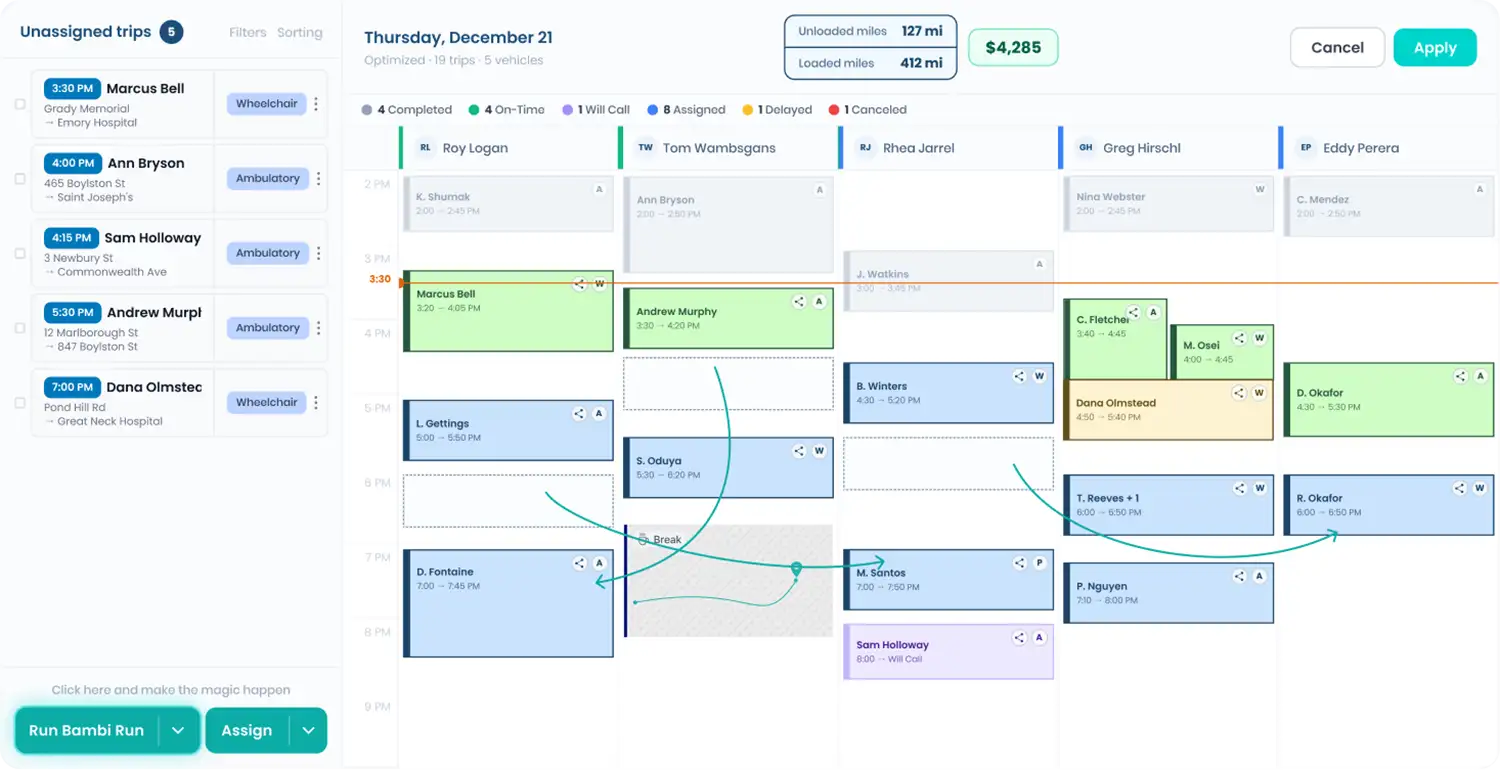
Whichever path you take (a grant-funded contract, an SBA loan, or bootstrapped private pay), your fleet still needs to run efficiently once the money lands. That's the whole reason "Run Bambi Run" exists: one click and the AI assigns your trips, so a lean, newly funded fleet can run more trips per vehicle instead of burning cash on windshield time. Bambi runs $69 per vehicle per month, flat, with no contracts, so it's easy to budget into whatever funding plan you build. See pricing or talk to us about getting your fleet running.
About the author: Nick Hoffmeyer is Head of Marketing at Bambi, the AI-powered dispatch and scheduling platform for non-emergency medical transportation (NEMT) providers. He leads Bambi's growth, SEO, and content strategy and works with NEMT owner-operators every day on the systems that help fleets run more trips with less stress. Connect with Nick on LinkedIn.