

If you are looking for the closest thing Canada has to a Medicaid NEMT programme, this is it. And the first thing to understand is that it is not one.
The Non-Insured Health Benefits Medical Transportation Benefit spent $789.6 million in FY2023-24. That is 37.6% of all NIHB spending, making transportation the single largest benefit in the programme, and it grew 11.1% year over year. There is no provincial programme in Canada remotely this large.
But it does not work like a broker. There is no national portal, no self-serve enrolment, no published national rate schedule for ground transport, and no dispatch platform pushing trips to you. Getting paid by NIHB is business development, not credentialing. Here is what that actually looks like.
What the benefit is
NIHB is administered by Indigenous Services Canada through the First Nations and Inuit Health Branch. The Medical Transportation Benefit funds access to medically required health services that cannot be obtained in the client's community of residence.
- Who is eligible: registered First Nations people, Inuit recognized by a land claim organization, and children under two whose parent is eligible. That was 959,207 eligible clients in FY2023-24.
- It is a payer of last resort. The policy requires clients to have exhausted all other available sources of benefits first.
- Modes covered are broad. Ground includes private vehicle, commercial taxi, fee-for-service driver and vehicle, band vehicle, bus, train, snowmobile taxi and ambulance. Water includes motorized boat, boat taxi and ferry. Air includes scheduled and chartered flights, helicopter, air ambulance and medevac. The standard is the most efficient and economical mode.
The one clause that decides whether you can bill
Section 10.2 of the policy framework is the whole answer, and it is worth reading in full:
"Only service providers who have a negotiated contractual arrangement or who have been approved by FNIHB or a First Nations or Inuit health authority or organization will be reimbursed for medical transportation benefits they have provided."
So direct billing is the stated design. ISC says explicitly that wherever possible the programme works with providers to bill directly so clients do not pay up front. But you must first have an arrangement or an approval, and there is no single place to get one.
- Rates are negotiated rates, rates set out in contribution agreements, published FNIHB rates, or actual expense with original receipts.
- Invoices must be submitted within one year. Section 10.3.
- Fee-for-service drivers not otherwise regulated must keep a copy of driver licences, vehicle registration and public carrier insurance certificates on file with FNIHB or the relevant health authority.
Who to actually contact, because it is not one office
This is where most operators go wrong. NIHB medical transportation is administered region by region, and in several places not by ISC at all.
- ISC regional offices handle Manitoba, Ontario, Saskatchewan, Alberta, Quebec and Atlantic. Regional contacts include Atlantic at 40 Havelock Street in Amherst, Nova Scotia, and Manitoba's medical transport line at 1-877-983-0911.
- British Columbia is different. Benefits transferred to the First Nations Health Authority in 2013, which is why BC does not appear in ISC's regional spending tables at all. Travel is arranged by Community Patient Travel Clerks employed by individual First Nations, or by FNHB Medical Transportation Operations for communities without one.
- The territories are different again. In the Northwest Territories the territorial health authority NTHSSA administers the federal NIHB medical transportation programme through the same Medical Travel Office that runs the territorial programme. In Nunavut, the Government of Nunavut books flights and boarding homes, paid by NIHB and GN.
- Individual Nations and tribal councils hold contribution agreements and administer the benefit directly for their members.
One clarification worth making, because it trips people up. Express Scripts Canada is NIHB's claims processor, and you will see that referenced everywhere. ISC states explicitly that ESC handles all claims except medical transportation. Pharmacy, dental, medical supplies and equipment, vision and mental health go through ESC. Transportation does not. Do not waste time trying to enrol with ESC for transport.
Where the money actually is, by region
Regional spending in FY2023-24 broke down as follows: Manitoba $261.4M, Ontario $166.0M, North $129.9M, Saskatchewan $115.9M, Alberta $69.5M, Quebec $28.6M, Atlantic $18.3M.
But the headline numbers will mislead you if you stop there, because the modal split matters enormously for a ground operator.
- Manitoba is mostly aviation. Air ambulance accounts for $91.0M and scheduled flights another $57.6M, so $154.6M of Manitoba's $261.4M is air. You cannot bid on most of it.
- Saskatchewan is the ground opportunity. Land ambulance at $35.8M plus land and water at $17.6M equals $53.4M of ground spend, against only $14.4M of air. For a road-based operator, Saskatchewan is the better NIHB market despite being the smaller region overall.
- Atlantic runs through contribution agreements. Of $18.3M, operating funds are only $6.6M against $11.7M in contributions, meaning your counterparty is usually a First Nation or regional organization rather than a federal office.
How to approach this well
Two things are true at once. NIHB is the largest organized payer of medical transportation in Canada, and it is the hardest to access, because there is no front door.
The buyer is frequently a First Nation exercising self-determination over its own health administration. That is a relationship, not a credentialing exercise. Approach a Patient Travel Clerk or a regional office the way you would approach any institutional customer: understand what they need, be clear about what you can reliably deliver, and expect the conversation to take time.
Practically: identify the communities in your service area, find out whether they administer their own benefit or route through an ISC regional office, and start there. Keep your driver licences, vehicle registrations and public carrier insurance certificates current and on file, because the policy requires them. And note the one-year invoicing deadline before you let paperwork slide.
One thing we could not verify and will not guess at: there is no FY2024-25 annual report as of July 2026. The ISC annual report index runs only through 2023-24, so the figures above are the most current published.
Get started with Bambi
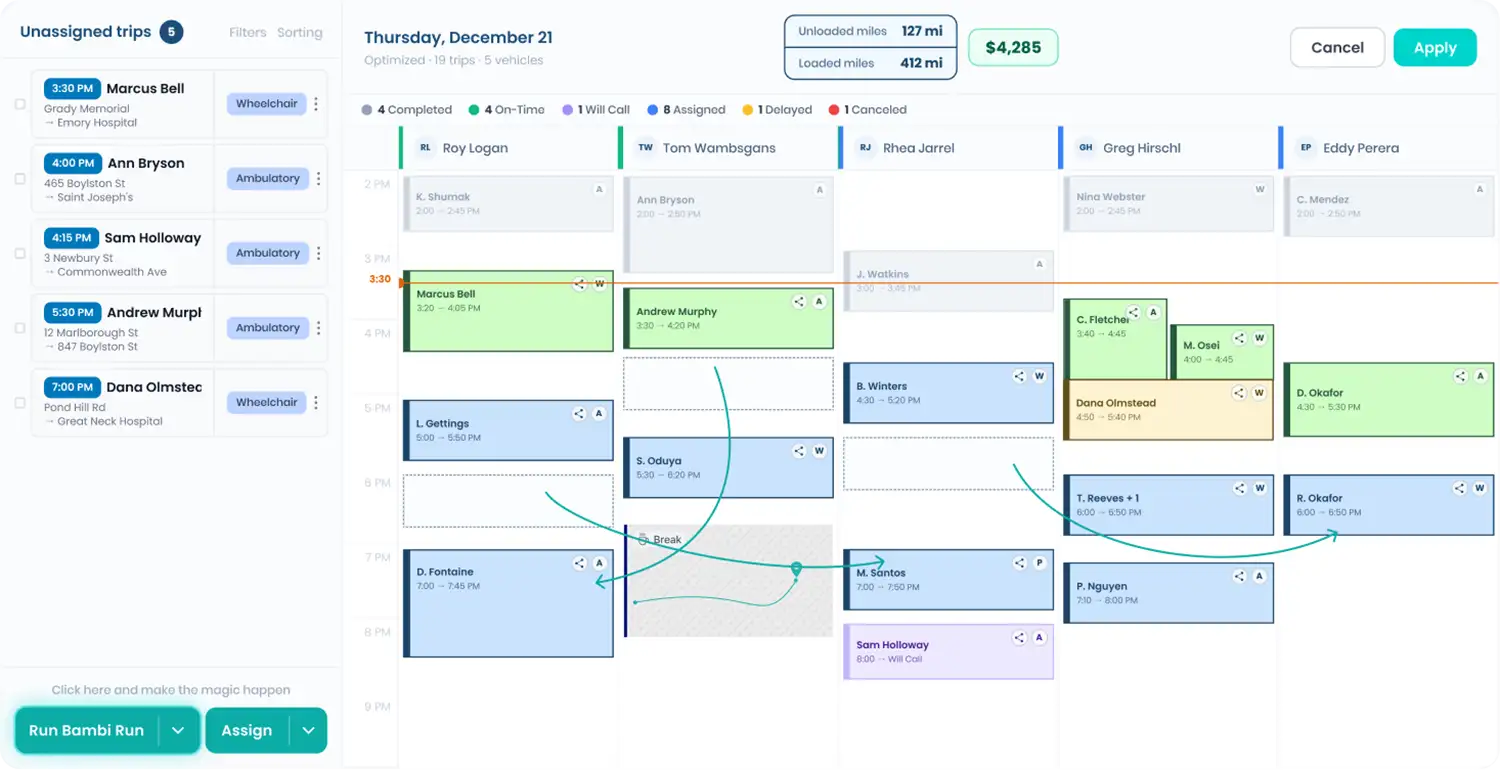
Our aiNEMT software handles scheduling, dispatching, care coordination and real-time tracking. In a market with no broker feeding you trips, the admin all lands on you, which is exactly where software earns its keep. Get in touch for a demo.