
NEMT software must prioritize reliable technical support to ensure smooth operations, compliance, and financial stability for transportation providers. Here’s what you should look for:
- 24/7 Live Support: Immediate assistance during emergencies like system crashes or routing errors.
- Onboarding & Training: Role-specific training, pilot rollouts, and data migration audits to reduce errors.
- Self-Service Tools: Knowledge bases, video tutorials, and AI-driven real-time help for quick problem-solving.
- Regular Updates: Frequent software updates to address bugs, maintain compliance, and improve functionality.
- Dedicated Account Managers: Personalized support for tailored solutions and guidance on complex workflows.
Missed pickups, billing delays, and compliance violations can cost providers thousands of dollars annually. Choosing software with robust support features minimizes downtime, improves efficiency, and ensures uninterrupted patient care.
Problems NEMT Providers Face Without Adequate Technical Support
When technical support falls short, it can throw Non-Emergency Medical Transportation (NEMT) operations into disarray. This affects everything from dispatch and billing to compliance and scheduling, ultimately risking patient care and financial stability.
System Failures During Peak Hours
Picture this: it’s the morning rush (6:00–9:00 AM), and your software crashes. Dispatchers are left scrambling with spreadsheets or paper manifests to manage trips. The result? Missed pickups, which can cost providers $25–$100 per incident due to broker penalties. On top of that, routing inefficiencies from these failures can drive up fuel costs by as much as 30%.
One rural fleet managed to boost its on-time performance from 82% to 94% in just six months after improving technical support. Without such support, though, repeated failures can lead to staff burnout. Replacing a single dispatcher can cost upwards of $10,000. These issues highlight how system reliability during peak hours is not just a convenience - it’s a necessity.
Compliance Violations and Billing Delays
When technical support doesn’t address compliance issues promptly, providers face serious risks. Missing GPS logs or electronic signatures, for instance, can trigger Medicaid audits and hefty clawbacks. One provider had to repay $350,000 because its system couldn’t verify proof of delivery with GPS. As Mindbowser puts it:
"In Medicaid-driven markets, compliance isn't a feature request. It's survival."
Billing errors or manual processes only add to the stress. Payment cycles can stretch to 60, 90, or even 120 days, while Medicaid denials - often caused by eligibility check failures - average 15% to 20%. However, with automated eligibility checks and dedicated support, one multi-payer NEMT company cut its Medicaid denial rate from 18% to under 5% in just a year. This shows how the right technical solutions can transform billing and compliance challenges.
Dispatching and Scheduling Problems
When technical issues go unresolved, dispatching can quickly spiral into chaos. Without tools like real-time GPS tracking or mobile apps, dispatchers struggle to provide accurate ETAs or adapt to changes on the fly. Drivers might end up zigzagging inefficiently, wasting both time and fuel.
Take one mental health transport provider as an example: their system couldn’t send automated reminders, leading to a 30% no-show rate. Dispatchers had to spend 40% of their time manually contacting riders. Such inefficiencies contribute to a larger problem - between 20% and 40% of riders missing appointments, which adds to the staggering $150 billion in annual costs from missed medical appointments nationwide.
These scheduling breakdowns don’t just waste resources; they can also damage relationships with hospitals and brokers. As Tom Malan from NEMT Cloud Dispatch points out:
"NEMT scheduling mistakes are one of the biggest reasons providers lose thousands of dollars every month without realizing it."
All of this underscores a simple truth: robust technical support isn’t optional - it’s essential to keeping operations smooth and costs under control.
Required Technical Support Features for NEMT Software
To address the challenges of system failures, compliance issues, and scheduling disruptions, NEMT software must include targeted technical support features. These features ensure smoother operations and minimize the risk of service interruptions.
24/7 Live Support Access
NEMT operations run non-stop, so technical support must be available at all hours. Having round-the-clock phone and chat support is critical for handling emergencies like GPS malfunctions or routing errors during off-peak hours, such as early mornings or late nights. Immediate assistance can prevent these issues from escalating into major disruptions.
Live support also proves essential during compliance audits, disputes over claims, or sudden scheduling conflicts. For team members who may not be tech-savvy, having access to real-time guidance ensures that small problems don’t spiral into larger service failures. Before choosing the right NEMT software, confirm whether 24/7 support is part of the service agreement.
Complete Onboarding and Training Programs
The typical implementation period for NEMT software ranges from 2 to 8 weeks. During this time, role-specific training equips each team member to use the platform effectively, reducing errors and avoiding the frustration of navigating unnecessary features.
A pilot rollout - starting with a smaller portion of the fleet - allows for focused training and troubleshooting before scaling up. This phase is also the perfect time for data migration audits to catch inaccuracies that could lead to billing issues or compliance violations. Tracking metrics like driver app adoption rates and claim acceptance percentages during the first 90 days can help measure the success of your training efforts.
Self-Service Tools and Real-Time Help
Self-service options like knowledge bases, video tutorials, and live chat empower users to solve common problems on their own, avoiding long waits for support. AI-driven tools can further reduce response times by providing instant answers to frequently asked questions. Features like real-time GPS validation and automated ETAs help dispatchers regain control quickly during disruptions.
Driver mobile apps also act as self-service tools, offering turn-by-turn navigation, digital signature collection, and inspection checklists for pre- and post-trip evaluations. Automated alerts for expiring driver credentials or vehicle maintenance needs help identify potential issues before they impact operations.
In addition to these features, regular software updates and access to a dedicated account manager can ensure the system remains reliable and efficient over time.
Software Updates and Dedicated Account Support
Regular Updates for Bug Fixes and Compliance
NEMT regulations are constantly changing, and your software needs to keep up. Frequent updates help your platform adjust to new broker and Managed Care Organization (MCO) policies without requiring a complete system overhaul. These updates not only address bugs - like those that can cause billing delays or dispatching errors - but also tackle operational issues that could disrupt your workflow.
Keeping up with updates also ensures HIPAA compliance. Features like encrypted data storage, role-based access, and automated tracking for driver licenses, vehicle inspections, and medical training certifications are built into these updates. Automation like this is a game-changer for audit readiness, as the software can automatically collect electronic signatures, GPS-verified proof of service, and timestamps - key requirements from state agencies.
"In 2026, choosing NEMT software is no longer an IT decision; it's a financial and compliance decision." - Ali Khan, Caretap
When considering software vendors, it's important to ask how frequently they release updates and whether those updates include AI-driven features like predictive scheduling or proactive compliance alerts. These tools are quickly becoming industry standards and can help prevent penalties or service interruptions by staying ahead of state-specific Medicaid changes.
While technical updates are crucial, having access to personalized support can make an equally big difference in your daily operations.
Assigned Account Managers
Having a dedicated account manager transforms your software from a generic tool into a solution tailored to your needs. These managers provide direct, human support - not just automated responses - ensuring your platform is set up to meet the specific demands of your market. Whether you need help with private pay portals, EDI claims submission, or integrations with major brokers, account managers can guide you every step of the way.
"The most flexible NEMT software providers view their relationship with NEMT companies as ongoing partnerships rather than simple vendor-client transactions." - RouteGenie
Account managers are especially helpful for navigating complex workflows like batch claim submissions or tracking denials to ensure the software aligns with your payer mix. When evaluating vendors, check if this level of support is included in the base price or if it requires an upgraded support tier. Look for providers that offer customized onboarding and long-term collaboration instead of just basic, transactional support.
How to Evaluate Support Response Times and Availability
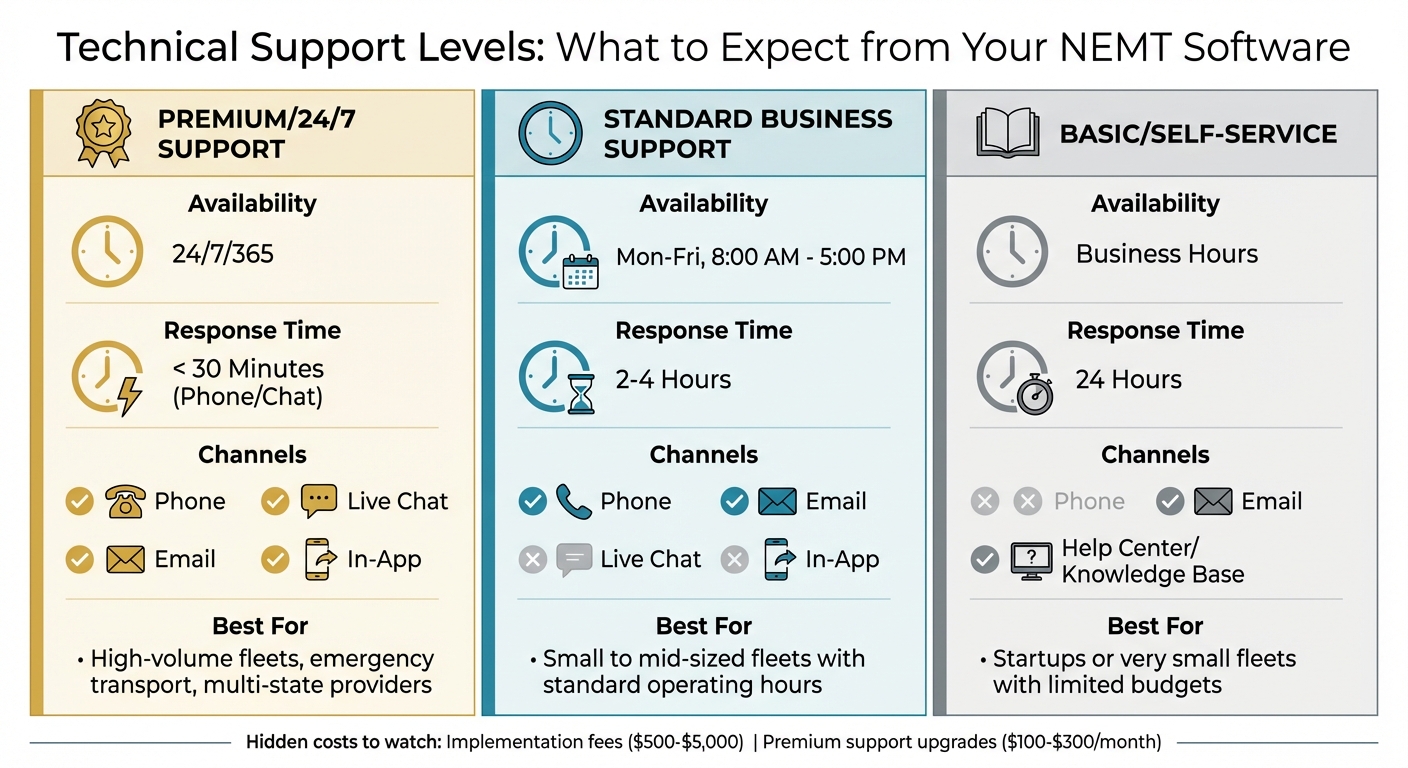
When you're choosing NEMT software, evaluating support response times and availability is critical. These factors can make or break your operations. A vendor offering 24/7 support ensures you can resolve common software problems - like a dispatch glitch - at any time, while limited business hours might leave you stuck, potentially costing you revenue.
To get a clear picture, ask vendors direct questions like: "What are your support hours?", "Do you provide a dedicated account manager?", and "Is 24/7 support included, or does it require an upgrade?". Many companies reserve premium support for higher-priced plans, so clarifying this upfront helps avoid surprise costs later. This step ensures the support structure aligns with your business needs.
Take it a step further by testing real workflows instead of relying solely on demos. For example, request a walkthrough of how the software handles technical issues. Simulating scenarios like dispatch or billing problems can give you a firsthand look at how quickly and effectively the vendor responds. This practical approach is often more revealing than promises made during sales pitches.
Another key factor is the variety of communication channels. Phone support is ideal for urgent issues but often comes with a premium price tag. Email support, while useful for keeping an audit trail, tends to be slower. The best vendors provide multiple options - phone, live chat, email, and in-app support - so you can choose the channel that fits the urgency of your issue.
Support Metrics Comparison Table
Here's a quick comparison of support levels to help you assess your options:
Support LevelAvailability HoursTarget Response TimeAvailable ChannelsBest ForPremium / 24/724/7/365< 30 Minutes (Phone/Chat)Phone, Live Chat, Email, In-AppHigh-volume fleets, emergency transport, multi-state providersStandard BusinessMon-Fri, 8:00 AM - 5:00 PM2 - 4 HoursPhone, EmailSmall to mid-sized fleets with standard operating hoursBasic / Self-ServiceBusiness Hours24 HoursEmail, Help Center / Knowledge BaseStartups or very small fleets with limited budgets
Finally, keep an eye out for hidden support costs. Beyond the software's base price, you might encounter charges for implementation, training, or upgraded support tiers. For instance, vendors may charge $100 to $300 monthly for faster response times or direct phone support. Onboarding fees can range from $500 to as much as $5,000. Understanding these costs upfront can save you from unexpected expenses and help you plan your budget more effectively.
Conclusion
The technical support elements discussed earlier play a key role in ensuring smooth operations and financial stability. As Ali Khan from Caretap aptly states:
"In 2026, choosing NEMT software is no longer an IT decision; it's a financial and compliance decision".
A strong support system keeps your fleet running efficiently, ensures billing accuracy, and keeps compliance documentation ready for audits.
Key features to look for include round-the-clock live support for after-hours emergencies, thorough onboarding and training programs to prepare your staff, and self-service tools like knowledge bases for quick problem-solving. Proactive support, combined with dedicated account managers, helps address issues promptly and tailors solutions to your needs.
When choosing NEMT software, dig deeper. Ask about response times, communication options, and any hidden costs like implementation fees or upgraded support tiers. Investing $20,000 in the right NEMT software can deliver over $30,000 in annual benefits - a 1.5x return on investment in just a year. Operators using specialized NEMT software with robust support report a 98% drop in unbilled claims and save 2 to 3 hours daily on scheduling and dispatch. These improvements can mean the difference between thriving or struggling in this competitive field.
These benefits only become a reality when technical support is used to fully unlock your platform's potential and resolve issues before they escalate. Together, these features ensure uninterrupted service, compliance, and financial efficiency.
Choose vendors who prioritize support as a central feature, not an afterthought. Reliable transportation for critical appointments and accurate billing depend on a support system that ensures operational efficiency. With strong technical support, your NEMT operations can consistently deliver high-quality patient care while maintaining financial and regulatory stability. The right support makes all the difference - make it a top priority when selecting your NEMT software.
FAQs
What support SLAs should I demand?
When it comes to Non-Emergency Medical Transportation (NEMT) software, a solid Service Level Agreement (SLA) is essential for smooth operations. Here’s what a good SLA should cover:
- 24/7 customer support: For urgent issues, round-the-clock support is a must. This ensures that critical problems can be addressed immediately, no matter the time.
- Real-time troubleshooting: Quick, efficient problem-solving keeps operations running without unnecessary delays.
- Regular software updates: Keeping the software up-to-date ensures it stays compliant with regulations and adapts to industry changes.
SLAs should also clearly outline response times based on the severity of issues. For example, critical outages should receive immediate attention, while less severe problems might have longer response windows. On top of that, having dedicated account management can make a big difference. Personalized assistance helps providers stay on track, maintain reliability, and meet industry standards with confidence.
How do I test support before signing?
When you're considering support options, make the most of trial periods or demo sessions. These opportunities let you test how responsive and helpful the support team truly is. Pay close attention to critical services such as live chat, help desks, and the quality of their documentation.
Be sure to ask about important features like 24/7 support, onboarding assistance, and whether they provide dedicated account managers. These can make a big difference in your overall experience.
Another smart move? Check out user reviews or talk to current customers. Their insights can give you a clearer picture of how effective the support is, especially during your trial phase. Experiencing the support firsthand is the best way to ensure you're making the right choice before committing.
What support fees are usually hidden?
Hidden fees tied to support in NEMT software can sneak up on you, often tied to things like advanced features, adding more users, or surpassing trip volume caps in basic plans. Many providers leave these costs out of their initial pricing details, so it’s crucial to carefully review the terms to steer clear of unexpected charges.