
How to Start an NEMT Business in Kansas: A Several Part “Bambi Knows Best” State-By-State Series
Part 1: Research the Kansas NEMT Market
Before launching a new NEMT business in Kansas, it's essential to conduct thorough market research. This ensures that you're not entering an oversaturated market and helps identify any gaps in existing NEMT services. For instance, you may find that while there are NEMT providers in your area of Kansas, they only offer services to Adult Day Care centers. This presents an opportunity to expand your services to rehabilitation centers, hospitals and more healthcare facilities. In this section, we'll outline how to get started and where to focus your market research efforts in Kansas.
1 | Identify existing NEMT providers in your area
Across the state of Kansas, there are numerous NEMT providers servicing both rural areas and urban centers. Directories aggregate these providers, and many healthcare facilities partner with NEMT services. It's wise to explore all options and be bold, like Bambi, by reaching out to them for guidance! Although these providers may be your competitors, they could also become valuable business partners. Approach them thoughtfully to gain insights into your market. Below are some helpful directories, services and providers to begin your search for NEMT business in Kansas:
2 | Assess the demand for NEMT services
Determine if there is adequate demand for your NEMT business to enter the market in your local area of Kansas. Also, consider whether you'll be crossing multiple jurisdictional lines or operating within a minimal radius. To make this assessment, research local hospitals, health and wellness facilities, including establishments such as:
3 | Decide on a target market
After researching NEMT market opportunities and assessing demand from healthcare facilities, identify the demographic that strategically makes the most sense to target. Will you focus on seniors, individuals with disabilities or a broader patient population? Specializing in a specific group will allow you to tailor your services and marketing strategies more effectively.
As of the latest estimates in 2023, the population of Kansas is approximately 2.9 million people. The population is varied across the state and includes urban centers like Witchataw, as well as suburban and rural areas.(Source: United States Census Bureau - Kansas Population Estimates)
4 | Choose a specific NEMT service (or offer them all!)
NEMT providers offer a variety of services in their vehicle fleets, including ambulatory, stretcher and wheelchair support. It's recommended to start with one service based on the needs of your target market and market gaps, and then expand from there. This approach ensures sustainability! Take note of what competitors are doing and either differentiate yourself or identify a niche neighborhood that could benefit from your support. Start with a well-equipped fleet to meet the specific needs of that service, whether it's supporting ADCs or physical therapy centers.
5 | Understand the different Medicaid delivery models
KanCare is Kansas' Medicaid program administered by the state. Before January 2013, transportation for Medicaid beneficiaries was provided statewide through a broker by the Kansas Department of Health and Environment. Since January 2013, the state transitioned to a mandatory Managed Care Organizational (MCO) approach under a Section 1115 Demonstration Waiver, requiring all Medicaid recipients to enroll in one of three designated health plans, which are the following: are Aetna Better Health of Kansas (Aetna), Sunflower State Health Plan (Sunflower), and United Healthcare Community Plan of Kansas (United).
In Kansas, the Medicaid program primarily utilizes a managed care delivery model for NEMT. And those three aforementioned MCOs provide NEMT services throughout the state.
How it works is that these managed care organizations are contracted by the Kansas Department of Health and Environment (KDHE) to provide comprehensive healthcare services, including transportation, to Medicaid beneficiaries. They manage and coordinate NEMT services for eligible individuals, ensuring they have access to necessary medical appointments and services.
Under Kansas' revamped NEMT program, each MCO is contracted with a broker to oversee medical transportation services. Two health plans have partnered with LogistiCare which is now Modivcare, while the third has engaged Access2Care, a subsidiary of American Medical Response. These brokers operate under full-risk, competitively bid contracts.
Here are some fast KS facts according to report State-by-State Profiles for Examining the Effects of Non-Emergency MEdical Transportation Brokerages on Transportation Coordination:
6 | Getting Paid
NEMT fee schedules in Kansas are structured according to the guidelines and rates established by the Kansas Medicaid program. Here’s how it works:
NEMT services for Medicaid recipients in Kansas are reimbursed based on the fee schedule set by the Kansas Medicaid program. This schedule outlines rates for different types of transportation services, including mileage rates for various vehicle types and rates for waiting time.
Kansas Medicaid operates under a managed care model, where some Medicaid recipients are enrolled in Managed Care Organizations (MCOs). These MCOs have specific contracts and fee schedules with NEMT providers. Providers must adhere to the rates and guidelines set by the MCOs when delivering services to their members. Think of it as a quasi-employment scenario.
To receive payment, NEMT providers submit claims for the services they have rendered to Medicaid recipients. Claims must detail the type of service provided, mileage accrued, and waiting times. These claims are then processed by the Kansas Medicaid program or the relevant MCO. Upon verification that the services rendered align with the fee schedule and additional guidelines, payment is issued.
Well done for navigating through this information-packed first part! Now, let's progress to Part 2 on developing a business plan. Click here to continue, or skip ahead to other sections in the series by visiting the table of contents.
How to Start an NEMT Business in Kansas:
A Several Part “Bambi Knows Best” State-By-State Series
Welcome to Kansas, the Sunflower State, where the golden fields stretch as far as the eye can see and the community spirit shines just as brightly. In Kansas, the warmth of the people matches the sunny landscapes, reflecting a character that is both resilient and welcoming. With deep agricultural roots, Kansans embody a blend of hard work, ingenuity and a neighborly heart. It's a place where small-town charm meets forward-thinking innovation, making it the perfect backdrop for your entrepreneurial journey. Just like Bambi and his friends in the forest, in Kansas, you'll find a supportive and nurturing environment that fosters growth and success.
But Kansas isn't just charming; it's caring too. It’s an excellent place in the Midwest to launch your non-emergency medical transportation (NEMT) business for several reasons. From the bustling urban centers of Kansas City, Overland Park and Wichita to the expansive rural areas across the state, there are abundant opportunities to establish your NEMT business.
The NEMT industry plays a crucial role in providing essential healthcare access to everyone. If you have a caring nature and possibly work in healthcare already but are considering transitioning from scrubs to software, starting an NEMT business in Kansas could be an incredibly rewarding career adventure. Whether you're drawn to entrepreneurship by a passion for helping others or by the potential for innovation in healthcare services, Kansas offers a promising environment to start your journey.
As a care-tech company dedicated to supporting our customers and their passengers, we are committed to setting your NEMT business on the road to success. We take pride in providing informative content about the NEMT industry, along with streamlined product features such as Run Bambi Run, designed to save you time in your daily operations. Whether you're a seasoned NEMT broker or a new NEMTpreneur, we're here to assist you in launching and maintaining a sustainable NEMT business.
This Bambi Knows Best series will guide you through each crucial step in starting your own certified NEMT business in Kansas. From researching the local market and crafting a business plan to navigating regulations, securing funding, building your fleet, hiring and training your team and managing essential technology, we've got you covered every hop of the way.
As you dive into your own research, we recommend hiring local consultants and connecting with other NEMT business owners in your area for valuable insights. At Bambi, we believe in growing a forest of friends over frenemies!
Below is a hoof-full of a table of contents that allows you to follow along or click through to the articles that pertain to your particular needs.
Part 1: Research the Kansas NEMT market
Part 2: Develop a business plan and get registered in Kansas
Part 3: Study Kansas’ regulations and get insured
Part 4: Secure funding in Kansas
Part 5: Flesh Out Your NEMT Fleet in Kansas
Part 6: Hire and Train Up Your NEMT Dream Team
Part 7: Take Care of That Tech
In summary, launching an NEMT business in Kansas requires dedication, meticulous planning, and an unwavering commitment to providing exceptional patient care. By conducting thorough research of the Kansas market, understanding local rules and regulations, securing funding and vehicles, assembling a skilled team and leveraging technology, you can navigate challenges with the agility of Bambi and establish a thriving NEMT business that positively impacts your local Kansas community.
.png)
See the full interview on YouTube.
Please don't forget to subscribe and like NEMT Experts Podcast on YouTube.
Also, available to watch on Spotify
And listen (audio only) on your other favorite podcast platforms Apple and Pandora.
Bambi CEO Nirav Chheda talks with Alex Stoia, Manager of Corazon Concierge, the only private NEMT business in New Mexico, about preparing his NEMT business to meet the growing NEMT demands across the state.

"To make it plain for everyone to understand... The Bambi software, an all-in-one software, is better for all NEMT owners out there and is easy to use, you don't have to add any plugins or integrations. Go over there and check them out to make your business run a bit smoother and get as many appointments that you can handle. I'm giving my stamp of approval because this is something the transportation industry needs."
Donte also says that Bambi is an all-in-one dispatching software that includes features like appointment scheduling, payment processing, and customer management. He likes that the software is easy to use and that it doesn’t require any additional plugins to function. For example, the software has built-in credit card checkout and doesn’t require integration with services like Stripe or Square. Additionally, the software includes features for private pay clients, which Donte finds important.
Another feature that Donte highlights is the use of AI for trip scheduling. The software can automatically assign trips to drivers based on their qualifications (e.g., stretcher vs. wheelchair). This can be a big time saver for NEMT business owners who have many drivers and trips to manage.
Donte indicates that the software costs $69 per month for unlimited trips, and suggests owners out there try the free demo that is available.
.png)
See the full interview on YouTube.
Please don't forget to subscribe and like NEMT Experts Podcast on YouTube.
Also, available to watch on Spotify
And listen (audio only) on your other favorite podcast platforms Apple and Pandora.
Bambi CEO Nirav Chheda talks with Julian Ssemalulu, Owner of Bellshan Homecare, about his great experience in switching over to Bambi's incredibly easy-to-use NEMT dispatch software.
How to Start an NEMT Business in Missouri: A Several Part “Bambi Knows Best” State-By-State Series
Part 7: Take Care of That Tech
Last but not least, leveraging technology is crucial for streamlining your operations and enhancing patient care in your Missouri NEMT business.
Settle up on some NEMT Software: Embrace technology to streamline operations and enhance patient care. Explore NEMT software solutions that automate scheduling, dispatching and route optimization (like ours!). Then there’s GPS tracking to offer real-time vehicle location and facilitate communication with patients. Bambi helps everyone from seasoned pros to NEMTpreneurs get their businesses started, streamlined and sustainable, offering a clean and calming software to soothe those biz savvy souls.
Well there you have it! You studied up on the Missouri several part series, thoroughly researched and written up by our caring and diligent editorial team at Bambi. As we want to be sure when you’re ready to enter the MO NEMT market, you do so with nimble grace — Bambi style.
And remember, Bambi knows best! Our team and tech are here to help! Get in touch today if you have questions about getting started or simply just want a demo of our fun-in-one aiNEMT software built for softies like you! Sometimes, a taste of streamlined, easy-to-use software is all it takes to persuade an entrepreneur to make the leap and prance forward like Bambi in business.
How to Start an NEMT Business in Missouri: A Several Part “Bambi Knows Best” State-By-State Series
Part 6: Hire and Train Up Your NEMT MO Dream Team
Building a competent and compassionate team from safe drivers to skilled dispatchers is needed for delivering high-quality NEMT services and ensuring a positive experience for your patients. Hiring NEMT professionals in Missouri can be done through several platforms and tactics like adding job postings on employment sites like Indeed to LinkedIn to attending job fairs as vendors. The options are endless. There’s just one more article left in the series! Go on now, move onto the final part, Part 7 all about taking care of that tech, click here or skip ahead to the other sections in the series by visiting the series’ table of contents here.
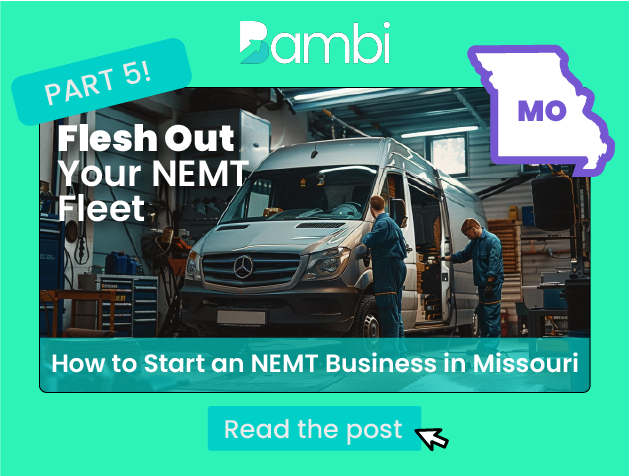
How to Start an NEMT Business in Missouri: A Several Part “Bambi Knows Best” State-By-State Series
Part 5: Flesh Out Your NEMT Fleet in Missouri
Building a reliable and accessible fleet is essential for the success of your NEMT business. This part in the series covers the key considerations for selecting and maintaining vehicles and equipment to ensure safe and comfortable patient transportation.
Select your vehicles: Invest in comfortable and accessible vehicles that cater to your chosen patient population. Consider features like wheelchair ramps or lifts, ensuring compliance with Americans with Disabilities Act (ADA) regulations.
Pick your supporting equipment: There is a variety of equipment you can purchase to accompany your fleet, such as ramps, lifts and first-aid kits. Conduct local research to find the best brands that support your sustainability efforts. Supporting Missouri businesses can also be more efficient and environmentally friendly.
Maintain regular vehicle checks: Develop a comprehensive maintenance plan to guarantee your fleet is safe for everyone and the planet!
So close! Now to move onto Part 6 on hiring and training up your dream team, click here or skip ahead to the other sections in the series by visiting the series’ table of contents here.
How to Start an NEMT Business in Missouri: A Several Part “Bambi Knows Best” State-By-State Series
Part 4: Secure Funding in Missouri
Startups cost to start up. So be realistic about the initial investment required. Factor in vehicle purchases, licensing fees, insurance costs, marketing expenses and operational overhead — and then see about securing adequate funding to get your NEMT business off the ground and sustaining it during the initial stages.
The following are places where you can look for financial support. Explore funding options such as small business loans, seeking angel investors or even crowd-funding platforms.
Here’s a comprehensive list of some of your options in Missouri:
The SBA offers various loan programs for small businesses, including the 7(a) loan program, which provides financial assistance for businesses with special requirements.SBA Loans. Missouri Small Business Development Centers (SBDC). The SBDC provides guidance on funding opportunities and can help you prepare business plans and loan applications.
While direct grants for starting a business are rare, there are grants available for specific purposes like technological innovation, rural development — and if you’re an NEMT servicing Missouri rural residents, you might just have a chance at a grant! — and more. Grants.gov is a comprehensive resource for finding federal grants.You’re over half way there in this comprehensive series! In order to move onto Part 5 on how to flesh out your NEMT fleet, click here or skip ahead to the other sections in the series by visiting the series’ table of contents here.
