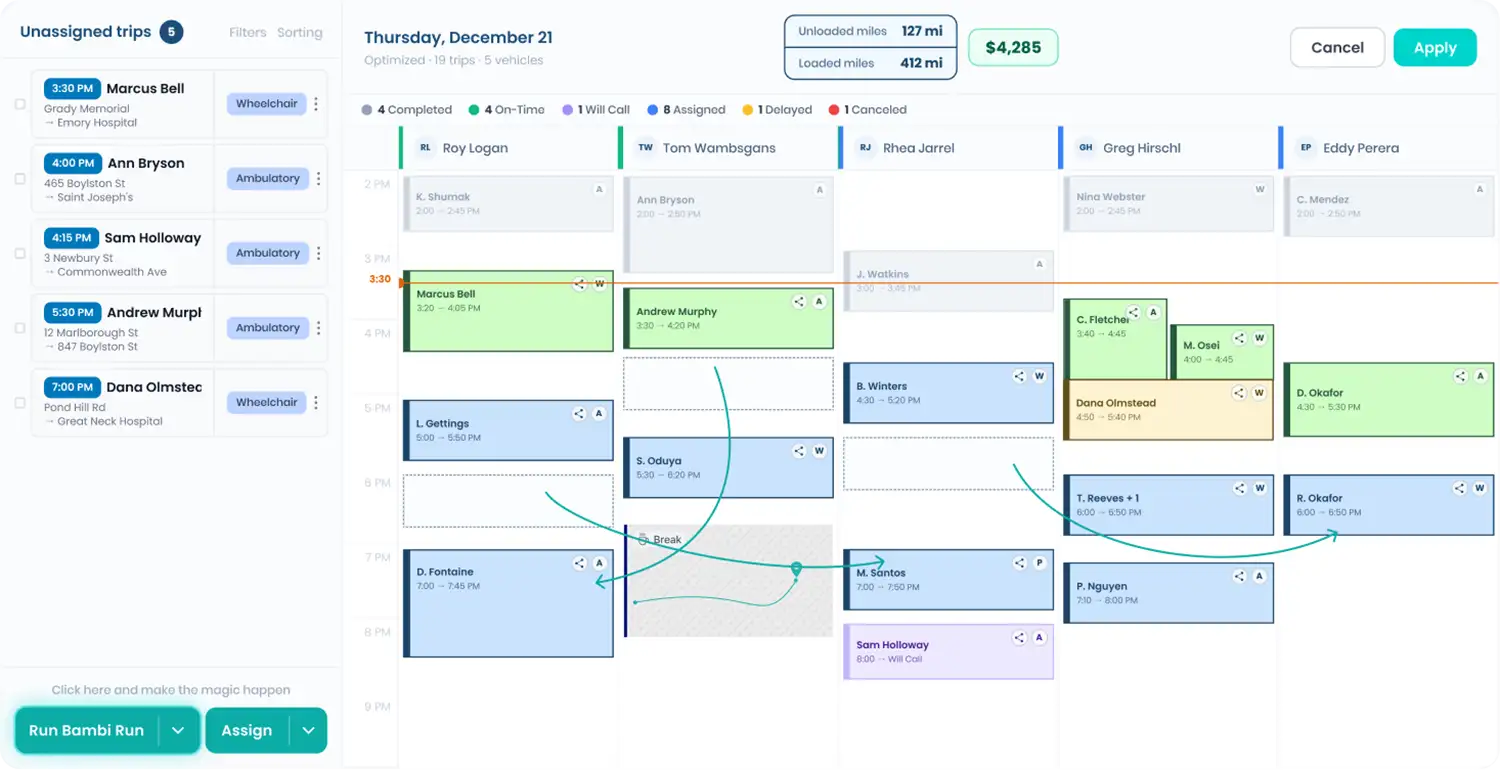

Dynamic scheduling transforms how Non-Emergency Medical Transportation (NEMT) providers handle compliance. By using AI-driven systems, providers can automate critical tasks like trip reassignment, route recalculation, and resource allocation in real-time, ensuring adherence to regulations while reducing errors and inefficiencies. Here's what you need to know:
- Automated Compliance Checks: Systems track driver hours, vehicle maintenance, and credential expirations, sending alerts to prevent non-compliant assignments.
- Error Reduction: GPS-based validations and automated data entry eliminate manual mistakes, improving Medicaid claim acceptance rates (e.g., from 82% to 96%).
- Optimized Assignments: Automatically matches trips with certified drivers and vehicles meeting specific needs (e.g., ADA compliance).
- Improved Timeliness: Real-time route adjustments ensure patients arrive on time, meeting payer performance benchmarks.
- Scalability: Efficiently manages demand surges without sacrificing compliance or service quality.
Dynamic scheduling outperforms static systems across key metrics like documentation accuracy, on-time performance, and claim acceptance rates. Tools like Bambi simplify compliance with features like integrated GPS, automated logs, and HIPAA-compliant dashboards, all for $69 per vehicle per month - making compliance automation accessible for providers of all sizes.
Benefits of Dynamic Scheduling for Compliance
Automated Tracking and Compliance Alerts
Dynamic scheduling systems are designed to keep an eye on compliance factors and address potential issues before they escalate. These systems monitor driver work hours, vehicle maintenance schedules, and credential expiration dates in real time. For instance, if a driver is nearing their maximum allowable hours or a vehicle's inspection deadline is approaching, the system sends automatic alerts to prevent non-compliant assignments. Real-time GPS tracking ensures drivers stick to approved routes, creating an audit trail that simplifies compliance recordkeeping. This proactive approach helps reduce errors in documentation, making compliance management smoother.
Fewer Documentation and Reporting Errors
Manual data entry often leads to mistakes that can result in claim denials or audit failures. Dynamic scheduling minimizes these risks by automating trip logs and using GPS-based validations to accurately record pickup times, drop-off locations, and mileage - completely removing the need for human intervention. Adopting Electronic Data Interchange (EDI) can cut administrative overhead by 30–50%, streamlining workflows and reducing errors. As HIPAA Vault highlights:
EDI reduces errors and accelerates reimbursements by automating workflows.
Additionally, built-in formatting rules validate data before it’s transmitted, ensuring records are audit-ready and meet regulatory standards. This automation not only reduces errors but also ensures that every driver and vehicle assignment complies with the necessary regulations.
Better Driver and Vehicle Assignment Compliance
Dynamic scheduling systems use real-time alerts to enforce compliance on every trip. These systems ensure that drivers have up-to-date certifications and meet rest and credential requirements. For trips requiring wheelchair-accessible vehicles or specialized medical accommodations, the system automatically assigns ADA-compliant vehicles and properly trained drivers. For example, by December 2025, Curb Health plans to enhance compliance with a HIPAA-compliant dashboard that allows care coordinators to monitor rides in real time while protecting patient privacy. This automation reduces the risk of compliance oversights that often occur with manual scheduling.
Better On-Time Performance for Payer Requirements
Timeliness is a critical metric for payers and brokers when evaluating Non-Emergency Medical Transportation (NEMT) providers. Dynamic scheduling optimizes routes in real time, accounting for factors like traffic conditions, to ensure patients arrive on time for checkups, chronic condition treatments, or specialist appointments. In May 2025, American Logistics reported a 98% utilization rate for its proprietary mobile application, which streamlined operations through automated documentation and GPS tracking. These tools help reduce delays, improve adherence to schedules, and meet the performance benchmarks required by payers. Strong performance metrics also support scalable and compliant operations.
Resource Efficiency and Scalability
Dynamic scheduling doesn’t just ensure compliance - it also helps providers scale operations efficiently, even during peak periods. By tracking maintenance schedules and reallocating resources in real time, these systems maintain compliance while managing increased demand. Transportation providers emphasize that brokers play a crucial role in navigating the complex requirements of NEMT programs. With over 55 million NEMT rides provided annually, dynamic scheduling enables providers to expand their operations without compromising regulatory standards, ensuring both efficiency and compliance.
Static vs. Dynamic Scheduling for Compliance
When it comes to compliance, static and dynamic scheduling systems offer very different approaches. Static scheduling sticks to fixed plans, which can quickly fall apart when unexpected events occur. Imagine a driver calling in sick, traffic piling up, or a patient needing a last-minute ride - these rigid systems simply can't keep up. The result? Missed appointments, compliance issues, and unhappy patients. Static systems just don't have the flexibility to handle the unpredictable nature of real-world operations.
Dynamic scheduling, on the other hand, is built for adaptability. Systems like Bambi's AI-powered software continuously monitor conditions and automatically adjust schedules as needs change. This real-time responsiveness is crucial in the Non-Emergency Medical Transportation (NEMT) space, where compliance means more than just being on time. It involves ensuring drivers are properly credentialed, maintaining accurate records, and meeting strict data protection standards like HIPAA. Dynamic systems handle all of this seamlessly - verifying certified crews, generating audit-ready documentation, and safeguarding sensitive information.
Compliance Metrics Comparison
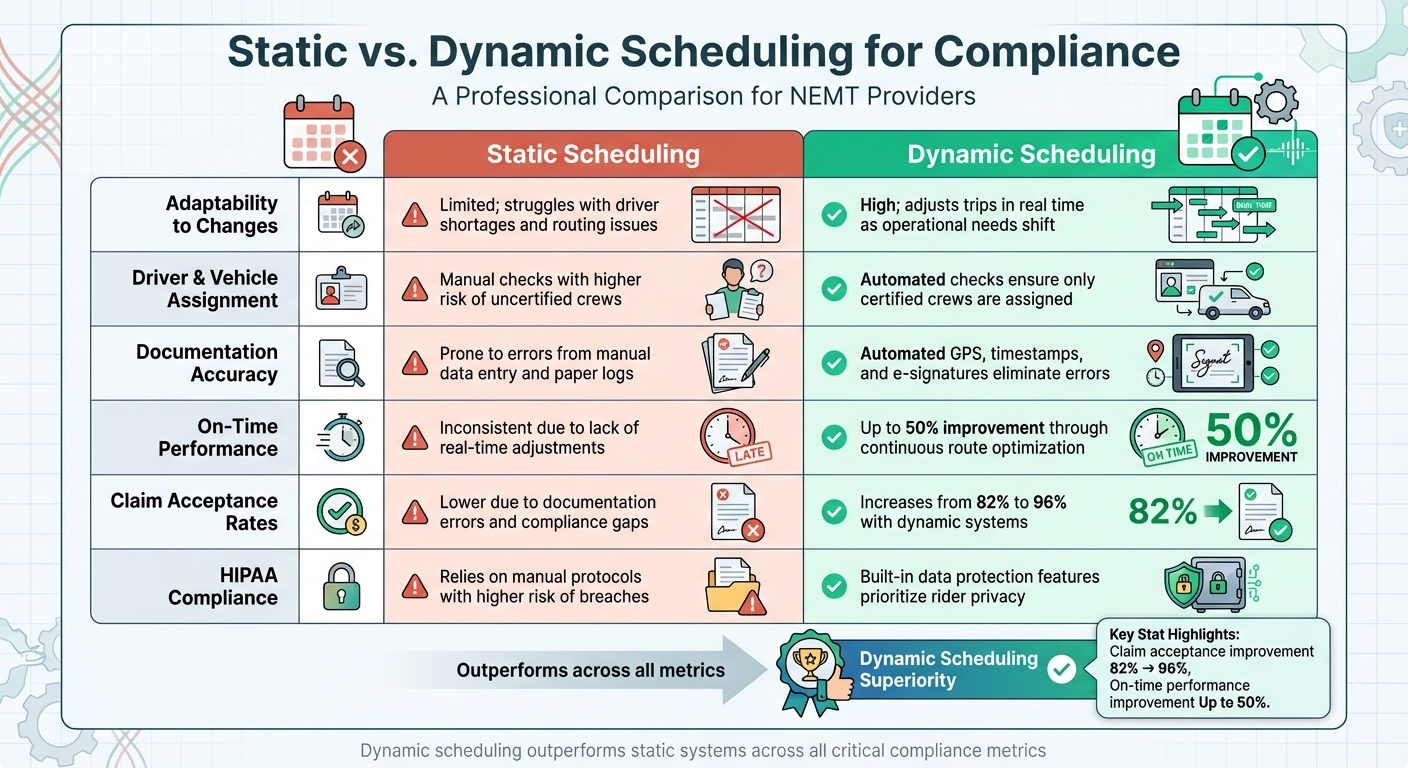
The advantages of dynamic scheduling become even clearer when you look at the numbers. Providers using AI-driven systems have reported impressive results: Medicaid claim acceptance rates have jumped from 82% to 96%, and on-time arrivals have improved by as much as 50%. Dynamic systems also reduce errors by validating data in real time, whereas static methods often lead to mistakes that can cause claim denials. Here's how the two approaches stack up across key compliance metrics:
Compliance MetricStatic SchedulingDynamic SchedulingAdaptability to ChangesLimited; struggles with driver shortages and routing issuesHigh; adjusts trips in real time as operational needs shiftDriver & Vehicle AssignmentManual checks with higher risk of uncertified crewsAutomated checks ensure only certified crews are assignedDocumentation AccuracyProne to errors from manual data entry and paper logsAutomated GPS, timestamps, and e-signatures eliminate errorsOn-Time PerformanceInconsistent due to lack of real-time adjustmentsUp to 50% improvement through continuous route optimization Claim Acceptance RatesLower due to documentation errors and compliance gapsIncreases from 82% to 96% with dynamic systems HIPAA ComplianceRelies on manual protocols with higher risk of breachesBuilt-in data protection features prioritize rider privacy
Dynamic scheduling clearly outperforms static systems in every critical area, offering a smarter, more reliable way to meet compliance requirements while improving overall efficiency.
Using AI Tools Like Bambi for Compliance
AI-driven tools like Bambi are changing the game for NEMT providers by making compliance easier and more reliable. Instead of juggling paper logs, endless phone calls, and error-prone spreadsheets, Bambi automates critical tasks like driver certification checks and HIPAA-compliant data protection to safeguard rider privacy.
With features like integrated GPS, timestamps, and e-signatures, Bambi creates audit-ready records that simplify billing and regulatory processes. The platform’s audit history logs every change with timestamps, ensuring a clear accountability trail during regulatory reviews.
Dynamic scheduling is another standout feature. Tools like "Add Requests on the Fly" and "Real-Time Updates" adapt schedules instantly to new information, such as updated pickup locations or extended wait times. Built-in safeguards ensure compliance by assigning trips only to certified drivers and vehicles that meet specific needs, such as wheelchair accessibility. These adjustments work seamlessly with broader documentation systems to maintain smooth operations.
Bambi also simplifies reporting by integrating with major broker systems like SafeRide and Modivcare. Pre-shift vehicle inspections enhance safety standards, reducing risks of breakdowns or accidents. Real-time tracking and driver-dispatch notifications keep everyone on the same page, cutting down on miscommunications that could lead to compliance issues. Plus, these efficiencies contribute to cost savings.
Priced at $69 per vehicle per month, Bambi is accessible to providers of all sizes. By automating compliance checks and eliminating manual data entry, the platform helps avoid documentation mistakes, regulatory fines, claim denials, and payment delays. It’s a practical solution for ensuring compliance while keeping operations efficient.
Conclusion
Dynamic scheduling is reshaping compliance efforts for NEMT providers by automating critical checks, cutting down on errors, and simplifying the process of meeting regulatory requirements. Tools like automated tracking, real-time notifications, and centralized data management minimize manual errors that could jeopardize documentation accuracy. Features such as recurring ride setups, bulk trip uploads, and tailored vehicle assignments ensure patient needs are met while adhering to accessibility standards.
The impact is clear. Over two years, the US Veterans Health Administration reported an 83% drop in missed appointments for veterans using dynamic scheduling solutions [10]. Similarly, a 2019 Adams Clinical study found that improved transportation access reduced clinical trial dropout rates by up to 20% over two years [10]. These numbers highlight how dynamic scheduling can significantly improve patient adherence and outcomes, emphasizing its role in maintaining compliance.
Taking this further, AI-driven platforms amplify these benefits by offering real-time monitoring and generating audit-ready documentation. This technology removes the burden of repetitive manual tasks and ensures compliance remains strong, even as operations expand. For NEMT providers, adopting AI-powered dynamic scheduling isn't just a convenience - it's a necessity for sustainable growth and meeting strict regulatory demands. By combining automated safeguards, detailed reporting, and real-time flexibility, providers can confidently build a system that supports both operational efficiency and rigorous compliance standards.
FAQs
How does dynamic scheduling help NEMT providers stay compliant?
Dynamic scheduling plays a crucial role for NEMT providers by automating trip updates and adjustments in real time, significantly cutting down on manual mistakes. This ensures patients reach their destinations on time while keeping dispatch communications secure and fully HIPAA-compliant.
By simplifying operations, dynamic scheduling boosts accuracy and operational efficiency, enabling providers to concentrate on delivering quality care and staying aligned with regulatory requirements without added hassle.
How can AI-powered dynamic scheduling tools like Bambi help reduce costs in NEMT operations?
AI-driven dynamic scheduling tools, like Bambi, can help NEMT providers trim expenses by automating essential tasks such as dispatching and managing shifts. These tools ensure vehicles are used efficiently, reduce idle time, and lower costs related to overtime, fuel, and administrative tasks.
By simplifying operations and boosting efficiency, dynamic scheduling allows providers to make the most of their resources. This not only cuts costs but also helps maintain compliance and improve the quality of service delivered to patients.
How does dynamic scheduling improve punctuality for NEMT providers?
Dynamic scheduling uses real-time data to make ongoing adjustments to routes and driver assignments, helping to cut down on delays and inefficiencies. This approach often leads to trips being completed on time more reliably, with some providers reporting up to a 30% boost in punctuality.
By quickly adapting to unexpected changes - like traffic jams or last-minute cancellations - dynamic scheduling allows NEMT providers to maintain dependable service while streamlining their operations.