This is the Manitoba chapter of Bambi's guide to starting a non-emergency medical transportation business, and it opens with the same warning every Canadian chapter does. There is no Medicaid here, and there is no transportation broker.
Manitoba Health does not cover land ambulance transports. Provincial health insurance does not cover it. Getting a patient to a medical appointment in a wheelchair van or a stretcher van is not an insured service, and no province has ever tendered a transportation brokerage contract. Modivcare, MTM and Verida have no Canadian operations. But Manitoba is the exception that proves the rule in one important way: it is the only province in Canada with a purpose-built licence for stretcher transportation. If you want a regulated market with a real barrier to entry, this is it.
So the question is not "how do I credential with the broker." It is "who actually pays, and how do I get in front of them." That is what this guide covers.
Part 1: Who Actually Pays
Part 2: Licensing and Regulation
Part 3: Registering the Business
Part 4: Vehicles, Drivers and Insurance
Part 5: Who Buys, and the Market
Part 6: Technology
This is the Manitoba chapter of Bambi's complete guide to starting a NEMT business. For the national picture, start with our guides to the NIHB Medical Transportation Benefit and winning health authority transport contracts.
In This Guide
- Part 1: Who Actually Pays
- Part 2: Licensing and Regulation
- Part 3: Registering the Business
- Part 4: Vehicles, Drivers and Insurance
- Part 5: Who Buys, and the Market
- Part 6: Technology
Part 1: Who Actually Pays
- Shared Health solicitation 30335 covers 60 months of non-emergency patient transportation, and notably includes transfers between facilities and residences, not just facility to facility. Residence trips are the recurring, schedulable work.
- The Northern Patient Transportation Program runs on a warrant system where carriers invoice the programme. Money reaches the operator.
- Employment and Income Assistance issues standing orders in writing to the transportation firm, which again means direct payment to you rather than client reimbursement.
- NIHB is enormous here, but read the modal split before you get excited. Manitoba is the largest NIHB medical transportation region in Canada at $261.4M in FY2023-24. However, $91.0M of that is air ambulance and $57.6M is scheduled flights, so $154.6M of the $261.4M is aviation you cannot bid on. The ground opportunity is real but it is a fraction of the headline number.
- Manitoba Public Insurance covers transportation statutorily and can direct-pay per claim, but there is no self-serve credentialing path. You negotiate case by case.
- Note who is excluded from covered inter-facility transfers: social assistance recipients, WCB, MPI, NIHB, VAC and CAF clients. Those exclusions are not gaps in demand, they are pointers to which payer to invoice instead.
Part 2: Licensing and Regulation
The Emergency Medical Response and Stretcher Transportation Act is the only statute of its kind in Canada.
It states directly that no person may operate a stretcher transportation service without a valid licence. Two features make this materially different from every other province:
- A public need test. You must show the service is needed, which means an application is an argument, not a form.
- A mandatory agreement with Shared Health. The provincial health organisation is a required counterparty to your licence, not just a potential customer.
Read this as an opportunity, not an obstacle. A public need test is a barrier to entry, and barriers to entry protect incumbents. In an unregulated province like Ontario anyone with a van competes with you tomorrow. In Manitoba, getting licensed is hard and staying licensed is durable. If you are prepared to do the work of a real application, Manitoba rewards it.
Seated and wheelchair transport without a stretcher does not attract the Act. That is a lighter path if you want to start smaller.
Part 3: Registering the Business
- Incorporation: $350 with share capital, $120 without, plus $45 name reservation. Online processing runs 4 to 6 business days.
- Business name: $45 name reservation plus $60 registration, three-year term.
- Annual return: $65. Two consecutive misses means dissolution, so diarise it.
- RST is 7%, but passenger and patient transport is absent from the taxable services list, so your service revenue is likely not RST-taxable. Confirm with a Manitoba accountant, and note that ambulances themselves are RST-exempt goods.
- WCB Manitoba is mandatory for transportation. Coverage extends to contract workers and family members regardless of hours worked. Directors are excluded from the definition of worker.
- Watch the rate classification, because the spread is enormous. Transportation NEC runs $1.18 per $100 of payroll and taxi runs $0.48, but Emergency Ambulance Workers is assessed at a flat $25.00 per individual. Which class you land in will materially change your cost base. Get the classification confirmed in writing before you hire.
Part 4: Vehicles, Drivers and Insurance
- Driver licence: a wheelchair-accessible van seating ten or fewer is a Class 5 vehicle, so a Class 5 licence is provincially sufficient. Manitoba's regulation defines a bus as designed to carry 11 or more persons including the driver, and a passenger vehicle as ten or fewer. At 11 or more seats you move to Class 4. This is one of the lighter driver-licensing regimes in Canada.
- Class 4 covers buses up to 24 passengers, ambulances and other emergency vehicles.
- Insurance: Manitoba Public Insurance is the compulsory basic provider. Buy commercial excess above the basic limits.
Part 5: Who Buys, and the Market
How to get in. Manitoba is a two-track market. Track one is the Shared Health procurement, which is a formal bid. Track two, which most operators overlook, is the standing-order channel through Employment and Income Assistance, where the province issues written orders directly to wheelchair transport firms. That second track is lower-ceremony and starts generating revenue faster.
Market size. Population about 1.50 million, with a 65-plus share of 17.3%, the youngest of the six eastern and prairie provinces. The demand driver here is not age. 18.1% of Manitobans report Indigenous identity, the highest share in the country, and combined with distance that is what makes Manitoba the largest NIHB region. Understand the ground-versus-air split before you model revenue.
Part 6: Technology
Get started with Bambi
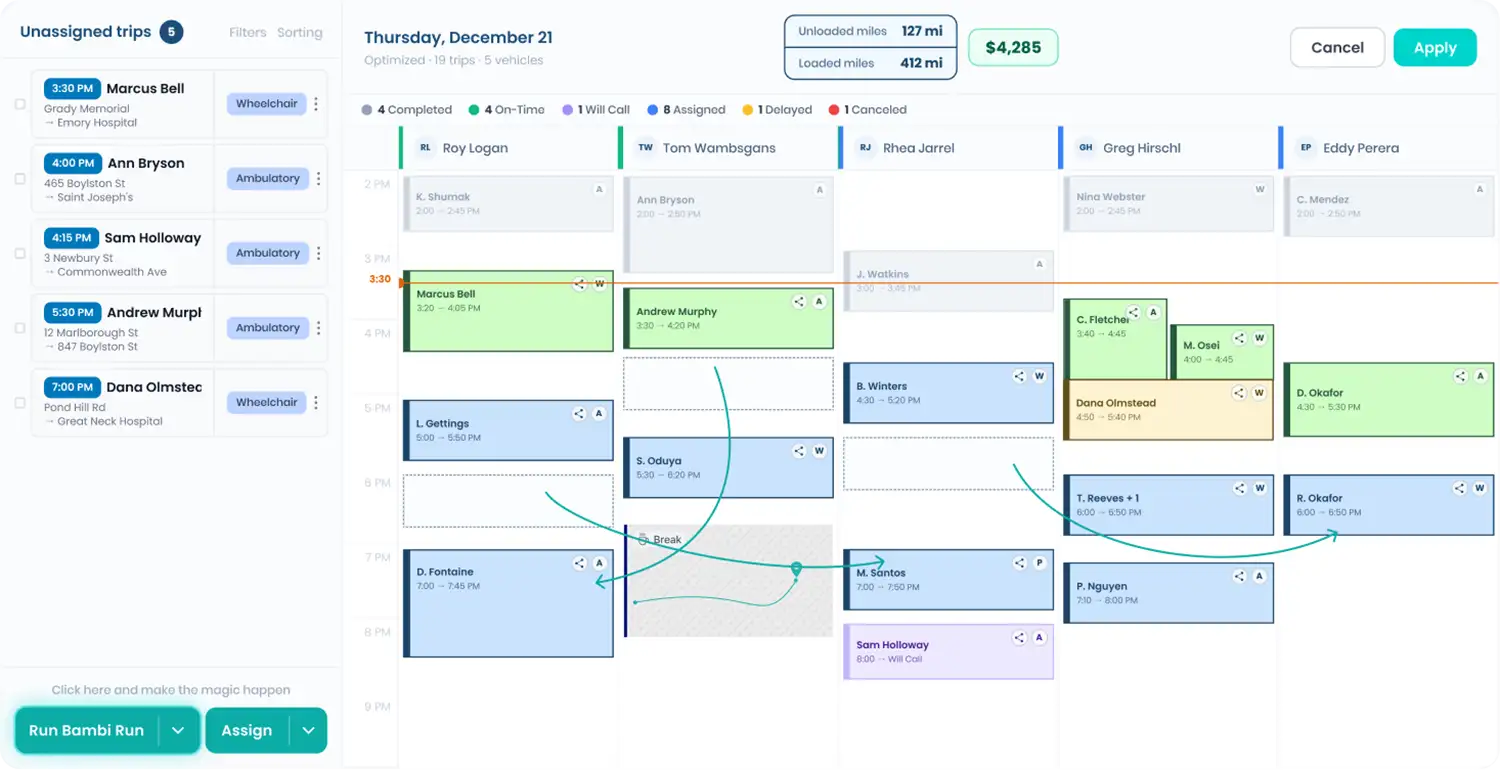
Our aiNEMT software handles scheduling, dispatching, care coordination and real-time tracking. In a market with no broker feeding you trips, the admin all lands on you, which is exactly where software earns its keep. Get in touch for a demo.