
This is the Ontario chapter of Bambi's guide to starting a non-emergency medical transportation business, and it opens with the same warning every Canadian chapter does. There is no Medicaid here, and there is no transportation broker.
OHIP covers ambulance, and only partly. Provincial health insurance does not cover it. Getting a patient to a medical appointment in a wheelchair van or a stretcher van is not an insured service, and no province has ever tendered a transportation brokerage contract. Modivcare, MTM and Verida have no Canadian operations. Ontario adds a second wrinkle that no other province has: nobody licenses you either. We wrote a separate piece on that gap because it deserves one.
So the question is not "how do I credential with the broker." It is "who actually pays, and how do I get in front of them." That is what this guide covers.
Part 1: Who Actually Pays
Part 2: Licensing and Regulation
Part 3: Registering the Business
Part 4: Vehicles, Drivers and Insurance
Part 5: Who Buys, and the Market
Part 6: Technology
This is the Ontario chapter of Bambi's complete guide to starting a NEMT business. For the national picture, start with our guides to the NIHB Medical Transportation Benefit and winning health authority transport contracts.
In This Guide
- Part 1: Who Actually Pays
- Part 2: Licensing and Regulation
- Part 3: Registering the Business
- Part 4: Vehicles, Drivers and Insurance
- Part 5: Who Buys, and the Market
- Part 6: Technology
Part 1: Who Actually Pays
Ontario has no single payer for this work. It has a handful, and they behave very differently.
- Ontario auto insurance (SABS) is the most structured door. Transportation is its own enumerated benefit under O. Reg. 34/10 s.15(1)(g), and a transport company can hold an FSRA service provider licence and bill insurers directly through HCAI on an OCF-21. The catch is decisive: the s.3(1) definition of an authorized transportation expense pays only for distance after the first 50 kilometres of a trip, unless the person is catastrophically impaired. Ontario auto is a long-distance payer, not a local-trips payer. See our full guide to billing Ontario auto.
- ODSP and Ontario Works. The Mandatory Special Necessities benefit names both taxis and ambulances as eligible modes, and ODSP policy states that paying the vendor direct is the recommended approach. This is real, recurring, and widely underused by operators.
- WSIB funds travel to treatment, but Ontario has already contracted it out. WSIB tells injured workers to book through Rapid City Transportation. Entry is winning a competitive re-tender on Biddingo, not enrolling.
- NIHB spent $166.0M on medical transportation in Ontario in FY2023-24, the second largest region in the country.
- Hospitals and long-term care. Ontario has no provincial program and no vendor of record, so buying happens at hospital group purchasing organizations. More on that in Part 5.
- Private pay. With no insured benefit and an unregulated market, a large share of Ontario volume is simply families and facilities paying invoices.
What does not pay you: the Northern Health Travel Grant. It is the purest patient-reimbursement programme in Canada. It requires 100 km one way to the nearest specialist, applies a 100 km deductible, and pays a flat 41 cents per kilometre whether you travel by car, air, bus or rail. Taxi is explicitly excluded. Because the payment is distance-derived rather than invoice-derived, a carrier would have nothing to bill against. Do not build a plan around it.
Part 2: Licensing and Regulation
Ontario does not license non-emergency patient transfer. At all.
This is not an oversight in our research. It is a genuine void, and it is visible in the statute. The Ambulance Act defines an ambulance in a way that requires three things together: an unstable patient, and care required en route, and a stretcher. A medically stable patient who simply needs a stretcher falls outside the definition. The vehicle is therefore not an ambulance, the business is not an ambulance service, and the Act's certification requirement never applies.
The consequences are real. No vehicle standard, no equipment standard, no staffing standard, no patient-care standard, no oversight body. Ontario requires no credential of any kind for staff on a non-ambulance transfer. And because the Act's fee restrictions attach only to certified ambulance services, an unregulated transfer company may bill a patient whatever it likes.
The Ontario Ombudsman documented this in June 2011, finding "serious issues, from a lack of infection control to unsafe vehicles and poorly trained staff", and both ministries pledged to regulate. We checked every bill introduced from 1999 to June 2026 and found nothing. We wrote the whole story up separately, because it is the single most important thing to understand about operating here.
What this means for you. Two things, in tension. Entry is easy, which is good for you and bad for the industry's reputation. And because there is no licence to point at, your credibility has to come from somewhere else: your insurance limits, your driver training, your vehicle standards, your references. Hospitals and insurers notice which operators hold themselves to a standard nobody enforces.
Municipal licensing does not fill the gap either. Toronto's licensing and vehicle-for-hire chapters contain no mention of ambulance, stretcher, patient transfer, medical transport, wheelchair or paramedic. Toronto's Private Transportation Company definition is broad enough on its face to reach a pre-booked operator and no exemption clearly resolves it, so get local advice. Ottawa's by-law includes an auxiliary services category for prearranged transport with personal assistance that looks like the closest fit in the province, and it appears to require licensing. Check your municipality.
Part 3: Registering the Business
- Incorporation: $300 online through the Ontario Business Registry. A NUANS report is required for a named corporation, bought from a private search house.
- Business name for a sole proprietorship or partnership: $60, valid five years.
- GST/HST: register once you pass $30,000 over four consecutive calendar quarters, or immediately if you pass it in a single quarter.
- Employer Health Tax: the first $1,000,000 of Ontario payroll is exempt, with no exemption above $5M payroll.
- WSIB: register within 10 calendar days of hiring your first employee. Note the structure: drivers who do not own the vehicle they drive are workers and must be covered. Owner-operators are not automatically covered and have to apply for optional insurance.
Part 4: Vehicles, Drivers and Insurance
The sleeper compliance item most Ontario operators miss
Regulation 611 defines an accessible vehicle as a passenger vehicle or bus designed or modified to transport persons with disabilities and used for that purpose, when operated for compensation. Accessible vehicles need a semi-annual, six-month inspection sticker.
Read that again, because the thresholds do not line up the way people expect. A wheelchair-accessible minivan under ten passenger seats is a Class G vehicle, does not trigger CVOR, and needs no commercial driver licence. It still needs six-month inspections, because it is an accessible vehicle operated for compensation. That is the catch.
- Driver licence: Class F covers ambulances and buses seating up to 24. A sub-10-seat accessible van is Class G. Ontario law does not clearly state whether the ten-passenger threshold counts the driver, so treat the nine-versus-ten boundary as your risk point and get advice before you buy a vehicle that sits right on it.
- Medicals: commercial drivers report every five years under 46, every three years from 46 to 64, annually at 65 and over.
- Criminal record checks are not mandated by provincial regulation for this work. Your customers will require them anyway. Do them.
- Insurance: the Insurance Act sets a flat $200,000 third-party liability minimum, and there is no elevated figure for buses or for-hire vehicles. Ontario's Public Vehicles Act was repealed on July 1, 2021, so the old public vehicle category no longer exists.
Do not treat $200,000 as adequate. It is the lowest floor of any jurisdiction in this series, it has not moved in decades, and no hospital or insurer will contract with you at that limit. Carry commercial limits that reflect what you are actually carrying.
One more: AODA transportation standards apply to designated public sector organizations. A private for-profit operator is not captured. That is a compliance relief and a competitive opening, because the accessibility expectations your public-sector customers face flow down to you contractually even though the regulation does not reach you directly.
Part 5: Who Buys, and the Market
Hospital group purchasing is the main institutional door. Ontario buys through shared-service organizations rather than a provincial contract. The real ones are Mohawk Medbuy Corporation, Plexxus in the Toronto area, Champlain Health Supply Services in the Ottawa region, and Healthcare Materials Management Services, the London joint venture affiliated with Mohawk Medbuy. Watch their bid portals and register as a supplier.
Long-term care is a channel, not a payer. Ontario homes may charge residents extra for optional services including transportation, but the regulations impose no obligation on a licensee to arrange or fund trips to appointments, and the Retirement Homes Act does not mention transport at all. So the home is your customer or your referral source, never your guaranteed payer. Get the commercial terms in writing.
Market size. Ontario has roughly 9,260 in-centre haemodialysis patients, more than any other province, and each of them travels three times a week. 18.9% of the population is 65 or over. The best available demand anchor for inter-facility work is a 2009 study in Healthcare Policy that found about 400,000 inter-facility patient transfers a year in Ontario, 80% of them routine and non-urgent, at roughly $704 per one-way trip. That figure is old, and we flag it as old, but the Ombudsman's description of an industry moving "hundreds of thousands of patients every year" corroborates the order of magnitude.
There is one consolidator worth knowing: Transdev Canada, operating in Ontario as Voyago Health and, in Ottawa, Priority Patient Transfer Service. Everyone else is small and local.
Part 6: Technology
Get started with Bambi
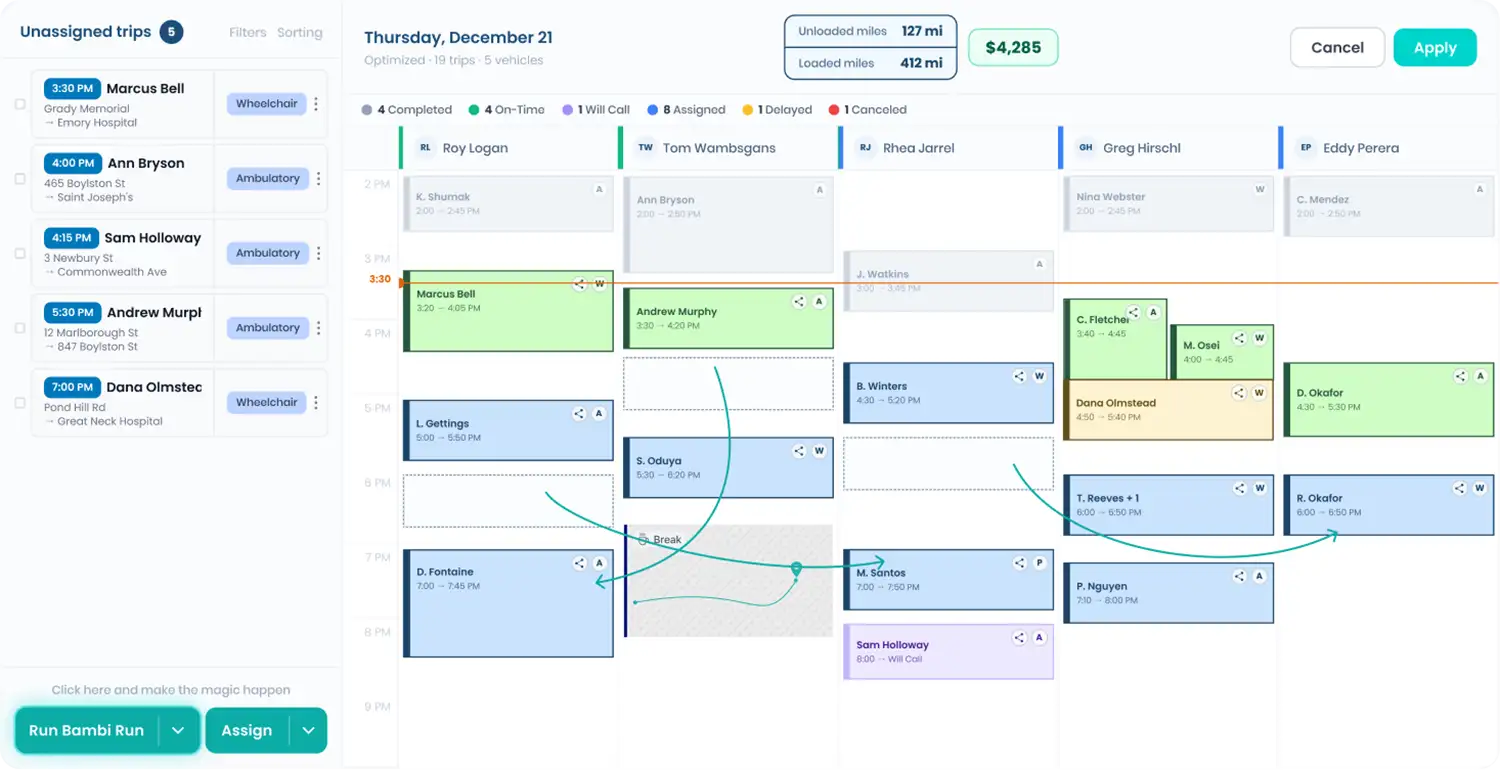
Our aiNEMT software handles scheduling, dispatching, care coordination and real-time tracking. In a market with no broker feeding you trips, the admin all lands on you, which is exactly where software earns its keep. Get in touch for a demo.