Idling wastes fuel, damages engines, pollutes the air, and risks costly fines. For Non-Emergency Medical Transportation (NEMT) providers, managing idle time is critical to cutting costs, staying compliant with laws, and ensuring passenger comfort. Here's what you need to know:
Why It Matters: Idling burns up to 1 gallon of fuel per hour, increasing costs by $2,000–$5,000 annually per vehicle. It also accelerates engine wear and harms air quality.
Federal Rules: Agencies like the EPA, FMCSA, and DOE set guidelines and offer programs (e.g., SmartWay, Clean Cities ) to limit idling and promote idle-reduction technology.
State and Local Laws: Most states cap idling at 3–5 minutes, with stricter rules in places like California and New York. Fines range from $250 to $3,000.
Solutions for NEMT Providers : Use telematics, geofencing, and auto-shutoff systems to monitor and reduce idle time. AI-driven dispatch tools like Bambi ($69/month per vehicle) optimize routes and cut unnecessary waiting.
Balancing compliance, cost control, and passenger comfort is key. Smart policies and technology can save money, reduce emissions, and avoid fines.
NEMT Idle Reduction: Costs, Regulations, and Savings by State
Federal Idle Reduction Policies and Guidelines
Three key federal agencies play a role in shaping idle reduction policies for Non-Emergency Medical Transportation (NEMT) operations: the Environmental Protection Agency (EPA) , the Federal Motor Carrier Safety Administration (FMCSA) , and the Department of Energy (DOE) . Each agency contributes through specific regulations and programs. The EPA sets national emissions standards and provides anti-idling guidance that states and cities often adopt. FMCSA focuses on commercial vehicle safety and hours-of-service rules, which determine when and where drivers can rest or wait, as well as how auxiliary power units (APUs) fit into compliance. Meanwhile, the DOE supports research on the fuel and emissions impact of idling and offers tools and resources through its Clean Cities coalitions to help fleets adopt idle-reduction technologies. Together, these programs establish compliance standards, influence state regulations, and spotlight technologies that cut fuel costs and reduce regulatory risks. Below, each agency's contributions are explored in detail.
EPA Guidance and Voluntary Programs
The EPA takes a voluntary approach to idle reduction, rather than enforcing a single nationwide mandate. It publishes model policies that typically limit idling to 3–5 minutes, with exceptions for extreme weather, safety concerns, maintenance, and certain medical needs. These guidelines help NEMT providers create internal policies that distinguish between "necessary" and "unnecessary" idling. For example, they may require drivers to turn off engines after a set period when it’s safe or pre-condition vehicles before pickups. The EPA also runs the SmartWay Transport Partnership , which encourages fleets to adopt strategies that reduce fuel use and emissions. This program provides efficiency benchmarks and recognizes companies that meet its standards. FMCSA regulations further complement these efforts by addressing driver rest and idle reduction.
FMCSA Rules for Commercial Vehicles
FMCSA's hours-of-service (HOS) rules set limits on the daily and weekly driving hours for commercial drivers and require specific rest breaks. While many NEMT vehicles and drivers fall under state-specific passenger-carrier rules rather than interstate commercial driver’s license (CDL) requirements, the same safety principles apply. Managing downtime between trips is essential to avoid unnecessary engine idling. FMCSA also recognizes the use of auxiliary power units (APUs) , which allow drivers to run air conditioning, heating, or onboard equipment during mandatory rest periods without idling the main engine. To support adoption, FMCSA provides weight exemptions for vehicles equipped with idle reduction technology. For NEMT providers, this means they can plan safe breaks and maintain comfort without relying on prolonged idling.
DOE Research and Clean Cities Program
DOE research highlights the significant costs of idling. For instance, idling for just one hour burns approximately 0.25–1 gallon of fuel per vehicle, with emissions comparable to driving 15–50 miles. Nationwide, truck idling wastes about 5.5 billion gallons of fuel annually . APUs can help reduce particulate matter and nitrogen oxide emissions by 70–90% during rest periods and save up to $1,800 per truck annually in fuel costs for long-haul operations. The DOE’s Clean Cities program, a network of local coalitions, provides resources to help fleets adopt idle-reduction technologies. These include technical assistance, case studies showcasing fuel savings, connections to funding opportunities, and training for fleet managers. For NEMT operators, Clean Cities offers practical tools to assess idling patterns, choose suitable technologies, and access financial support.
State and Local Idle Reduction Rules
State and local governments, building on federal guidelines, have established their own idling limits and exemptions, often tailored to local needs. Most states impose limits of 3–5 minutes, but the specifics of enforcement and penalties can vary significantly. Knowing these rules - and the exemptions for medical transport - helps operators stay compliant while ensuring passenger safety and comfort. Below, we’ll explore typical state regulations, stricter examples, and city-specific rules.
Common Features of State Regulations
Most state anti-idling laws restrict commercial vehicle idling to 3–5 minutes, with exceptions for essential operations like maintaining medical equipment or ensuring passenger comfort in extreme weather. In colder conditions - typically below 40°F - idling for engine warm-up is often allowed, as is idling necessary for powering medical devices during transport. Operators are advised to document these exemptions in trip logs, as fines for violations can range from $250 to $2,000.
States with Strict Regulations: Examples
Some states take a more aggressive stance on idling. California’s Air Resources Board enforces a statewide 5-minute limit under its Diesel-Fueled Commercial Motor Vehicle Idling Regulation. Vehicles from model year 2008 or newer must have automatic shutoff systems that activate after 5 minutes. Exemptions exist for situations like aiding disabled passengers or powering medical devices. For low-use vehicles - those operating under 1,000 miles or 100 hours annually - independent verification is required for compliance credits.
New York imposes even stricter limits in certain areas, with idling capped at just 1 minute in some zones. Penalties start at $350, but idling for medical needs is allowed for up to 5 minutes. Meanwhile, New Jersey sets a general 3-minute limit, but environmental zones reduce this to 1 minute, with fines reaching as high as $3,000. Non-Emergency Medical Transport (NEMT) providers in these states benefit from exemptions for medical necessities but should ensure proper documentation to avoid penalties.
City Ordinances and High-Activity Areas
At the city level, regulations often go beyond state mandates, especially in high-traffic or pollution-prone areas. For example, New York City enforces a 3-minute idling limit, with fines ranging from $350 to $2,000. Los Angeles applies a similar 3-minute cap in sensitive zones, while Chicago generally allows idling for up to 10 minutes but limits it to 3 minutes in residential areas.
Hospital districts, where vehicle activity is high, often implement zero-idle policies. These are enforced through patrols, automated cameras, and complaint-driven ticketing, with fines sometimes doubling in areas with severe pollution. Operators near medical centers can benefit from using GPS tracking and route optimization tools to document minimal idling and ensure compliance with local rules. Pre-trip planning, combined with driver training on weather protocols and medical needs, can further reduce the risk of fines while maintaining efficient and passenger-friendly operations. Adapting to these local requirements helps NEMT providers strike a balance between meeting regulations and keeping passengers comfortable.
sbb-itb-6bd01f8
How Idle Reduction Policies Affect NEMT Operations
State and federal regulations are just the beginning when it comes to the challenges faced by Non-Emergency Medical Transportation (NEMT) providers. Operational costs and penalties tied to idle reduction rules add another layer of complexity. For example, a NEMT van idling at a rate of 0.8 gallons per hour could rack up an additional $2,000–$5,000 annually in fuel costs. This estimate is based on 1–2 hours of daily idling over 250 operating days, with diesel priced at roughly $3.50 per gallon. Beyond fuel, idling also accelerates engine wear, leading to issues like carbon buildup and oil contamination. This can increase maintenance expenses by 10–20%, or approximately $1,500–$3,000 per vehicle each year. In areas with strict idle reduction enforcement, such as those near hospitals, violations can result in hefty fines, further straining budgets.
Cost and Compliance Risks for NEMT Providers
States such as California, New York, and New Jersey impose steep penalties for idling violations, ranging from $350 to $3,000. For a fleet of 10 vehicles idling just one hour daily, the fuel waste alone could exceed $10,000 annually at $4.00 per gallon diesel. And that’s before factoring in additional maintenance costs and potential fines. Non-compliance doesn’t just hit the wallet - it can also tarnish a provider’s reputation. Frequent violations near healthcare facilities may lead to patient complaints, negative reviews, and even lost contracts with Medicaid brokers. These risks underscore the importance of implementing tighter controls and smarter fleet management practices .
Best Practices for Dispatch and Fleet Management
Reducing idle time starts with improving dispatch operations. Aligning pickup times with facility schedules can make a big difference. For instance, arriving 10–15 minutes early while accounting for traffic can cut wait times by 25–50% while still maintaining an on-time performance rate above 85%. Predictive analytics can help dispatchers identify peak hours and coordinate schedules with brokers, minimizing unnecessary waiting in loading zones.
Geofencing technology is another valuable tool. By setting virtual boundaries around hospitals or high-traffic areas, fleets can receive alerts or even trigger automatic engine shutoffs after 3–5 minutes of idling. These systems integrate with telematics to log compliance data, keeping dispatchers informed via mobile apps. Providers using geofencing in urban hospital zones have reported idle time reductions of 20–40%, leading to significant fuel savings and fewer violations. Additionally, regular driver training on local idling laws, weather-related protocols, and medical exemptions is essential for maintaining compliance while ensuring passenger comfort. When paired with technology, these strategies can be implemented effectively and sustainably.
Technology Solutions for Idle Reduction
Telematics systems equipped with GPS and engine loggers allow real-time monitoring of idle times, fuel consumption, and vehicle locations. Features like fleet-wide dashboards and driver scorecards have been shown to reduce fuel costs by 15–30%. Auto-shutoff systems, which turn off engines after 3–5 minutes of idling and restart based on brake or door activity, cost between $500 and $1,500 per vehicle. These systems often pay for themselves within 12–18 months through annual fuel savings exceeding $1,000 per vehicle.
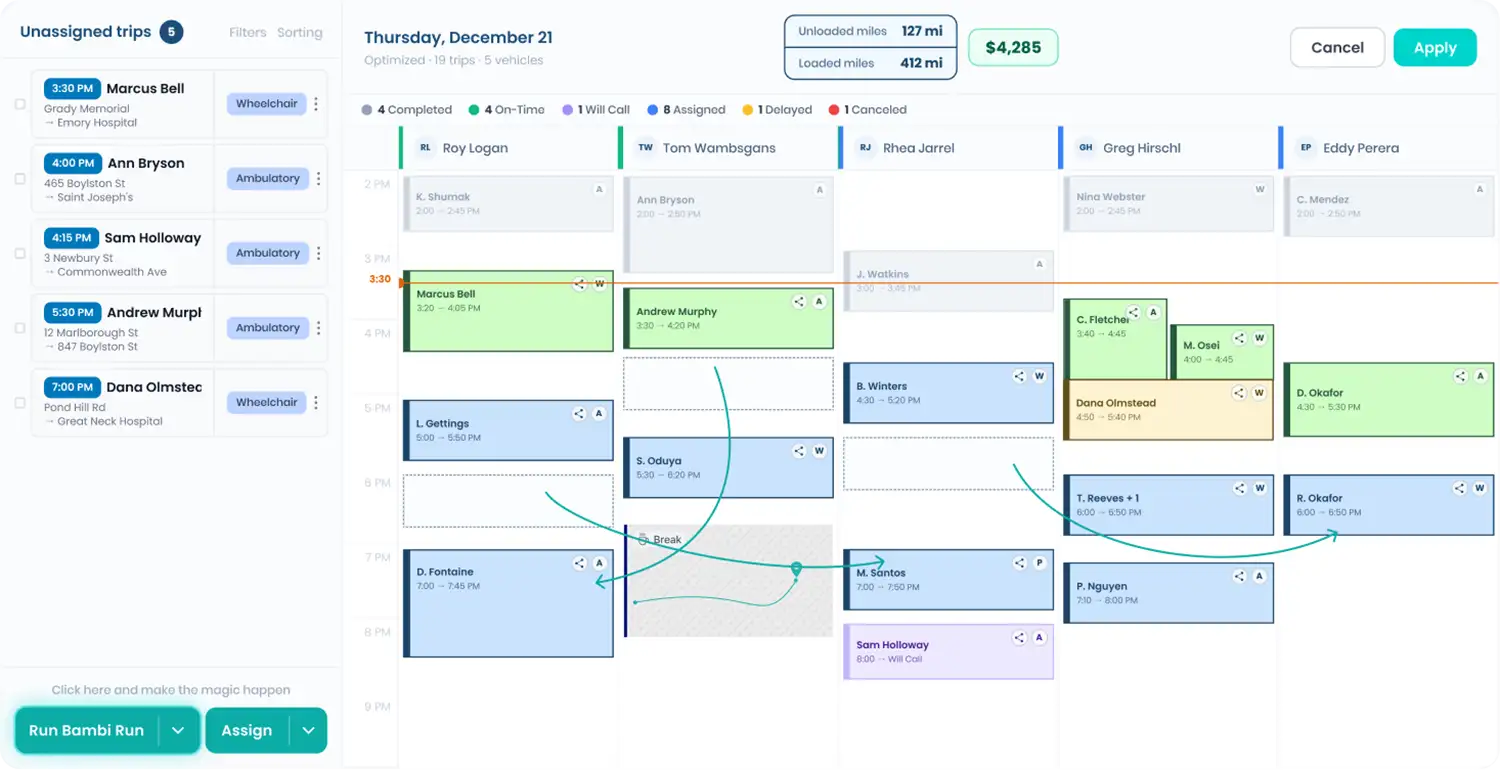
AI-powered dispatch platforms like Bambi take optimization to the next level. These tools dynamically adjust routes and trip assignments, cutting down on deadhead miles and reducing wait times that lead to unnecessary idling. With real-time GPS and traffic updates, dispatchers can make proactive schedule changes, while mobile apps provide drivers with instant navigation and trip updates. Providers using route optimization have reported significant improvements, including a rise in driver utilization from 60% to 85%, a 30% drop in deadhead miles, and a 50% boost in on-time performance. These efficiency gains can translate into fleet-wide fuel savings of $10,000 to $50,000 annually. At $69 per vehicle per month, Bambi ’s AI-driven scheduling and compliance tools offer an affordable way to meet regulatory requirements, particularly in regions with stringent idle reduction policies.
Key Takeaways for NEMT Providers
Strict idle reduction regulations - like California's 5-minute shutdown rule - aren't just about avoiding fines; they also help save money. Cutting down on idling can save over $2,000 per vehicle annually when fuel costs are $4.00 per gallon. On the flip side, non-compliance can lead to hefty fines and expensive retrofits, making it crucial for providers to stay within the rules.
To navigate these regulations, NEMT providers can take advantage of exemptions offered by the FMCSA and individual states. For example, federal weight exemptions under MAP-21 (2012) allow for an additional 550 lbs, enabling the installation of idle reduction equipment - like auxiliary power units - without penalties for exceeding the vehicle's gross weight rating (GVWR).
Technology can also play a huge role in simplifying compliance and improving operations. Tools like automatic shutdown systems, GPS-enabled telematics , and AI-powered dispatch platforms can significantly reduce idle time and optimize fleet performance. According to DOE programs, fleets using idle reduction technology have seen efficiency gains of 10–15%. One example is AI-driven scheduling software, such as the platform offered by Bambi , which dynamically adjusts routes and trip assignments to minimize deadhead miles and waiting times. At just $69 per vehicle per month, this solution offers an affordable way to meet regulatory requirements while boosting efficiency.
These insights emphasize the importance of aligning regulatory compliance with smarter operations to achieve better outcomes for NEMT providers.
FAQs
What are the consequences of breaking idle reduction laws in states like California and New York?
Violating idle reduction laws in states like California and New York, where regulations are strict, can lead to steep fines - sometimes stretching from several hundred to thousands of dollars. Repeat offenses could even result in operational restrictions for vehicles.
These laws aim to cut emissions, enhance air quality, and boost fuel efficiency. For NEMT providers, staying compliant not only helps avoid costly penalties but also supports efforts toward cleaner, healthier communities.
How can NEMT providers leverage technology to cut down on vehicle idling and reduce costs?
Non-emergency medical transportation (NEMT) providers can cut down on vehicle idling and save on costs by using AI-powered routing and dispatch software . These tools work in real-time to analyze routes, assign trips more effectively, and adjust schedules on the fly. The result? Vehicles are used more efficiently and spend less time idling.
This approach not only trims unnecessary fuel use but also improves fleet performance and overall operations. Plus, adopting such technology helps providers align with state and federal idle reduction policies, keeping them compliant while boosting efficiency.
Are there any exemptions to idle reduction policies for NEMT providers?
Yes, idle reduction policies often come with exemptions tailored for Non-Emergency Medical Transportation (NEMT) providers, and these can differ based on state and federal guidelines. These exemptions typically cover situations involving medical needs , emergencies , or special permissions issued by state authorities. The goal is to ensure that NEMT providers can focus on patient care and safety without unnecessary restrictions.
For instance, idling may be allowed to maintain a comfortable temperature for patients with certain health conditions or during emergencies that demand immediate action. It's essential to review the idle reduction rules specific to your state to understand which exemptions apply to your services.
Related Blog Posts
Comments
Lorem ipsum dolor sit amet, consectetur adipiscing elit. Suspendisse varius enim in eros elementum tristique. Duis cursus, mi quis viverra ornare, eros dolor interdum nulla, ut commodo diam libero vitae erat. Aenean faucibus nibh et justo cursus id rutrum lorem imperdiet. Nunc ut sem vitae risus tristique posuere.