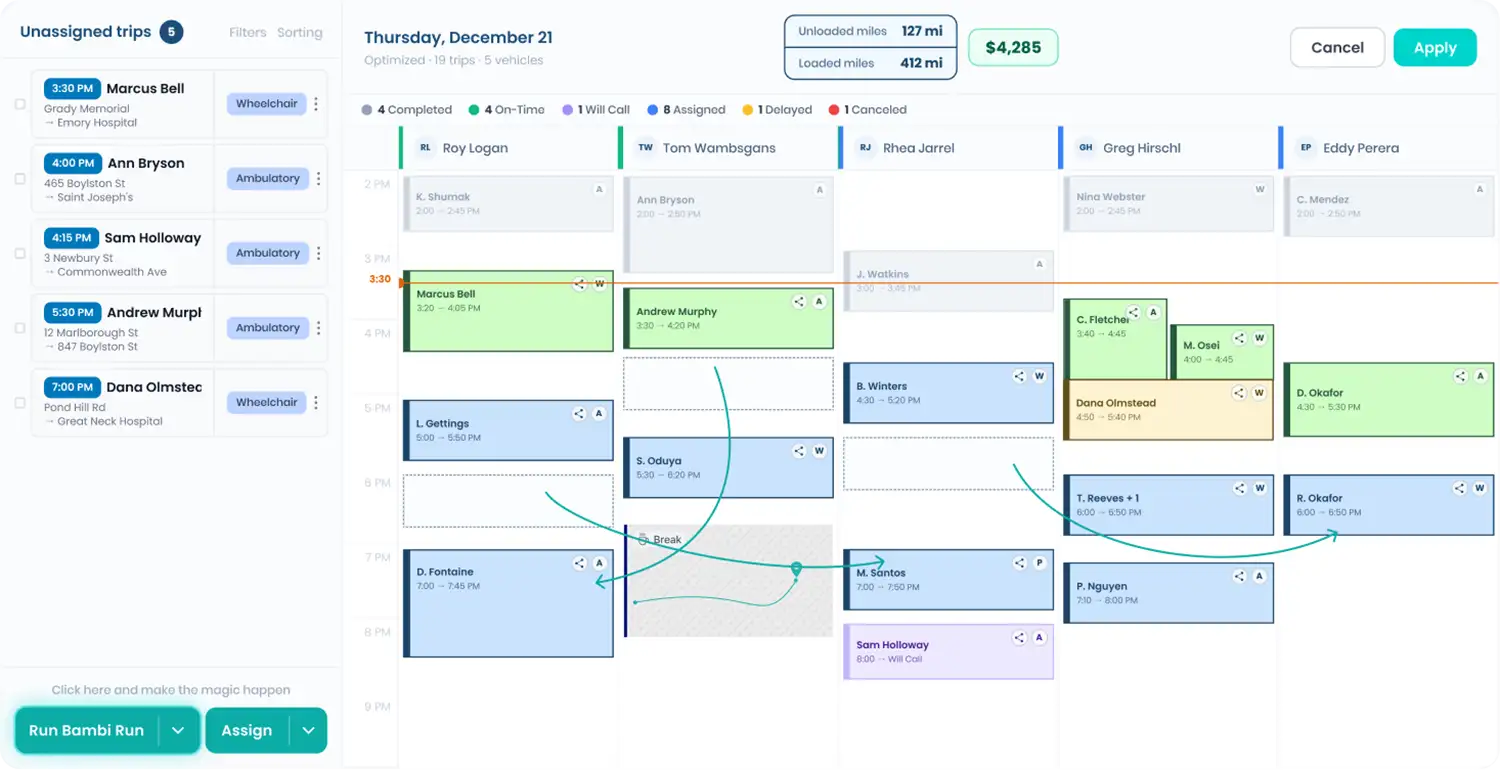
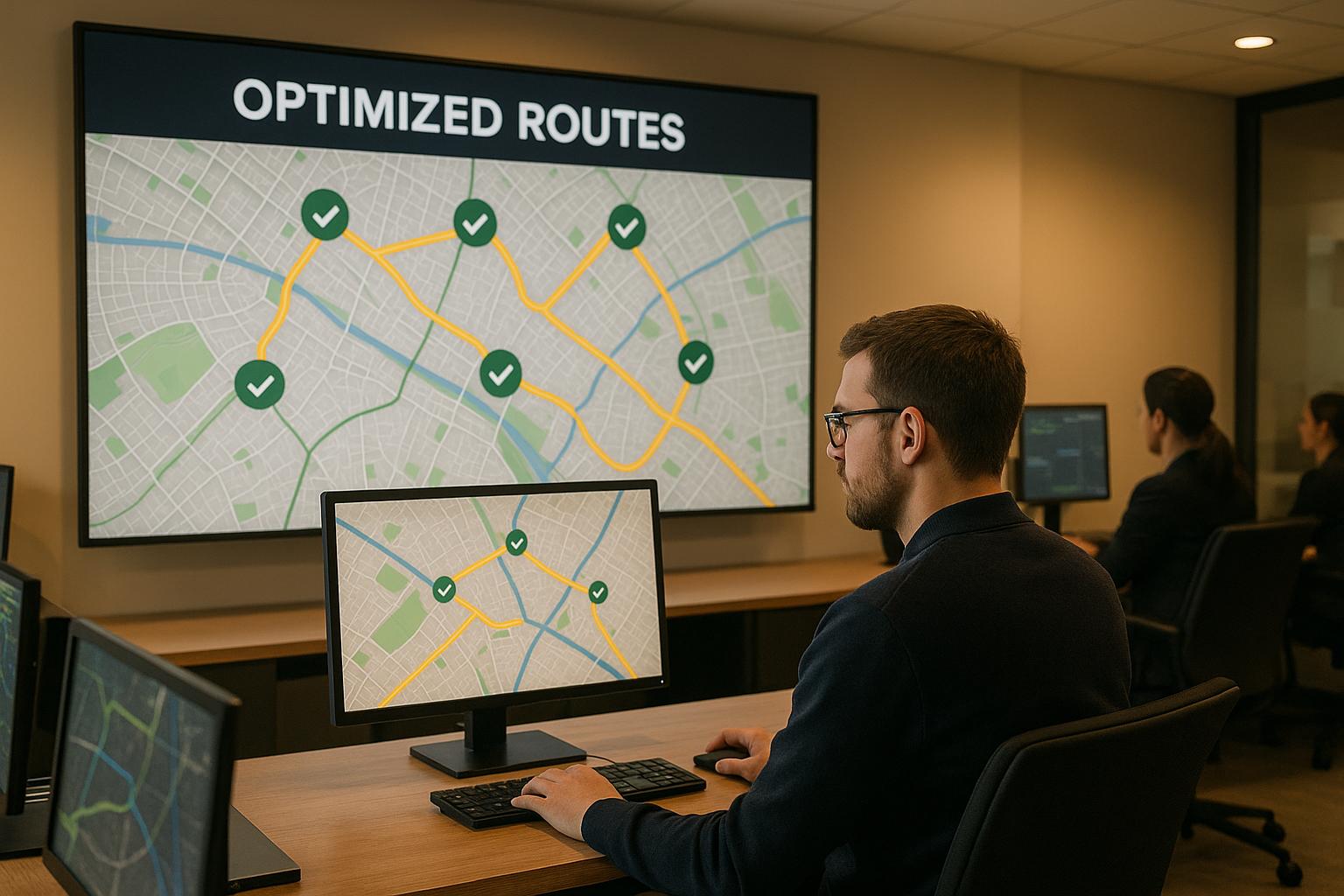
- Route Optimization: Cuts fuel and mileage costs by 10–25% through efficient trip grouping and real-time adjustments.
- Labor Savings: Automates dispatching, reducing overtime and manual workload, saving hours daily.
- No-Show Management: Sends automated reminders to reduce wasted trips and improve vehicle utilization.
- Administrative Automation: Streamlines billing and claims, reducing errors and speeding up reimbursements.
Case studies show savings of up to 40.5% in operating costs or millions annually by adopting these tools. The key? Start small with a pilot, track metrics like cost per trip and no-show rates, and expand as you see results.
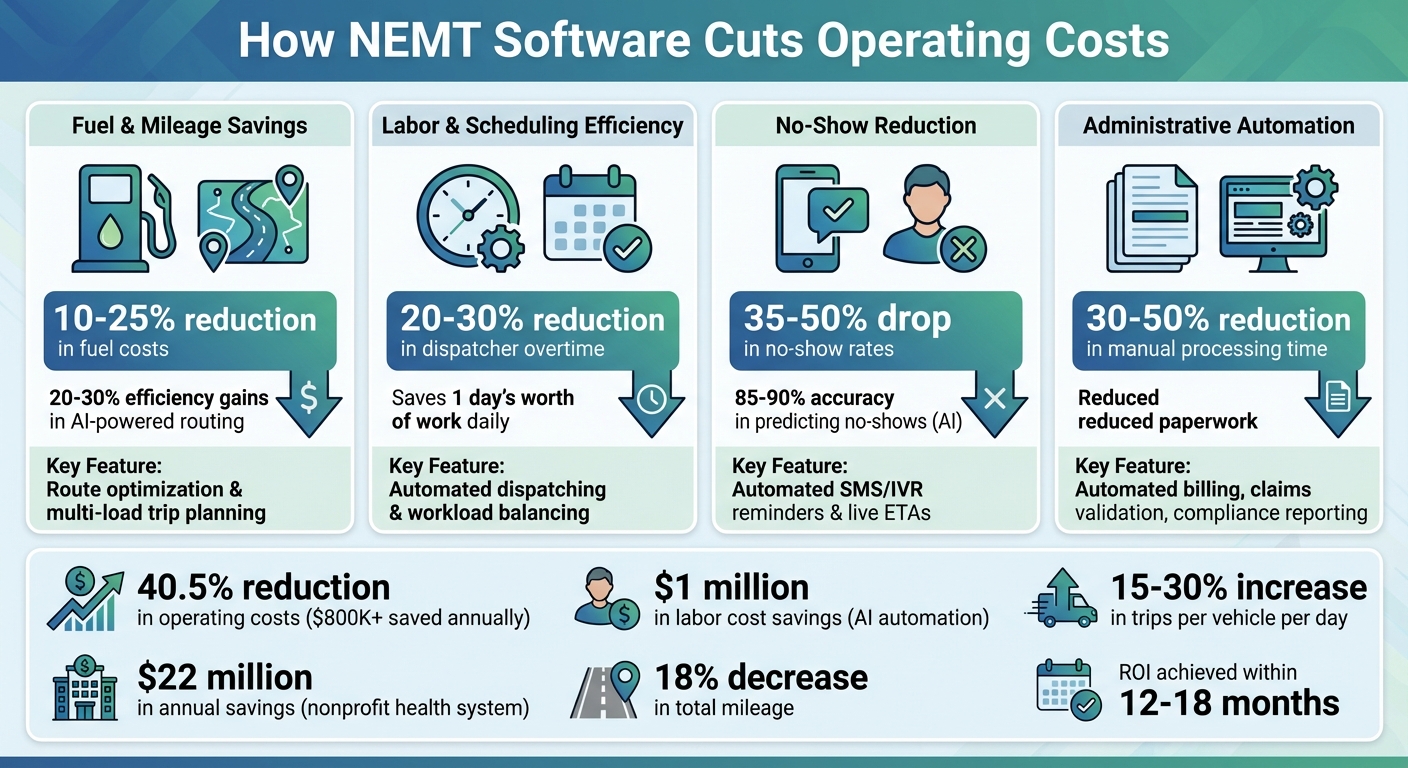
Where NEMT Software Cuts Costs
NEMT software helps providers tackle four major cost areas: fuel and mileage, labor and scheduling, no-shows and cancellations, and administrative overhead. These are some of the largest expenses in the industry, but modern platforms streamline operations, delivering real savings by automating tasks that once required constant manual effort. Let’s break down how these tools make a difference.
Fuel and Mileage Savings
One of the biggest wins with NEMT software is route optimization. The system groups nearby trips, sequences pickups and drop-offs in the most efficient order, and adjusts routes in real time based on traffic conditions. This means less fuel burned and less wear on vehicles.
AI-powered dispatch systems have shown 20–30% efficiency gains in routing and scheduling for early adopters. Since fuel is a major variable cost in NEMT operations, cutting miles driven by even 10–25% can lead to substantial savings each month. Multi-load trip planning - where multiple passengers share the same vehicle when schedules align - further spreads fuel and vehicle costs across more trips.
Labor and Scheduling Efficiency
Beyond fuel, labor costs also shrink with automation. Instead of relying on manual schedules and phone calls, the software assigns trips to the most suitable driver and vehicle based on factors like location, capacity, and current routes. This not only balances driver workloads but also reduces overtime by enforcing shift rules and visualizing schedules.
"Bambi's saving my staff hours of daily work and our team has much more time to focus on improvements." – Jeffrey Hoff, Reliant Transport
Another dispatcher shared: "How much time it saves me? It's like a day's worth of time. And sometimes once I make the dispatch, the system just does the work, so I don't have to sit on the computer all day trying to see where the driver is". With fewer hours required per trip, labor costs drop significantly.
Reduced No-Show and Cancellation Costs
No-shows and cancellations are a huge drain on revenue. When a rider doesn’t show up, the provider has already spent money on fuel, vehicle wear, and driver wages - without earning anything in return. Automated reminders via SMS, phone calls, and app notifications help reduce these losses by confirming trip details 24–48 hours ahead and again just before pickup.
Live ETAs sent via GPS tracking also keep riders informed about their ride’s arrival time, cutting down on no-shows. Additionally, conversational AI and virtual assistants can handle appointment confirmations, process text responses, and manage schedule changes without human involvement. These proactive measures allow providers to adjust or cancel trips before dispatch, protecting both revenue and operational efficiency.
Administrative Savings Through Automation
Administrative tasks like billing, claims submission, compliance documentation, and reporting can eat up a lot of time when handled manually. NEMT software simplifies these processes by integrating directly with Medicaid brokers and health plans, so trip data flows into billing without manual input.
Built-in validation features catch errors related to eligibility, mileage caps, and service levels, reducing claim denials and rework. Automated reporting also eliminates hours of manual data entry. One large U.S. NEMT company that switched to a cloud-based platform with automation saw its annual operating costs drop from $2,015,120 to $1,192,600 - a 40.5% reduction, saving over $800,000 per year. Adding conversational AI for routine tasks shaved off another $1 million annually in labor costs.
Case Study 1: Mid-Sized Medicaid Provider Using Route Optimization
Problems Before Software
A mid-sized NEMT provider serving Medicaid beneficiaries across multiple counties faced major challenges with their manual dispatching process. Assigning trips manually led to inefficiencies, with dispatchers struggling to optimize routes. This lack of route planning resulted in excessive deadhead miles - drivers often traveled long distances without passengers, wasting fuel and adding unnecessary costs.
Late trips became a common issue due to poor tracking and the inability to adjust routes effectively. Communication between staff and drivers was fragmented, causing missed pickups and compliance problems, such as incomplete timestamps. These issues delayed Medicaid reimbursements and increased the risk of audits. On top of that, some vehicles sat idle while others were overworked, making it difficult to distribute workloads fairly. These operational hurdles highlighted the need for a technology-driven solution.
Software Features Used
To tackle these problems, the provider adopted an advanced route optimization tool. The software’s AI engine analyzed all scheduled trips, grouping nearby pickups and drop-offs and sequencing them for maximum efficiency. It factored in traffic patterns and appointment times to create the best possible routes.
Manual dispatching was replaced with an automated system that assigned trips to the nearest available vehicle in real time. The software also adjusted routes dynamically to account for cancellations or last-minute ride requests. With live GPS tracking, dispatchers gained full visibility of drivers, enabling quicker issue resolution and accurate ETAs.
"How much time it saves me? It's like a day's worth of time. And sometimes once I make the dispatch the system just does the work, so I don't have to sit on the computer all day trying to see where the driver is."
- Julian, Bellshan Homecare
These features streamlined operations, reducing inefficiencies and cutting costs.
Results and Savings
In just six months, the provider saw a 20% reduction in deadhead miles. Optimized routing allowed for a 15% increase in completed trips per shift. Real-time tracking and dynamic routing significantly improved on-time performance by eliminating delays tied to static schedules. GPS-based trip verification simplified Medicaid claims, cutting down on denials due to missing documentation. The combined benefits - lower fuel costs, reduced overtime, and fewer administrative errors - delivered significant monthly savings while improving service quality for riders.
Case Study 2: Nonprofit Health System Using Centralized Software
Problems Before Software
A nonprofit health system in California managed non-emergency medical transportation (NEMT) services across 6–10 facilities, including acute care hospitals, outpatient clinics, and specialty centers. Every weekday, the system coordinated between 200–400 trips, using sedans, wheelchair vans, and stretcher units. Most of these trips served Medicaid patients, along with some Medicare Advantage and charity care riders.
The process was fragmented, relying on separate scheduling systems handled through phone calls, faxes, and emails. Nurses and case managers often had to input trip details multiple times, which sometimes resulted in duplicate vehicle assignments for patients traveling between the same locations at similar times. This inefficiency created extra mileage, delays, and missed pickups. Patients frequently faced longer wait times, discharge processes slowed, and emergency departments experienced backups.
Trip details were later re-entered into spreadsheets and billing systems, leading to inconsistent mileage records, incomplete timestamps, and missing credentials. These errors caused claims to be denied and Medicaid reimbursements to be delayed.
Workflow Changes and Software Integration
To address these challenges, the health system adopted a centralized scheduling platform that streamlined communication and data entry across all facilities. Transport requests were now entered directly into the platform by inpatient units, emergency departments, and clinics. The software automatically checked trip eligibility and requirements, queuing trips for immediate dispatch.
Sophisticated routing algorithms grouped compatible rides, reducing mileage and driver hours. Dispatchers could track vehicles on a live map, making real-time adjustments if discharges were delayed or patients weren’t ready. Completed trip data was sent directly to billing systems, eliminating the need for duplicate data entry.
The platform also integrated with ADT (admission-discharge-transfer) feeds from the hospital’s information system, enabling it to anticipate discharge-related transportation needs. Case managers could request rides seamlessly without leaving their clinical systems. The rollout began with a pilot program at two facilities, where metrics like wait times and mileage were tracked. After seeing positive results, the system was implemented organization-wide.
Financial and Operational Results
Within 12–18 months, the health system significantly reduced operational inefficiencies. Total driven miles decreased by 10–20%, thanks to better routing and fewer unnecessary trips, all while maintaining or even increasing trip volume. Administrative workloads also dropped, with fewer phone calls, schedule changes, and manual rework required.
By capturing accurate trip data and automating claims, the system reduced denial rates, sped up reimbursements, and minimized audit risks. Partnering with VectorCare, the nonprofit achieved $22 million in annual savings, cutting costs in areas like fleet usage, administrative overhead, and redundant services.
Real-time tracking and centralized dispatch improved on-time performance, while route optimization boosted trips per vehicle per day by 15–30%, effectively increasing capacity without adding new vehicles. Automated reminders and clearer pickup windows improved communication with patients, reducing preventable no-shows and same-day cancellations. These results highlight how centralized software can transform operations and deliver major cost savings.
Case Study 3: AI-Driven Dispatch for Recurring Trips
Predictive Features and Benefits
A mid-sized NEMT provider, primarily managing dialysis and physical therapy transportation, struggled with inefficiencies caused by manual routing for their recurring, high-volume trips. These challenges led to unnecessary trips, uneven workloads for drivers, and overall operational headaches.
To tackle these issues, the provider adopted AI-powered dispatch software. This system used demand modeling and machine-learning algorithms to optimize recurring trip patterns automatically. By analyzing historical data - like patient schedules, clinic hours, traffic patterns, and vehicle availability - it forecasted trip volumes and created efficient routes. One standout feature was its ability to predict no-shows with an impressive 85–90% accuracy. This allowed dispatchers to reassign vehicles in advance and fill scheduling gaps proactively.
The software also sent automated SMS and IVR reminders to patients ahead of their pickups, which significantly reduced preventable no-shows. By grouping trips geographically and adjusting routes in real time, the system cut average mileage per vehicle by 15–25%. These changes not only lowered fuel consumption and reduced empty miles but also maintained high service quality. The predictive capabilities of the system played a key role in driving these operational improvements.
Efficiency Gains and Cost Savings
Within 12–18 months, the provider saw a 20–30% increase in trip density and a 35–50% drop in no-show rates. Total mileage decreased by 18%, resulting in annual fuel savings of approximately $180,000.
Fleet utilization rose by 22%, while dispatcher overtime was reduced by 35%, thanks to the automation of routine assignments. The cost per mile dropped by 15–25%, and the overall return on investment was achieved within the same 12–18-month period. These savings didn’t just come from better fuel efficiency but were also driven by reduced labor costs and fewer billing errors.
Implementation Lessons
The provider’s experience highlighted the importance of staff training and change management during implementation. At first, dispatchers were apprehensive, fearing that automation might replace their expertise. To address this, the company organized 2–4 weeks of hands-on training sessions. These sessions focused on helping staff interpret AI-generated recommendations, override algorithms when needed, and use analytics for better decision-making. This approach eased concerns and reduced adoption resistance, cutting operational errors by 40%.
The rollout began with a pilot program focused on dialysis routes in one metropolitan area. This phased approach allowed the team to fine-tune workflows, resolve configuration issues, and build internal advocates who later helped train others. Once the system went live across the fleet, the company monitored key performance indicators - like fuel cost per mile, no-show rates, trip density, and dispatcher hours - on a monthly basis to ensure sustained success. Regular reviews and adjustments to routing constraints helped maintain the 20–30% efficiency improvements over time.
What NEMT Providers Can Learn From These Cases
The following insights highlight the key strategies and tools that have led to measurable cost savings in previous examples.
Software Features That Drive Savings
Case studies reveal that certain software features - like route optimization, automated scheduling, real-time tracking, and communication automation - play a major role in cutting costs. For example:
- Route optimization reduces idle driving and unnecessary mileage, making trips more efficient.
- Automated deadhead reduction fills empty vehicle legs, increasing passenger capacity and reducing wasted trips.
- Real-time GPS tracking allows dispatchers to adjust routes instantly in response to traffic or delays, helping to avoid detours and maintain on-time performance.
Communication tools also make a big difference. Automated SMS and IVR reminders prompt riders to confirm, cancel, or reschedule trips, which improves vehicle utilization and reduces wasted trips. Two-way communication channels keep riders updated on schedule changes, minimizing last-minute no-shows and allowing open slots to be reused. Additionally, automated billing and trip validation streamline claims processing and speed up reimbursements, while compliance automation reduces audit risks and manual tasks.
These features are not just operationally effective - they’re financially impactful. Research shows that every $1 spent on NEMT services can save about $11 in avoided emergency room visits and hospital admissions.
Best Practices for Implementation
Implementing these technologies successfully requires strong leadership and thoughtful process redesign. Start by setting clear goals, such as achieving 20–40% cost reductions, to motivate teams and measure success. Instead of simply updating software, focus on overhauling workflows. For instance, centralizing scheduling and dispatch can eliminate duplicated efforts and conflicting decisions. Standardizing data collection - like recording pickup/drop-off times, mileage, and reason codes - supports more accurate analytics and billing.
Launching a pilot program is a smart first step. Choose a specific region, facility, or service line to test the new system. Establish baseline metrics, such as cost per trip, on-time performance, no-show rates, fuel expenses, and dispatcher call volumes. This approach allows you to validate the system’s reliability before expanding it across the organization.
How to Measure ROI
Tracking ROI involves monitoring a focused set of metrics that directly tie to cost savings and service quality. Key indicators include:
- Cost per trip
- Trips per vehicle per day
- Miles per trip
- Fuel spend per mile
- Vehicle utilization rate
- No-show and cancellation rates
- Billing denial rates
- Time to reimbursement
These metrics help paint a clear picture of financial and operational performance. For example, reducing costs per trip and increasing trips per vehicle reflect better fleet efficiency. Lower no-show rates and faster reimbursements improve cash flow.
In one case, operating expenses dropped by 40.5%, and labor savings exceeded $1 million annually. Another example saw $22 million in yearly savings. Regularly monitoring these performance indicators ensures that efficiency gains are sustained over time and supports the case for ongoing investment in software solutions.
How to Evaluate and Implement NEMT Software
Turning insights from case studies into actionable steps requires a clear plan. Jumping into a software purchase without understanding your current operations often leads to challenges in demonstrating ROI or convincing leadership of its value. A methodical approach - setting measurable goals, auditing existing processes, and starting small with a pilot - can minimize risks and build confidence. The first step? Establish clear, measurable objectives.
Set Specific Cost and Performance Goals
Using the insights shared earlier, define 3–5 concrete targets directly tied to your financial outcomes. For instance, aim to cut monthly fuel expenses by 10–20% within six to twelve months, reduce the average miles per trip by 15%, or boost vehicle utilization (trips per vehicle per day) by 10–25%. Labor efficiency goals might include reducing dispatcher overtime by 20–30% or shortening call handling times through automation. Operationally, focus on reducing no-shows by 20–30% with automated reminders or cutting time spent on manual scheduling and trip validation by 30–50%. Express these targets in dollar amounts and anchor them to current baseline metrics.
Audit Your Current Operations
Before diving into implementation, take a close look at your existing processes to identify areas for improvement. Map out the entire transportation workflow, from trip requests and eligibility checks to scheduling, dispatch, trip execution, documentation, and billing. Collect baseline data, including monthly trip volumes, on-time pickup rates, no-show and cancellation rates, average trip lengths, fuel costs, and driver overtime. Track administrative hours spent on scheduling, phone calls, and manual billing or claims processing. Ensure the data is accurate to support better routing and billing.
Identify recurring pain points, such as excessive deadhead miles, idle drivers while others are overloaded, last-minute trip changes causing communication delays, or frequent late pickups due to limited visibility into traffic or driver locations. Use this pain-point list to build your software requirements - features like route optimization, centralized scheduling, automated communication tools, and compliance workflows should directly address these challenges.
Start Small With a Pilot Program
Begin with a limited pilot program to test the software in a controlled environment. Select one region, a small portion of your fleet (10–20%), or a specific payer contract. Run the pilot for 60–90 days, tracking metrics such as fuel costs, miles per trip, on-time performance, trips per vehicle, dispatcher productivity, no-show rates, claim denials, and administrative hours. These metrics align with the efficiency improvements discussed in earlier case studies.
Ensure the pilot mirrors real-world operations, including recurring appointments, scheduled discharges, and last-minute trip requests. Conduct regular check-ins - weekly or bi-weekly - with dispatchers, drivers, and back-office staff to identify usability issues and opportunities for refinement. If the pilot delivers measurable improvements, expand in phases while continuing to monitor key performance indicators (KPIs).
Conclusion
Case studies highlight the tangible benefits of software-driven solutions in Non-Emergency Medical Transportation (NEMT). For example, one contact center slashed expenses by 40.5%, saving over $800,000 annually, while AI-driven automation added another $1 million in labor savings. A California nonprofit reported $22 million in yearly savings through centralized scheduling and improved fleet management. Additionally, AI-powered dispatch systems deliver 20–30% efficiency gains, cutting fuel costs, reducing no-shows, and boosting trips per vehicle.
These results showcase how technology can reshape NEMT operations, even for smaller fleets. Tools like optimized routing, automated reminders, centralized dispatch, and compliance workflows can yield measurable savings. For instance, reducing deadhead miles or adding just a few extra trips per vehicle each day can significantly impact the bottom line. Subscription-based cloud platforms make it easier for smaller providers to test these solutions and scale up as they see returns on investment.
Adopting software-driven optimization is no longer just an option - it’s essential for U.S. NEMT providers. With rising fuel and labor costs, shrinking margins, and increasing payer demands for performance data, automation and data-driven tools are among the few controllable factors. By matching software capabilities to operational needs, providers can achieve cost savings while improving patient care. The case studies here demonstrate that combining the right software with disciplined workflows and proper staff training not only reduces costs but also enhances service quality, strengthening contract renewals and driving long-term growth.
To begin, focus on identifying key cost drivers like fuel expenses, overtime, no-shows, and billing errors. Look for software features that directly address these challenges. Start small - pilot a solution in one region or on a single contract for 60–90 days, tracking metrics such as cost per trip, on-time performance, and administrative hours before and after implementation. For more guidance on software evaluation, fleet management, and compliance workflows, check out the Bambi NEMT blog. It’s packed with practical advice, checklists, and real-world examples tailored to U.S. NEMT providers at every stage of their journey.
FAQs
How can NEMT software help lower fuel and mileage expenses?
NEMT software helps transportation providers save on fuel and mileage expenses by using AI-driven route planning to map out the most efficient paths for drivers. This approach eliminates unnecessary detours, reduces fuel consumption, and decreases vehicle wear and tear.
The software also offers real-time re-routing, allowing drivers to adjust their routes instantly to bypass traffic, road closures, or other unexpected obstacles. This ensures trips remain quick and cost-efficient. By optimizing trip assignments and enhancing route efficiency, NEMT providers can cut operational costs while continuing to deliver dependable service to their clients.
What are the first steps to start using NEMT software for a small fleet?
To get started, assess the specific needs of your fleet. Are you focusing on scheduling, dispatching, or meeting compliance standards? Select user-friendly software tailored for NEMT providers to streamline these tasks. After choosing the right platform, input your vehicle and driver details into the system. Make sure to train your team thoroughly so they feel confident using the software. Consider launching a pilot program first to test and adjust workflows before implementing it across your entire fleet.
How can NEMT providers evaluate the ROI of using software?
NEMT providers can measure the return on investment (ROI) of software by examining key performance indicators like improved efficiency, fewer labor hours, increased trip capacity, and better dispatch precision. These metrics directly impact both cost reduction and revenue generation.
For instance, many providers experience noticeable gains in scheduling and communication processes, cutting down on wasted time and resources. By monitoring these improvements over time, providers can clearly identify the financial and operational advantages that come with adopting the software.
Run the numbers: the free NEMT business cost calculator adds up what your fleet costs each month, per vehicle and per mile.