
NEMT Rate Reality 2026: Why $25–$34/hr Labor Costs Are Creating an Access Crisis
Nearly 70% of NEMT providers report that current reimbursement rates are failing to keep their businesses sustainable. With national labor costs for drivers now clustering between $25 and $34 per hour, the gap between operating costs and payout is reaching a breaking point.
- Sustainability Crisis: Only about 10–15% of the industry feels they have the capacity to grow under current rates.
- Labor Pressures: 60% of providers pay at least $25/hr for fully loaded driver costs.
- Patient Risk: If rates don't move, 60% of providers may exit the market, and 55% of medical appointments could be missed.
This data shows that the struggle to stay afloat isn't just happening to a few small players; it is the dominant condition for the entire industry.
The Reality of Rate Sustainability in 2026
The latest NEMTAC industry survey findings suggest that the industry is operating on razor-thin margins. While about 20–25% of providers find their rates "generally sustainable," the vast majority—roughly 65–70%—describe their current situation as either barely sustainable or completely unsustainable. This isn't tied to just one type of market; the stress is visible across urban, suburban, rural, and frontier environments .
Labor Costs: The $25–$34 Reality
One of the most eye-opening findings is how consistent labor costs have become across the country. Instead of seeing wild swings based on location, driver costs have clustered tightly.
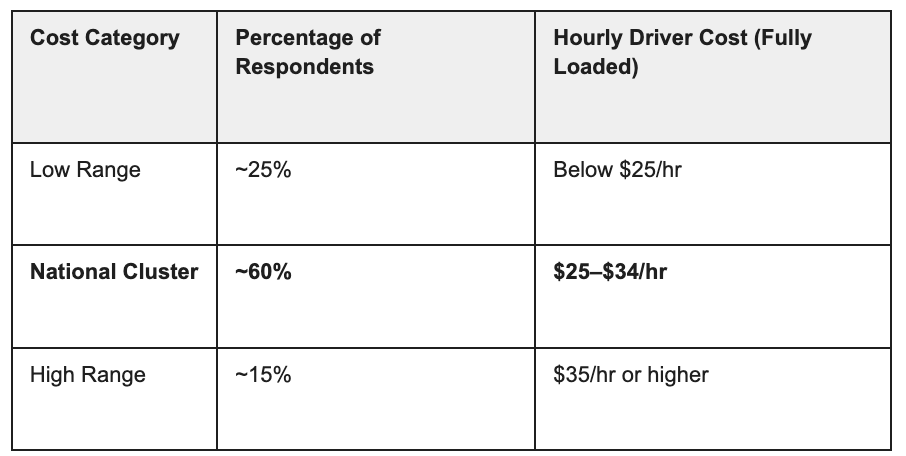
"Labor costs are relatively consistent nationally, suggesting sustainability challenges are driven more by rate design and trip economics than by workforce variability alone."
Identifying the Real Risks to Patient Care
The survey makes one thing very clear: the biggest threat of low reimbursement isn't just lower profits for owners. It's the total collapse of service reliability for patients who need it most. When rates stay stagnant while costs like labor and fuel rise, the entire network begins to contract.
Access and Service Gaps
Respondents identified several high-probability risks if reimbursement structures aren't updated to match real-world costs:
- Provider Exit: 60% of stakeholders expect companies to simply stop providing services.
- Missed Appointments: 55% predict an increase in patients missing critical medical care.
- Wait Times: 55% expect patients to face significantly longer waits for their rides.
- Rural Coverage: Nearly half (45–50%) see a high risk of losing service in rural and frontier areas.
How to Use These Findings for Your Business
If you are running an NEMT business, this data is a tool for your next conversation with a broker or a state agency. It provides a neutral, national reference point to show that your rising costs aren't an "individual" problem—they are a systemic reality.
- Validate Your Labor Math: If a contract assumes your labor costs are significantly below the national average of $25–$34/hr, your risk of becoming unsustainable is extremely high.
- Stress-Test Your Trips: Look at your "non-ideal" trips, such as rural mileage or long loading times for wheelchair-accessible vehicles (WAV).
- Focus on Access: When talking to payers, frame the conversation around patient access and reliability. The data shows that access is the first thing to break when rates are too low.
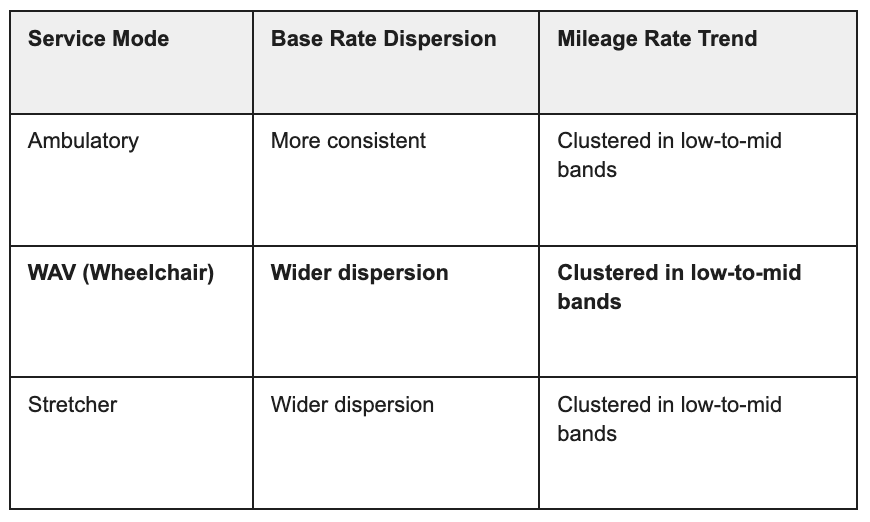
Service Mode Rate Dispersion
Different service types see different levels of rate consistency.
Run the numbers: the free NEMT rate calculator turns your rate card into what a trip actually bills, compared as flat, per-mile and hourly.
Essential Takeaways from the NEMTAC Survey
- Sustainability is Rare: Only a small subset of providers (10–15%) feel they have the capacity to grow under current rates.
- Base vs. Mileage: High base rates alone don't guarantee sustainability if the mileage rates don't support the actual trip length.
- Early Warning: For brokers, these findings are an "early-warning signal" that sustainability stress appears long before you see a visible service failure.
Shared Experience: If you feel like your margins are disappearing, you are not alone; the results suggest this experience is "widely shared" across the NEMT system.