

By Nick Hoffmeyer, Head of Marketing at Bambi · Updated September 28, 2026 · 8 min read
A well-utilized ambulatory van typically grosses $44,000 to $68,000 a year and a wheelchair van $52,000 to $78,000, before expenses. Stretcher vehicles can gross $90,000 to $225,000, but they carry a two-person crew and much higher costs. Net margins usually land between 8% and 20%. The gap comes down to trip rates, trip volume, and how much of each shift is spent driving empty.
This post is the per-vehicle deep dive: what a single unit brings in, what it costs to run, and where the margin actually comes from. If you want owner take-home pay instead of per-vehicle revenue, that's a different number entirely, covered in how much NEMT companies make.
How Much Revenue Does One NEMT Vehicle Generate?
One NEMT vehicle's annual revenue depends almost entirely on its type, its average rate per trip, and how many billable trips it completes daily. The table below compares the three main vehicle classes side by side. Revenue figures assume about 250 working days a year and a blended average rate across broker, facility, and private-pay trips.
- Ambulatory van: Blended avg. per trip: $25–$30; Trips per day: 7–9; Annual gross revenue: $44,000–$68,000; Net profit margin: 8–12%; Vehicle cost: $30,000–$60,000
- Wheelchair van: Blended avg. per trip: $35–$45; Trips per day: 6–7; Annual gross revenue: $52,000–$78,000; Net profit margin: 12–20%; Vehicle cost: $60,000 used to $90,000+ new
- Stretcher vehicle: Blended avg. per trip: $120–$180; Trips per day: 3–5; Annual gross revenue: $90,000–$225,000; Net profit margin: 10–20%; Vehicle cost: $60,000 used to $225,000+ new
These are planning ranges based on typical industry cost structures, not a guarantee for any operator. Check them against your own market's rates, insurance quotes, and payer mix before you commit to a purchase or lease.
Ambulatory Vans: The Lowest-Cost Entry Point
Ambulatory vans serve riders who can walk to the vehicle without assistance, which keeps the vehicle, driver, and insurance costs lower than wheelchair or stretcher units. Startup costs typically run $30,000 to $60,000 for a road-ready van. At a $28 blended average and eight trips a day, one van grosses about $56,000 a year. After driver pay, fuel, maintenance, dispatch software, and insurance, an 8 to 12% margin leaves roughly $4,500 to $6,700 a year for that vehicle.
That thin margin is why the single biggest lever for ambulatory vans is utilization, not rate. Standing orders (dialysis, chemo, physical therapy, three trips a week for the same rider) fill a schedule far more predictably than one-off trip requests. Cutting deadhead miles, the empty miles driven between trips, can move margin by several points, since fuel and driver time are the two biggest cost lines on a low-rate vehicle. More on measuring that in deadhead miles in NEMT.
Target before adding a second vehicle: a steady 7 to 9 completed trips a day, not just trips on the schedule.
Wheelchair Vans: The Middle Ground
Wheelchair vans cost more to buy and to insure, but they command higher per-trip rates. Private-pay wheelchair trips often carry a base rate of $65 or more plus mileage, while broker rates run lower. A blended average of $35 to $45 a trip is a realistic planning number for most mixed fleets. At six or seven trips a day, annual gross revenue runs $52,000 to $78,000.
Because the rate per trip is higher, wheelchair vans tolerate a bit more inefficiency than ambulatory vans and still turn a healthy margin, with 12 to 20% net typical. Facility partnerships (dialysis centers, adult day programs, assisted living) tend to be the most reliable source of recurring wheelchair volume, since those riders need the same trip on a fixed schedule every week.
Stretcher Vehicles: Highest Revenue, Highest Complexity
Stretcher vehicles bring in the most revenue per unit. Three to five trips a day at a blended $120 to $180 can gross $90,000 to $225,000 a year. That revenue comes with real complexity: a two-person crew that roughly doubles labor cost, higher insurance costs due to injury-claim risk, and a vehicle that runs from about $60,000 used to $225,000 or more new. Higher revenue does not mean a higher margin; 10 to 20% net is typical once the crew and insurance are paid.
Most operators don't start here. The common path is to establish cash flow with ambulatory or wheelchair units first, then add a stretcher vehicle in year two or three once staffing and cash reserves can absorb the bigger fixed costs. Confirm current new and used stretcher vehicle pricing with your equipment vendor before budgeting; prices shift with chassis and conversion costs.
Which Vehicle Type Should You Add Next?
- Entry cost: Ambulatory: Lowest; Wheelchair: Middle; Stretcher: Highest
- Typical net margin: Ambulatory: 8–12%; Wheelchair: 12–20%; Stretcher: 10–20%
- Staffing complexity: Ambulatory: Single driver; Wheelchair: Single driver; Stretcher: Two-person crew
- Revenue predictability: Ambulatory: Needs volume; Wheelchair: Steady with facility contracts; Stretcher: Fewer, higher-value trips
- Best for: Ambulatory: New operators, cash-flow building; Wheelchair: Operators with facility relationships; Stretcher: Established fleets, year 2–3
Fleet size matters less to profitability than payer mix and utilization. Diversifying beyond a single payer, a mix of Medicaid broker trips, private pay, and Medicare Advantage or VA contracts, tends to lift blended margins meaningfully compared to relying on one broker's rate schedule alone. Check payer-mix percentages against your own broker contracts; they vary by state and by which brokers operate in your service area.
What Actually Moves the Margin Needle
Three things move per-vehicle margin more than anything else on this page:
- Utilization. An empty vehicle costs the same in insurance and payments whether it runs two trips a day or eight.
- Deadhead miles. Every mile driven without a rider is pure cost. Route and trip-bundling software that groups nearby pickups cuts this directly.
- Recurring contracts. Standing orders from dialysis, chemo, and physical therapy riders are the fastest path to breakeven because they guarantee daily volume without new sales effort each week.
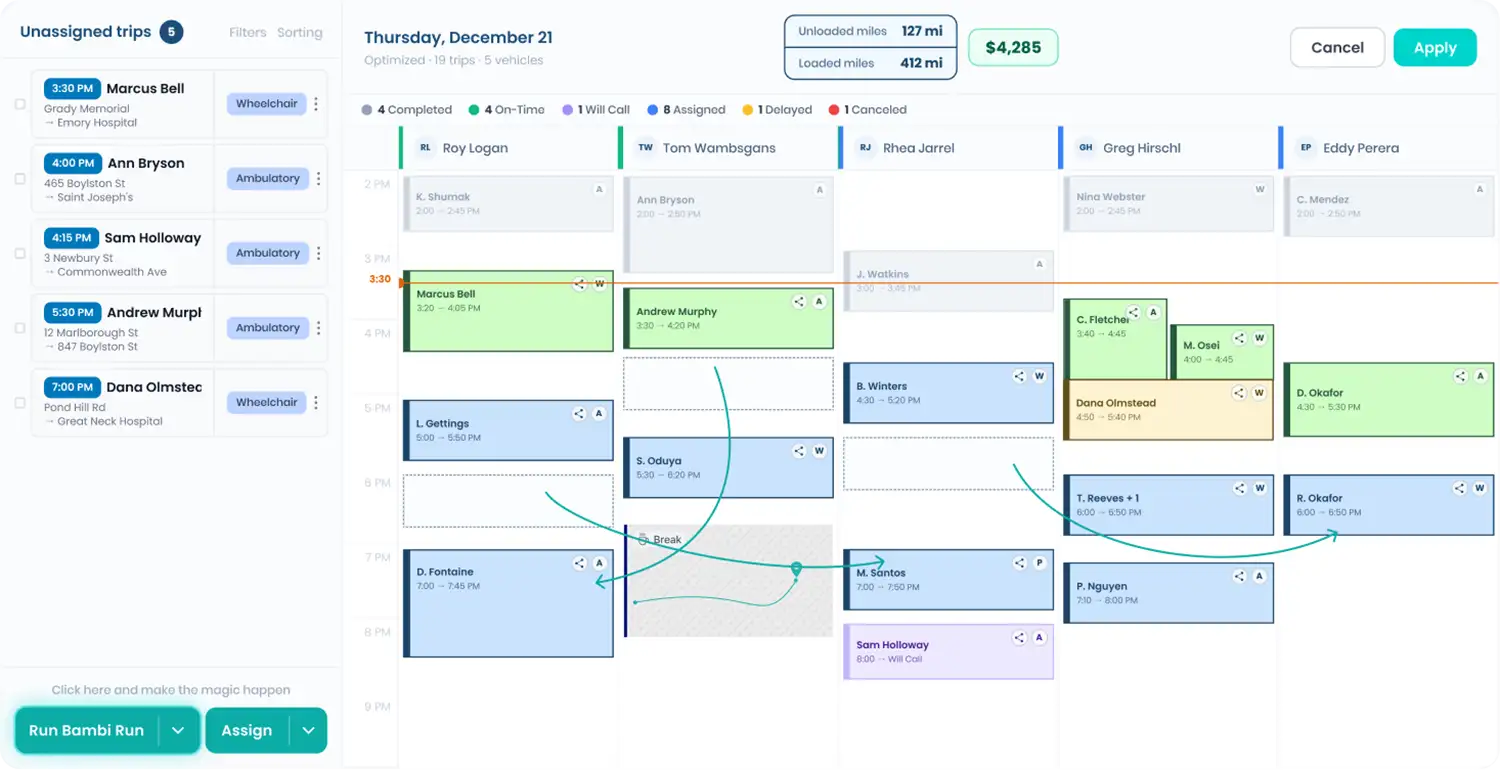
This is where scheduling software like Bambi's Run Bambi Run AI trip assignment tends to show up directly in the P&L: one click reassigns and bundles nearby trips instead of a dispatcher manually stringing routes together, which is the difference between a van running six trips a day and one running nine.
FAQ
How do I estimate revenue per vehicle for my own market? Multiply your typical trip rate by your average daily completed trips, then annualize it. Use local broker rate schedules or private-pay rates, not national averages, since rates vary significantly by state and payer. Check locally before using in a plan.
What trip volume do I need to break even per vehicle? Divide the vehicle's monthly costs by your average revenue per trip, then by working days. For example, $4,500 in monthly costs at a $28 average trip is about 161 trips a month, or roughly 8 a day over 21 working days. See our NEMT business plan template for how to build the rest of the plan around that number.
Which costs cut into NEMT margins the most? Driver pay, often more than half of a vehicle's revenue, is the largest line, followed by insurance and fuel. For a full breakdown of insurance costs by vehicle type and carrier, see our insurance provider review.
Is stretcher service worth the extra complexity? It can be, since each vehicle brings in the most revenue, but margins (10–20% net) are not automatically higher than a wheelchair van's, and it only makes sense once you have the staffing and cash reserves to support a two-person crew and higher insurance costs. Most operators add stretcher capacity after their ambulatory or wheelchair units are already profitable.
How is revenue per vehicle different from what I actually take home? Revenue per vehicle is gross; take-home is what's left after every driver, fuel, insurance, and overhead cost, and it changes a lot by fleet size. We cover that separately in how much NEMT companies make.
Fewer Headaches, More Revenue Per Vehicle
Every lever in this post, utilization, deadhead miles, recurring contracts, gets easier to pull with the right dispatch tools. Bambi's AI scheduling assigns and bundles trips automatically so vehicles run fuller routes without a dispatcher manually rebuilding the schedule every morning. See pricing or book a demo to see it against your own trip data.
About the author: Nick Hoffmeyer is Head of Marketing at Bambi, the AI-powered dispatch and scheduling platform for non-emergency medical transportation (NEMT) providers. He works with NEMT owner-operators every day on growth, SEO, and the operational systems that help fleets run more trips with less stress. More from Nick: LinkedIn