
Managing trip intake and billing in Non-Emergency Medical Transportation (NEMT) can be challenging without the right tools. Four platforms - NEMT Platform, RoutingBox, Tobi, and MediRoutes - offer solutions to simplify these processes by integrating with brokers like Modivcare and MTM while automating tasks like scheduling, billing, and compliance.
Key Features:
- NEMT Platform: AI tools for automated trip intake, broker integrations, and centralized billing.
- RoutingBox: Wide broker compatibility, automated trip imports, and real-time updates for billing and scheduling.
- Tobi: Open API for Medicaid broker integration, bulk trip uploads, and affordable pricing.
- MediRoutes: Real-time trip updates, automated scheduling, and flexible API connections.
Benefits:
- Save Time: Platforms eliminate manual data entry and reduce trip scheduling from hours to minutes.
- Improve Billing: Automated claims reduce errors and speed up reimbursements.
- Broker Integration: Direct API connections ensure smooth data sharing and compliance.
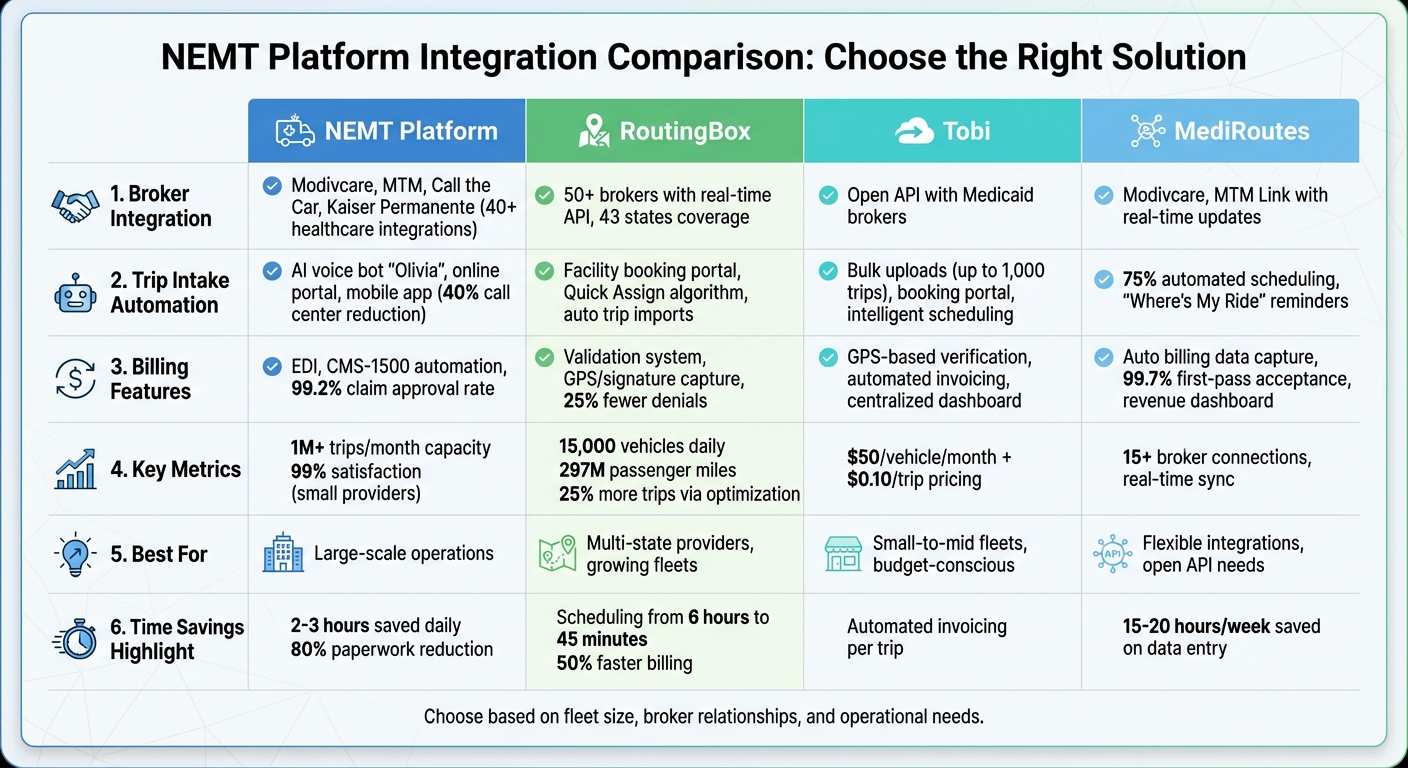
Choosing the right platform depends on your fleet size, broker relationships, and operational needs. Below is a quick comparison to help you decide.
Quick Comparison
PlatformBroker IntegrationTrip Intake AutomationBilling FeaturesCRM ConnectivityBest ForNEMT PlatformModivcare, MTM, Kaiser PermanenteAI-powered tools, voice botAutomated claims, EDI supportQuickBooks, Google MapsLarge-scale operationsRoutingBox50+ brokers, real-time APIFacility booking portalValidation system for claimsXLS/CSV import supportMulti-state providersTobiOpen API with Medicaid brokersBulk trip uploadsGPS-based claim verificationEHR and billing platformsSmall-to-mid fleetsMediRoutesModivcare, MTM, real-time updates"Where’s My Ride" alertsRevenue dashboard, automatedOpen API for CRMsFlexible integrations
These platforms reduce errors, increase efficiency, and simplify billing tasks, making them essential for NEMT providers of all sizes.
1. NEMT Platform
The NEMT Platform integrates seamlessly with major brokers through API connections, allowing providers to sync trip data effortlessly from brokers like Modivcare, MTM, Call the Car, and Kaiser Permanente. With over 40 healthcare integrations and the capability to manage more than 1 million trips each month, the platform is built to handle large-scale operations efficiently. These integrations form the backbone of the platform’s advanced features, which are detailed below.
Broker Compatibility
Using an Automated Traffic Management System (ATMS), the platform ensures real-time trip matching and distribution. Specialized brokerage importers automatically pull trip data from broker portals, eliminating the need for manual data entry. This automation can save providers around 2–3 hours of administrative work every day. For instance, Green Med Trans Inc., which manages over 5,000 trips monthly, achieved a 99.2% claim approval rate and 88% automated dispatch coverage by leveraging these tools. With precise data ingestion, the platform simplifies the entire trip intake process.
Trip Intake Automation
The platform supports multiple intake methods, including an online portal, a mobile app, and direct API integration. It also features "Olivia", an AI voice bot capable of answering calls, booking rides, and providing updates. This innovation helped Aerotranscare reduce its call center workload by 40% while managing over 3,000 trips per month. Additionally, smart validation algorithms verify trip details and confirm authorizations, catching errors early and ensuring smoother operations.
Billing Integration
Claim creation is fully automated for formats like EDI, CMS-1500, and broker-specific billing templates. Providers can monitor claim statuses through a centralized dashboard, making it easy to track what’s pending, paid, or requires attention. The system streamlines billing tasks, ensuring claims are filed on time and errors are resolved quickly to avoid payment delays.
CRM Connectivity
Beyond broker integrations, the platform connects with tools like QuickBooks for accounting, Google Maps for routing, and Net2Phone for communication. It also features a centralized member database that stores key details such as demographics, service preferences, and trip histories, eliminating the need for external spreadsheets. These integrations significantly reduce manual coordination for NEMT providers. For example, Helping Hands Transportation cut paperwork by 80% and achieved 100% compliance accuracy after adopting these digital tools.
2. RoutingBox
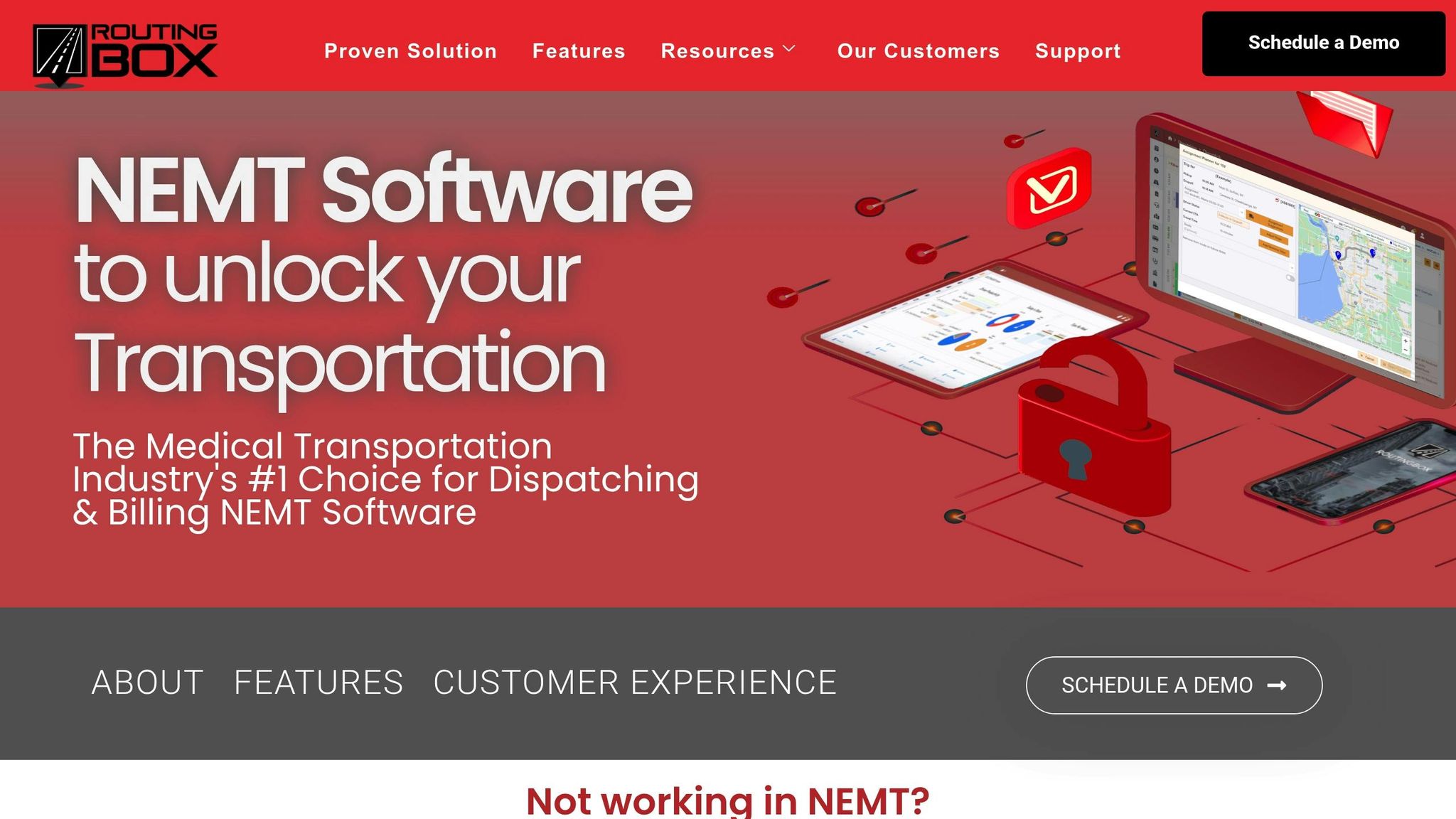
RoutingBox connects NEMT (Non-Emergency Medical Transportation) providers with over 50 regional brokers through direct API integrations and document uploads. With more than 15,000 vehicles using the platform daily across 43 states, RoutingBox has facilitated transportation for over 1 million passengers, covering more than 297 million passenger miles. This extensive network ensures smooth integration with brokers.
Broker Compatibility
RoutingBox simplifies workflows by automatically pulling trip data from broker portals and sending completed trip details back for billing. This automation removes the need for manual data entry. It supports specific billing file formats required by major brokers like Access2Care (CSV), Fidelis Care, and MTM. Alaina Maciá, MTM's President and CEO, highlighted this collaboration:
"With the support of preferred RSD partners like RoutingBox, we have the ability to push and pull data - including live GPS tracking - between MTM Link and the software our providers already use".
Additionally, the platform's Trip Importer validates addresses during the import process, ensuring accurate location data for drivers and reducing unnecessary miles.
Trip Intake Automation
RoutingBox offers a facility booking portal and a Quick Assign algorithm to streamline trip scheduling. These tools enable direct bookings and automatically match trips to vehicles based on capacity, schedules, and load times. This self-service option eases the workload for dispatchers while providing real-time status updates to facilities. Any trip changes or cancellations are instantly reflected, allowing driver manifests to adjust accordingly and avoiding wasted trips.
Billing Integration
The platform integrates real-time data into billing processes seamlessly. Its mobile app captures essential trip details, such as electronic signatures, GPS coordinates, and timestamps, ensuring digital verification for every trip. A built-in validation system flags incomplete trips before billing files are generated, helping providers correct errors and minimize claim denials. The Broker Billing interface supports specific file formats for brokers and standard billing formats, allowing providers to filter trips by "Ready" or "Billed" status to avoid duplicate invoices or missed claims.
CRM Connectivity
RoutingBox's Trip Importer can process data from various electronic sources, including XLS and CSV formats, making it compatible with different facility management systems and spreadsheets. This flexibility allows providers to centralize trip data from multiple sources into a single system, simplifying operations and reducing the need to juggle multiple software platforms.
3. Tobi
Tobi connects effortlessly with major Medicaid brokers through an Open API, ensuring smooth and efficient data sharing. Its pricing model is straightforward: $50 per vehicle per month, plus $0.10 per trip. This flat-rate setup provides clarity and predictability for providers managing numerous vehicles and high trip volumes.
Broker Compatibility
Tobi simplifies trip management by automatically importing and updating ride details, whether it’s a single trip or a bulk upload of up to 1,000 rides. This eliminates the need for manual data entry and ensures driver manifests are always up to date. The platform also includes features like electronic documentation, e-attestation, and real-time vehicle tracking with geofencing, helping providers meet broker compliance standards.
Trip Intake Automation
With Tobi’s Booking Portal, healthcare facilities and priority clients can directly schedule trips. For larger volumes, the platform supports bulk imports via spreadsheets or CSV files. Intelligent algorithms handle the heavy lifting when it comes to scheduling and routing, making the process more efficient.
Billing Integration
Tobi streamlines invoicing by automating the process for each trip. It takes into account factors like distance, additional services, and service codes, while electronically processing claims to speed up reimbursement times. A centralized dashboard provides real-time tracking of payment statuses and claims, while GPS-based data ensures service delivery is verified, creating audit-ready documentation.
CRM Connectivity
Tobi securely stores customer information, including contact details, medical needs, and transportation preferences. Thanks to its Open API, it integrates seamlessly with Medicaid brokers, billing platforms, EHR systems, and other tools, breaking down data silos. As Tobi highlights:
"Tobi can potentially integrate with any other software ecosystem using an API. We currently work with leading Medicaid brokers and medical billing providers and regularly add to the list of supported applications".
Akandu Ukoha, Executive Director at Marcy Transportation Services, shared his perspective:
"Lots of great features make our daily tasks very easy. The booking platform allows customers to book trips automatically. The price is very affordable, and customer service is responsive".
With its comprehensive integrations and user-friendly features, Tobi stands out as a powerful solution for optimizing NEMT operations.
4. MediRoutes
Since its launch in 2008, MediRoutes has been leveraging an open API to tailor workflows and seamlessly connect with major U.S. brokers like Modivcare and MTM.
Broker Compatibility
MediRoutes integrates closely with broker systems, including MTM Link, by automatically importing trip data in real time. This means that whenever trips are updated, added, or canceled, dispatchers and drivers are instantly notified, ensuring everyone is working with the latest information. For MTM users, the system also shares detailed, real-time trip and vehicle data. As Zackie, Supervisor at United Community Action Network Transportation, puts it:
"We used to do everything by manual data entry, so now all our rides are imported, and we just schedule to the driver we want them to go to".
These real-time updates are the backbone of MediRoutes' automated scheduling features.
Trip Intake Automation
MediRoutes simplifies trip intake by automating the process, significantly reducing the need for manual scheduling. Paula, COO at WheelCare Transportation, highlighted this efficiency:
"75% of the time the scheduling is done automatically. Every once in a while, since we have integrated with brokers, the broker part has not been easy and the problems I've had, MediRoutes has tried being the mediator between the two and fix the problem".
Additionally, the platform’s "Where's My Ride" (WMR) system helps reduce no-shows and cancellations by sending automated voice, email, or text reminders to passengers.
Billing Integration
MediRoutes takes automation a step further by streamlining billing. It captures essential data like GPS information, timestamps, and electronic signatures. For MTM Link users, marking a trip as "Performed Completely" automatically compiles all necessary billing data. A detailed revenue dashboard then provides a clear monthly breakdown, making billing more efficient and transparent.
CRM Connectivity
With its open API, MediRoutes allows for smooth two-way data exchange with external systems. Rob, COO at Quality Transport Services (QTS), explained its importance:
"It's very important for us to be with a company that has an open architecture that allows us to connect to, pull data, and push data back, so that we can utilize the data in our business processes".
This flexibility enables providers to integrate their existing CRM tools while maintaining automated workflows, ensuring a cohesive and efficient operation.
Advantages and Disadvantages
Let’s break down the strengths and challenges of each platform based on their features and real-world applications.
NEMT Platform stands out for its AI-powered automation, which has delivered impressive results. For example, Green Med Trans Inc achieved a 99.2% claim approval rate while handling over 5,000 trips each month. Additionally, its AI Receptionist feature has been shown to reduce call center workloads by as much as 40%. However, small operators may find its extensive feature set overwhelming. As Raza, the owner of Aerotranscare, shared:
"Being a small operator in Virginia area, most solutions in the market contained too many features & options and I didn't know how or which ones to use".
RoutingBox shines in broker compatibility, with integrations spanning over 25 brokers and payers. Users report significant time savings, such as cutting billing time in half and reducing denials by 25%. Sherina T. from Great Lakes PACE highlighted that schedule creation time dropped from 6 hours to just 45 minutes. On the downside, some integrations, like MediTrans, are still in development, which could impact providers in certain regions.
Tobi places a strong emphasis on security, meeting HITRUST RAPID Assessment and HIPAA attestation standards. Cheryl Kastrenakes, Executive Director at Greater Mercer Transportation Management Association, praised its reporting capabilities:
"NovusMED's reporting capabilities provides us the data we need to accurately invoice. The report integrates with our invoicing program – this has saved us a huge amount of time".
However, users should be aware that additional module costs may apply.
MediRoutes offers real-time broker synchronization and an open API architecture, making it an attractive option for providers seeking flexibility. Rob, COO at Quality Transport Services, emphasized:
"It's very important for us to be with a company that has an open architecture that allows us to connect to, pull data, and push data back, so that we can utilize the data in our business processes".
Paula from WheelCare Transportation noted that 75% of scheduling tasks are automated. That said, broker integration issues sometimes require MediRoutes to step in as a mediator.
Each platform has its strengths, but the choice will depend on your specific operational needs and challenges.
Conclusion
Integrated platforms tackle some of the biggest workflow challenges in NEMT operations, but finding the right fit depends on your fleet size and operational goals. For small operators managing 1–10 vehicles, simplicity and cost-effectiveness are top priorities. NEMT Platform shines in this area, offering essential automation without overwhelming users with unnecessary features. As Raza from Aerotranscare noted, straightforward solutions often serve smaller operators better. This platform boasts a 99% customer satisfaction rate for small providers, making it a reliable choice.
For providers with expanding fleets, scalability becomes the game-changer. RoutingBox stands out by helping operators complete 25% more trips through its multiload optimization feature. Its Trip Importer monitors over 25 brokers in real time, while the automated calling system significantly reduces no-shows by 25–30%. These tools have proven invaluable for companies like Demitri Transportation LLC, allowing them to handle growing demands more efficiently.
When managing broker relationships across multiple states, integration capabilities are critical. RoutingBox simplifies this with its dedicated Trip Importer, and MediRoutes supports connections with over 15 brokers while achieving a 99.7% first-pass claim acceptance rate. Both platforms help eliminate the tedious manual data entry that can eat up 15–20 hours per week.
Billing efficiency is another key factor. Platforms that automate processes like 837P and CMS-1500 file generation can greatly improve claim approval rates and reduce errors. For example, NEMT Platform helped Green Med Trans Inc achieve a 99.2% claim approval rate. Providers using broker-integrated software also report 40% faster claim processing and 65% fewer billing errors - a clear boost to profitability.
Ultimately, your choice should reflect both your current challenges and your future growth plans. Small operators benefit from user-friendly platforms, mid-sized fleets thrive with scalable solutions, and providers managing multiple brokers need robust integration tools. By aligning your needs with each platform's strengths, you can streamline operations and position your business for long-term success.
FAQs
How can I choose the best NEMT platform for my fleet and operational needs?
Selecting the right NEMT platform depends heavily on your fleet size, operational needs, and integration preferences. If you’re running a smaller fleet, look for platforms that offer straightforward trip import options, like CSV uploads or API connections, along with basic dispatch features that are quick and easy to set up. For medium-sized fleets - typically those with 10 to 30 vehicles - platforms with automated scheduling, real-time vehicle tracking, and multi-payer billing capabilities can significantly cut down on manual tasks. For fleets with 30 or more vehicles, it’s worth investing in platforms with advanced tools like analytics, auto-assignment, and integrated payment processing to efficiently manage larger volumes.
Integration is another key factor. The platform should work seamlessly with brokers like MTM, Modivcare, or Veyo, as well as your existing CRM systems. Whether you rely on API connections or file-based data sharing, make sure the platform supports your preferred method. If billing is a major focus, check whether it can export invoices in your required format or connect directly to your accounting software. For fleets dealing with complex routes, consider platforms with AI-powered dispatching to optimize mileage and ensure timely arrivals.
Scalability is also critical. A cloud-based solution that can grow with your business and offers reliable customer support will help ensure your operations run smoothly. By aligning the platform’s features with your specific needs, you can streamline trip intake, simplify billing, and improve overall efficiency.
What are the benefits of integrating NEMT platforms with brokers like Modivcare and MTM?
Integrating your NEMT platform with brokers like Modivcare and MTM can completely transform how you manage operations. By automating trip intake, you cut down on manual data entry and significantly reduce errors. Trip requests are sent directly into your dispatch system in real time, eliminating the need for duplicate spreadsheets and avoiding transcription mistakes. This streamlined process not only speeds up claim submissions but also lowers administrative costs and ensures you stay compliant with Medicaid and state regulations.
Beyond simplifying operations, integration brings powerful tools to the table, including automated scheduling, smart route optimization, and live vehicle tracking. These features help improve on-time performance, drive down per-trip costs, and create a better experience for patients. The result? Faster reimbursements, smoother workflows, and higher satisfaction scores - all of which give you a stronger edge in the competitive NEMT industry.
How can automated tools for trip intake and billing benefit my NEMT operations?
Automated trip intake tools make managing ride requests a breeze by instantly capturing them as they're submitted. This eliminates the need for manual data entry, cutting down on errors. With all the information centralized, dispatchers can quickly assign the nearest qualified driver, keep riders updated in real time, and fine-tune scheduling for quicker pickups and better efficiency.
When it comes to billing, automation takes the hassle out of the process. Completed trips are immediately turned into claims that meet payer requirements and are submitted electronically to Medicaid, Medicare, or private insurers. This speeds up reimbursements, reduces the chances of claim rejections, and trims down administrative work. Plus, built-in reporting tools make audits and financial reviews simpler, helping you stay on top of compliance while keeping cash flow steady.
By combining these tools, the entire process - from ride request to payment - flows effortlessly. The result? Fewer delays, lower costs, and a smoother experience for both providers and riders.