
For NEMT (Non-Emergency Medical Transportation) fleets, vehicle reliability is critical. Predictive maintenance uses performance data - like engine fault codes, tire pressure, and fuel efficiency - to predict issues before they cause breakdowns. This approach minimizes disruptions, reduces costs, and ensures patients get to their appointments on time. By scheduling repairs based on real-time data, fleets avoid unnecessary part replacements and emergency repairs, improving uptime and safety while cutting downtime by up to 50%.
Key benefits include:
- Early problem detection: Catch issues like overheating or brake wear before they escalate.
- Cost savings: Replace small parts (e.g., $300 sensors) to avoid major repairs (e.g., $5,000 engine rebuilds).
- Improved reliability: Keep more vehicles operational during peak hours.
- Data-driven decisions: Use telematics, sensors, and maintenance history to optimize repairs.
This data-driven strategy ensures smoother operations, better patient care, and lower operational costs.
What Predictive Maintenance Is and How It Helps NEMT Fleets
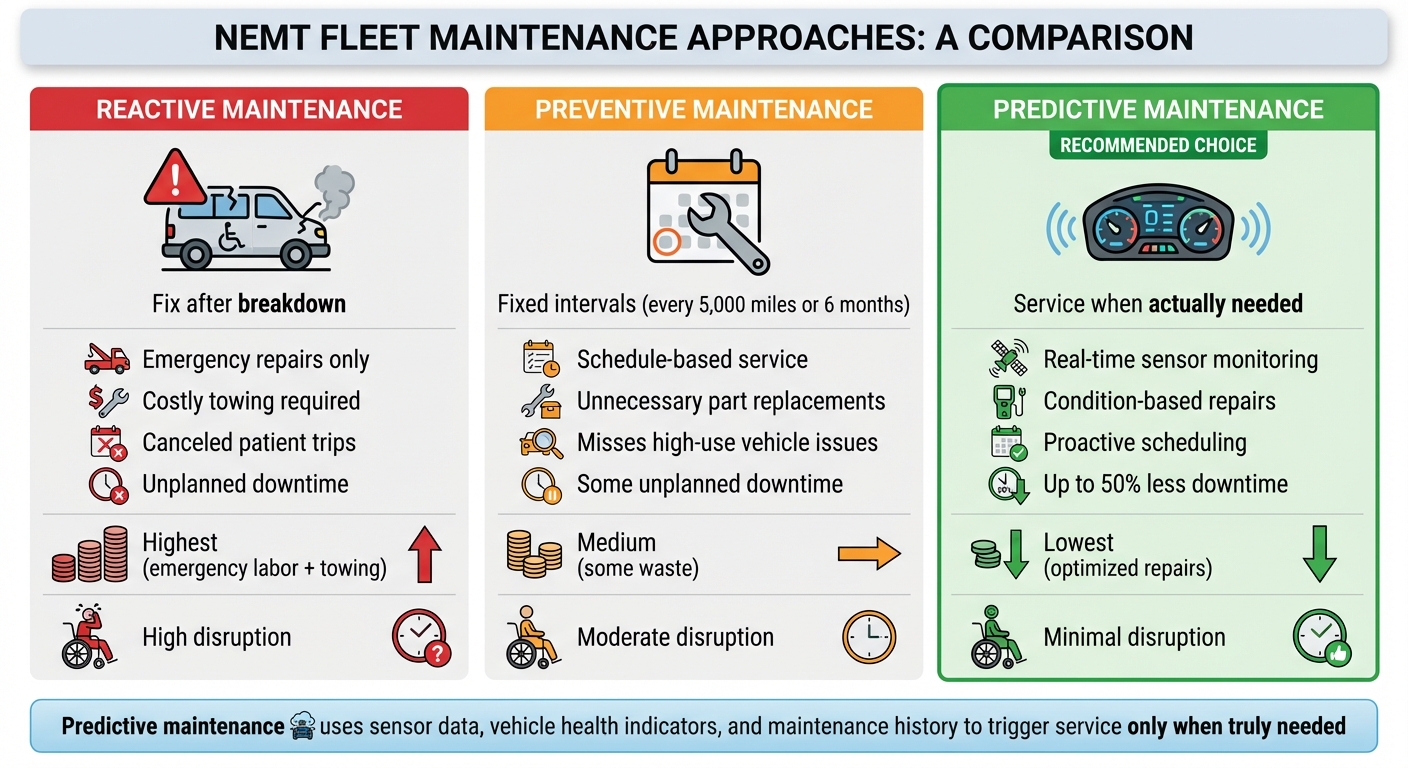
For Non-Emergency Medical Transportation (NEMT) fleets, staying operationally reliable is non-negotiable. This is where predictive maintenance steps in. By using real-time and historical vehicle performance data - like engine diagnostics, mileage, temperature, and fault codes - it predicts when a component is likely to fail. This allows for repairs to be scheduled with precision, minimizing disruptions and maximizing efficiency. Instead of reacting to breakdowns, this approach enables proactive planning, saving time and money.
Now, compare this to reactive maintenance, where vehicles are fixed only after they break down. This method often leads to costly towing, emergency repairs, and canceled trips - outcomes that are unacceptable in patient-critical operations. On the other hand, scheduled (preventive) maintenance operates on fixed intervals, such as every 5,000 miles or six months, regardless of the vehicle's actual condition. While this is a step up from reactive maintenance, it can still result in unnecessary part replacements or missed issues on high-use vehicles that need attention sooner.
Predictive maintenance takes it a step further by combining sensor data, vehicle health indicators, and maintenance history. This approach triggers service only when it's truly needed, reducing unplanned downtime and extending the lifespan of vehicles operating on tight schedules. It’s a form of condition-based maintenance, where service decisions are based on the vehicle's actual condition and risk, not just a calendar or odometer reading.
How Predictive Maintenance Stops Breakdowns Before They Happen
With continuous monitoring, predictive maintenance can catch subtle changes in vehicle performance that manual inspections might overlook. For instance, slight increases in vibration, gradual temperature hikes, or irregular battery voltage can signal underlying issues. Imagine your telematics system detecting repeated engine misfires or a slow rise in transmission temperature over a few days. Instead of waiting for a breakdown, your team gets an alert, schedules the vehicle for service during a low-demand period, and swaps in another unit. This ensures patient appointments remain uninterrupted.
Automated data collection also plays a key role by generating work orders the moment performance thresholds are crossed. This transforms maintenance from guesswork into a data-driven process. The result? Breakdowns are prevented before they disrupt operations, keeping your fleet running smoothly and patients on schedule.
Why NEMT Providers Need Predictive Maintenance
For NEMT providers, predictive maintenance is more than a technical advantage - it’s essential for meeting service commitments. These operations run on tight, medically driven schedules, with trips aligned to fixed appointment times for clinics, dialysis, or therapy sessions. A single breakdown can mean missed treatments, denied claims, or penalties from healthcare partners. Worse, patients often have no backup transportation, leaving them stranded and putting your reputation at risk.
NEMT vehicles face heavy wear and tear due to urban traffic, frequent stops, door cycles, and lift operations. This constant use accelerates the need for maintenance, especially for critical systems like brakes, transmissions, and accessibility equipment. Predictive maintenance helps ensure on-time performance, safeguards relationships with healthcare providers, and supports compliance with Medicaid and broker audits. By catching issues early, you can reduce last-minute cancellations, keep more vehicles available during busy periods, and ensure safety systems - like wheelchair lifts, brakes, and HVAC - stay reliable for passengers with medical needs.
These benefits highlight how predictive maintenance not only improves operations but also ensures the safety and reliability that NEMT providers and their patients depend on. The next section will dive deeper into how performance data tracking supports these efforts.
What Performance Data to Track for Predictive Maintenance
Predictive maintenance works best when you focus on tracking the data that directly impacts safety, reliability, and scheduling. Instead of trying to monitor everything, start with metrics that reveal when critical components are wearing out. This approach allows you to plan maintenance during off-peak times, avoiding unexpected breakdowns that could disrupt medical pickups. Collecting the right data is key to making predictive maintenance systems effective.
Where Performance Data Comes From
Most performance data comes from in-vehicle systems. For example, engine diagnostics are pulled from the vehicle’s ECU (engine control unit) via the OBD-II port. This includes diagnostic trouble codes (DTCs), coolant temperature, oil pressure, battery voltage, and fuel system stats, all of which can help predict failures weeks in advance. Telematics systems add another layer by providing information like GPS location, speed, idling time, and trip distance. Accelerometers within these systems track harsh driving behaviors - such as sudden braking or sharp turns - which can accelerate wear on brakes, tires, and engines.
Tire pressure monitoring systems (TPMS) offer real-time pressure and temperature data for each wheel, helping prevent blowouts and uneven wear. For non-emergency medical transportation (NEMT) vehicles, accessibility equipment sensors are crucial. These sensors monitor wheelchair lift cycles, door operations, and lift motor performance - a failed lift could leave a mobility-impaired patient stranded. Finally, your maintenance management system stores historical data like repair logs, work orders, and inspections. Combining this history with real-time sensor data helps identify patterns that predict failures well in advance.
Which Vehicle Components to Monitor First
Start by focusing on safety-critical systems and components where failure could jeopardize passenger safety or disrupt appointments. For example, braking systems - including pads, rotors, fluid, and ABS sensors - should be a top priority. NEMT vehicles often operate in urban traffic and carry heavy equipment, which accelerates brake wear. Brake-related issues are among the most common reasons for commercial vehicles being taken out of service in the U.S..
Wheelchair lifts and ramps also require close attention. Track lift cycle counts, motor current (a rise in current can signal mechanical resistance), and any error codes. A malfunction here directly impacts your ability to serve patients with mobility challenges.
Other priorities include batteries and charging systems, which endure frequent key cycles, short trips, and power demands from lifts and medical equipment. Monitor voltage at start-up, cranking voltage, and any low-voltage events - repeated jump-starts are a clear warning sign. Additionally, keep an eye on tires (pressure, tread depth, and age), steering and suspension components (for a smooth ride, especially with frail passengers), and engine cooling systems. Trends in coolant temperature often indicate issues with the water pump or thermostat weeks before failure.
Tools for Collecting Vehicle Data
The backbone of your data collection is an OBD-II telematics device. Plugged into the OBD-II port, it continuously gathers engine and emissions data while also tracking GPS location, speed, and driver behavior. Many of these devices can also monitor fuel levels, coolant temperature, and other critical metrics.
For tire monitoring, use the vehicle’s built-in TPMS or install aftermarket sensors that provide detailed pressure and temperature readings for each wheel. Specialized NEMT equipment, like wheelchair lifts, benefits from dedicated IoT sensors that track lift position, door cycles, and motor current. Batteries can be monitored with sensors that track voltage and charge levels.
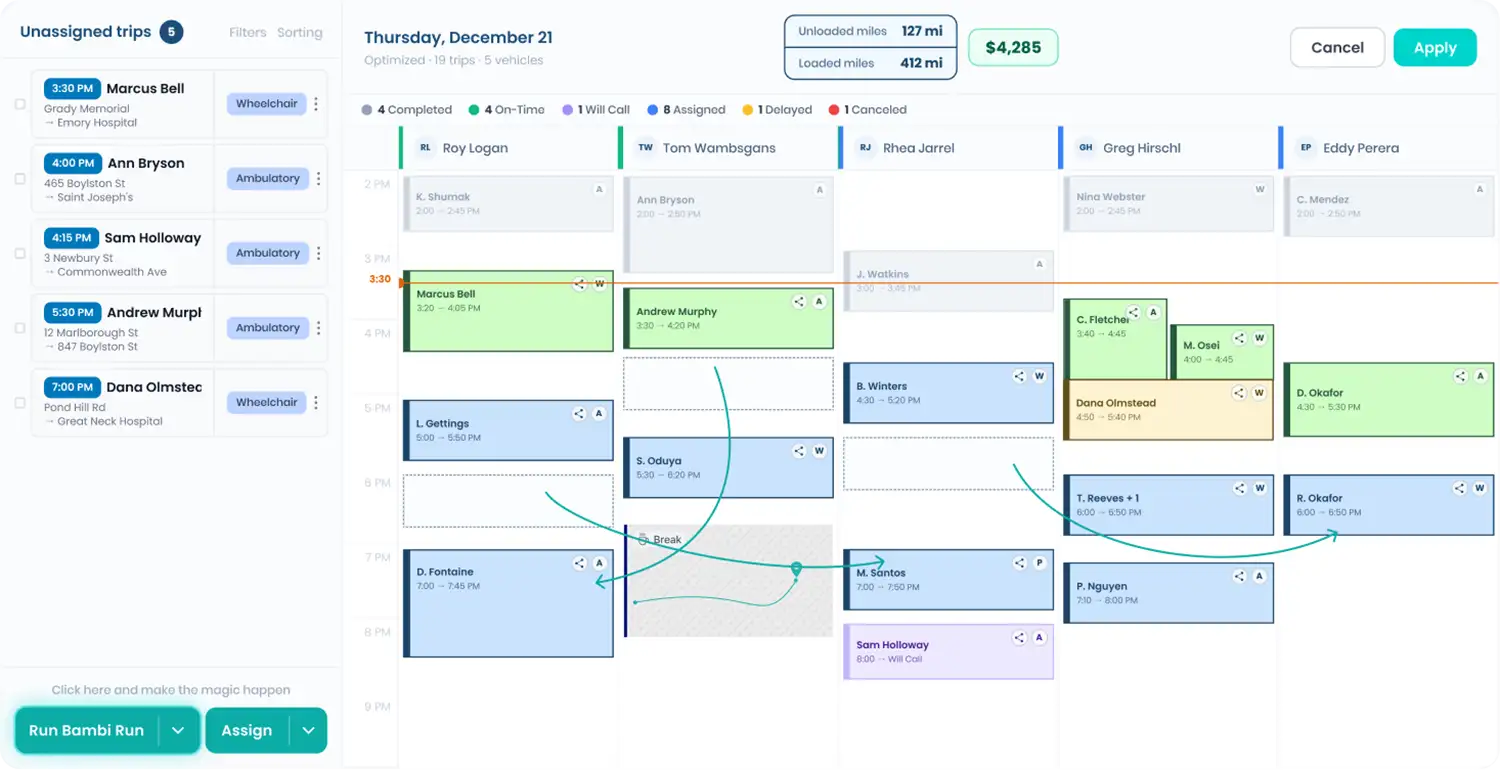
All of this data feeds into a fleet management platform, which analyzes patterns, flags abnormalities, and sends alerts when thresholds are crossed. For NEMT operators, platforms like Bambi can integrate predictive maintenance alerts with scheduling and dispatch systems. This ensures that even when a vehicle needs service, medical trips remain on schedule by reassigning routes or vehicles as needed.
How to Set Up a Predictive Maintenance System
Start by mapping out your data flow and focusing on the components most likely to disrupt trips. For many NEMT fleets, the usual culprits are engines, transmissions, brakes, and wheelchair lifts. Identify which of these cause the most breakdowns or delays, and set clear goals like reducing incidents and improving on-time performance. Next, take stock of your data sources: what your OBD-II ports provide (like fault codes, mileage, or engine hours), what telematics units track (such as GPS location, speed, and harsh braking), and what additional sensors monitor (tire pressure in psi, battery voltage, or lift cycles). This inventory becomes the foundation for a predictive maintenance system designed to reduce unexpected downtime.
Once you’ve cataloged your data, the next step is connecting it to a central platform. This is typically a CMMS (computerized maintenance management system), fleet management software, or an integrated NEMT solution like Bambi. Telematics devices and IoT sensors stream data via cellular or Wi-Fi to this hub, where it’s time-stamped, converted to U.S. measurement units (e.g., °F for temperature, psi for pressure), and linked to each vehicle’s maintenance history. The platform applies specific rules - like flagging coolant temperature above a set °F threshold, brake pad thickness below standard, or recurring fault codes across trips. When these conditions are met, the system automatically generates a work order, pre-filled with details such as the asset ID, fault description, sensor readings, recommended tasks, required parts, and urgency. This integration transforms raw data into actionable maintenance tasks through automated workflows.
How Data Moves from Vehicles to Maintenance Tasks
The process of turning vehicle data into maintenance actions follows a structured workflow. Telematics devices and sensors continuously capture performance metrics, which are sent to the cloud or a central data center. Edge devices handle initial processing, filtering out irrelevant data and flagging potential issues for quicker alerts. Once in the central system, the data is cleaned and stored alongside historical repair and inspection records. Automated rules or machine learning models analyze this data in real time, comparing current readings to normal baselines and historical failure patterns.
When a rule is triggered - like oil pressure dropping below safe levels or abnormal vibration levels - an automated work order is created. The system assigns it to a technician or repair shop and notifies both the maintenance team and dispatch. To ensure smooth operations, maintenance alerts are integrated with scheduling tools. For instance, if a vehicle is flagged for urgent service, it’s marked as unavailable in dispatch views, preventing it from being assigned to medical trips.
How to Set Alert Thresholds for Maintenance
Establishing effective alert thresholds requires a mix of manufacturer guidelines and fleet-specific data. Start with OEM recommendations for maximum coolant temperature (°F), minimum oil pressure (psi), and brake pad thickness. Then, refine these limits by analyzing your fleet’s history. For example, if alternators on a specific vehicle model tend to fail within two to three weeks of frequent low battery voltage, set your alert threshold slightly above that point. Use both fixed limits (e.g., temperature exceeding X°F) and trend-based rules (e.g., tire pressure dropping 10–15% over several days or rising vibration levels compared to a vehicle’s baseline).
To avoid overwhelming your team with excessive alerts, combine recurring issues into a single confidence score. This approach minimizes alarm fatigue while ensuring critical problems are addressed. With clear thresholds in place, you can better align maintenance alerts with your daily dispatch operations.
How to Coordinate Maintenance with Daily Operations
Integrating your maintenance system with dispatch and scheduling tools is key to minimizing disruptions. When a predictive alert is triggered, the software can check upcoming trip assignments and suggest service windows that cause the least disruption - such as during mid-day lulls, late evenings, or between recurring appointments like dialysis trips. Avoid over-scheduling your fleet by leaving a maintenance buffer during peak hours. Use color-coded status flags in your scheduling system - like "Monitor", "Schedule Soon", or "Down for Maintenance" - so dispatchers can quickly identify vehicles to avoid for critical or long-distance trips.
Platforms like Bambi can even reassign trips automatically from vehicles requiring urgent repairs, helping maintain high on-time performance. To keep everything running smoothly, assign clear responsibilities: maintenance managers set thresholds and coordinate with dispatch, technicians validate alerts and complete repairs, and dispatchers follow established procedures to reassign trips as needed. This ensures the entire process works seamlessly without manual errors or redundant data entry.
How to Analyze Data to Predict When Maintenance Is Needed
When your data flows into a central system, it’s time to turn those raw numbers into predictions that help you prevent breakdowns. The idea here is to spot patterns that indicate a component is wearing out or on the verge of failure, allowing you to schedule maintenance before it disrupts patient trips. This involves using several analytical methods, each aimed at catching different types of problems at various stages. Let’s break down the key methods that transform performance data into actionable plans.
Methods for Analyzing Maintenance Data
Start with trend analysis to monitor how critical metrics evolve over time. For example, you can calculate 7-day rolling averages for engine temperature, fuel efficiency, or brake wear rate. This smooths out daily fluctuations and highlights gradual deterioration. Imagine noticing a 15% rise in fuel consumption over three weeks - this could point to emerging issues in the engine or fuel system. Similarly, regression lines for metrics like battery voltage or DEF (Diesel Exhaust Fluid) usage per mile can flag subtle problems, such as increasing resistance or minor leaks, before they escalate into roadside failures.
Time-series tracking helps distinguish normal seasonal patterns from actual anomalies. Take fuel consumption, for instance - NEMT vehicles naturally use more fuel in winter due to the added HVAC load and idling at hospitals during busy hours. By understanding these seasonal changes, you can filter out false alarms and focus on genuine issues, like a sudden 20% drop in fuel efficiency that doesn’t align with weather or route changes. Time-over-threshold metrics, such as hours spent above recommended transmission temperatures or harsh-braking events per 1,000 miles, can also reveal signs of accelerated wear.
Anomaly detection takes this a step further by identifying unusual behavior that doesn’t fit established baselines. Threshold-based detection flags single variables exceeding safe limits - like coolant temperature surpassing a set degree or tire pressure falling below standard psi. Statistical outlier detection catches unexpected deviations, such as an engine suddenly consuming 20% more fuel under the same conditions. The most advanced method, multivariate anomaly detection, examines combinations of metrics. For example, it might detect a scenario where normal RPM coincides with rising temperature and falling oil pressure - an early warning of an issue that single-metric alerts might miss. This kind of analysis helps you prioritize vehicles that need immediate attention.
Using Machine Learning to Improve Predictions
Machine learning models can take your maintenance predictions to the next level. Classification models, like gradient boosting or random forests, can predict whether a component is likely to fail within a specific time frame - say, 30 days or 3,000 miles - based on sensor data and usage patterns. Meanwhile, regression models estimate continuous outcomes, such as the number of miles left before brake pads hit critical thickness or the exact date an oil change will be required.
Survival analysis, also known as hazard modeling, is another powerful tool. It predicts the likelihood of failure over time, factoring in vehicles that haven’t experienced issues yet. This method allows for more nuanced, risk-based scheduling. To make these models work, you’ll need to annotate historical data with real failure events, split it into training and test sets, and train algorithms using features like mileage, engine hours, average speeds, and environmental conditions. Evaluate the models by tracking their precision (how often alerts correctly identify issues), recall (how many true issues are caught early), and lead time (the average time or distance between an alert and a failure).
To keep the models accurate, retrain them regularly as new vehicles, routes, and driving patterns emerge, and as more failure data becomes available. Tailor models to specific vehicle types or duty profiles - like wheelchair vans versus sedans or urban versus rural routes - to ensure predictions account for context-specific wear patterns. Engage mechanics and dispatchers in the process by having them rate the usefulness of alerts and document root causes in your CMMS (Computerized Maintenance Management System). This feedback loop will help improve the model’s performance over time.
How to Turn Data Analysis into Maintenance Schedules
The final step is translating analytical insights into actionable maintenance schedules. This requires setting up rule-based workflows tied to your fleet’s calendar and trip bookings. For instance, you might create a rule like: “If predicted brake pad life is under 1,000 miles and the vehicle averages 500 miles per week, schedule an inspection within three days.” These rules ensure that maintenance is planned without disrupting operations.
Integrate these analytical outputs with your existing maintenance systems to automate scheduling. Prioritize vehicles based on risk and mission importance - those used for critical trips, such as dialysis or recurring therapy, may need stricter thresholds to avoid cancellations. Maintenance alerts can also be linked to dispatch tools, so when a vehicle is flagged for service, platforms like Bambi can automatically reassign trips to other vehicles. This keeps your fleet running smoothly while the flagged vehicle is serviced. By shifting from static, calendar-based maintenance to dynamic, condition-based schedules, you can respond to actual wear and tear rather than sticking to fixed timelines.
How to Measure the Results of Predictive Maintenance
Once you’ve implemented predictive maintenance, the next step is proving its worth. To do this, track metrics that highlight fewer breakdowns, cost savings, and improved vehicle availability. Without clear data, it’s tough to justify the investment or pinpoint areas for improvement. The secret lies in monitoring the right KPIs and using what you learn to fine-tune your system over time.
Which Metrics to Track
Start by looking at unexpected breakdowns per 10,000 miles (or per vehicle per month). This metric shows whether your system is catching problems before they turn into major failures. Research suggests predictive maintenance can cut unplanned downtime by as much as 50%. If breakdowns are decreasing compared to your pre-implementation numbers, you’re heading in the right direction.
Another key metric is maintenance cost per mile, which acts as a financial health check. Calculate it by dividing your total maintenance expenses - including parts, labor, towing, and fees - by the total miles driven. Breaking this down by vehicle type (like sedans, wheelchair vans, or stretcher vans) can help you spot outliers. For instance, a Non-Emergency Medical Transportation (NEMT) operator might see costs drop from $0.18 to $0.13 per mile over a year as emergency repairs decrease and more work gets scheduled during off-peak times.
Vehicle uptime is another critical measure. This tracks the percentage of scheduled service time a vehicle is available, with a target of 95–97% for core service vehicles. To complement this, monitor metrics like road calls per 1,000 trips and on-time performance impacted by vehicle issues (the percentage of late or missed trips due to mechanical problems). Tools like Bambi can combine these figures with dispatch and trip data, helping you connect maintenance decisions to overall service reliability.
Also, keep an eye on whether the same component needs repair within 90 days. A high repeat rate might suggest that predictive alerts aren’t leading to effective fixes or that alert thresholds need adjustment. Track mean time between failures (MTBF) for critical parts like alternators, batteries, and wheelchair lifts - this number should rise as issues are caught earlier. Similarly, monitor mean time to repair (MTTR), which should decrease or remain steady as you move from reactive to planned maintenance.
These metrics provide a foundation for ongoing improvement, which we’ll explore in the next section.
How to Improve Your Predictive Maintenance Over Time
With clear metrics in place, use your data to make your predictive maintenance system even better. After a major breakdown, dive into telemetry data from the 30 to 90 days before the failure. Look for patterns like recurring engine misfire codes or rising coolant temperatures under load. If warning signs were missed, adjust your alert rules - lower thresholds or shorten the time between fault codes and required service visits.
Address false-positive alerts by tweaking thresholds to require multiple confirming events rather than isolated spikes. Use analytics from your CMMS (Computerized Maintenance Management System) to identify which alerts are linked to costly failures and refine those thresholds. This process improves the accuracy of rule-based systems and lays the groundwork for more advanced machine learning.
If you’re using machine learning models, retrain them regularly as you gather more data. Adjust models to account for differences in vehicle types or duty cycles - urban sedans, for example, don’t operate the same way as rural wheelchair vans. Mechanics and dispatchers should also provide feedback on alerts, rating their usefulness and documenting root causes in your CMMS. This feedback not only helps fine-tune the system but also builds confidence in its effectiveness. Additionally, integrate downtime forecasts with dispatch tools so vehicles at higher risk can be reassigned.
Review your results quarterly. Compare current KPIs - like breakdown rates, maintenance cost per mile, vehicle uptime, and trip reliability - against your baseline data from before predictive maintenance was introduced. Industry benchmarks suggest aiming for a 25–50% reduction in unplanned downtime and a 10–20% decrease in maintenance costs per mile within 12 to 24 months. If progress is slower than expected, dig into the data. Are alerts being ignored? Are thresholds too loose or too strict? Are there issues with parts availability or technician training? Remember, predictive maintenance isn’t a “set it and forget it” solution - it’s an ongoing process of measuring, learning, and improving.
Conclusion
Using performance data to drive maintenance decisions is a game-changer for NEMT fleet operations. By leveraging real-time sensor data, fault codes, and maintenance logs, you can identify and address issues before they escalate - minimizing patient delays and cancellations. Studies show this approach can reduce downtime by up to 50% and extend vehicle lifespan by 20–40%. The result? Fewer emergency repairs, lower operational costs, and more vehicles ready to serve patients when they need them most.
Fewer mechanical issues also mean more reliable, on-time pickups for critical appointments like chemotherapy or physical therapy. This consistency not only alleviates stress for patients but also allows dispatchers to maintain steady driver-vehicle assignments, fostering trust and continuity. Addressing early warning signs - like unusual wheel bearing noises or rising coolant temperatures - helps control repair costs, reduce overtime, and keep budgets predictable, all while ensuring your fleet stays operational.
Centralized systems are a key part of this strategy. Tools like Bambi integrate sensor data, telematics, and maintenance logs into actionable alerts. These platforms make it easier to identify underperforming vehicles, schedule maintenance during downtime, and adjust routes without disrupting patient care.
Start small by focusing on your most critical vehicles. Track metrics like road calls and maintenance costs per mile, and refine alert thresholds over time. Even incremental improvements can reduce disruptions and demonstrate the value of investing in predictive maintenance. The more data you gather, the more precise and effective your system becomes.
Cultivating a data-driven culture is essential. Regularly reviewing key metrics - such as on-time pickup rates and unscheduled repair costs - ensures that maintenance, dispatch, and management teams are aligned. Treating performance data as a strategic tool not only prevents breakdowns but also strengthens contracts, builds payer confidence, and reinforces the mission of NEMT: providing safe, reliable access to care for every trip, every day. Embracing this approach safeguards timely care and upholds the core purpose of NEMT services.
FAQs
How does predictive maintenance help keep NEMT vehicles reliable?
Predictive maintenance plays a key role in keeping NEMT vehicles dependable by analyzing performance data to spot early signs of wear and tear or potential issues. This forward-thinking method allows you to schedule repairs or replace parts before a breakdown happens, reducing the chances of unexpected downtime.
Catching problems early doesn’t just keep your vehicles running longer - it also boosts your fleet’s overall efficiency. The result? Smoother day-to-day operations and consistent, reliable service for your passengers.
What performance data is most important for predicting maintenance needs?
Monitoring key performance metrics like engine temperature, oil pressure, vibration levels, fuel consumption, brake wear, tire pressure, and battery health plays a crucial role in keeping your fleet running smoothly. Keeping an eye on these factors helps spot potential problems early, preventing them from turning into costly repairs.
Analyzing this data over time allows you to anticipate when certain components might fail, making it possible to plan maintenance ahead of time. This approach minimizes unexpected downtime and boosts the efficiency and reliability of your entire fleet.
How does predictive maintenance lower costs for NEMT providers?
Predictive maintenance offers a smart way for NEMT providers to cut costs by leveraging performance data to spot potential vehicle issues early - before they turn into costly repairs or sudden breakdowns.
By fine-tuning maintenance schedules, this approach reduces vehicle downtime, keeps your fleet operating smoothly, and even helps extend the life of your vehicles. The result? More reliable service, streamlined operations, and a better experience for your passengers.