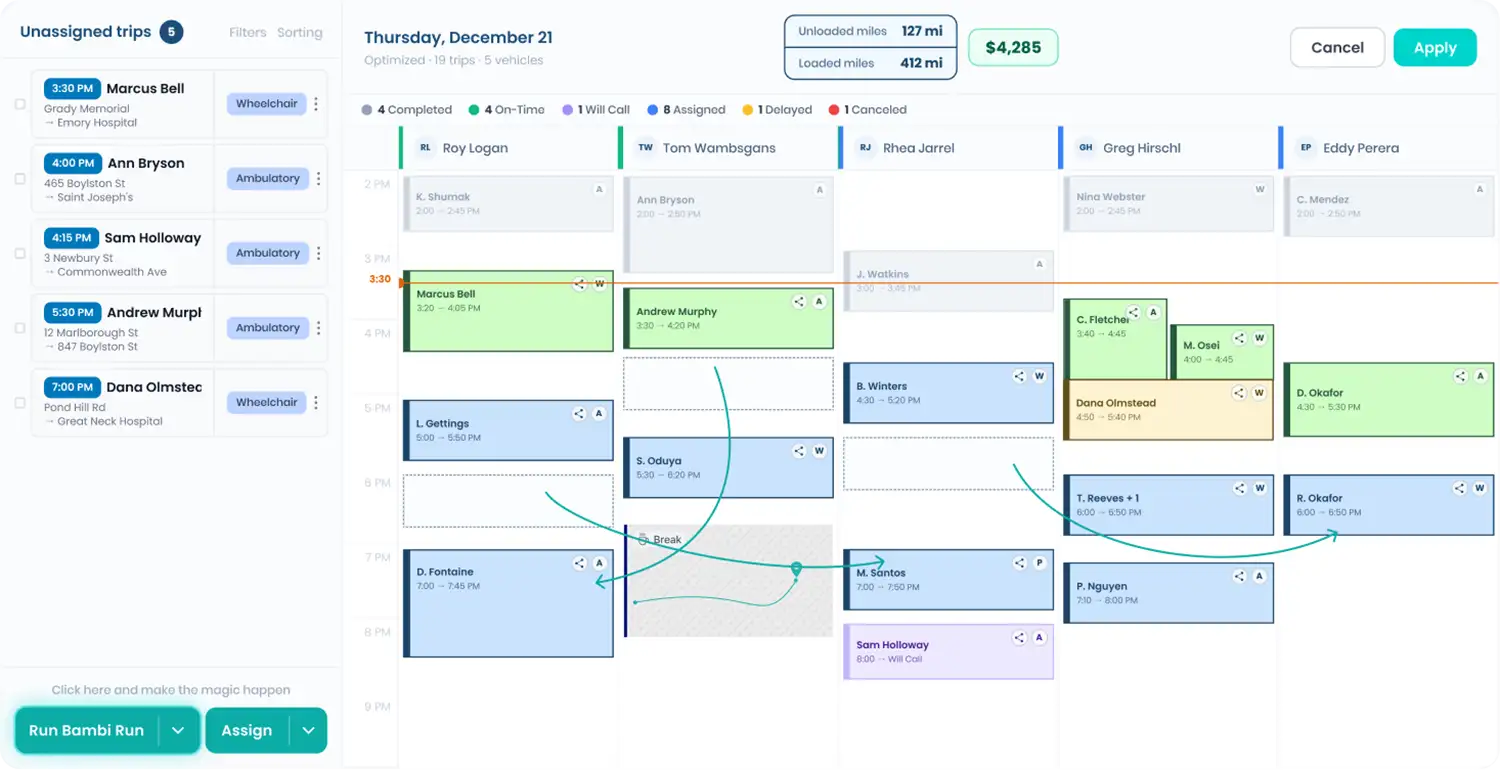

Managing a Non-Emergency Medical Transportation (NEMT) business involves handling drivers, vehicles, patient schedules, billing, and compliance. Dispatch software simplifies this by providing detailed reports that turn raw data into actionable insights. These reports help identify inefficiencies, track performance, and ensure compliance with Medicaid and broker requirements. Here's what you can expect:
- Trip Performance: Analyze on-time pickups, trip completion rates, cancellations, and delays.
- Driver Activity: Monitor work hours, productivity, and certifications.
- Billing and Reimbursement: Automate claims, track denials, and manage cash flow.
- Fleet and Route: Optimize routes, track fuel usage, and schedule maintenance.
- Compliance Dashboards: Stay audit-ready with automated tracking of certifications and inspections.
These tools allow NEMT providers to improve efficiency, reduce costs, and meet regulatory standards, ensuring better service and smoother operations.

Trip Performance Reports
Trip performance reports provide a straightforward view of how your service is performing. They cover everything from pickups and drop-offs to cancellations and delays, helping you identify and address inefficiencies early on. These insights enable smarter decisions about scheduling and routing.
The data can reveal telling patterns. For instance, you might notice that certain routes are consistently delayed, or that specific drivers struggle with punctuality. Take the example of a California-based NEMT provider that serves patients with specialized needs. By adopting an integrated reporting system in 2025, they saw a 40% drop in late pickups. Such results show the power of actively monitoring and analyzing performance metrics.
Key metrics to review include on-time performance, trip completion rates, no-show rates, and ETA accuracy.
On-Time Performance and Trip Completion Rates
Two essential metrics to keep an eye on are on-time pickup rate and trip completion rate. The on-time pickup rate measures how often drivers arrive as scheduled, while the trip completion rate tracks the percentage of trips successfully carried out.
Using automated route optimization and reporting tools can improve on-time arrivals by as much as 50%. This not only enhances patient satisfaction but also reduces complaints and ensures more dependable service. For example, if you notice frequent cancellations at specific times or delays on certain routes, you can adjust pickup windows using historical data, reroute drivers to avoid traffic bottlenecks, and offer targeted training to drivers who need support.
In addition to punctuality, other metrics like no-shows and ETA accuracy provide valuable insights into your operations.
No-Show and ETA Accuracy Reports
Tracking no-shows and ETA accuracy ensures a complete picture of your service. No-shows can be costly. When a patient misses a scheduled trip, resources like driver time, vehicle use, and fuel go to waste. No-show reports help identify patterns, such as patients who frequently miss appointments. By using smart dispatch systems and detailed reporting, you could reduce missed trips by up to 30% within three months.
ETA accuracy reports evaluate how reliable your estimated arrival times are. For example, if a patient is told their ride will arrive at 10:00 AM but it consistently shows up late, it damages trust in your service. A New York-based NEMT provider serving Medicaid patients tackled this issue by introducing real-time vehicle tracking and reporting in 2025. The result? A 60% drop in complaints about waiting times. Accurate ETAs not only improve patient trust but also make dispatch planning more efficient.
Driver Activity and Performance Reports
Driver activity reports offer a clear view of clock-in and clock-out times through mobile apps, using GPS to verify locations. This ensures accurate shift tracking and helps prevent time theft. The system also keeps tabs on critical credentials like driver’s licenses, CPR certifications, PASS training, and drug testing. Alerts notify you of upcoming expirations, so nothing slips through the cracks. Additionally, it categorizes staff as either W2 or 1099 employees, simplifying payroll and ensuring compliance with Medicaid and ADA requirements through timestamped records.
Driver Logs and Work Hours
Dispatch software generates detailed logs that include trip timestamps, odometer readings, and the number of patients transported during each shift. These logs are audit-ready and can be exported in formats required by major brokers, cutting down on administrative errors and speeding up reimbursement processes. For added convenience, you can integrate these logs with accounting tools like QuickBooks, making it easier to transition from activity records to invoicing and payroll.
Driver Productivity Reports
Productivity reports go beyond basic record-keeping by evaluating driver efficiency and route performance. These reports measure key metrics such as trips per driver, deadhead miles (distance traveled without passengers), and route adherence using GPS data. This level of insight allows you to identify top-performing drivers and address inefficiencies. For example, if a driver accrues excessive deadhead miles, you can adjust their route or provide additional training.
Real-time dashboards allow you to monitor delays or conflicts as they happen, eliminating the need to wait for end-of-day reports. By reviewing weekly and monthly trends, you can forecast future performance and optimize staffing levels during peak demand periods. This proactive approach helps keep operations running smoothly while controlling costs.
Billing and Reimbursement Reports
After operational and driver reports, billing reports take financial management to the next level by ensuring accuracy and improving cash flow.
Modern dispatch software transforms trip data into billable claims, cutting out manual entry and reducing errors. These systems run automated checks for modifiers, payer rules, and coding issues before submission, increasing the chances of first-pass acceptance. Dashboards provide a clear view of claim progress, helping identify and resolve payment cycle delays and rejections.
In some cases, providers have implemented statewide claims systems in just 90 days, recovering thousands of dollars from previously lost submissions.
Claims and Reimbursement Tracking
Claims tracking gives providers visibility into where each claim sits in the payment cycle. Platforms connected to top brokers like Modivcare and MTM carry trip data straight into billing, so payer-specific rules are handled in one system. If your payers require EDI claim files, check which formats a platform produces. GPS data is used to verify route accuracy, ensuring compliance and preventing penalties for overbilling or revenue loss from underbilling.
Denial management tools enable billing teams to quickly correct errors and resubmit claims. To reduce denials, link trip records directly to authorizations in the software, ensuring only approved rides are billed. This avoids issues like expired or missing authorizations. Additionally, comparing actual route geometry to pre-approved routes helps flag deviations so corrections can be made before claims are submitted.
This level of tracking also feeds into broader revenue analysis.
Invoice Summaries and Revenue Trends
Invoice summaries, built on trip and driver data, reveal essential revenue trends. They classify revenue by payer type, enabling providers to see which contracts are driving the most activity. The software calculates revenue per trip, helping identify profitable routes and underperforming contracts. Aging Accounts Receivable (A/R) reports track how long invoices remain unpaid - sorted by payer type (e.g., Medicaid vs. private pay) - to pinpoint cash flow challenges.
MetricTarget/Healthy BenchmarkRisk/Problem ZoneClean Claim Rate95% or higherBelow 90%Claim Denial RateUnder 5%Above 8%A/R Days (Medicaid)30–45 Days60+ DaysNet Collection Rate95–99%Below 95%Write-Off RateUnder 3–5%Above 5%First Pass Resolution85% or higherBelow 75%
To maintain steady cash flow, weekly dashboard audits are recommended, as monthly reviews may miss fast-developing billing issues. Digital invoices can be generated and sent directly from the dispatch panel, streamlining the billing process and improving cash flow predictability. Providers can also download billing data to create summaries by provider, detailing claim counts and total amounts, which are useful for medical and contract audits.
Route Optimization and Fleet Reports
Fleet and route reports go beyond billing to highlight inefficiencies and reveal cost-saving opportunities. These reports keep tabs on everything from fuel usage to vehicle idle time, offering actionable insights.
Automated route planning systems have proven to cut operational costs by 20%–30% and reduce fuel expenses by 15%–25%. By eliminating deadhead miles - achieving a 30% reduction through automation - fuel consumption drops, and driver utilization improves dramatically, jumping from below 60% to over 85%. This means more trips per driver, better deployment of specialty vehicles like wheelchair-accessible vans, and fewer vehicles left unused.
MetricImpact of Optimization/ReportingOperational Costs20%–30% Reduction Fuel Expenses15%–25% Reduction Deadhead Miles30% Reduction Driver UtilizationIncrease from <60% to >85%
Fuel Usage and Vehicle Utilization Reports
Fuel reports provide a detailed breakdown of consumption by route, driver, and vehicle, helping to pinpoint inefficiencies. Dispatch software uses historical and real-time data to suggest the fastest, most fuel-efficient routes, steering clear of traffic jams and construction zones. Multi-load optimization reports also come into play, identifying chances to group compatible pickups into a single trip. This approach maximizes vehicle capacity while cutting down on total miles driven.
Utilization reports focus on balancing workloads across the fleet by monitoring idle time and usage patterns. GPS data can flag drivers with excessive idle times, which waste fuel unnecessarily. Reviewing productivity reports regularly can highlight low-density routes that might benefit from multi-load scheduling. Additionally, analyzing cost-per-trip data can identify specific vehicles or routes that are driving up expenses.
These insights not only boost efficiency but also pave the way for proactive maintenance and longer fleet performance.
Maintenance Alerts and Route Efficiency
Maintenance reports keep track of vehicle health, mileage, and repair history. They also trigger alerts for routine servicing, helping to avoid costly emergency breakdowns. Real-time odometer-based alerts, as opposed to fixed calendar schedules, ensure that service intervals are optimized, extending the lifespan of your fleet.
"The reporting software holds the capability of monitoring driver behaviour and vehicle maintenance. Transportation providers can use this feature to reduce the risk of accidents, and comply with safety regulations." - TripWizard
Route efficiency reports take fleet management a step further by refining scheduling and resource allocation using real-time data. These metrics ensure vehicles undergo regular inspections, maintaining compliance with safety standards. By reducing mileage and idle time, NEMT providers can significantly lower their carbon footprint while supporting broader community goals.
Compliance and Custom Reporting Dashboards
Detailed operational reports are great for managing the day-to-day, but centralized dashboards take things up a notch by providing a big-picture view. These dashboards blend compliance performance with business insights, offering a real-time snapshot of key metrics like Medicaid documentation and patient feedback. Modern dispatch software makes it easy to build customizable dashboards that bring everything together in one place. This saves managers from tedious manual data searches and ensures they have access to role-specific metrics tailored to broker contracts. By combining operational data - like trip performance and fleet reports - with compliance tracking and analytics, these dashboards deliver a unified, actionable view.
Regulatory Compliance Tracking
Just as driver logs and route data boost efficiency, compliance dashboards ensure providers are always audit-ready and following the rules. These tools automate the tracking of critical compliance elements, such as driver certifications, vehicle inspections, and trip documentation. They also use APIs to verify route accuracy and flag deviations that might lead to claim rejections or billing errors.
Take WellTrans, for example. In 2023, the company achieved full operational compliance in just 90 days by digitizing logs and trip details. This move created a clear audit trail for Medicaid, Medicare, and ADA reviews. On top of that, automated alerts for expiring credentials and upcoming inspections helped minimize the risk of compliance issues.
Custom Analytics for Business Insights
Meeting regulatory requirements is important, but custom analytics take reporting a step further by uncovering deeper operational insights. For instance, software can aggregate patient feedback and complaint data to highlight potential service issues. If a dashboard shows repeated delays on certain routes or with specific drivers, managers can address the root causes - whether that’s scheduling adjustments or additional training - before service quality takes a hit.
Sure MET LLC is a great example of how custom analytics can transform operations. After switching to a specialized NEMT platform, the company recovered thousands of dollars in lost claims. The software flagged billing discrepancies their old system missed and revealed gaps in documentation and mileage tracking. By digging into cost-per-trip data and vehicle overhead, they pinpointed revenue leaks and fixed them.
Predictive analytics add even more value by forecasting high-demand periods, enabling providers to adjust staffing proactively. As brokers increasingly rely on data-driven scorecards to assign trip volumes, providers with clear and consistent metrics have a better shot at standing out in a competitive market.
Conclusion
Modern dispatch software helps you work smarter by turning operational data into actionable insights. This allows you to tackle inefficiencies, improve resource allocation, and make decisions grounded in facts rather than assumptions. By keeping track of key performance metrics, you can address problems swiftly and stay ahead of broker and regulatory expectations.
Automated compliance reporting simplifies staying audit-ready. It tracks crucial details like driver certifications, vehicle inspections, and trip documentation. Custom dashboards offer a clear view of revenue patterns and service gaps, giving you the tools to adapt and grow. Peter Drucker famously said, "If you can't measure it, you can't improve it", a sentiment that resonates deeply in NEMT. Transparent, reliable data fosters trust with brokers, healthcare providers, and patients, ensuring your operations run smoothly while meeting all necessary requirements.
Switching from manual vs. automated NEMT scheduling to automated reporting saves time, reduces errors, and delivers the transparency your stakeholders demand. Whether you're overseeing a small fleet or managing a large-scale network, these tools help you provide better service while keeping your business compliant and financially sound.
FAQs
What reports matter most for Medicaid and broker audits?
When it comes to Medicaid and broker audits, certain reports are critical. One of the most important is trip performance metrics, which include details like accurate trip documentation and route verification. These metrics ensure that every trip meets the required standards and can be verified.
Another essential component is billing and reimbursement summaries. These reports are crucial for confirming compliance with Medicaid reimbursement rules, helping to ensure that billing practices are accurate and align with regulatory requirements.
Together, these reports play a key role in showing transparency and maintaining adherence to the standards set by Medicaid and brokers.
How can reporting reduce late pickups and no-shows?
Reporting helps cut down on late pickups and no-shows by providing real-time trip management, driver activity tracking, and performance metrics. With these tools, NEMT providers can make quick adjustments, enhance communication, and fine-tune scheduling. The result? Improved on-time performance and fewer missed appointments.
Which billing reports help prevent claim denials?
Billing reports play a crucial role in preventing claim denials. Reports that ensure accurate trip documentation - like trip performance and route verification reports - help confirm that all necessary details are properly recorded. Similarly, billing summaries that verify mileage accuracy and service details are key to minimizing mistakes that might result in claim rejections.
Run the numbers: the free NEMT operational cost estimator puts a yearly dollar figure on empty miles, no-shows, drivers waiting and retyping broker trips.