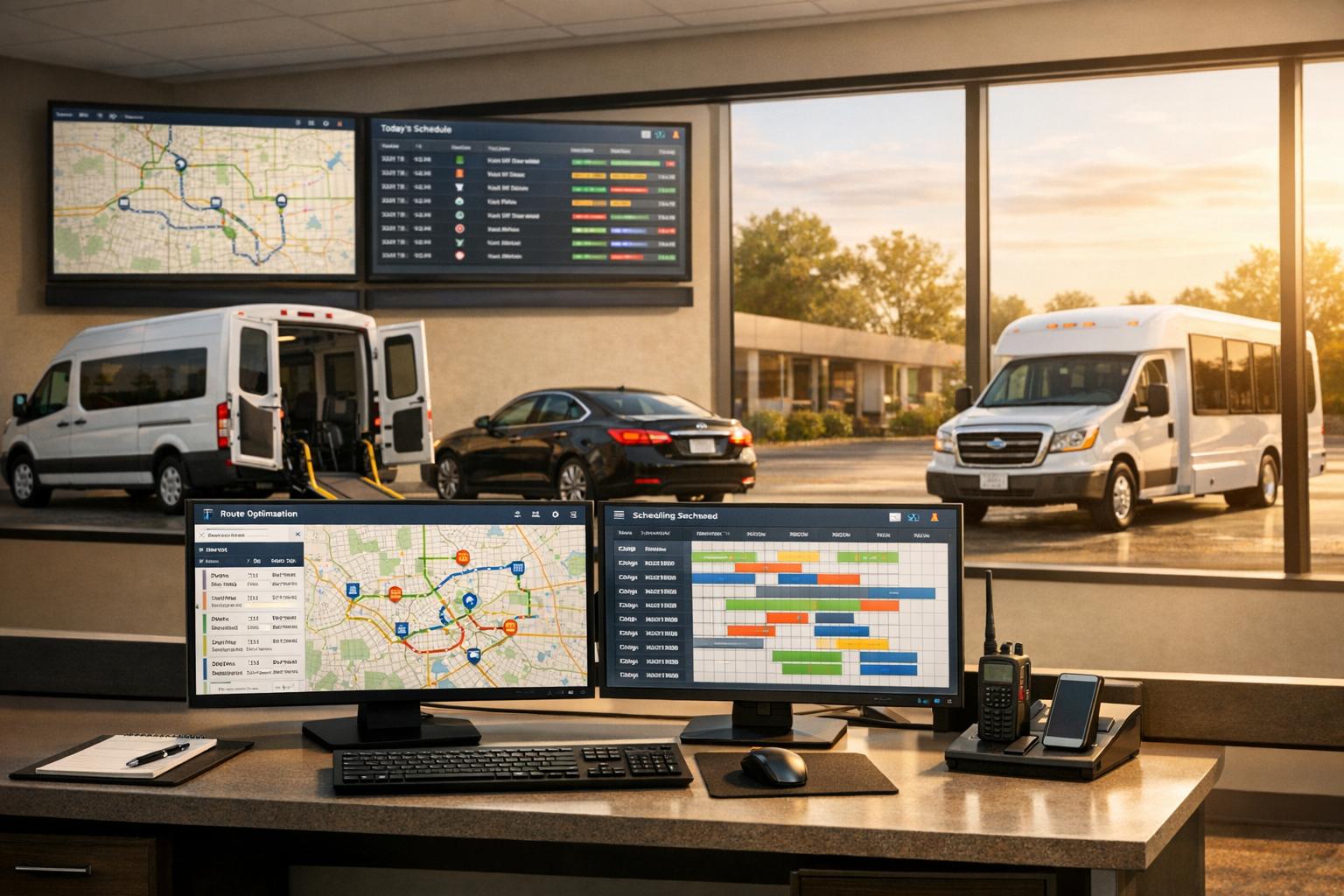
Managing a mixed fleet in NEMT (Non-Emergency Medical Transportation) is complex but solvable with the right tools. Here's how technology helps:
AI Scheduling: Matches patients with the right vehicles (e.g., wheelchair vans, sedans) while reducing human error and saving time.Route Optimization: Minimizes empty miles, cuts fuel costs (15–25%), and improves trip efficiency by up to 40%.Real-Time Tracking: Uses GPS to monitor vehicles, adjust for traffic, and improve on-time performance by 35%.Centralized Dashboards: Streamlines dispatch, compliance, and communication in one system, reducing admin workload by 40%.Predictive Maintenance: Tracks vehicle health to prevent breakdowns, saving up to 30% on operational costs.
Key Benefits of Technology for NEMT Mixed Fleet Management
Common Problems with Managing Mixed Fleets in NEMT
Operating a mixed fleet in Non-Emergency Medical Transportation (NEMT) involves juggling a variety of vehicles - sedans, wheelchair-accessible vans, and stretcher units - each with its own unique requirements. This complexity often leads to operational headaches that can hurt both service quality and profitability. Below, we’ll break down the key challenges by vehicle type, regulations, and communication gaps.
Different Vehicle Types Need Different Handling
One major hurdle is ensuring the right vehicle is matched to the right patient. For instance, a patient who needs oxygen support can’t use a standard sedan, while sending a stretcher van for a routine ambulatory trip wastes valuable resources. As noted by NextBillion.ai :
Failing to meet special needs of patients could lead to patient safety risks with regulatory consequences, cancellations of contracts or partnerships due to questionable service reliability.
Manual dispatching methods, such as relying on memory or outdated spreadsheets, make it easy to mismanage resources. Specialty vehicles may sit idle while patients with specific needs are delayed or improperly assigned. Some providers attempt to use skill-based tags (like "Code 101" for wheelchair ramps), but manual tracking is prone to errors.
Meeting Regulations for Different Vehicle Categories
Each type of vehicle comes with its own set of regulatory requirements. For example, wheelchair-accessible vans must comply with ADA standards and often require drivers trained in safe loading and unloading procedures. Larger vehicles, on the other hand, may require drivers to hold DOT/CDL certifications and adhere to strict Hours of Service logs. Additionally, all trips must follow HIPAA guidelines to protect patient health information.
The paperwork can be overwhelming. Medicaid trips, for instance, demand detailed audit trails that differ from those required for private-pay services. Specialized vehicles often need daily pre-trip inspections for equipment like wheelchair lifts and ventilators. When Premier Medical adopted digital compliance tracking, they achieved 100% HIPAA compliance and cut administrative time in half. Without centralized systems, providers risk missing key deadlines for driver license renewals, vehicle inspections, and insurance updates - potentially leading to fines and service disruptions.
Communication Problems Between Dispatchers and Drivers
Poor communication between dispatchers and drivers creates inefficiencies across the board. Relying solely on phone calls and spreadsheets prevents real-time tracking of vehicle locations, leaving dispatchers guessing about estimated arrival times. One New York NEMT provider serving Medicaid patients reduced customer complaints about wait times by 60% after implementing real-time vehicle tracking.
Manual systems also struggle to handle last-minute changes, such as cancellations or return trip requests, leaving drivers in the dark about schedule updates. Without live traffic or weather data integrated into dispatch systems, vehicles can get stuck in congestion, leading to late pickups and missed appointments. MedTransport Solutions tackled these issues with automated coordination, achieving a 40% cost reduction, a 25% increase in trips per vehicle, and a 95% on-time rate. Driver utilization rates improved dramatically, jumping from under 60% with manual routing to over 85% with automation.
These challenges highlight the pressing need for technological solutions, which will be explored in the next sections.
Artificial intelligence is reshaping how NEMT (Non-Emergency Medical Transportation) companies coordinate patient trips. Instead of relying on time-consuming phone calls and spreadsheets, AI systems quickly process a wide range of variables - like wheelchair accessibility, oxygen support, driver qualifications, and appointment times - to create optimized schedules in seconds. This eliminates much of the guesswork and human error, ensuring patients are paired with the right vehicles. It’s an approach that allows mixed fleets to function more efficiently by aligning vehicle features with specific patient needs.
Automated Scheduling for Different Vehicle Types
AI-driven scheduling tools analyze fleet capabilities and match vehicles - such as those equipped with wheelchair lifts or oxygen tanks - with drivers who have the necessary certifications.
The system prioritizes using in-house vehicles first, only turning to subcontractors or taxis when the primary fleet is fully booked. A great example of this in action is CareRide , which expanded its fleet from 10 to 30 vehicles in 2024, increasing operations by 300% without hiring additional dispatch staff. Remarkably, they maintained a 99% patient satisfaction rate during this growth. AI also handles real-time adjustments, instantly recalculating routes and reassigning vehicles when cancellations or delays occur.
Additionally, multi-passenger ride-sharing algorithms make it possible to group two to six compatible riders into a single trip. These algorithms consider factors like time windows and medical requirements, ensuring that each vehicle operates at maximum efficiency.
But scheduling is just one piece of the puzzle. AI also plays a key role in cutting down on inefficiencies, as we’ll see in the next section on route optimization.
Reducing Empty Miles and Boosting Efficiency
Empty miles - those trips where vehicles run without passengers - are a costly drain on resources. AI-powered route planning tackles this issue by sequencing trips to minimize these unproductive miles. This technology can reduce empty miles by 40% and deadhead miles (the distance between drop-offs and pickups) by 30%.
For instance, a midsize NEMT provider in Texas saved over $50,000 in fuel costs within just six months of adopting automated route optimization. During that time, they also increased their monthly trip volume by 25%. This was achieved by implementing strategies like facility clustering, where patients from the same nursing home or dialysis center are grouped into shared trips, and chaining multi-leg journeys (e.g., home → clinic → pharmacy → home) to keep vehicles busy throughout the day.
AI systems are capable of optimizing more than 100 routes in mere seconds - a task that would take hours using manual methods. Driver efficiency also sees a dramatic boost, with utilization rates climbing from under 60% with manual routing to over 85% when AI is in charge. Beyond that, these systems constantly monitor live traffic and weather conditions, rerouting drivers as needed to avoid delays caused by accidents or construction. This level of dynamic coordination simply isn’t achievable with static spreadsheets and manual planning.
Real-Time Tracking and Route Optimization
GPS tracking has revolutionized how NEMT companies manage their fleets by offering dispatchers real-time visibility . Instead of relying on manual check-ins, dispatchers can now monitor vehicle locations on a digital map, enabling quick decisions when delays occur. This technology, known as Automatic Vehicle Location (AVL) , also benefits patients by allowing them to track their ride's progress through app-based platforms, cutting down on customer inquiries. With this level of tracking, the foundation is set for dynamic routing, which takes fleet efficiency to the next level.
The numbers tell the story. Metro Services in Phoenix, Arizona, expanded its fleet from 7 to 20 vehicles over three years using real-time tracking and advanced analytics. As a result, their on-time performance rose from 89% to 97% , and customer satisfaction improved from 87% to 96%. Similarly, Aerocare Transport in Ohio grew its fleet from 8 to 18 vehicles in just 18 months. By adopting automated GPS tracking, they increased their monthly trips by 150% - from 580 to 1,450 - while cutting fuel costs from 28% to 21% of their total operating expenses.
Using Traffic and Weather Data
These systems go beyond simple tracking by incorporating live traffic and weather updates to reroute drivers around accidents, construction zones, or severe weather conditions. This dynamic rerouting ensures schedules stay on track, even when unexpected roadblocks arise. The system considers over 50 routing factors, such as one-way streets, restricted zones, and sudden closures, to keep everything running smoothly.
The financial benefits are hard to ignore. Advanced GPS tracking and route optimization can improve on-time arrivals by up to 50% compared to manual methods, while reducing fuel costs by 15% to 25%. Geofencing adds an extra layer of oversight by sending alerts if drivers stray from approved routes or enter restricted areas, ensuring they stay on course and reach pickup points as planned. Combined with dynamic routing, GPS data ensures both timely pickups and drop-offs.
Keeping Pickups and Drop-offs on Schedule
Accurate route planning plays a crucial role in the quality of NEMT services. Delayed rides can disrupt treatment schedules and increase healthcare costs. GPS-integrated platforms solve this problem by matching patient-specific needs - such as wheelchair or stretcher accommodations - with the nearest suitable vehicle in the fleet.
This approach has a direct impact on healthcare outcomes. It can lead to a 40% increase in treatment adherence and lower hospital readmissions. For instance, Valley Rise Transportation in Pennsylvania expanded its fleet from 6 to 15 vehicles over two years. By using tracking and scheduling tools, they improved driver efficiency from 3.5 to 5.4 trips per day. At the same time, the owner's administrative workload dropped significantly, from 45 hours to just 18 hours per week. Automated notifications sent via text or app keep patients updated on driver locations and estimated arrival times, reducing no-shows and building trust in the service.
Centralized Dashboards for Fleet Management
Centralized dashboards bring all fleet data into a single, real-time view, eliminating the hassle of juggling spreadsheets, phone calls, and paper logs. This streamlined system makes it easier to manage various types of vehicles - whether it's ambulatory sedans, wheelchair vans, or stretcher-equipped options.
For example, some platforms have helped providers expand their fleets by up to 300%, reduce operational costs by 40%, and improve trip efficiency by 25%, all while maintaining strong on-time performance. These systems offer real-time GPS tracking on interactive maps, allowing users to instantly see driver statuses, passenger loads, and vehicle locations. By integrating real-time tracking and route optimization, these dashboards connect every part of fleet management into one cohesive system.
Better Communication Between Teams
Centralized systems also improve communication between dispatchers and drivers. Dispatchers can send detailed trip instructions directly to drivers through mobile apps, while drivers update their status in real time. This streamlined communication helps eliminate coordination issues, boosting fleet productivity. Additionally, automated notifications - via SMS and email - keep patients informed, reducing the volume of inquiry calls.
Role-based access control ensures that corporate administrators have complete oversight, while regional managers and dispatchers only see the data relevant to their roles. This setup not only promotes efficient teamwork but also ensures compliance with HIPAA regulations.
Automated Compliance and Record Keeping
To cut down on manual paperwork, automated compliance tracking keeps all regulatory documentation organized. It digitizes certifications, inspections, and insurance records, sending timely alerts before expirations to prevent any lapses.
For instance, Premier Medical achieved full HIPAA compliance while halving their administrative workload by adopting such a platform. These systems also maintain detailed audit trails, logging user actions and data changes to simplify state inspections and Medicaid audits. Digital signatures replace traditional paper-based trip verifications, offering immediate proof of service for billing and speeding up the documentation process. Raquel Purvis, Owner of Goodwill Transportation Services , shared her experience:
"NEMT Platform is amazing. For a team that runs over 300 legs daily to have the support of their team is a breath of fresh air. One of my biggest issues before utilizing them was billing. They handle that process with ease ensuring all claims are filed timely."
The dashboard also tracks vehicle-specific features - like wheelchair lifts, stretcher tie-downs, or oxygen equipment - ensuring that patients are matched with vehicles suited to their medical or mobility needs. This precise matching system prevents errors and keeps your mixed fleet running smoothly across all vehicle types.
sbb-itb-6bd01f8 Predictive Maintenance and Telematics for Mixed Fleets
Telematics systems are reshaping how vehicle maintenance is managed by offering real-time performance monitoring. These systems collect data on engine fault codes, battery health, and overall vehicle performance, enabling fleet managers to detect issues - like a weakening battery or engine trouble - before they escalate into costly roadside breakdowns. For mixed fleets that include sedans, wheelchair vans, and stretcher vehicles, this technology is especially helpful, as it addresses the unique maintenance needs and usage patterns of each vehicle type. By doing so, telematics builds on earlier tech-driven improvements, ensuring vehicles are always ready for the road.
The move from traditional preventive maintenance to predictive maintenance marks a significant shift in fleet management. Similar to how AI optimizes scheduling and routing, predictive maintenance uses real-time data to keep vehicles in peak condition. Instead of sticking to rigid schedules, such as servicing every 5,000 miles or six months, telematics tracks actual mileage and operating hours , triggering maintenance only when necessary. For instance, a system might automatically generate a maintenance ticket at 450 hours for a vehicle that needs servicing every 500 hours. This smarter, data-driven strategy has helped organizations save as much as $4.2 million in repair and downtime costs .
Using Data to Predict Repair Needs
Telematics relies on IoT sensors to monitor key physical variables - like vibration, temperature, pressure, and noise - detecting anomalies that indicate potential failures. When an issue is spotted, fleet managers are notified immediately, allowing them to address problems before they escalate into major breakdowns. This condition-based monitoring applies across all types of vehicles, from standard sedans to specialized ones equipped with wheelchair lifts or stretcher systems.
Fuel consumption tracking is another useful feature. Irregular fuel patterns can signal mechanical issues, such as problems with oxygen sensors, clogged filters, or engine defects. By analyzing historical data and performance trends, AI models establish "health metrics" for vehicle components and flag deviations that could disrupt operations. This proactive approach ensures that small issues are addressed early, preventing them from turning into costly repairs.
With its focus on early fault detection, predictive maintenance not only reduces downtime but also lowers repair expenses.
Lowering Downtime and Repair Costs
Predictive maintenance offers clear financial advantages by keeping vehicles operational longer and avoiding unnecessary repairs. When combined with automated route planning, this approach can cut operational costs by 20% to 30% and reduce fuel expenses by 15% to 25% . Additionally, electronic DVIRs (Driver Vehicle Inspection Reports) allow drivers to upload defect photos directly to maintenance dashboards, speeding up the repair process.
By using predictive analytics to schedule maintenance during off-peak times, service disruptions are minimized. This strategy also extends the lifespan of vehicles, often surpassing their typical operational limits.
Feature
Preventive Maintenance
Predictive Maintenance
Trigger Calendar or set mileage intervals
Real-time vehicle condition data
Method Manual observation and inspections
Automated sensors and machine learning
Efficiency May replace functional parts early
Fixes issues only when necessary
Downtime Scheduled but sometimes excessive
Reduced by avoiding unexpected failures
How Bambi Software Supports Mixed Fleet Operations
Bambi Software showcases how technology can streamline mixed-fleet operations by combining scheduling, compliance, and communication tools into a single platform. This makes it easier to coordinate a variety of vehicles, such as sedans, wheelchair vans, and stretcher-equipped options.
With accolades like the NEMTAC Innovation in NEMT Award 2025 and a perfect 5.0-star rating on major platforms, Bambi is priced at $69 per vehicle per month with no hidden fees. Its integrated system helps operators manage different vehicle types effortlessly.
The "Run Bambi Run" feature leverages AI to instantly optimize schedules, matching passengers with the right vehicles and certified drivers. Dispatchers can set specific constraints, ensuring that only vehicles with necessary features and qualified crews are assigned.
"Switching over to Bambi is the most impactful thing I've done for my NEMT business. Bambi's AI is saving my staff hours of daily work." – Jeffrey Hoff, Owner, Reliant Transport
Bambi dynamically adjusts trips in real time. Operators can oversee multiple depots and vehicle categories from a single account, while also tracking vehicle health and maintenance to minimize downtime. The platform includes a driver app for iOS and Android, connecting drivers and dispatchers with real-time trip updates, navigation, and automated notifications.
"Bambi's been a game changer for us, especially with the scheduler optimizer. Beforehand, assigning the trips to the drivers was very time consuming, and now with Bambi, it's as easy as clicking Run Bambi Run!" – Tanner Ramsey, Dispatcher, PrimeCare Patient Transport
In addition to its scheduling capabilities, Bambi simplifies compliance and regulatory processes.
Better Scheduling and Compliance Management
Bambi tackles challenges like manual adjustments, regulatory complexities, and communication gaps with tools such as pre-shift vehicle inspections, GPS-based timestamps, and electronic signatures for service verification. An audit trail tracks all system changes, offering clear documentation for regulatory reviews. This automated compliance system works seamlessly across all vehicle types, ensuring safety and legal standards are met.
The platform is HIPAA-compliant , safeguarding rider privacy. Integrations with brokers like SafeRide and Modivcare allow for automated trip intake from multiple sources. Companies using Bambi's dispatch solutions have reported a 35% improvement in on-time performance and a 60% faster response time to scheduling changes.
"You can book a trip within about two or three minutes. It cut my time in half." – Tony Jackson, Top Choice Medical Transport
Conclusion
Managing a mixed NEMT fleet doesn’t have to feel like an uphill battle. By leveraging automated scheduling, you can slash dispatcher workloads by 40%. Add AI-powered route optimization, and you’re looking at cutting costs by 20–30% while reducing empty miles by as much as 40%. On top of that, many companies see on-time performance improve by 35% and fleet utilization jump by 42% with integrated dispatch systems.
A smart way to start? Roll out a pilot program at one of your most stable locations. This helps you test the technology, gather insights, and build internal buy-in. Look for platforms that offer real-time GPS tracking, automated compliance tools, and centralized dashboards for a clear, unified view of your operations. Make sure the solution integrates seamlessly with your existing systems and includes mobile apps for drivers to keep things running smoothly.
The benefits aren’t just theoretical. Real-world results show reduced costs, more trips per vehicle, and happier patients. It’s no wonder that 32% of businesses report achieving a positive ROI in under a year. Choosing a unified platform that combines scheduling, compliance, and real-time tracking could be the key to transforming how you manage your fleet.
FAQs
How does AI-powered scheduling improve efficiency for NEMT companies with mixed fleets?
AI-driven scheduling transforms how NEMT providers manage their operations. It automatically matches trips with the best-suited vehicles, fine-tunes routes in real time, and adjusts seamlessly to unexpected events like traffic jams or last-minute cancellations. The result? Shorter travel times, lower fuel usage, and less vehicle downtime - all of which contribute to better punctuality and reduced costs.
On top of that, AI can anticipate when vehicles need maintenance, keeping them in excellent condition and cutting down on surprise breakdowns. By improving communication between dispatchers and drivers, AI scheduling ensures a smoother, more dependable transportation experience for both providers and passengers.
How does predictive maintenance benefit NEMT providers?
Predictive maintenance is a game-changer for NEMT providers, helping them spot potential vehicle problems before they escalate into costly breakdowns. By leveraging data from GPS systems, telematics, and onboard sensors, it identifies components that need attention, enabling timely repairs and reducing unplanned downtime. This proactive strategy doesn't just prevent disruptions - it can save providers a lot of money, with downtime costs often ranging between $448 and $760 per vehicle per day .
But the benefits go beyond cost savings. Predictive maintenance helps extend the lifespan of vehicles, improves safety, and ensures compliance with healthcare regulations that demand reliable transportation. With fewer unexpected repairs, drivers can stay focused on delivering timely and efficient trips, boosting overall fleet performance and enhancing the quality of service for patients.
How do centralized dashboards improve communication and ensure compliance for NEMT providers?
Centralized dashboards pull together all the critical data - like GPS locations, driver updates, vehicle maintenance logs, and billing records - into one convenient platform. This setup allows dispatchers to monitor vehicles in real-time, communicate instantly with drivers, and reassign trips on the fly. The result? Smoother coordination across mixed fleets and fewer delays caused by scattered communication. For Non-Emergency Medical Transportation (NEMT) providers, this means more dependable service delivery.
These dashboards also take the hassle out of compliance by automating repetitive tasks. Integrated telematics, for instance, can track mileage and flag maintenance needs, while billing tools generate invoices complete with the necessary documentation as trips wrap up. Plus, with a fully searchable audit trail, managers can quickly produce reports to meet Medicaid, Medicare, or state transportation requirements. These capabilities make centralized dashboards a must-have for keeping mixed fleet operations compliant and running efficiently.
Related Blog Posts 


Comments
Lorem ipsum dolor sit amet, consectetur adipiscing elit. Suspendisse varius enim in eros elementum tristique. Duis cursus, mi quis viverra ornare, eros dolor interdum nulla, ut commodo diam libero vitae erat. Aenean faucibus nibh et justo cursus id rutrum lorem imperdiet. Nunc ut sem vitae risus tristique posuere.