
Non-Emergency Medical Transportation (NEMT) providers face challenges like handling last-minute schedule changes, managing diverse passenger needs, ensuring compliance with regulations, and reducing inefficiencies in routing and billing. Manual processes often lead to higher costs, missed appointments, and patient dissatisfaction. This is where scheduling tools come in to simplify operations.
Below is what an NEMT scheduling tool needs to handle, the U.S.-specific requirements to check, and how Bambi handles that checklist.
How to Choose NEMT Scheduling Tools
Picking the right scheduling software can revolutionize your NEMT operations. The key is to focus on features that solve your specific challenges and help your business thrive. Let’s dive into the essential features every NEMT scheduling tool should include.
Core Features for Scheduling Optimization
- Real-time fleet tracking and GPS integration: This feature provides complete fleet visibility and uses advanced route optimization to adapt to traffic, weather, and past travel data.
- Automated scheduling and route optimization: Handles multiple factors like patient mobility needs, vehicle requirements, driver qualifications, and appointment priorities. Machine learning continuously improves scheduling decisions.
- Patient management system: Stores detailed patient information while ensuring HIPAA compliance. It also integrates seamlessly with healthcare and insurance platforms.
- Mobile driver applications with offline capabilities: Gives drivers access to trip details, navigation, and communication tools - even in areas with low connectivity.
- Advanced billing and claims processing: Simplifies financial operations by managing payment sources, reimbursement rates, and documentation. It integrates with Medicaid and private insurers for real-time claims processing.
- Reporting and analytics dashboard: Offers real-time insights into key performance indicators (like on-time performance and vehicle utilization) and uses predictive analytics to support decisions about fleet expansion and service improvements.
- Integration and API capabilities: Ensures compatibility with EHRs, insurance platforms, and Medicaid systems, reducing manual data entry and eliminating silos.
U.S.-Specific Requirements
NEMT providers in the U.S. face unique regulatory and operational demands. Here’s what you need to know:
- HIPAA compliance: This is non-negotiable. Non-compliance can lead to fines as high as $50,000 per violation. Choose software designed with compliance at its core, not as an afterthought.
- Medicaid integration: This directly affects your revenue. Your software must manage Medicaid eligibility, prior authorizations, and trip documentation to maintain billing accuracy. Mistakes in compliance can result in clawbacks worth hundreds of thousands of dollars.
- Integration with your NEMT brokers: If you work with brokers like Modivcare or MTM, ask how each one connects. A live API connection brings trips in automatically; a file import means someone downloads and uploads the broker trip file. Both work, but you should know which you are buying, broker by broker.
- Billing system compatibility: Smooth financial operations depend on software that turns completed trip data into invoices your payers accept and exports cleanly to your accounting tools.
- Dispatch-to-billing synchronization: When trip records flow straight into billing, you avoid retyping and catch missing signatures or timestamps before a claim goes out.
When considering the total cost of ownership, don’t just look at licensing fees. Factor in implementation, training, support, and integration costs. Request demos and trial periods to evaluate the interface, system speed, and customer support. A vendor’s history of innovation and reliability is critical since this software is a long-term investment for your business.
With these features and requirements in mind, you are ready to evaluate any scheduling tool. Here is how Bambi measures up.
How Bambi handles NEMT scheduling

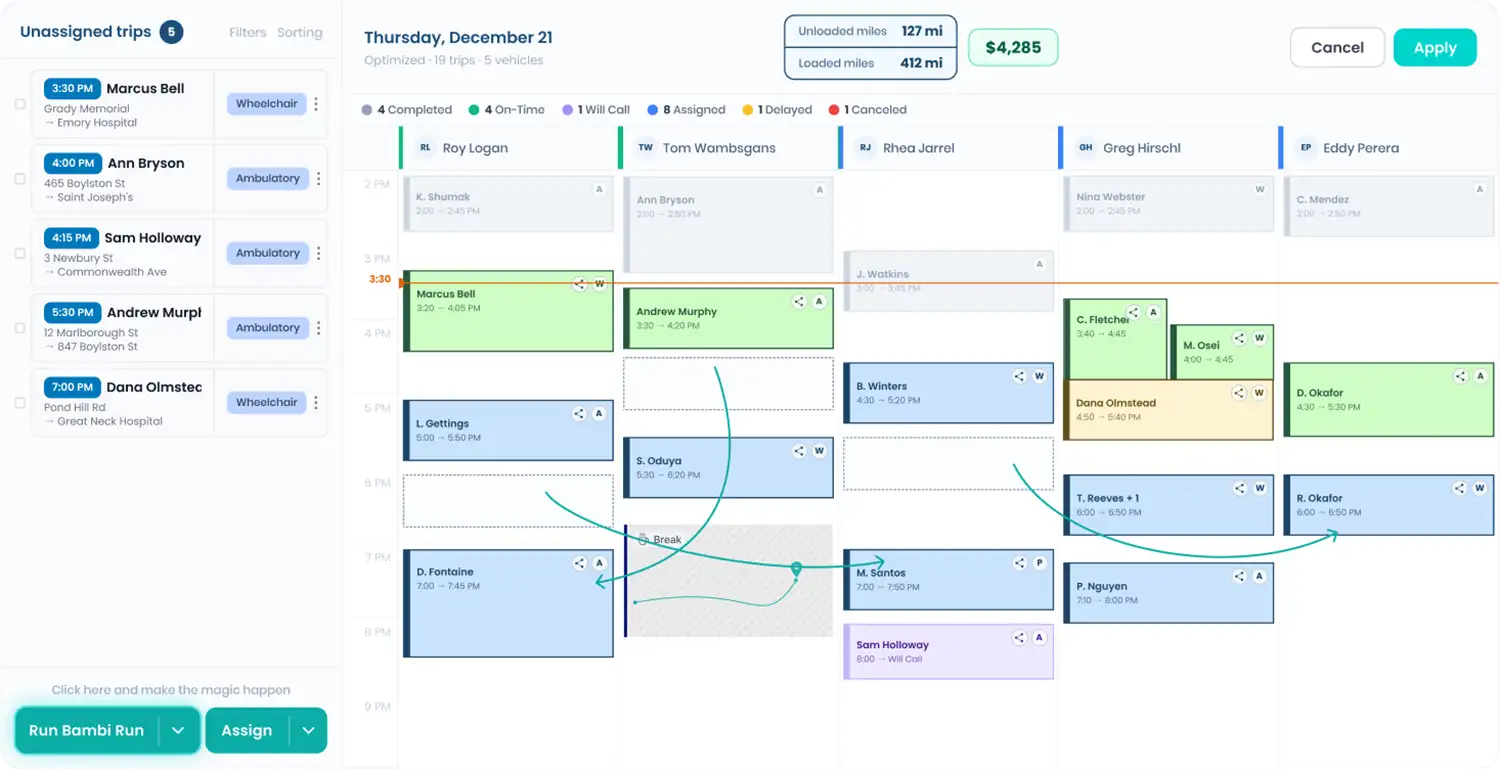
Bambi simplifies scheduling with its AI-driven tools, automating time-consuming manual processes. Its standout feature, Run Bambi Run, uses machine learning for one-click scheduling and efficient fleet assignments. The real-time conflict prevention system identifies scheduling overlaps and provides alternatives based on factors like vehicle availability, driver assignments, and travel times. This live scheduling capability ensures quick adjustments for delays, traffic, or last-minute requests.
Key features include fleet management, staff scheduling, advanced pricing rules, integrations with brokers like SafeRide and Modivcare, real-time GPS tracking, and an NEMT Driver App for seamless communication. Bambi also prioritizes compliance with HIPAA, offers GPS timestamps with audit trails, and boasts a 5.0-star rating.
Pricing: $69 per active vehicle per month, with no hidden fees.
How to Choose the Right Tool for Your NEMT Business
Picking the right tool for your Non-Emergency Medical Transportation (NEMT) business isn't just about ticking boxes - it’s about finding a solution that aligns with your operations and helps you tackle scheduling challenges head-on. Whether you’re managing a small fleet or overseeing a multi-state operation, the right tool can streamline processes and boost efficiency.
Start by evaluating your budget. Some tools, like Bambi, offer clear pricing models, while others may require custom quotes. If manual errors are a recurring issue, consider an AI-powered solution to automate and simplify your workflows. On the other hand, if you prefer more control, traditional route optimization tools might be a better fit.
Compliance is non-negotiable. Ensure the tool meets HIPAA requirements with features like strong encryption, access controls, and proper documentation. This is critical for protecting sensitive patient information.
Integration is another key factor. The tool should work seamlessly with your existing billing software, electronic health records (EHRs), and state Medicaid systems. This reduces the risk of duplicate data entry and minimizes errors, saving you time and effort.
Think about the implementation process too. Some tools require extensive setup and training, while others are ready to deploy quickly. Factor in the learning curve for your team - both dispatchers and drivers - when planning a transition to a new system.
Scalability is crucial for long-term success. The tool you choose should be able to grow with your business, handling more trips, larger service areas, and increasingly complex routes as your operations expand.
Lastly, prioritize customer support. A provider with responsive and knowledgeable support can make all the difference when scheduling issues arise, ensuring patient care isn’t compromised.
The fastest way to judge any of this is a demo with your own trips. See Bambi run your own trips.
FAQs
What features should an NEMT scheduling tool have to ensure compliance and operational efficiency?
To keep things running smoothly and in line with regulations, an NEMT scheduling tool should offer automated compliance checks. These checks ensure that driver certifications, vehicle safety standards, and necessary documentation are always up to date. Incorporating features like AI-driven scheduling, real-time GPS tracking, and data integration can simplify processes, minimize mistakes, and elevate service quality. Such tools not only help providers adhere to industry standards but also boost reliability and improve patient care.
How can AI-powered scheduling improve efficiency in NEMT operations compared to traditional methods?
AI-driven scheduling is changing the game for NEMT operations by taking over challenging tasks like route planning and dispatching. This not only cuts down on manual work but also reduces mistakes and makes better use of resources.
By leveraging real-time data and sophisticated algorithms, AI fine-tunes routes to cut travel times and save on fuel expenses. It also improves communication between drivers and dispatchers, ensuring pickups and drop-offs happen on time. The outcome? More streamlined operations, better care for patients, and a noticeable boost in productivity.
What should you consider when assessing the total cost of owning an NEMT scheduling tool beyond its upfront price?
When assessing the total cost of ownership (TCO) for an NEMT scheduling tool, it’s crucial to consider more than just the upfront price. Ongoing expenses like maintenance, software updates, training, and customer support can accumulate over time and impact your budget.
You should also account for hidden fees, data security protocols, and any hardware requirements necessary to operate the software. Don’t forget to evaluate the costs associated with scaling the system as your business expands and how well the tool integrates with your current workflows. These factors play a key role in determining the long-term costs and the overall value of the solution.
Run the numbers: the free NEMT operational cost estimator puts a yearly dollar figure on empty miles, no-shows, drivers waiting and retyping broker trips.