About this episode
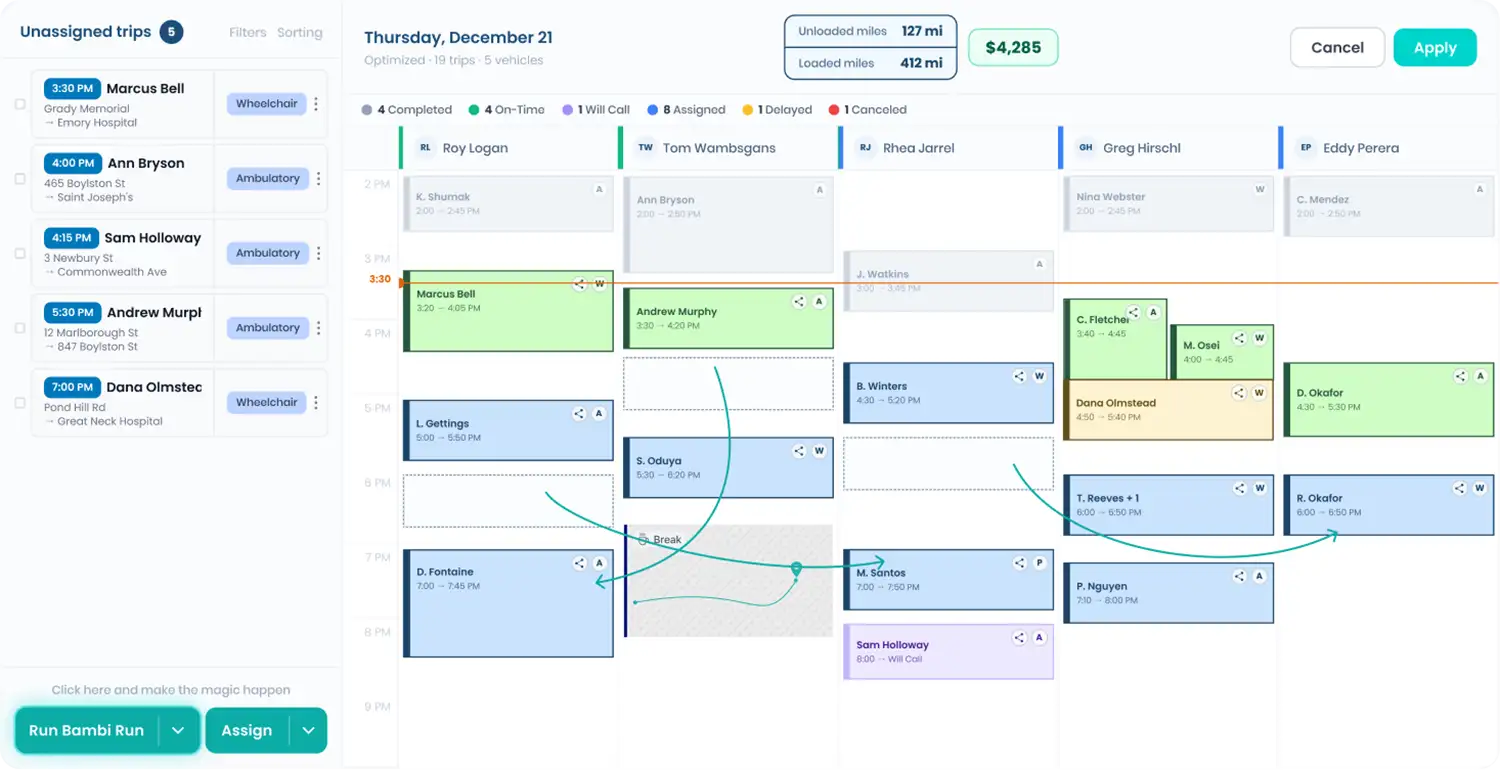
Recorded live at NEMTAC 2023, this episode is a stage presentation by host Nirav Chheda rather than a guest interview. Chheda pulls provider owners out of the audience to work through scheduling scenarios, showing that current optimizers maximize trip count and minimize fleet miles while ignoring the operating costs that decide whether a trip is profitable. He then demonstrates profit based scheduling, continuous background reoptimization when a driver runs late, automatic placement of required driver breaks, and machine learning that predicts will call and hospital discharge timing.
Key takeaways
- Chheda argues current route optimizers maximize completed trips while minimizing total fleet miles, a proxy that ignores whether any single trip actually earns more than it costs to run.
- Calculating profit per trip means folding in thirty to forty operating costs including fuel, labor and vehicle depreciation, which is why Chheda says providers rarely attempt it by hand.
- In the demo, profit aware software recommends putting an extra vehicle on the road and accepting trips a conventional optimizer would reject, because revenue exceeds the marginal cost.
- A real time dispatch scenario shows one new trip cascading across three drivers, moving Margaret to driver A, Bob to driver B and Laura to driver C automatically.
- For will call and hospital discharge trips, Chheda describes models trained on time of day, weather and patient characteristics to predict wait times and appointment lengths.
Chapters
- 0:00 Introduction
- 0:41 Rising costs versus flat reimbursement
- 1:51 What route optimizers actually optimize for
- 3:06 Live scheduling demo with three vehicles
- 5:27 Optimizing for profit per trip
- 7:03 Projecting driver needs days ahead
- 7:56 Real time dispatch reshuffling
- 12:12 Continuous background reoptimization
- 12:44 Placing required driver breaks
- 13:57 Predicting will call and discharge trips