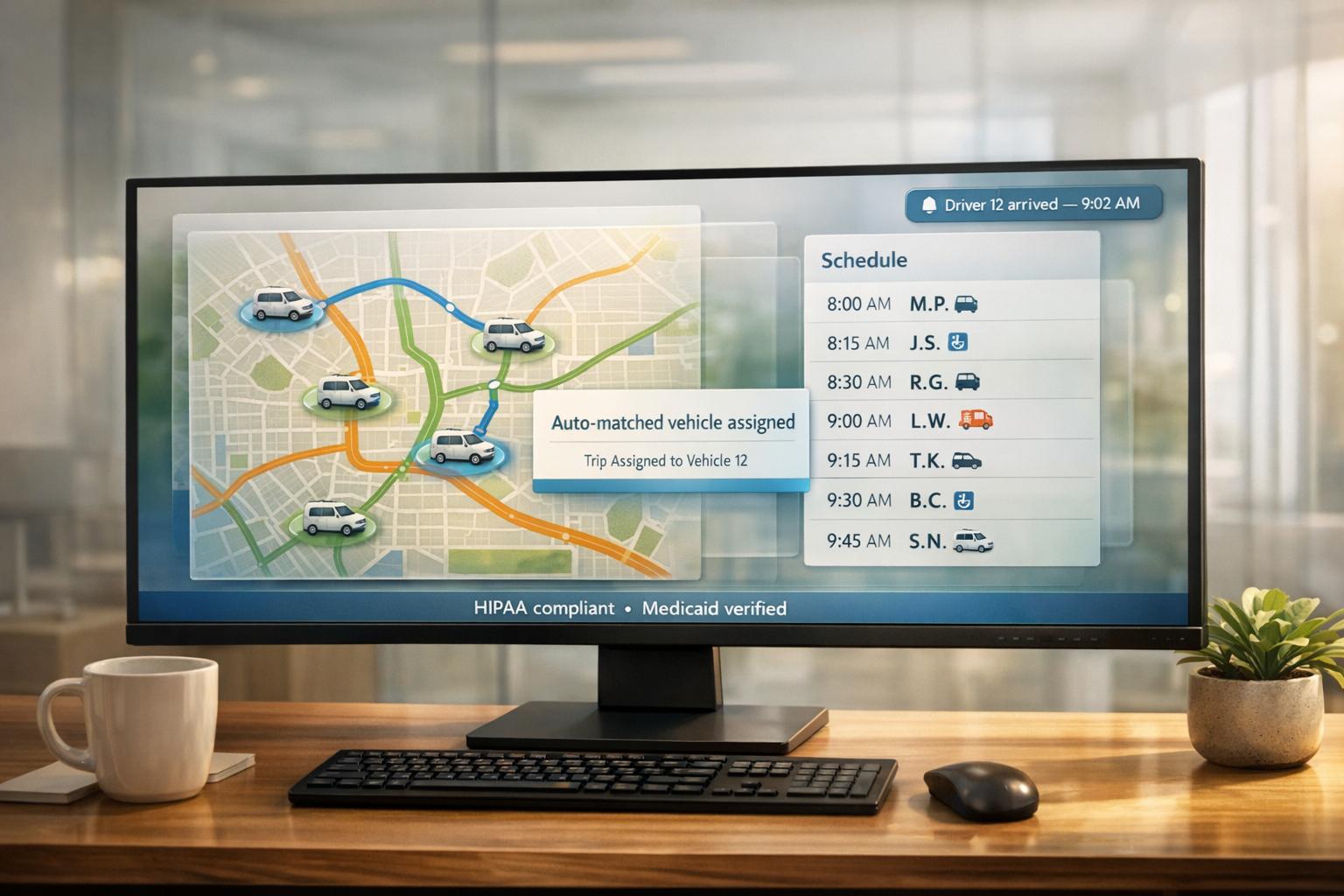
NEMT (Non-Emergency Medical Transportation) providers face daily obstacles in managing schedules for vehicles, drivers, and patient needs. Manual methods like phone calls and spreadsheets often lead to errors, inefficiencies, and compliance risks. AI-powered software, such as Bambi , offers a solution by automating trip assignments, optimizing routes, and providing real-time updates.
Key Benefits of AI-Powered Scheduling:
Automated Trip Matching : Matches trips with the right vehicles and certified drivers, saving time.Smart Route Planning : Reduces deadhead miles by 5–15% and improves trip completion rates by 25%.Real-Time Updates : Keeps dispatchers, drivers, and patients informed, cutting no-show rates by 25–30%.Compliance Made Easy : Ensures HIPAA compliance and automates documentation for Medicaid audits.Cost Efficiency : Affordable pricing at $69/month per vehicle with no hidden fees.
By reducing scheduling time by 40% and increasing fleet efficiency, tools like Bambi help NEMT companies deliver reliable service while meeting regulatory demands.
AI-Powered NEMT Scheduling Software Benefits and Performance Metrics
Common Scheduling Challenges in NEMT Operations
Manual Processes and Human Error
Relying on spreadsheets and phone calls makes it tough for dispatchers to match passengers with the right vehicles and crews effectively. Each trip involves verifying that vehicles have the necessary equipment - like wheelchair ramps or stretchers - and ensuring drivers have the proper certifications. This process is time-consuming and leaves plenty of room for mistakes.
Adding to the complexity is the sheer volume of communication. Dispatchers often face "communication overload" from brokers, care facilities, and patients. Juggling dozens of calls, emails, and texts can lead to missed details, like entering the wrong pickup time or forgetting a patient's need for a stretcher. Even small errors can snowball, disrupting multiple trips and schedules.
These manual processes become even more problematic when unexpected changes arise.
Managing Last-Minute Changes
In NEMT operations, last-minute issues like cancellations, no-shows, or emergency requests happen all the time. For instance, if a driver calls in sick just 30 minutes before their first pickup, dispatchers must scramble to reassign routes, find replacement drivers, and update everyone involved - all while handling new requests. Paper-based schedules quickly become outdated, and without real-time updates on vehicle locations, addressing traffic delays or adding stops becomes a major headache. These inefficiencies often lead to longer wait times and poorly optimized routes.
The constant need to adapt to these dynamic conditions also makes it harder to stay compliant with regulatory requirements.
Meeting Regulatory Requirements
Manual processes further complicate adherence to strict regulatory standards. NEMT providers must ensure compliance with Medicaid reimbursement rules and HIPAA regulations . Each trip requires detailed documentation, including GPS timestamps, electronic signatures, and records of the certified crew member who handled the transport. Relying on paper logs makes it nearly impossible to maintain the comprehensive audit trails that regulators demand, increasing the risk of compliance violations.
Dispatchers also face the challenge of ensuring only certified crews handle specific trips. This means cross-checking driver certifications, vehicle equipment, and maintenance records before assigning trips. Missing any of these steps could lead to safety issues, denied reimbursements, or, worse, jeopardizing the safety of patients during transport.
sbb-itb-6bd01f8 How AI-Powered Software Addresses Scheduling Problems
AI-powered scheduling tools are transforming how operations are managed, offering precision and responsiveness that manual methods simply can't match. These platforms take over the complex task of dispatching by automatically pairing trips with the best-suited drivers and vehicles using real-time data. They analyze a variety of factors - such as vehicle type (ambulatory, wheelchair, stretcher), driver certifications, proximity, traffic conditions, and even past driver performance - to ensure every ride is assigned to the right team. The results? A reduction in deadhead miles by 5%–15% and a decrease in patient wait times of up to 40%.
Automated Trip Assignment
Gone are the days of manually cross-checking driver qualifications, vehicle readiness, and availability. Automated trip assignment handles all of that, sequencing pick-ups, drop-offs, and wait times to prevent double-bookings. Advanced systems can juggle over 50 constraints, such as appointment windows, driver skills, and vehicle equipment, to ensure schedules are both compliant and efficient. If a patient cancels or a last-minute "will-call" trip pops up, the software instantly reworks the routes. This adaptability takes the pressure off dispatchers, who no longer need to scramble to make quick decisions. In fact, switching to AI-powered scheduling can cut scheduling time by 40%. From there, the system integrates seamlessly into dynamic route management.
Smart Route Planning
Smart routing takes things a step further by continuously factoring in live traffic, road conditions, and historical data. It optimizes ride-sharing by grouping patients from the same location into one vehicle, maximizing capacity while cutting down on the number of vehicles needed. Providers using automated routing have seen a 25% increase in completed trips without adding more vehicles or drivers. The system also keeps track of vehicle maintenance schedules and driver working hours, ensuring safety and compliance while avoiding overuse of resources. Together, automated assignments and optimized routing make the most of every fleet.
Real-Time Updates and Driver Communication
Real-time communication tools keep everyone in the loop - dispatchers, drivers, and patients. These features sync data across dashboards and apps, offering live updates on pickup times, locations, and equipment requirements. Automated alerts send reminders, trip status updates, and tracking links directly to patients, which has been shown to lower no-show rates by 25%–30%. James R., Director of Transportation at VitalTrans , highlighted the benefits:
"Real-time GPS and automated trip updates cut our call volume by half. Families and patients love the transparency".
Integrated chat and push notifications allow for quick coordination during delays or route changes. Drivers can also collect electronic signatures and GPS timestamps at pickup, ensuring compliance and eliminating the need for extra paperwork.
Bambi takes the benefits of AI-powered scheduling and turns them into practical, everyday efficiency. Its user-friendly design makes it easy to integrate into your current operations, no matter the size of your business.
Step 1: Evaluate Your Business Needs
Start by assessing your current operations to choose the right software. Take stock of your fleet size, vehicle types, and any special equipment or certifications required. Bambi is designed to scale, whether you’re managing just 3 vehicles or overseeing 10,000+ trips per month. Roslyn Taggart, owner of B811 Medical Transportation , shared:
"It's so easy to use, the Bambi team is always responsive, and the 'Run Bambi Run' scheduler works great even with just 3 vehicles".
If you work with brokers like SafeRide or Modivcare , identify those partnerships early to ensure smooth data integration. Also, review your manual scheduling process - how much time is spent on it daily? This gives you a baseline to measure improvements. Pricing is simple at $69 per month per vehicle , with no onboarding fees, support costs, or long-term contracts.
Once you've mapped out your needs, configure the platform to match your operations.
Set up the system to align with your business requirements. Use the "Driver & Vehicle Constraints" feature to ensure trips requiring specialized care are assigned to the right vehicles and certified drivers. For instance, if a patient needs a wheelchair-accessible van, the platform will automatically assign a driver with the necessary equipment.
Automate recurring trips for patients with regular appointments, saving hours of manual work each week. You can also define vehicle capacities, time buffers for appointments, and driver shift schedules to ensure trips are only assigned when resources are available. If you operate multiple depots, Bambi allows you to manage them all under one account while maintaining separate scheduling rules for each location. The platform is HIPAA compliant , ensuring data security and rider privacy. With the "Run Bambi Run" feature, the AI can instantly analyze trip requests and suggest optimized schedules.
Step 3: Upload and Test Your Data
Next, import your trip data into the platform and verify its accuracy. If you work with brokers, connect with them to automatically pull in trip details that follow your scheduling rules. The system handles last-minute changes, like no-shows or reassignments, while keeping the rest of the schedule intact.
Start small - try scheduling a single day’s trips to compare the AI-generated assignments with your manual process. Are routes more efficient? Are drivers being matched correctly with the right certifications and equipment? Make adjustments to your rules as needed before rolling out the system across your entire operation.
Once you’re confident in the setup, prepare your team to use the platform effectively.
Step 4: Train Your Team
Provide training for your team using Bambi’s tutorials. Dispatchers should learn how to use the "Run Bambi Run" feature and make manual adjustments when necessary. Drivers will need to download the NEMT Driver App pre-shift vehicle inspections .
Bambi offers 24/7 customer support via phone and email to address any questions your team might have. Tanner Ramsey, a dispatcher at PrimeCare Patient Transport , praised the system, saying:
"Bambi's been a game changer for us, especially with the scheduler optimizer. Beforehand, assigning the trips to the drivers was very time consuming and now with Bambi it's as easy as clicking Run Bambi Run!".
Once the platform is live, track key metrics like on-time performance, trip completion rates, and driver utilization. Bambi’s analytics tools make it easy to spot areas for improvement. Jeffrey Hoff, owner of Reliant Transport , shared:
"Bambi's AI is literally saving my staff hours of daily work. Our team has more time to focus on improvements and finding new customers".
Use this data to fine-tune your scheduling rules. For example, if certain routes are consistently delayed due to traffic, adjust your time buffers. Or, if a driver is particularly skilled at handling wheelchair patients, prioritize them for those trips. Bambi has earned a 5.0/5.0 rating on platforms like SourceForge , Slashdot , GetApp , Capterra , Software Advice , and G2 , and it won the NEMTAC Innovation in NEMT Award 2025
Compliance and Efficiency Benefits of Bambi
Navigating federal and state regulations can be a daunting task for NEMT companies. Bambi simplifies this process by automating documentation, safeguarding patient data, and improving communication to cut down on delays.
Maintaining Regulatory Compliance
Bambi's platform is designed to meet HIPAA standards, using encryption, secure servers, and role-based access controls to protect sensitive patient health information. This ensures only authorized personnel can access medical details, reducing the likelihood of privacy breaches. The system also automates the collection of e-signatures and GPS timestamps for every trip, making Medicaid and state compliance straightforward. These tools remove uncertainty during service verification and provide precise records for billing and audits.
With detailed audit trails, Bambi tracks every action within the system, including who accessed information and when. Features like pre-shift vehicle inspections and automated trip logs help maintain safety standards while providing essential documentation for audits. Additionally, the platform verifies driver certifications and vehicle equipment, minimizing compliance errors. By integrating directly with broker systems, Bambi streamlines data sharing and reporting. These compliance tools, combined with real-time communication features, help avoid delays and missed appointments.
Reducing No-Shows and Late Arrivals
Missed appointments and delays can hurt both care quality and operational efficiency. Bambi addresses this with real-time vehicle tracking , SMS updates, and push notifications to keep patients informed. The NEMT Driver App allows drivers and dispatchers to quickly adapt to last-minute changes. For instance, if a patient cancels or a driver gets stuck in traffic, the AI-powered system can instantly reassign trips while ensuring compliance with driver certifications and vehicle requirements.
Measuring and Growing Your NEMT Business with Bambi
Keeping an eye on key metrics is essential for understanding how your NEMT operation is performing. Bambi's platform provides real-time insights into metrics like cost per trip, on-time performance, and error reduction. This helps you see if your scheduling software is cutting costs while improving service quality.
Take cost per trip , for example. This metric reveals how financially efficient your operation is. Industry averages range from $15 to $35, depending on factors like service type and location. If your costs are higher, Bambi’s route optimization tools can help identify where time or miles are being wasted. Similarly, on-time performance is crucial - aim for over 95% to stay competitive and maintain payer contracts. With GPS timestamps and automated trip logs, Bambi ensures precise tracking without the need for manual input.
Another important metric is vehicle utilization rates . A rate above 80% indicates strong efficiency, while anything below 60% suggests untapped capacity for growth. Bambi’s AI can help you complete 25% more trips using the same fleet and driver count. Additionally, keeping billing errors
With these insights, you’ll have the tools to plan for strategic growth.
Using Data to Scale Operations
Metrics are more than just numbers - they can guide your business growth. Bambi transforms trip data into actionable strategies. By consolidating scheduling, dispatching, and performance information into one platform, it provides a clear and reliable foundation for decision-making. This eliminates guesswork when deciding whether to expand your fleet or explore new markets. Reviewing trip data also helps refine scheduling processes, paving the way for operational improvements.
Bambi’s analytics can highlight high-demand areas and profitable service lines. Consistently achieving a vehicle utilization rate of 80% or higher is a strong indicator that you’re ready to add more vehicles or drivers. The platform’s "Run Bambi Run" optimization feature can save dispatchers 50–75% of their scheduling time, enabling your team to handle more trips without needing additional staff. For businesses operating in multiple regions, Bambi’s centralized dashboard makes it easier to identify the most profitable areas and allocate resources effectively.
This data-driven approach helps you scale your business confidently, ensuring you maintain the service quality and compliance standards that set your operation apart.
Conclusion
Handling the complexities of NEMT scheduling doesn't have to overwhelm your team. Tools like Bambi simplify operations by automating trip analysis, pairing drivers with the right certifications , and optimizing routes with real-time updates. These features not only make daily workflows easier but also help maintain regulatory compliance and operational consistency.
On top of saving time, Bambi ensures compliance through automated documentation and secure, HIPAA-compliant data management. Priced at just $69 per month per vehicle - with no hidden fees or long-term contracts - this technology is accessible for fleets of any size.
Whether you're managing a small operation or expanding your services, better scheduling and fewer errors allow you to focus on what truly matters: providing dependable transportation for the patients who rely on you. Bambi’s perfect 5.0-star rating and the 2025 NEMTAC Innovation Award highlight its value to NEMT providers everywhere.
FAQs
How long does it take to set up NEMT scheduling software?
The time it takes to set up NEMT scheduling software depends on the platform and its specific features. Many of today’s solutions are built for fast implementation, ranging from just a few minutes to a few hours. Some platforms focus on simplicity, offering tools like one-click automation that allow organizations to start scheduling trips efficiently right away.
What data should I track to prove scheduling ROI?
Tracking the return on investment (ROI) of scheduling software for NEMT companies involves focusing on a few key areas. Start with cost reductions , such as savings on fuel, staff hours, and vehicle maintenance. Then, evaluate operational efficiency by looking at metrics like on-time pickups, trip completion rates, and how well the fleet is utilized. Don’t overlook customer service metrics, such as shorter wait times and fewer complaints, as they directly impact satisfaction. Lastly, keep an eye on financial performance , including profit margins and revenue per trip. Regularly monitoring these metrics will clearly show how the software boosts both efficiency and profitability.
Can the software handle will-calls and last-minute trip changes?
The software handles will-calls and last-minute trip changes with ease by dynamically adjusting schedules and reallocating trips in real time. This allows for quick adaptations, ensuring dependable service and the flexibility to address changing demands.
Related Blog Posts 


Comments
Lorem ipsum dolor sit amet, consectetur adipiscing elit. Suspendisse varius enim in eros elementum tristique. Duis cursus, mi quis viverra ornare, eros dolor interdum nulla, ut commodo diam libero vitae erat. Aenean faucibus nibh et justo cursus id rutrum lorem imperdiet. Nunc ut sem vitae risus tristique posuere.