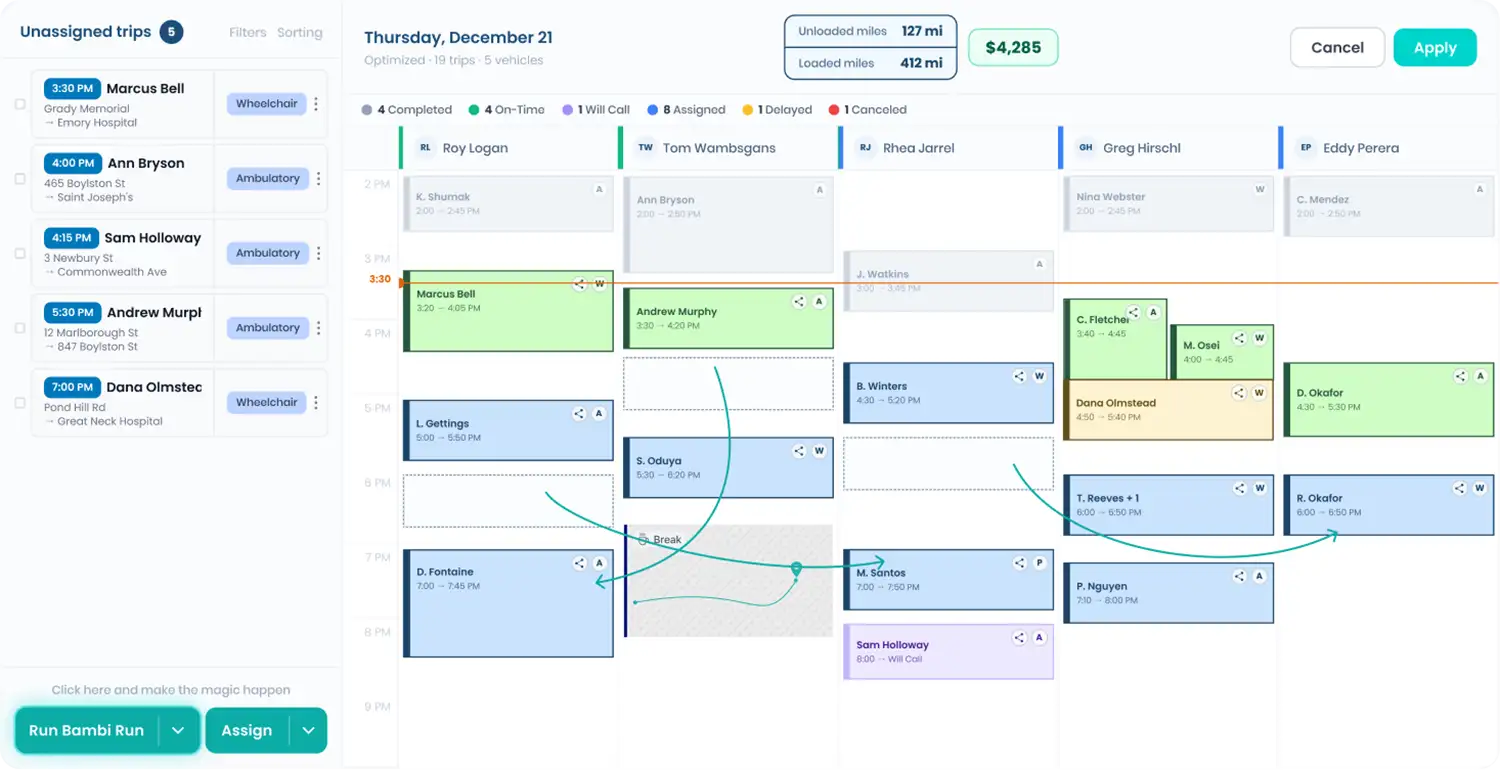

When oil prices rise, transportation costs can quickly spiral out of control, especially for Non-Emergency Medical Transportation (NEMT) providers. Fuel is a significant expense, and inefficient routing - like unnecessary backtracking or driving without passengers - wastes both fuel and money. Here's the solution: route optimization. By using smart software to plan efficient routes, providers can cut fuel costs by 15-25%, reduce deadhead miles, and improve vehicle usage.
Key Takeaways:
- Deadhead mileage (30-40% of total miles) burns fuel without generating revenue.
- A 50% increase in gas prices can cost fleets thousands more monthly.
- Route optimization reduces wasted miles, groups trips better, and adjusts for real-time traffic.
- Providers using AI tools report up to a 30% drop in operational costs and significant profit increases.
Efficient routing isn’t just about saving money - it ensures timely, reliable service for patients who depend on transportation for critical medical appointments. With rising fuel prices, adopting smarter routing strategies is no longer optional - it’s essential for staying competitive.

How Inefficient Routes Increase Costs During Fuel Price Spikes
NEMT Cost Structure Breakdown
Every mile your NEMT vehicle travels comes with a price tag - whether it’s carrying passengers or not. The cost per mile includes four key components: fuel, driver wages, vehicle maintenance, and overhead expenses like insurance and administrative costs. When fuel prices surge, that cost per mile rises sharply.
Here’s a critical point: 30% to 40% of total miles driven by NEMT vehicles are deadhead miles - miles driven without passengers. These trips burn fuel, pay for driver time, and wear out vehicles, yet they don’t bring in any revenue. For instance, if your fleet logs 10,000 miles per month and 35% of those are deadhead miles, you’re spending resources on 3,500 miles that generate zero income.
Now, imagine gas prices jumping from $3.00 to $4.50 per gallon - a 50% increase. Those 3,500 deadhead miles suddenly cost hundreds, if not thousands, more each month. Multiply that by your entire fleet, and the financial strain becomes massive.
Common Routing Problems That Waste Fuel
Manual scheduling often leads to routing inefficiencies that drive up fuel costs. Backtracking and zig-zagging are prime examples. When routes aren’t optimized, drivers may pass the same intersections repeatedly or crisscross through territories unnecessarily. This adds extra miles without any added benefit.
Another issue is underutilized capacity - sending a van out for just one rider instead of grouping similar trips wastes fuel. Every additional trip compounds the fuel usage across the fleet.
Idling is another hidden drain. Sitting in traffic burns 0.25 to 0.5 gallons of fuel per hour. Poorly planned routes that don’t consider real-time traffic conditions leave drivers stuck in congestion, wasting fuel and time. On top of that, inefficient timing can pressure drivers to speed or accelerate aggressively, which cuts fuel efficiency by 15% to 30%.
Calculating the Cost of Wasted Miles
The financial impact of inefficient routes becomes clear when you crunch the numbers. Start by calculating your Deadhead Percentage: divide deadhead miles by total miles driven. If 30% to 40% of your miles fall into this category, there’s plenty of room to improve.
Take Aerocare Transport in Ohio as an example. By optimizing routes from June 2023 to December 2024, they cut fuel expenses from 28% to 21% and increased daily trips from 4.2 to 6.8. Similarly, Valley Rise Transportation in Pennsylvania boosted driver utilization from 3.5 to 5.4 trips per day over two years. This led to a 144% increase in monthly revenue, while operating costs rose by only 116%, improving their net profit margin by 41%.
To put this into perspective, if fuel costs $4.00 per gallon and your fleet averages 12 miles per gallon, every 100 wasted miles costs $33.33 in fuel alone. Scale this across thousands of miles each month, and the losses quickly add up. Cutting mileage by just 10% to 20% through better routing could save thousands of dollars, especially during fuel price spikes. These figures highlight the urgent need to adopt smarter routing strategies to minimize waste and control costs. Up next, we’ll dive into how optimized routing solutions can tackle these challenges head-on.
How Route Optimization Works for NEMT
What Route Optimization Does
Route optimization relies on advanced algorithms to sift through extensive data and determine the most efficient way to transport passengers. It evaluates factors like pickup and drop-off locations, appointment schedules, vehicle capacities, and driver availability.
The system organizes trips to reduce backtracking and unnecessary miles, often grouping multiple passengers into a single vehicle run - a process known as multi-stop planning. For instance, if three patients need transportation to the same medical center within a 30-minute window, the algorithm consolidates them into one trip instead of dispatching three separate vehicles.
This method also addresses "deadhead miles", where vehicles travel empty after dropping off passengers. The software immediately identifies nearby pickups and assigns them as the next trip, ensuring that vehicles remain productive rather than idle.
NEMT Routing Requirements
NEMT routing comes with unique challenges. Unlike package delivery, patient transportation involves added complexities. The software must match passengers with specific needs - like wheelchair lifts or stretchers - with appropriately equipped vehicles. It also accounts for vehicle capacity and ensures that these requirements are met.
Timeliness is critical. Medical appointments often have strict schedules, and delays can lead to missed treatments or rescheduling. Route optimization enforces these time constraints. Additionally, it tracks driver work-hour limits and adheres to Medicaid shared-ride policies, which encourage maximizing vehicle capacity when feasible.
Real-life scenarios can be unpredictable, with cancellations, no-shows, or last-minute ride requests happening regularly. Dynamic scheduling allows the software to instantly adjust routes for all affected drivers, keeping operations smooth despite these changes. Integrating AI further enhances this capability, enabling real-time adaptability.
How AI and Data Improve Routing
AI-powered tools add another layer of efficiency by incorporating real-time data like traffic, weather conditions, and road closures. This allows the system to reroute drivers automatically to avoid delays.
Beyond real-time adjustments, predictive analytics use historical trip data to foresee potential delays. For example, if certain routes are consistently slower during morning rush hours, the AI adds time buffers to those schedules, maintaining on-time performance even during peak periods.
The technology handles a staggering number of variables - over 70, including vehicle types, patient mobility needs, and service zones. This level of automation not only simplifies planning but also reduces costs. Providers can see operational expenses drop by 20% to 30% and fuel costs cut by 15% to 25%.
Methods to Cut Mileage and Fuel Costs
Group Trips by Location and Time
One way to cut down on unnecessary mileage is through trip stacking. This method groups passengers heading to nearby destinations within overlapping timeframes, helping to reduce redundant trips and deadhead miles by as much as 30%.
Another effective approach is proximity-based dispatching. This system assigns new rides to the closest available driver who’s already on the road. For example, if a driver drops off a passenger near a dialysis center and another pickup is scheduled in the same area, the system automatically routes that driver to the next assignment. This avoids sending a vehicle from across town, saving both time and fuel.
Coordinating round trips with healthcare facilities can also make a big difference. By partnering with clinics to schedule automated return trips, vehicles avoid traveling back empty after drop-offs. Instead, the system books the return leg immediately, keeping drivers busy and reducing idle miles.
These strategies not only lower mileage but also create opportunities to make the most of vehicle capacity.
Maximize Vehicle Capacity with Shared Rides
Expanding on trip stacking, maximizing vehicle capacity takes fuel savings a step further. Multi-loading - filling vehicles with multiple passengers heading in the same direction - spreads fuel costs across several riders, boosting the profitability of each trip. With automated multi-loading, driver utilization can increase from 60% to over 85%.
Success here depends on matching the right passengers to the right vehicles. For instance, wheelchair-accessible vans should prioritize riders who need that equipment, while ambulatory passengers can use standard vehicles. Smart allocation ensures specialty vehicles are fully utilized, reducing the number of cars on the road. This strategy can cut overall fleet fuel consumption by 15% to 25%.
Use Real-Time Dispatch and GPS Tracking
Even with effective trip grouping and capacity strategies, real-time adjustments are crucial. Live GPS tracking gives dispatchers a full view of the fleet, allowing them to reassign routes quickly when schedules shift. This minimizes wasted miles and keeps operations running smoothly.
Dynamic rerouting is another key tool. When unexpected changes like traffic jams, bad weather, or road closures occur, live data integration automatically redirects drivers to avoid delays. This not only saves fuel but also prevents unnecessary idling. On-time arrivals can improve by up to 50%, while travel times may shrink by as much as 40%.
AI-Powered Software for Route Optimization
What AI-Powered NEMT Software Does
AI-powered NEMT (Non-Emergency Medical Transportation) software takes the guesswork out of scheduling and dispatching. By analyzing trip requests, rider locations, appointment times, and vehicle capacity, it automates the entire process. Instead of manually piecing together routes, dispatchers can generate optimized assignments with just one click. The system ensures the right driver and vehicle are matched to each request, factoring in real-time locations, wheelchair accessibility, and any required medical equipment.
These platforms also come with fleet analytics dashboards, offering insights into key performance indicators like on-time performance, cost per trip, vehicle usage, and driver productivity. Features like real-time GPS tracking and integration with healthcare systems provide complete fleet visibility and allow for seamless electronic trip requests. On top of that, mobile driver apps streamline operations with turn-by-turn navigation, real-time updates, and automated check-ins.
One standout example is Bambi, an AI-powered NEMT platform priced at $69 per vehicle per month. Designed specifically for medical transportation providers, its "Run Bambi Run" scheduler automates fleet assignments in seconds, eliminating hours of manual effort. With a perfect 5.0-star rating on platforms like G2, Capterra, and Software Advice, Bambi has proven itself as a reliable tool for improving operations.
Benefits of Using AI Tools
AI routing technology offers impressive operational improvements. It can cut empty miles by 40%, increase daily trip capacity by 25%, improve on-time performance by 15%, and reduce dispatch time by 50%. McKinsey & Company also highlights that AI-driven logistics can lower operational costs by up to 30% in transportation industries.
Beyond saving on mileage, these tools significantly lighten the workload for dispatchers.
"Switching over to Bambi is the most impactful thing I've done for my NEMT business. Bambi's AI is saving my staff hours of daily work."
- Jeffrey Hoff, Owner, Reliant Transport
This testimonial underscores how tailored solutions like Bambi can deliver measurable results. Additionally, the software enhances compliance and improves the passenger experience. Automated trip reminders via SMS, email, or phone help reduce no-shows, while real-time ride tracking lets passengers check estimated arrival times. Features like GPS-based timestamps and electronic service verification simplify billing, ensuring accuracy for mileage-based reimbursements. These benefits, backed by clear ROI metrics, make a compelling case for adopting AI.
Measuring ROI from AI Route Optimization
To determine the return on investment (ROI) from AI-powered route optimization, monitor key metrics before and after implementation. Focus on monthly mileage, fuel expenses, total trips per vehicle, and dispatcher scheduling hours. Generating monthly reports can help identify trends and highlight improvements in service quality. Compare metrics like cost per trip, on-time arrival rates, and driver utilization percentages over time.
Even smaller fleets can see noticeable results.
"I love Bambi! It's so easy to use... and the 'Run Bambi Run' scheduler works great even with just 3 vehicles."
- Roslyn Taggart, Owner, B811 Medical Transportation
The data should reveal whether you're hitting industry benchmarks, such as a 15% to 30% reduction in fuel costs, 25% fewer missed trips, and a 30% to 40% drop in deadhead miles. These improvements translate directly into cost savings, especially during periods of high fuel prices.
Conclusion
With fuel prices climbing and operational challenges intensifying, NEMT providers need to rethink how they manage routes. Optimizing routes isn’t just a smart move - it’s a financial lifeline. Advanced route optimization systems can cut fuel expenses by 15% to 25% and overall operational costs by 20% to 30%. These savings are especially crucial during fuel price surges, often determining whether a provider stays profitable.
Switching from manual dispatching to AI-driven software tackles inefficiencies head-on. By reducing deadhead miles, grouping trips more effectively, and adjusting for real-time traffic, providers can boost driver utilization rates from under 60% to over 85%. This means more trips completed daily without increasing fleet size or fuel consumption.
The results speak for themselves. In 2025, a midsize NEMT provider in Texas adopted a modern route optimization platform and saved over $50,000 in fuel costs within six months. At the same time, they increased their monthly trip volume by 25%. These outcomes show what’s possible when providers embrace optimization tools.
As fuel prices remain unpredictable, the real question isn’t whether you can afford to invest in route optimization - it’s whether you can afford not to. Cutting mileage, lowering fuel use, and improving service quality creates a competitive edge that safeguards profitability, no matter what happens at the pump. Implementing these proven strategies ensures long-term success for NEMT providers.
FAQs
How do I calculate my deadhead mile percentage?
To figure out your deadhead mile percentage, take the miles driven without passengers (deadhead miles), divide that by your total miles driven, and multiply the result by 100.
This percentage highlights how much of your driving is non-revenue, giving you insight into where you can cut down on deadhead miles to boost efficiency. Use tools like GPS tracking or trip logs to keep precise records of both total and deadhead miles for accurate calculations.
What data do I need to start route optimization?
To kick off route optimization, start by gathering essential data: trip schedules, vehicle locations, rider requirements, fuel consumption, and vehicle maintenance details. Using digital scheduling and dispatch tools can make this process much smoother. It's also important to analyze current routes, trip durations, and deadhead miles (empty vehicle travel). Combining real-time tracking with historical trip data allows you to design efficient, data-informed routes that cut down on unnecessary mileage and help save on fuel costs.
How fast can route optimization pay for itself?
Route optimization can often cover its own costs in just a few months to a year. How? By slashing fuel and operational expenses. Many businesses see a 15-25% drop in costs thanks to better trip efficiency, making the investment pay off quickly.