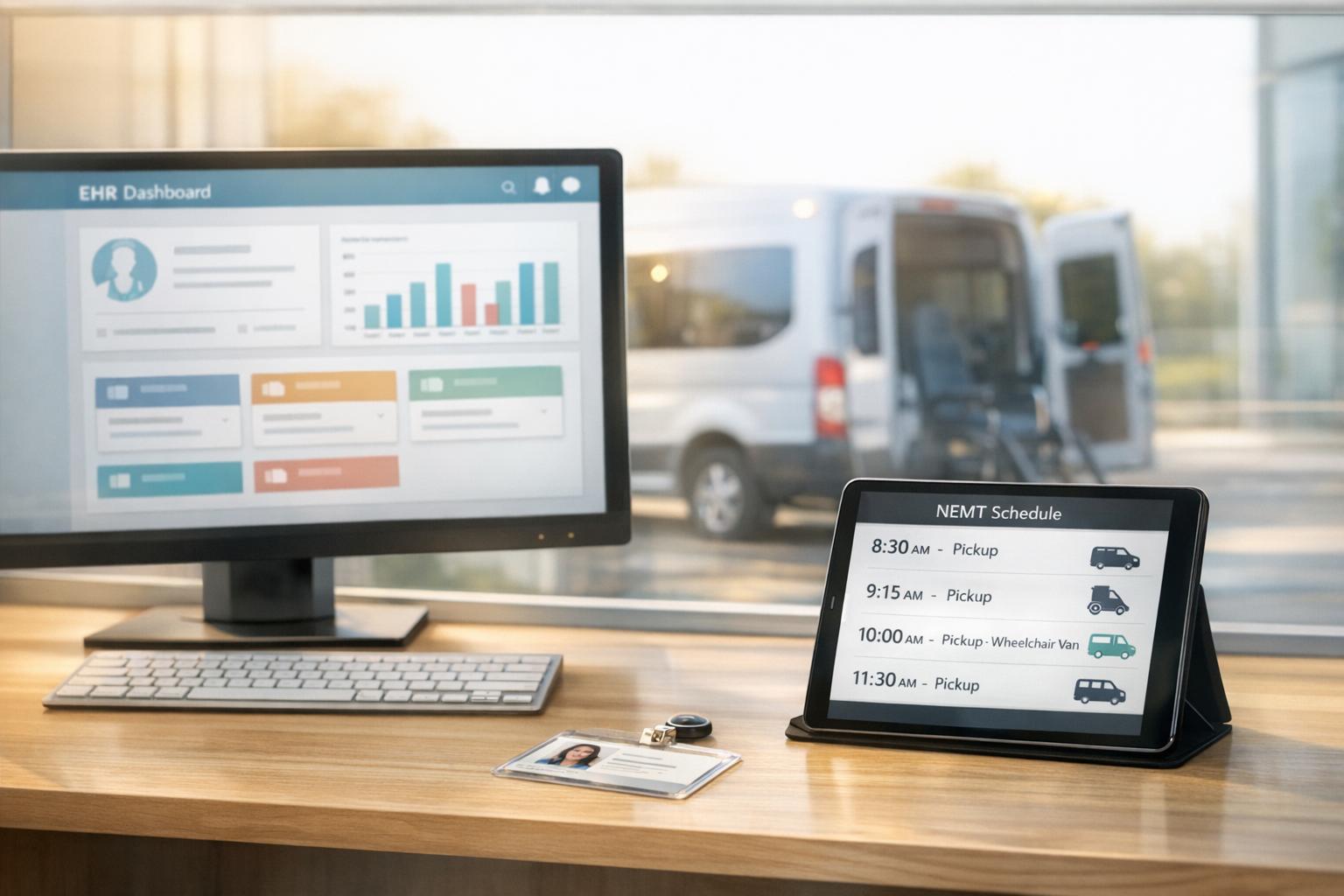
Non-Emergency Medical Transportation (NEMT) scheduling platforms can integrate with Electronic Health Records (EHRs) to improve patient care, reduce errors, and streamline operations. By connecting these systems, providers can automate trip scheduling, access real-time patient data, and ensure compliance with healthcare standards. Here's how integration works:
- Data Sharing: Use APIs like FHIR R4 or HL7 v2 to exchange patient information (e.g., mobility needs, appointments) in real time.
- Legacy System Compatibility: Middleware translates outdated formats into modern standards, ensuring smooth communication.
- Security: Protect sensitive data with AES-256 encryption, OAuth 2.0, and Role-Based Access Controls (RBAC).
- Benefits: Faster claim processing, reduced no-show rates, and better patient safety with real-time updates and accurate trip logs.
Integration simplifies workflows, reduces costs, and enhances patient experiences, making it a crucial step for providers aiming to modernize their services. This often involves choosing the right NEMT software to handle complex integrations.
Technologies That Enable NEMT-EHR Integration
Integrating Non-Emergency Medical Transportation (NEMT) platforms with Electronic Health Records (EHR) systems relies on three critical components: data exchange protocols, tools for bridging legacy systems, and robust data security measures.
APIs and Data Exchange Protocols
RESTful APIs using JSON are now the go-to method for real-time data sharing between NEMT platforms and healthcare systems. These APIs allow for immediate confirmation of data exchanges and efficiently handle complex information, making them perfect for urgent trip requests. For instance, Kaiser Permanente employs a REST API that provides real-time access to patient profiles, mobility needs, and synchronized appointments, all safeguarded by end-to-end encryption and multi-factor authentication.
FHIR R4 (Fast Healthcare Interoperability Resources) acts as a universal standard for healthcare data, ensuring smooth communication between EHR systems and insurance verification tools. Similarly, HL7 v2 standards manage specific healthcare data formats, like Admission, Discharge, Transfer (ADT) and Order Entry (ORM) data, ensuring compliance with industry protocols.
Webhooks add another layer of efficiency by sending real-time updates on trip status changes directly to NEMT systems, eliminating the need for manual monitoring. For operations handling high volumes, Electronic Data Interchange (EDI) ensures compliance with state Medicaid systems. Companies like MTM Transit utilize EDI, while legacy systems that lack real-time capabilities often rely on SFTP with CSV files for batch processing.
- REST API / JSON: Primary Use Case: Real-time communication; Key Benefit: Instant data exchange and confirmation
- FHIR R4: Primary Use Case: EHR and insurance verification; Key Benefit: Standardized healthcare data sharing
- HL7 v2: Primary Use Case: Clinical data (ADT, ORM); Key Benefit: Compliance with healthcare standards
- SFTP / CSV: Primary Use Case: Legacy system connectivity; Key Benefit: Reliable batch data processing
- Webhooks: Primary Use Case: Status change notifications; Key Benefit: Immediate updates
While these tools enable real-time data flow, many healthcare organizations still depend on older systems, requiring additional solutions to bridge the gap.
Middleware for Legacy System Compatibility
Healthcare providers often rely on legacy systems with proprietary formats that modern NEMT platforms can't process directly. Middleware solutions step in as translators, converting older formats like HL7 v2.x into modern FHIR resources that today's platforms can understand. These tools also standardize data across systems, ensuring consistent handling of key resources like Patient, Appointment, and Location.
"For organizations still operating legacy systems with proprietary formats, middleware solutions serve as essential translators, converting outdated formats like HL7 v2.x into modern FHIR resources." - MediDrive Blog
Middleware's "connect once" architecture simplifies operations by enabling NEMT providers to manage multiple legacy broker relationships through a single interface, avoiding the need for separate connections. It also incorporates features like idempotency controls to prevent duplicate data submissions and durable queues to maintain data integrity during disruptions. Middleware can even handle complex scenarios, such as trips that cross midnight or require "will-call" status, by adding a flexible logic layer between EHR systems and NEMT platforms.
Once legacy systems are integrated into modern workflows, securing these connections becomes the next priority.
HIPAA Compliance and Data Security Requirements
Protecting patient information is critical when linking transportation services with healthcare systems. All data must be encrypted using AES-256 during both transmission and storage, while OAuth 2.0 and multi-factor authentication (MFA) secure access.
Role-Based Access Controls (RBAC) ensure staff only see the data relevant to their duties. For example, drivers access trip details, while billing teams handle financial records. Driver apps should also include features like automatic logouts, remote data wiping, and device-level encryption to safeguard information in uncontrolled settings.
Systems must maintain immutable audit trails that document who accessed Protected Health Information (PHI), when it happened, and what actions were taken. This is essential, as HIPAA violations can lead to severe penalties. Additionally, integration platforms should establish Business Associate Agreements (BAAs), provide annual staff training, and have incident response plans ready for potential breaches. When choosing an NEMT platform, look for vendors offering open APIs and test integrations in a sandbox environment with dummy credentials to ensure everything runs smoothly before going live.
How to Implement NEMT-EHR Integration
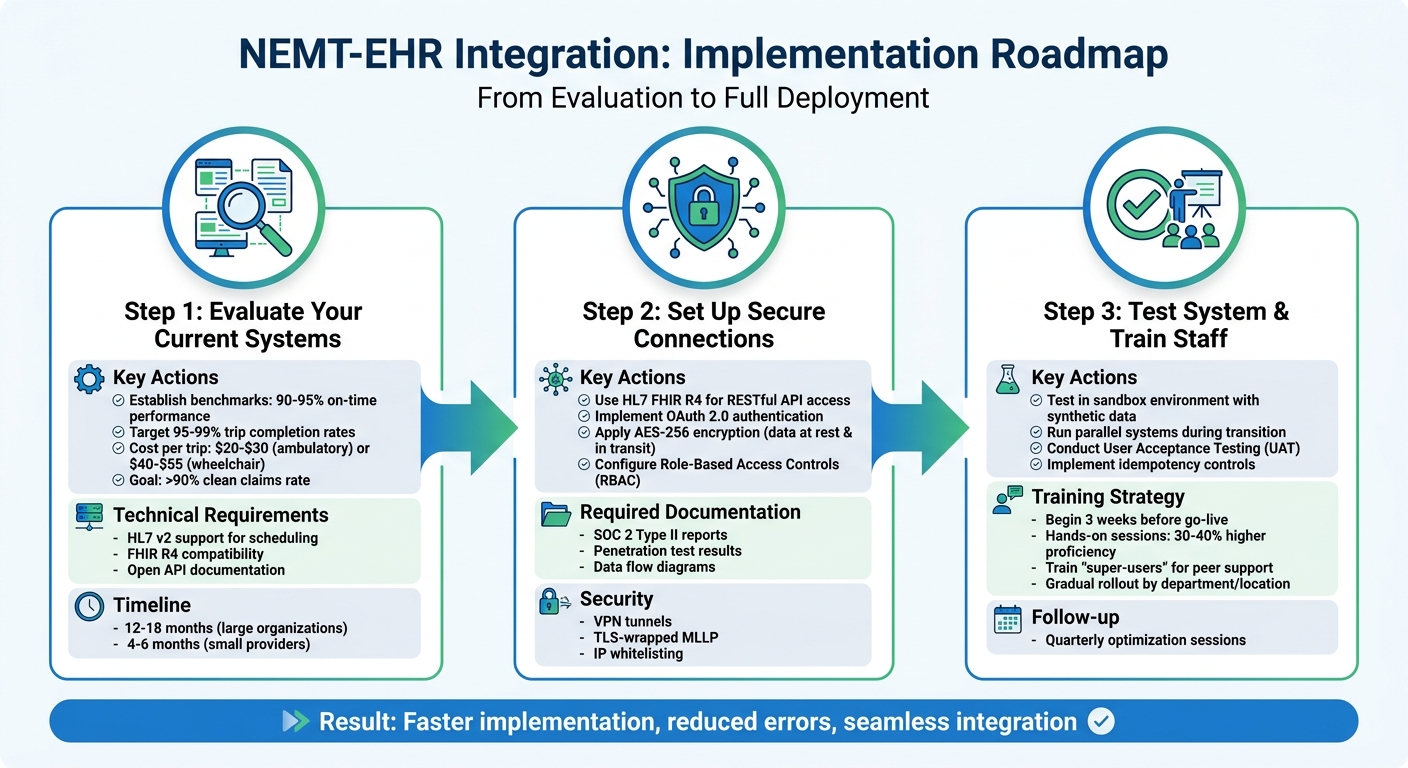
Successfully integrating NEMT (Non-Emergency Medical Transportation) systems with EHR (Electronic Health Record) platforms requires a mix of technical expertise and operational planning. While large healthcare organizations may need 12 to 18 months for implementation, smaller NEMT providers can often complete the process in 4 to 6 months. A step-by-step approach - from system evaluation to staff training - helps ensure a smooth transition.
Evaluate Your Current Systems and Integration Requirements
Start by examining your existing workflows to pinpoint areas where integration can make the biggest difference. Establish benchmarks for key performance indicators like on-time performance (90–95%), trip completion rates (95–99%), and no-show percentages. Financial metrics are equally important - review the cost per trip (e.g., $20–$30 for ambulatory services or $40–$55 for wheelchair services) and claims denial rates (each denial can cost $25–$118). The goal is to achieve a clean claims rate exceeding 90%.
Next, assess your technical infrastructure. Does your software support HL7 v2 for scheduling and admission/discharge/transfer (ADT) data? Can it handle FHIR R4 resources for modern data exchange? Platforms with open API documentation are ideal, as they help avoid vendor lock-in and allow for future growth. Don’t forget to gather input from drivers, dispatchers, and billing staff - these are the people who deal with scheduling issues, redundant paperwork, and manual record-keeping, all of which can lead to audit problems and reimbursement delays.
Once you’ve evaluated your systems and identified problem areas, you’re ready to establish secure and compliant connections with healthcare providers.
Set Up Secure Connections with Healthcare Providers
Connecting with healthcare facilities requires both technical know-how and strong partnerships. Use HL7 FHIR R4 for modern RESTful API access and HL7 v2 for real-time notifications, such as patient admissions or scheduling updates. Authentication should follow OAuth 2.0 standards, with user-facing apps using the Authorization Code flow and system-to-system integrations relying on Client Credentials with JWT-based certificates.
For example, when working with Epic Systems, start by requesting "Read" access to essential FHIR resources. This is often easier to get approved than "Write" access and allows you to prove the system’s value before requesting expanded permissions. If you’re working with legacy HL7 v2 messaging over MLLP (which lacks built-in encryption), secure the connection using VPN tunnels, TLS-wrapped MLLP, and IP whitelisting.
Healthcare providers will typically require documentation before granting access to their production systems. Prepare materials like SOC 2 Type II reports, recent penetration test results, and data flow diagrams. Protect all data with AES-256 encryption, both at rest and in transit, and use Role-Based Access Controls (RBAC) to ensure that only authorized personnel can view sensitive patient information.
Test the System and Train Your Staff
Once secure connections are established, the next step is rigorous testing and thorough staff training. Testing should focus on four key areas: system functionality, data accuracy, workflow performance, and security compliance. Always test integrations in a sandbox environment with synthetic data before moving to live systems. Confirm that critical details - such as patient mobility needs, addresses, and appointment times - transfer correctly between your NEMT platform and the EHR.
During the transition, run the integrated system alongside your legacy system to maintain service continuity and build confidence among staff. Record user acceptance testing (UAT) results to validate the system’s performance before full deployment. To ensure smooth operations, implement idempotency controls to prevent duplicate trip submissions and use durable queues to maintain data integrity in case of disruptions.
Begin role-specific training about three weeks before the official go-live date. Administrative staff should focus on mastering integration settings, while operational staff should concentrate on scheduling and dispatch tasks. Hands-on training sessions often lead to 30–40% higher user proficiency compared to lectures alone. As NextGen Invent Corp explains:
"Implementing an EHR system requires comprehensive training programs. These programs ensure a smooth transition by educating users on new workflows, functionalities, and benefits of EHR integration".
Train "super-users" who can assist their peers and reduce the need for ongoing technical support. Roll out the system gradually across departments or locations, using feedback from early adopters to refine processes. Finally, set up feedback loops and plan quarterly optimization sessions to address any issues that arise during day-to-day use.
Benefits of NEMT-EHR Integration
Connecting Non-Emergency Medical Transportation (NEMT) systems with Electronic Health Records (EHR) offers a range of practical advantages that can elevate operational efficiency and patient care.
Improved Scheduling and Coordination
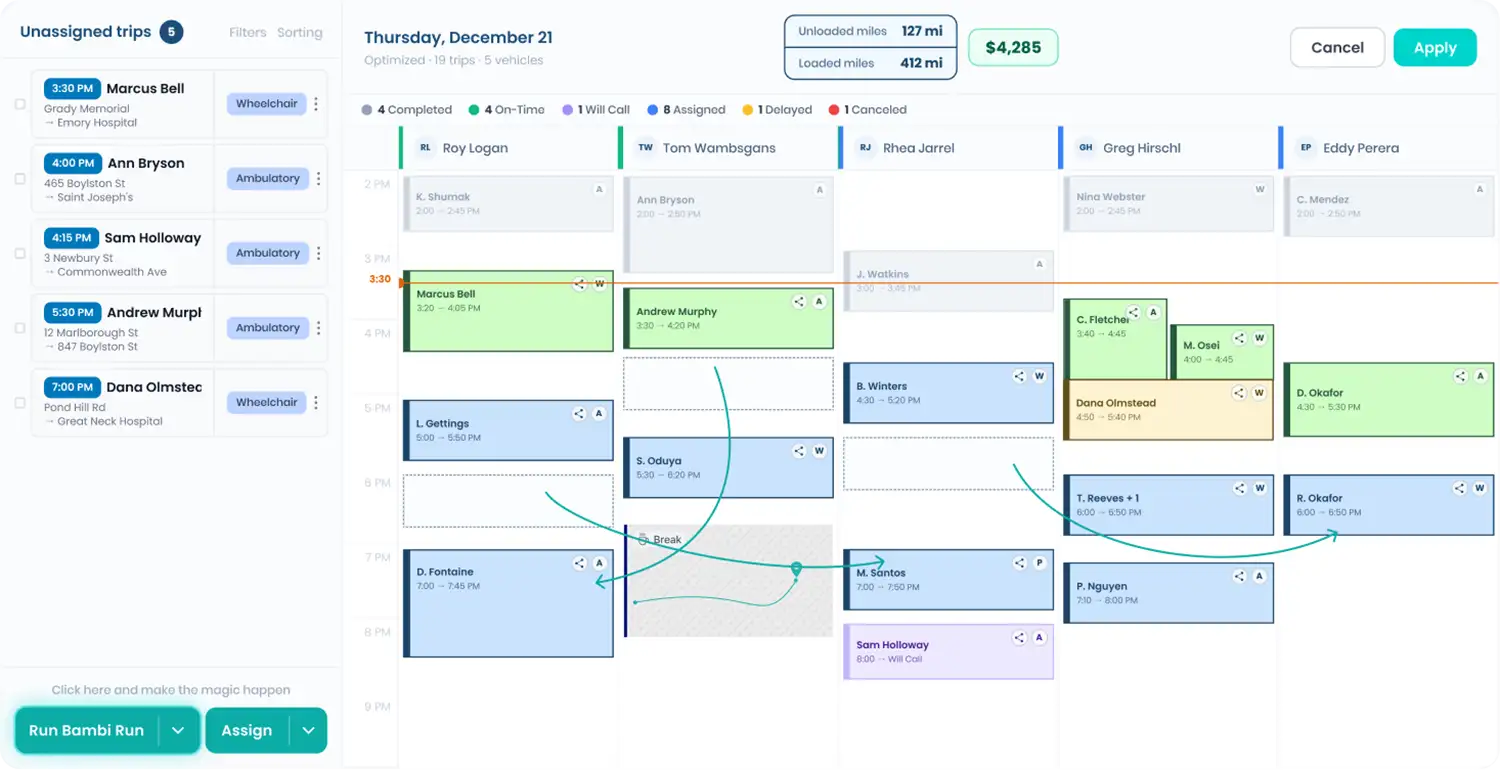
By integrating NEMT systems with EHR platforms, healthcare facilities and transportation providers can eliminate the need for manual data transfers. With just one click, hospital staff can access patient demographics, mobility needs, and appointment details directly from the EHR system. This seamless synchronization automatically generates necessary forms like Physician Certification Statements (PCS) and medical necessity documents, ensuring trips are both auditable and eligible for reimbursement. This process reduces administrative time significantly - from 3 hours to just 30 minutes - giving staff more time to focus on patient care.
When patient needs or discharge times change, NEMT providers receive instant updates, enabling dispatchers to adjust schedules without disrupting hospital workflows. The system's intelligent vehicle matching uses EHR data to assign the right vehicle and driver for each patient, whether they need a wheelchair-accessible van, a stretcher, or bariatric support. Additionally, centralized dashboards provide real-time visibility into trip statuses, vehicle locations, and estimated arrival times, ensuring smooth operations for hospitals, brokers, and transportation vendors. These streamlined processes not only save time but also contribute to safer and more reliable patient transportation.
Better Patient Safety and Experience
Integration ensures that the right vehicle arrives for the right patient every time. NEMT platforms can pull medical histories and mobility requirements directly from the EHR, allowing dispatchers to immediately determine whether a patient requires specialized transportation, such as a stretcher or wheelchair-accessible van. Real-time GPS tracking and accurate estimated arrival times (ETAs) remove uncertainty, helping patients and caregivers feel more at ease while improving appointment adherence.
Safety features like telematics and IoT sensors monitor driver behavior in real time, tracking issues such as speeding, harsh braking, or route deviations. These tools allow for immediate coaching, resulting in safer rides. For instance, organizations using such systems reported a 37% drop in harsh braking incidents and 42% fewer speeding events within a year. Automated notifications - sent via SMS, voice, or app in the patient’s preferred language - keep patients informed about trip statuses, fostering a more inclusive experience. GPS tracking combined with route optimization can reduce patient wait times by up to 30%, while in-app panic buttons enable dispatchers to respond quickly to emergencies by pinpointing the vehicle’s exact location.
Lower Costs and Faster Reimbursements
Integrated systems not only enhance operations but also help cut costs and speed up reimbursement processes. Real-time eligibility checks ensure that services are only provided to patients who qualify, while connecting billing to scheduling eliminates duplicate data entry, saving valuable administrative hours.
As Matt Saltzman of Ready Steady Transportation Services noted:
"I especially value how the billing is connected with ride scheduling, so I don't have to double report."
Denied claims can cost providers $25–$118 per reprocessing, so ensuring clean claims on the first submission avoids these expenses. Features like route optimization can reduce fuel consumption by 15% to 25%, while GPS-verified trip logs provide a reliable audit trail, protecting providers during reviews.
Common Integration Challenges and Solutions
Integrating Non-Emergency Medical Transportation (NEMT) systems with Electronic Health Records (EHR) offers clear advantages, but the process often comes with technical and operational hurdles. Tackling these challenges effectively can save time, money, and headaches.
Fixing System Compatibility Problems
A common roadblock in integration is system compatibility. Many NEMT providers rely on outdated broker systems that don't support real-time communication, which limits trip visibility. These older setups often use inconsistent data formats, which can lead to vendor lock-in and reduced flexibility. On top of that, mismatched address formats and service codes between NEMT platforms and healthcare systems frequently result in scheduling errors and billing issues.
To overcome these problems, selecting the right integration method is key. For modern EHRs, REST APIs using JSON are ideal for real-time data exchange. Legacy systems, on the other hand, often work better with SFTP and CSV files. Adopting healthcare data standards like HL7 v2 and FHIR R4 ensures smooth communication between your platform, EHR systems, and insurance verification tools. Additionally, mapping healthcare service codes to internal trip types can help prevent billing rejections. Testing integrations in a sandbox environment before going live can help catch potential issues early.
Integration MethodBest Use CaseKey AdvantageREST API (JSON)Modern EHRs and BrokersReal-time data exchange with instant confirmation HL7 / FHIRHealthcare/EHR SystemsAligns with medical data standards SFTP (CSV)Legacy Broker SystemsReliable for batch processing at high volumes WebhooksReal-time NotificationsImmediate alerts for trip updates or cancellations
Rolling out integrations gradually - starting with one department or location - over a 20 to 24-week period can help identify and resolve compatibility issues without disrupting operations. Implement idempotency controls to avoid duplicate submissions and use retry mechanisms to maintain data integrity during connectivity hiccups.
Once compatibility is resolved, safeguarding data privacy becomes the next priority.
Meeting Data Privacy and Regulatory Requirements
When it comes to patient data, compliance with HIPAA regulations is non-negotiable. Violations can result in hefty fines, ranging from thousands to millions of dollars. The challenge is even greater because drivers often operate in uncontrolled environments where devices can be lost or stolen, and data is transmitted over public networks.
To protect sensitive information, use AES-256 encryption for both data transmission and storage. Role-Based Access Control (RBAC) should limit access - drivers only see trip data, while billing teams handle financial records. Mobile apps should feature automatic logout, remote data wipe capabilities, and device-level encryption. Additionally, maintaining immutable audit trails that log user interactions with patient data helps track access and actions.
Partnering with technology providers that prioritize compliance in their architecture is crucial. Conduct internal compliance audits quarterly and bring in third-party auditors periodically to uncover vulnerabilities. Train all staff - including dispatchers and drivers - on HIPAA rules annually, using simulation exercises to reinforce best practices. Finally, develop a well-documented incident response plan to handle and report data breaches as required by the HIPAA Breach Notification Rule.
While technical and regulatory measures are vital, collaboration with healthcare providers also plays a major role in successful integration.
Working Effectively with Healthcare Providers
Strong partnerships with healthcare providers can significantly enhance the success of integrated systems. Transportation issues are responsible for up to 25% of hospital discharge delays, making reliable NEMT services a critical need for facilities.
Start by identifying key decision-makers like transportation coordinators, case managers, social workers, and administrators to streamline communication. Before reaching out, conduct a workflow audit to understand current discharge delays and response rates. Use specific data, such as patient volumes or recent service expansions, to demonstrate your understanding of their needs. Focus discussions on addressing their biggest challenges, such as missed appointments, administrative burdens, and discharge delays.
A great example of effective integration is the partnership between Roundtrip and ESO in May 2025. They automated ride planning and intake, eliminating manual workflows for dispatchers. Brian Ryther, Roundtrip's Chief Technology Officer, highlighted the impact:
"This integration is a game-changer for transport companies eager to leverage technology as a strategic advantage to scale their operations. This is about making copy/paste a thing of the past and giving dispatchers one fewer screen to monitor".
To build trust, formalize expectations with Service Level Agreements (SLAs) that outline guaranteed pickup windows and response times. Establish dedicated communication channels, such as direct phone lines, integrated chat features, or online portals, to close coordination gaps. Train select facility staff as "super-users" who can serve as on-site resources, reducing long-term support costs and encouraging system adoption. Finally, share regular reports - monthly or quarterly - highlighting metrics like on-time arrivals and patient satisfaction. These reports help justify the partnership to facility management and build long-term trust.
Conclusion
Connecting NEMT scheduling platforms with electronic health records is reshaping how transportation supports patient care. Providers using integrated systems report impressive results: claims processed 40% faster, 65% fewer billing errors, a 40% increase in broker contracts, and 30% higher contract retention rates.
The financial benefits are equally striking. Missed medical appointments cost the U.S. healthcare system around $150 billion each year. For dialysis patients, consistent transportation saves Medicaid approximately $3,423 per patient monthly. Reliable rides also make patients 2.6 times more likely to complete their treatments, improving health outcomes and reducing emergency room visits. These changes not only cut costs but also boost service reliability and patient care quality.
This integration elevates NEMT from simple ride coordination to becoming a key player in healthcare delivery. Leading brokers like ModivCare and MTM increasingly prefer providers with advanced, integrated technology. Relying on manual processes isn't just outdated - it could jeopardize your ability to secure future contracts. Start by reviewing your workflows, identifying inefficiencies in areas like eligibility checks and preventing revenue loss, and choosing platforms that align with HL7 and FHIR standards for smooth EHR communication.
The path forward is clear: assess your systems, phase in integration, provide comprehensive staff training, and track metrics like on-time performance and claim processing speed. These steps, rooted in the strategies shared throughout this article, position providers to excel in a healthcare landscape that prioritizes efficiency, accountability, and better patient outcomes. Integration isn't just a tool - it's a competitive advantage for NEMT providers committed to delivering patient-focused care.
FAQs
What EHR data should an NEMT platform pull first?
An effective Non-Emergency Medical Transportation (NEMT) platform should focus on integrating Electronic Health Record (EHR) data, especially when it comes to patient scheduling and transportation needs. Crucial details to pull from EHRs include:
- Patient identifiers: Ensuring the right patient is matched with the right service.
- Appointment specifics: Date, time, and location of medical visits.
- Pickup and drop-off locations: Accurate addresses to streamline transportation logistics.
- Special requirements: Mobility aids, medical equipment, or other individualized needs.
This approach not only improves scheduling accuracy but also enhances coordination between healthcare providers and transportation services. The result? A smoother, more reliable experience tailored to each patient’s unique circumstances.
How do you integrate with an EHR if it doesn’t support FHIR?
If an EHR doesn’t support FHIR, it’s still possible to integrate it with an NEMT scheduling platform through other methods, such as API connections or data-sharing protocols. Many times, custom APIs or middleware solutions are used to facilitate smooth communication and data exchange, making sure that patient details and scheduling information flow efficiently between the systems.
What permissions does an EHR usually require for NEMT access?
EHR systems come with strict permission protocols to maintain HIPAA compliance when allowing NEMT access. These protocols often involve secure authentication, role-based permissions, and limited data sharing. The goal is to protect sensitive patient information while still enabling seamless coordination between healthcare providers and transportation services.
Run the numbers: the free NEMT operational cost estimator puts a yearly dollar figure on empty miles, no-shows, drivers waiting and retyping broker trips.