
Finding the right funding (that feels Bambi secure) is necessary for setting up your NEMT business in Delaware. Whether you’re exploring federal loans or local county grants, there are several avenues — or forest-filled financial paths — to consider. Our Bambi Knows Best guide will prance you along the financial options available to get your Delaware NEMT business up and running with Bambi style and that Disney protagonist of a character's confidence.
1 | Explore Small Business Loans
Delaware offers a variety of loan programs to give your new business a financial boost. The US Small Business Administration (SBA) is a great starting point, with options like the 7(a) loan program to cover startup costs and operating expenses. Local banks, credit unions and the Delaware Small Business Development Center can also provide guidance and resources to help you secure the funding you need.
2 | Tap into Delaware’s Financial Incentives
The Delaware Division of Small Business offers financial incentives to support new businesses and stimulate economic growth. From tax credits to low-interest loans, these programs can ease the financial burden of launching your NEMT business. Be sure to explore these opportunities — they’re the financial partners you need to help your business thrive.
3 | Seek Out Grants and Specialized Funding
Grants can be competitive but are a valuable source of funding, especially for healthcare and community-focused businesses. Look into grants available through the SBA and local opportunities provided by organizations like the Delaware Community Foundation. For NEMT services in rural or underserved areas, federal grants listed on Grants.gov can also potentially offer the financial support you’re looking for.
4 | Leverage Networking and Community Resources
In Delaware, networking can open doors to funding opportunities. Engage with local chambers of commerce, business associations and entrepreneurial groups to make connections that could lead to financial support. Attend workshops, pitch events and community get-togethers to promote your business — who knows, you might meet your next investor, business partner or patient rider at a local Delawarian event!
By exploring these funding options and staying alert for new opportunities, you’ll be well-prepared to launch and grow your NEMT business in Delaware. Keep your enthusiasm high and your approach proactive as you secure the resources needed to meet the transportation needs of communities across the state.
Ready to take the next step? Move on to Part 5, where we’ll guide you through building a top-notch NEMT fleet in Delaware. For more tips and insights, check out the table of contents in this Bambi Knows Best series.

Starting an NEMT business in Delaware? By now we assume so, even though it’s not always good to do so, but if you’ve already to committed to making it this far in our series, you mean serious biz — and for that we’d like to say, that’s the Bambi spirit!
But before you hit the road, you’ll need to master Delaware’s regulatory red tape, first. Don’t be scared, though. We’re here to help you hoof by hoof. Here’s your guide from Bambi Knows Best to help you navigate state rules, secure the right insurance and ensure your business is ready to go in the First State:
1 | Understand Delaware’s NEMT Regulations
To operate an NEMT business in Delaware, you must adhere to regulations set by the Delaware Public Service Commission (PSC) and the Delaware Division of Medicaid and Medical Assistance (DMMA). These rules cover everything from driver qualifications to vehicle safety standards. Compliance is key to ensuring your business operates safely and smoothly across Delaware.
2 | Follow Federal NEMT Standards
In addition to in-state regulations, your NEMT business must comply with federal standards from the Centers for Medicare & Medicaid Services (CMS), especially if you’re providing Medicaid-funded rides. These guidelines ensure that your operations meet national standards, keeping you aligned with both state and federal requirements.
3 | Secure the Right Insurance
Insurance is essential! So we suggest you work with providers who specialize in NEMT to obtain coverage that meets Delaware’s state and federal requirements. Key coverages that you’ll need include liability insurance, vehicle insurance and specialized protections for medical transport services. This step ensures that your business, team and those dear patient passengers are protected from any unforeseen events.
4 | Obtain Necessary Licenses and Permits
Make sure you acquire all required licenses and permits to operate legally in Delaware. The Delaware Public Service Commission handles transport permits, while local agencies can provide information on additional licenses specific to your NEMT operations. Covering all these Bambi bases will keep your business running smoothly without unnecessary regulatory roadblocks.
5 | Know Your Employer Responsibilities
As your business grows, it’s good to be aware of your responsibilities as an employer in Delaware. This includes workers' compensation, unemployment insurance and compliance with hiring regulations. The Delaware Department of Labor and the Delaware Division of Revenue are excellent resources to help you manage these obligations, ensuring your team is protected and you remain a completely compliant and kind-hearted employer.
By familiarizing yourself with Delaware’s regulatory landscape and securing the right insurance, you’ll be set for a successful NEMT business. Stay on top of compliance, and you’ll be on your way to serving communities across the First State with confidence.
Ready for your next step? Jump to Part 4, where we’ll explore funding options for your NEMT business in Delaware. Or head back to our table of contents for more insights to guide your NEMT journey!
Now that you’ve mapped out the Delaware NEMT market and where you see yourself fitting into it, it’s time to set the stage with a solid business plan. So let’s get down to biz with the biz essentials around securing funding, setting up shop and navigating Delaware’s regulatory landscape!
First and Bambi foremost, we suggest consulting resources like the Delaware Division of Small Business, the Delaware Department of State, and the Delaware Economic Development Office for tips on starting your business. Key steps include choosing the right business structure, completing registration, obtaining necessary licenses and permits and understanding Delaware’s tax regulations.
These links above are your partners in this process, offering advice, training and support for new businesses. Local chambers of commerce are also valuable for networking, resources, and additional guidance.
Here’s how to Bambi leap through the biz essentials of setting up your NEMT operations in Delaware:
1 | Choose a Business Structure
Selecting the right structure is like choosing your dance style — it determines your business's foundation! Common options in Delaware include Sole Proprietorship, Partnership, Limited Liability Company (LLC), and Corporation (C-Corp or S-Corp). Each has its own legal and tax benefits, so choose what aligns best with your business goals. Consulting a local legal advisor or accountant can clarify your options.
2 | Register Your Business Name and Entity
Once you’ve chosen a structure, it’s time to pick a name that reflects your brand’s identity and sticks — like a catchy Disney song! Register your business name with the Delaware Division of Corporations to make it official and ensure you comply with state requirements.
3 | Obtain an Employer Identification Number (EIN)
Planning to hire employees or need to manage your business finances? You’ll need an Employer Identification Number (EIN) from the IRS. It’s beyond Bambi important for tax purposes and handling employee records.
4 | Register for State Taxes
Head to the Delaware Division of Revenue to manage state taxes such as business taxes and gross receipts tax. They’ll also help you understand the permits required for your NEMT business.
5 | Acquire Necessary Licenses and Permits
Depending on your business location and services, you may need specific licenses and permits. Check with the Delaware Office of Professional Regulation and other local agencies for the requirements.
Ready to dive into the next steps? In Part 3, we’ll cover Delaware’s regulations and insurance requirements to keep your business operating smoothly. Click here to continue your journey, or explore our table of contents for more insights into setting up your NEMT business in this New England state.
Before you start making moves in Delaware’s NEMT market, it's essential to grasp the state’s healthcare and transportation landscape. From Wilmington’s bustling streets to the serene surroundings of Sussex County (we love a good alliteration at Bambi!), Delaware’s compact but diverse geography shapes the demand for NEMT services. Here’s how to get in and fit in with the Delaware NEMT scene:
1 | Identify Existing NEMT Providers in Delaware
Know your competition and potential collaborators! Delaware’s Medicaid program oversees Medicaid-funded NEMT services, working with brokers to meet state and federal standards. Key providers include:
Check local directories, state resources and online listings to find other NEMT providers across the state, especially in major hubs like Dover and Newark.
2 | Assess the Demand for NEMT Services
Delaware’s healthcare system and aging population create a rather large demand for NEMT. For the latest data, reach out to the Delaware Division of Public Health. Key areas to explore include:
3 | Decide on a Target Market
Focus on specific demographics such as seniors, individuals with chronic conditions, regular mental health checks or those requiring frequent general medical appointments. Tailoring your services to meet Delaware’s unique healthcare needs will help you stand out in the market and, ultimately, optimize your marketing spend. It’s good to have a niche — to keep things simple and streamlined!
4 | Choose Specific NEMT Services
Decide which services align best with Delaware’s needs — whether it’s rides to general medical appointments, specialized transport for dialysis or mobility solutions for seniors. Finding your niche (as aforementioned above) will help you navigate the competitive landscape and ensure your marketing efforts yield a high ROI.
5 | Understand Medicaid Delivery Models in Delaware
Delaware’s Medicaid program uses a fee-for-service model, managed by the Division of Medicaid and Medical Assistance. The state employs a brokerage model, where brokers coordinate transportation requests to streamline services and control costs.
Key facts about Delaware’s NEMT system:
6 | Getting Paid
NEMT payments in Delaware are primarily managed through Medicaid. Here’s how you’ll typically receive compensation:
Ensure you follow Medicaid billing guidelines closely for smooth and timely payments. It’s never fun to wait for a paycheck! For more details, connect with the Division of Medicaid and Medical Assistance or your brokerage partners directly.
With this market overview, you’re ready to move forward. Stay tuned for Part 2, where we’ll guide you through developing a business plan tailored to Delaware’s NEMT needs, or jump ahead in the TOC to get started on your NEMT journey in the First State!
Here you have it, our Delaware edition of Bambi Knows Best, where we guide you through setting up your non-emergency medical transportation (NEMT) business in the First State! Did you know that Delaware is the first state to ratify the US Constitution? Just as Delaware was first to shape the nation, it’s also a fantastic place to kick off and shape your NEMT venture.
Delaware’s communities are all about connection and care — core Bambi principles in the NEMT industry. The state’s small (or Thumper) size means you can quickly get to know your service area, build strong local relationships and manage your operations efficiently. Plus, Delaware's friendly atmosphere and commitment to community make it an ideal place to establish a business that values personal (or that Bambi soft) touch and dependable service.
Running an NEMT business in Delaware also means being nimble and responsive, much like Bambi in his forest, filled with friends in need. With a population of just under a million and a significant percentage of residents aged 65 and older, NEMT services play a crucial role in ensuring access to healthcare and maintaining independence.
Delaware’s blend of bustling cities, scenic countryside, and tight-knit communities means your business needs to adapt to various local needs. To properly thrive, you'll need to understand the state’s specific requirements: from regulatory guidelines to market trends and operational (tech included!) strategies.
In this guide, we’ll walk you through everything you need to know, from conducting market research and developing a business plan, to securing funding, building your fleet, hiring a capable team and integrating cutting-edge technology. Think of it as your forestmap to getting your NEMT business in Delaware on the right trail.
We’re here to support you every step of the way, and local business experts and Delaware’s NEMT network are great resources to help you stay aligned with community needs.
Ready to embark on your NEMT journey in Delaware? Follow our step-by-step guide:
Part 1: Researching the Delaware NEMT Market
Part 2: Developing a Business Plan and Registering Your Business in Delaware
Part 3: Understanding Delaware’s Regulations and Obtaining Insurance
Part 4: Securing Financing in Delaware
Part 5: Building Your NEMT Fleet in Delaware
Part 6: Recruiting and Training Your NEMT Team
Part 7: Leveraging Advanced Technology Solutions
With our guidance, you'll be set to make a meaningful impact in Delaware. Let’s get started!

Ready to roll all in with your care biz calling? Yeah, we Bambi thought so! Let’s drive your NEMT dream forward into 2025 and beyond!
The non-emergency medical transportation (NEMT) industry is not just growing—it's booming! 2025 is the year to start your incredible NEMTprener journey with a perfect blend of opportunity, tech innovation and a whole lot of your heart. If you've been thinking about launching your own NEMT business but haven’t quite taken the leap yet, it’s time to step out of that forest of motivation and into the field of taking chances — and make it happen. Here's why 2025 is the perfect time to hit that NEMT road:
Starting your NEMT business in 2025 isn’t just about tapping into a growing market—it’s about providing a crucial service that truly changes lives. It’s about stepping into a world where your work makes a positive difference, not just on paper, but in people’s everyday experiences. With these 25 reasons as your guide, we believe in you and the exciting, rewarding journey ahead. So, let’s hit the road together—2025 is YOUR year to make a real impact in the NEMT industry! You’ve got this! And you’ve got us as your tech experts! So really, you’ve got everything you need to succeed to go all Bambi for it!

You know that famous line from ’Twas the Night Before Christmas, where Santa shouts up ahead to his trusty reindeer, “Now, Dasher! Now, Dancer! Now, Prancer and Vixen!”? It’s the ultimate rallying cry, sparking action, teamwork and that Rudolph-redlight precision — all the qualities that make his sleigh fly high and ensure those oh-so-important global deliveries arrive exactly where they’re intended to go and on time.
Just like Santa’s sleigh and team of reindeer, your non-emergency medical transportation (NEMT) fleet operates with its own unique rhythm. But it's not just about the eco-friendly vans or the ADA equipment on board — it’s about the tech behind the scenes that ensures everything runs (yes, we’re all about puns!) smoothly. And that’s exactly where Bambi comes in.
So, hold those reindeer, you NEMTprenuers (and Santaprenuers)! We’ve got a sleighful of Bambis to dispatch, dash and deliver the utmost high-quality service faster than any Dasher would.
At Bambi, we channel that same rallying spirit into our aiNEMT platform. Just like Santa’s meticulously planned routes and on-time deliveries, Bambi’s platform streamlines your operations, ensuring your NEMT business runs smoothly with holiday cheer, bringing joy to your customers as they travel safely to and from their medical appointments (especially during this hectic time of year).
Santa's workshop isn’t just about eating sugar plums and crafting toys; it’s a finely-tuned system of impeccable organization, friendly elf-esque communication and on-time delivery. Similarly, our platform takes the chaos out of NEMT operations by automating schedules, optimizing routes and ensuring every ride is as smooth as Santa’s midnight flight. With tools like real-time tracking and centralized data management, you’ll always know where your “sleighs” are and what important trips are coming up next. Think of it as the GPS-powered sleigh your business deserves.
Just as Santa’s reindeer leap into action at his call, our feature, “Run, Bambi, Run!”, represents the speed, precision and caring heart we bring to your NEMT business. Whether it’s coordinating multiple rides or adapting to last-minute changes, Bambi’s aiNEMT platform helps your business move forward with confidence, delivering care, comfort and cheer (especially this time of year) to those who need it most.
Managing a growing NEMT business means staying on top of countless details big and small. Bambi’s platform acts like Santa’s list, keeping everything organized, accurate and accessible. From ride scheduling to compliance tracking, we take the guesswork out of the process, ensuring your care service is always on point — so you don’t have to check the list twice. Bambi’s got you covered. You can trust this Disney deer.
The holiday season reminds us of the importance of giving — and in the NEMT world, that means showing up for passengers with reliable, compassionate service. With Bambi as your NEMT caretech provider and partner, you’ll have the tools and jingle you need to spread joy not only during the holidays, but year-round, bringing peace of mind to caregivers and patients alike. Always.
So, as you deck the office halls and out your “sleighs” this holiday season, remember: Bambi is here to help your NEMT business fly higher than Santa’s shiny getup. And while we think of it, as it is the gift-giving season, why not gift yourself at least a demo of our fun Bambi sleigh to get those business bells ringing loudly in the new year? Let’s make that Disney kind of holiday magic happen together as we Run, Bambi, Run!
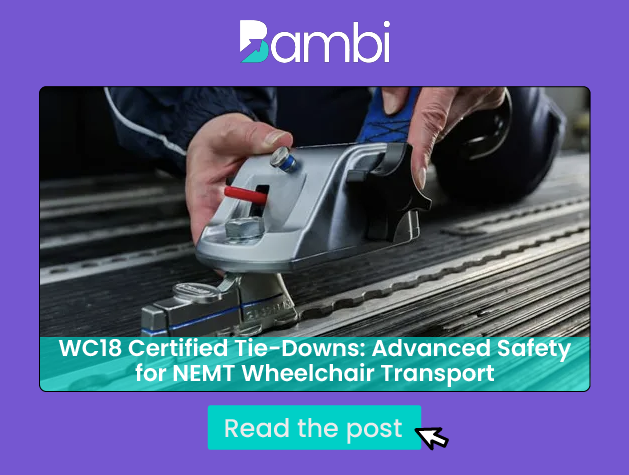
Ensuring Safety in Non-Emergency Medical Transportation with WC18 Certified Wheelchair Tie-Downs
Non-Emergency Medical Transportation (NEMT) providers play a crucial role in ensuring safe and reliable transportation for individuals with mobility challenges. One of the most critical aspects of this service is the proper securement of wheelchairs during transit. This is where WC18 certified wheelchair tie-downs come into play, offering a level of safety and security that is essential for both passengers and providers.
WC18 is a standard set by the American National Standards Institute/Rehabilitation Engineering and Assistive Technology Society of North America (ANSI/RESNA) Wheelchair Standards that governs wheelchair tie-down and occupant restraint systems (WTORS) used in motor vehicles. This standard ensures that wheelchair securement devices can withstand the forces experienced during a collision, providing crucial protection for wheelchair users during transportation.
The WC18 standard requires WTORS to pass two different dynamic strength tests:
These tests simulate real-world collision scenarios, ensuring that the tie-downs can effectively secure wheelchairs and protect occupants in the event of an accident.

WC18 certified tie-downs provide a higher level of safety for wheelchair users during transportation. By meeting rigorous testing standards, these systems ensure that wheelchairs remain securely fastened even in the event of a sudden stop or collision. This significantly reduces the risk of injury to passengers, providing peace of mind for both users and their families.
Using WC18 certified tie-downs helps NEMT providers comply with safety regulations and standards. This compliance is crucial not only for maintaining operating licenses but also for protecting the provider from potential legal liabilities in case of accidents. By using certified equipment, providers demonstrate their commitment to passenger safety and industry best practices.
WC18 certified tie-downs often incorporate advanced features that make them easier and quicker to use. For example, retractable systems can automatically tighten during small wheelchair movements, eliminating slack and reducing the potential for wheelchair movement. This improved efficiency can lead to faster boarding times and a smoother overall experience for both passengers and operators.
Modern WC18 certified tie-downs are designed to be compatible with a wide range of wheelchair models. This versatility is crucial for NEMT providers who serve diverse clientele with different types of mobility equipment. The ability to securely fasten various wheelchair designs ensures that providers can accommodate all passengers safely.
To effectively implement WC18 certified tie-downs, NEMT providers should consider the following steps:
They must pass a 30 mph frontal-impact test, include pelvic and shoulder restraints, have specific end fittings, be properly labeled, and provide instructions for installers and users. WC18 additionally requires testing with a wheelchair-anchored crashworthy lap belt.
Independent systems are anchored to the vehicle, while integrated systems are anchored to the seat or wheelchair. Partially integrated systems, with only the pelvic belt anchored to the wheelchair, are becoming more common.
While tiedowns are tested with a 187 lb wheelchair, they should work in most crashes even with heavier wheelchairs. For added safety, additional tiedown straps can be used, especially in vans and minivans.
For non-WC19 wheelchairs, using extra tiedown straps is recommended. For WC19-compliant wheelchairs, follow manufacturer instructions. The need for additional straps depends on factors like vehicle type and restraint system.
For non-WC19 wheelchairs, secure all points to either the seat or frame. For WC19-compliant wheelchairs, follow the manufacturer's instructions for using the tested securement points.
WC18 certified wheelchair tie-downs are not just a safety feature; they are an essential component of responsible and professional NEMT services. By investing in these advanced securement systems, providers demonstrate their commitment to passenger safety, legal compliance, and service quality. As the NEMT industry continues to evolve, the use of WC18 certified tie-downs will undoubtedly remain a crucial factor in ensuring safe and reliable transportation for individuals with mobility challenges.
For NEMT providers looking to enhance their services and prioritize passenger safety, implementing WC18 certified wheelchair tie-downs is a clear and necessary step forward. It's an investment that not only protects passengers but also safeguards the reputation and future of NEMT operations.
WC20 is a voluntary standard for wheelchair seating systems used in motor vehicles. It is part of the American National Standards Institute/Rehabilitation Engineering and Assistive Technology Society of North America (ANSI/RESNA) Wheelchair Standards, specifically Volume 4: Wheelchairs and Transportation. This standard was developed to evaluate the crash performance of different seating systems independently of the wheelchair frame
WC20 certified seating systems are designed to provide enhanced safety for wheelchair users during transportation. Some key features include:
NEMT providers should look for the following when selecting wheelchair seating systems:

To effectively incorporate WC20 certified seating systems into their services, NEMT providers should:
A1: These standards apply to wheelchair seating systems that are designed to be used as seats in motor vehicles. They cover both aftermarket seating systems and those provided by wheelchair manufacturers as an alternative to their standard seating systems.
A2: Occupant-restraint belts are designed to protect the wheelchair user during a vehicle crash or sudden maneuver. Positioning or postural belts are intended to help maintain the user's posture and are not crash tested. Occupant-restraint belts should be used for transportation, while positioning belts may not provide adequate protection in a crash.
A3: Postural and positioning belts are not designed or tested for occupant restraint in a vehicle crash. They may break or cause injury if relied upon for crash protection. It's recommended to use a properly positioned vehicle-anchored lap and shoulder belt system for occupant restraint during transportation.
A4: Head supports that are rigidly attached to the wheelchair seatback and tested with the seating system can be beneficial in a rear impact. However, soft headrests, collar-type supports, or headbands are not recommended for use during vehicle travel as they may increase the risk of neck injury in a frontal crash.
A5: While these systems may provide essential postural support, they haven't been evaluated for crash safety. If possible, transfer the wheelchair user to a vehicle seat. If this isn't feasible, use the customized seating system but ensure proper use of vehicle-anchored lap and shoulder belts. Be aware that there may be an increased risk of injury in a crash compared to using WC20-compliant seating.
Remember, these answers are based on the WC20 standards and general safety recommendations. Always consult with healthcare professionals and follow local regulations for the most appropriate and safe practices for individual situations.
WC20 certified wheelchair seating systems are a critical component of safe and effective NEMT services. By prioritizing the use of these systems, NEMT providers can enhance passenger safety, reduce liability risks, and demonstrate their commitment to quality care. As the industry continues to evolve, staying informed about the latest safety standards and best practices will be essential for NEMT providers to maintain a competitive edge and provide the best possible service to their clients.
