
Based on your learnings about the New York NEMT market, it is essential to develop a comprehensive and meticulous business plan. This is crucial for establishing your business and for accessing any potential funding.
Start by consulting resources like the New York Department of State to understand the initial steps involved in starting a business in New York. These steps will include selecting a business structure, completing your business registration, obtaining required licenses and permits and adhering to applicable tax regulations. The New York Small Business Development Center (NYSBDC) is also a valuable resource for startup support.
SCORE also operates in the state to provide business mentorship and advice. In the meantime of consulting with consultants, though, here's a concise quick guide to navigate this stage of launching your business:
Deciding on the legal structure of your business is an important step in establishing your company in New York State. Some of the most common options are Sole Proprietorship, Partnership, Limited Liability Company (LLC) and Corporation (C-Corp or S-Corp). Each comes with distinct legal and tax implications, so be sure you understand the differences.
Upon choosing the business entity that fits your business best, next you need to come up with a name for it. Have fun with this part of the creative process — it’s an exciting opportunity to express your brand's identity. Once you have a name, both the entity and the name must be registered with the New York Department of State to conduct business in New York.
Apply for an EIN from the IRS if you will be employing employees or operating as a corporation or partnership.
In New York, you can register for taxes and obtain necessary permits through the New York State Department of Taxation and Finance. This department handles various tax registrations, including sales tax and provides resources for obtaining the necessary permits for your operations.
Fantastic! Ready to move on to Part 3 where we delve into New York's regulations and insurance requirements? Click here to get started. If you'd like to explore other sections in the series, you can check out the table of contents here.
Welcome to New York State, where starting your NEMT business is as promising as a friendship between Bambi and Pizza Rat! Before diving into the details of launching your venture, conducting thorough market research is essential. This critical step will guide you through New York's diverse communities and expansive rolling Adirondack terrain — and beyond, helping you pinpoint underserved areas to avoid competing in over-saturated markets.
New York State has a substantial Medicaid population, providing essential non-medical services through its Medicaid program, known locally as Medicaid. Managed care health plans within the state also include comprehensive NEMT services. The New York State Department of Health is a valuable resource for locating information about NEMT providers statewide. Here are some of the leading NEMT providers offering services today:
To capitalize on the abundant opportunities for your NEMT business in the diverse landscape of New York, we recommend you begin by assessing local demand and deciding whether to serve multiple counties or focus within a specific radius. Conduct thorough research on nearby hospitals, healthcare facilities, wellness centers and other healthcare providers. Explore unconventional avenues to uncover distinctive opportunities that distinguish your business in the competitive market.
After diving into the NEMT market across New York State and gauging demand, pinpointing your target demographic is key — whether it’s seniors, individuals with disabilities or a broader patient base. Focusing on a specific group allows you to tailor your services and marketing strategies more effectively.
Ride the New York NEMT biz train like you would the NYC subway: strategically. By concentrating on the most in-demand services to meet your community's needs effectively. This strategic focus lays a strong foundation for long-term success. Stay ahead of the competition by offering unique services or targeting underserved niches. Launch with a top-notch fleet designed for New York, catering to destinations such as nursing homes, hospitals or other vital facilities.
New York runs the nation’s largest Medicaid transportation program, accounting for a quarter of all NEMT spending. This is huge! NEMT is classified as an administrative service for maximum flexibility, with federal reimbursement at 50%. Previously, New York had a county-based fee-for-service model, where counties covered 50% of Medicaid costs. Two-thirds of NEMT spending goes through this program, with the rest managed by Medicaid managed care organizations. Instead of brokers, New York now uses administrative contractors and medical transportation management firms to run call centers and coordinate services efficiently.
Here are some fast New York facts according to the report State-by-State Profiles for Examining the Effects of Non-Emergency Medical Transportation Brokerages on Transportation Coordination:
In New York State, NEMT providers receive payment through various methods under the Medicaid program:
Fee-for-Service (FFS): Providers submit claims directly to Medicaid for each NEMT service rendered. Reimbursement rates are determined by Medicaid and depend on the type of transportation service provided and other factors.
Managed Care Organizations (MCOs): New York operates under a managed care model where MCOs are contracted by Medicaid to oversee healthcare services, including transportation. NEMT providers contract with these MCOs and receive payment according to negotiated terms and rates set by the MCOs.
Administrative Contractors: Instead of brokers, administrative contractors and medical transportation management companies may coordinate NEMT services in New York. Providers work with these entities and receive reimbursement based on agreed-upon terms and rates.
Providers in New York must adhere to Medicaid billing guidelines and procedures when submitting claims for reimbursement. For detailed information and specific requirements, providers should consult the New York State Department of Health (NYSDOH) or their contracted MCO.
Get ready to navigate the New York NEMT scene at the speed of a New York minute! Stay tuned for Part 2, where we'll guide you through crafting a business plan tailored to New York's unique regulations and market dynamics. Stick with us, or jump ahead through the series' table of contents here.
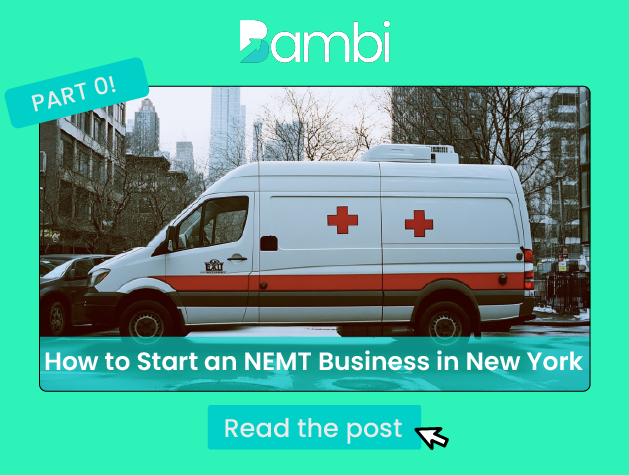
"Hey there, how ya doin'? Welcome to the Empire State!" As New Yorkers like to say.
The Empire State is renowned for its iconic skyline, vibrant culture and endless opportunities. New York buzzes with bustling business folk and tourists alike — have you seen NYC on any day of the week? People move in a New York minute, rushing to and from their jobs, appointments and tourist attractions. It’s no wonder it's one of the most traveled cities in the USA. From the bustling streets of Manhattan to the serene Adirondacks, the state offers a dynamic backdrop for your entrepreneurial journey.
Whether you're drawn to the financial powerhouses of Wall Street, the media and arts scene in Brooklyn or the tech startups in Buffalo, New York's diverse landscape presents plenty of prospects for launching your non-emergency medical transportation (NEMT) business.
Adding to its lively and unique landscape are the many diverse people who call it home — and some of which will call you up for your services! New York stands as the fourth most populous state in the United States, with more than 20 million residents. Its vast and varied population includes a significant number of seniors, urban dwellers and rural communities, each with distinct transportation needs. This demographic diversity showcases that there’s a high demand for reliable NEMT services statewide. Understanding and addressing these transportation needs is key to establishing a successful NEMT business that caters to the health and mobility of New Yorkers.
In fact, as of 2020, there were approximately 3.2 million residents aged 65 and older, constituting about 16% of the total population, further emphasizing the significant demographic segment that necessitates services such as NEMT to support their transportation needs.
All in all, navigating New York's regulatory maze and leveraging local insights are key to your biz's success. Start strong with this Bambi Knows Best series on launching your NEMT biz in the Empire State. We’ll walk you through everything: market research, a solid biz plan, state regs, funding, fleet building, team hiring and training, plus our top-notch software integration. We’re with you hoof in hoof.
We’ll also always say that it’s good to connect with local consultants and fellow NEMT pros to boost your know-how — especially if you’re new to New York — and community spirit. Anyway, let’s get to it; check out our guide for the getting your NEMT business started in New York:
So, what are you waiting for? Dive into the heart of New York and let the Empire State's unique blend of energy, like that beat of a New York minute, fuel your fire to kickstart your NEMT business adventure!
.png)
Bambi CEO Nirav Chheda talks with Andrew Brainard, the Founder/CEO of TransMedCare, about the unique business model of his NEMT company that does only long-distance 300+ mile trips.
Learn more about TransMedCare here: https://trans-medcare.com/
_________________________________________________________________________
See the full interview on YouTube.
Or check out the episode on Spotify.
Please don't forget to subscribe and like NEMT Experts Podcast on YouTube.
And listen (audio only) on your other favorite podcast platforms Apple and Pandora.
Podcast Show Notes:
Andrew Brainerd, CEO of TransMed Care, Discusses Long-Distance Non-Emergency Medical Transportation
In a recent episode of the NEMT Experts Podcast, Andrew Brainerd, CEO of TransMed Care, shared insights into the unique world of long-distance non-emergency medical transportation (NEMT). TransMed Care specializes in trips over 300 miles, filling a crucial niche in the healthcare transportation industry.
Brainerd's journey in NEMT began at age 22 as a driver for a local company. After gaining experience in various roles, including marketing and dispatching, he founded TransMed Care in 2015. The company has since grown to a fleet of 10 vehicles, each specially designed for long-distance patient comfort and safety.
Key Takeaways:
Interesting Quotes:
"Everything that we do is encompassed around the fact that individuals can't fly," Brainerd explained, highlighting the unique need their service fulfills.
On vehicle design: "We thought of everything when it comes to comfort, and we're always trying to innovate our vans to make sure that they are as comfortable for both not just the patient and the passenger, but also for our contractors who have to be on these vehicles for weeks at a time."
Regarding the specialized nature of long-distance NEMT: "It's not just, you know, I have a local business. Let me just do a long distance trip and see how it goes.... It's very costly. It's very risky. If you don't have the right insurance, the right personnel, you're opening yourself up to a liability."
Future Plans:
Brainerd envisions expanding the fleet, creating additional hubs in strategic locations, and potentially entering the local transportation market to meet high demand in certain areas.
This episode provides valuable insights into the specialized world of long-distance NEMT, highlighting the unique challenges and opportunities in this niche market. Brainerd's experience and TransMed Care's innovative approach offer a compelling case study in entrepreneurship and specialized healthcare services.
In the heart of Iredell County, North Carolina, a dedicated transportation service is making a profound difference in the lives of seniors and individuals with medical needs. R&W Senior Transport, founded by Wanda, a passionate advocate for the elderly, is more than just a ride – it's a commitment to safety, dignity, and exceptional care.
Why Choose R&W Senior Transport?
1. A Legacy of Love: Wanda's 20+ years in the medical field and her deep affection for seniors shine through in every aspect of R&W Senior Transport. The company, named after Wanda and her beloved grandson, is a testament to her dedication to creating a lasting legacy of service.
2. Inspiring Every Ride: R&W's mission is to make every journey a positive experience. From the moment you step into their clean and well-maintained vehicles, you'll be greeted with warmth and professionalism. Their drivers prioritize safety and go the extra mile to ensure passengers feel valued and appreciated.
3. Comprehensive Services: R&W Senior Transport offers a wide array of transportation options, including:
4. Serving the Community: R&W's commitment extends to a diverse clientele, including private individuals, assisted living residents, nursing homes, hospitals, doctor's offices, hospice facilities, rehabilitation centers, and insurance companies throughout Iredell County and surrounding areas.
Making a Difference
For seniors and individuals with limited mobility, reliable transportation is often the key to maintaining independence and accessing vital healthcare. R&W Senior Transport fills this critical need with compassion and professionalism. Their dedication to punctuality, safety, and personalized care ensures that passengers can focus on their health and well-being without the stress of transportation logistics.
Wanda's Vision
Wanda's vision for R&W Senior Transport goes beyond simply providing rides. She aims to foster a sense of community and belonging for her passengers. Her team's friendly demeanor and willingness to go above and beyond create an environment where seniors feel comfortable and cared for.
If you or a loved one in Iredell County require reliable, compassionate transportation, R&W Senior Transport is here to help. Experience the difference that a dedicated team and a legacy of love can make.
Contact R&W Senior Transport today to learn more about their services and schedule a ride.
Bambi CEO Nirav Chheda talks with Hamed Yazdi, the co-founder of Rideshare Mechanic (RSM) about vehicle inspections -- what they are, why they're done, how they're done, and how RSM is transforming vehicle inspections into a remote, quicker, and better process.
See the full interview on YouTube. Or check out the episode on Spotify.
Please don't forget to subscribe and like NEMT Experts Podcast on YouTube.
And listen (audio only) on your other favorite podcast platforms Apple and Pandora.
Podcast Show Notes:
Vehicle inspections are a crucial aspect of non-emergency medical transportation (NEMT) services, ensuring safety and compliance. In a recent episode of the NEMT Experts Podcast, Hamed Yazdi, co-founder of Rideshare Mechanic (RSM), shared valuable insights on the importance of vehicle inspections and how RSM is revolutionizing the process.
Yazdi explained that vehicle inspections are essential for two main reasons: safety and compliance. Various entities, including state and local regulatory agencies, managed care organizations (MCOs), brokers, and health plans, require these inspections to ensure vehicles meet safety standards. The frequency of inspections can vary, with some requiring annual checks while others mandate quarterly inspections.
Traditional vehicle inspections often involve significant costs and logistical challenges for transportation providers (TPs). Yazdi estimated that the total cost per vehicle per year could range from $200 to $1,000, considering both hard and soft costs. This includes vehicle downtime, driver time, and potential lost opportunities.
RSM offers an innovative solution to these challenges through virtual inspections. Using video chat technology, RSM's certified inspectors guide TPs through a thorough inspection process, which can be completed in 20-30 minutes. This approach not only saves time and money but also provides a more convenient option for TPs.
"By doing this virtual inspection, an NEMT business owner is effectively saving thousands of dollars per year, and it's from the comfort of wherever the vehicle is." - Hamed Yazdi
"We've developed a lot of processes and protocols in place to ensure that we have a very high quality process that's repeatable and scalable." - Hamed Yazdi
Yazdi emphasized the importance of eliminating fraud and ensuring transparency in vehicle inspections. He encouraged NEMT businesses and brokers to have an open mind about virtual inspections, highlighting the benefits of RSM's process in terms of safety, convenience, cost reduction, and compliance.
As the NEMT industry evolves and regulations become more stringent, innovative solutions like RSM's virtual inspections are likely to play an increasingly important role in ensuring efficient, cost-effective, and compliant operations for transportation providers and brokers alike.
.png)
Bambi CEO Nirav Chheda talks with Kristan Parker, the National Sales Director of Koala Capital, about how and why to get financing for purchasing assets to grow and run a NEMT business.
See the full interview on YouTube.
Please don't forget to subscribe and like NEMT Experts Podcast on YouTube.
Also, available to watch on Spotify.
And listen (audio only) on your other favorite podcast platforms Apple and Pandora.
Podcast Show Notes:
This podcast episode features an interview with Kristen Parker, the National Sales Director at Koala Capital, discussing financing options for non-emergency medical transportation (NEMT) businesses. Here's a summary of the key points and takeaways:
Kristen Parker revealed that 60% of Koala Capital's business is dedicated to NEMT financing1. This significant focus stems from the industry's growing importance and personal connection for Parker.
Parker emphasized several advantages of financing for NEMT businesses:
She stated, "I always encourage my customers to use other people's money so that they can keep their cash flow reserves for hiring staff or marketing or advertising or general unforeseen expenses or circumstances"1.
Parker highlighted the importance of revenue projections in determining financing needs. She advised NEMT business owners to project their potential earnings from new or existing business to assess if additional vehicles or equipment are required.
Koala Capital offers a streamlined application process:
Common equipment financed for NEMT businesses includes:
Parker expressed optimism about the NEMT industry's future, stating, "As we are all aging, this particular industry is going nowhere but up. It is absolutely crucially necessary now, and it's only going to get more and more needed"1.
Parker shared a success story of a startup that received financing for two NEMT vans, which helped launch their business during a challenging economic period in 2010.
In conclusion, this episode provides valuable insights into the financing options available for NEMT businesses and highlights the importance of strategic financial planning in this growing industry.
Nationwide Brokers
Regional Brokers
Additional Considerations When Comparing Brokers
Beyond service area, there are other key factors to consider when selecting an NEMT broker:
Remember, the best NEMT broker for your needs will depend on your specific location, patient population, and service requirements. It's essential to do your research and compare multiple brokers before making a decision.
Great job — be proud of yourself! You’ve navigated most of all of the critical steps to start your NEMT business in North Carolina. Now, it's time to harness the power of advanced technology to enhance your operations and improve service delivery across the state’s varied landscapes.
Harness the Power of NEMT Software
At Bambi, our cutting-edge aiNEMT software is designed to elevate your business by setting new benchmarks in patient care and operational efficiency. Whether you're managing routes through the urban sprawl of Charlotte or coordinating services across the scenic Appalachian region and the coastal plains, Bambi’s technology keeps you ahead in the industry.
Our all-in-one solution covers every facet of your NEMT operations, including scheduling, dispatching, care coordination and real-time GPS tracking. Bambi’s software streamlines your processes, allowing you to focus on delivering outstanding care and superior customer service. Customized to meet North Carolina’s diverse geographic and environmental conditions, our technology ensures reliable, consistent service in both city environments and remote areas.
Get Started with Bambi
Curious about how our aiNEMT software can transform your operations? Contact us for a demonstration or personalized advice tailored to your North Carolina NEMT business needs. Embrace technology that helps you navigate the state’s varied regions with ease and sets your business on the path to success.
Here’s to delivering exceptional NEMT services across the beautiful and diverse state of North Carolina!
