
Part 2: Develop a Business Plan and Get Registered in Arkansas
Since you’ve gained all those valuable insights from your Arkansas NEMT market research in Part 1, now it’s time to develop a detailed business plan. This is important for several reasons — like for registering your business and obtaining any potential funding.
If you require further assistance, consider contacting local business consultancies and business education centers like The Innovation Hub and Arkansas Small Business and Technology Development Center (ASBTDC).
We also recommend furthering your research through the Arkansas Department of Commerce and The Arkansas Secretary of State. Starting a new business and writing up a plan in Arkansas involves several important steps such as: selecting a business structure, registering the business, obtaining the necessary licenses and permits and understanding tax rules.
Here is a quick guide to help you through this part of the process:
1 | Choose a Business Entity
Decide on the legal structure of your business. Common options include Sole Proprietorship, Partnership, Limited Liability Company (LLC), and Corporation (C-Corp or S-Corp). Each structure has different legal and tax implications so be sure to understand the differences.
2 | Register Your Business Name and Entity
After selecting the entity that best suits your needs, you'll want to come up with a name for it. Have fun with it, we did when we came up with our name, Bambi, for instance!
Anyway, both the entity and the name must then be registered with the Arkansas Department of Finance and Administration if you are conducting business in Arkansas or with Arkansas customers.
3 | Obtain an Employer Identification Number (EIN)
Apply for an EIN from the IRS if you will have employees or operate as a corporation or partnership.
4 | Register for State Taxes
You’ll need to register with the Arkansas Taxpayer Access Point (ATAP) for state taxes such as sales tax and employer withholding tax.
Excellent! To move on to Part 3, where we discuss Arkansas' regulations and how to obtain insurance, click here. Or, if you’d rather, you can navigate to different sections in the series by visiting the table of contents here.
Part 1: Research the Arkansas NEMT Market
Prior to launching a new NEMT business in Arkansas, it's important to conduct thorough market research. This step ensures you avoid entering an oversaturated market and helps identify gaps in existing NEMT services. For example, you might discover that while there are NEMT providers in your particular area, they only serve Adult Day Care centers. This gap presents an opportunity to expand your services to rehabilitation centers, hospitals and other healthcare facilities.
In this section, we'll guide you on how to get started and where to focus your market research efforts in Arkansas.
1 | Identify existing NEMT providers in your area
In Arkansas, there are several NEMT providers operating under contracts with the state or through private arrangements. These providers work together to ensure that Medicaid beneficiaries and other eligible individuals in Arkansas have access to necessary medical transportation services. Some of the most notable NEMT providers and brokers include:
2 | Assess the demand for NEMT services
Assess whether there is sufficient demand for your NEMT business in your local Arkansas area. Consider whether you will be crossing multiple jurisdictional lines or operating within a limited radius. To make this determination, research local hospitals, health and wellness facilities and other establishments such as:
3 | Decide on a target market
After researching NEMT market opportunities and assessing demand, identify the demographic that makes the most sense to target, such as seniors, individuals with disabilities or a broader patient population. Specializing in a specific group will help you tailor your services and marketing strategies effectively.
The population of Arkansas is estimated to be around 3.02 million in 2024 (Source: World Population Review and Neilsberg). For a relatively large state, this population size is considered moderate.
4 | Choose a specific NEMT service (or offer them all!)
NEMT providers offer ambulatory, stretcher and wheelchair services. It's best to start with one service based on market needs and gaps, then expand. This ensures sustainability. Observe competitors and either differentiate or find a niche needing support. Begin with a well-equipped fleet tailored to your chosen service, whether it's for ADCs or physical therapy centers.
5 | Understand the different Medicaid delivery models
In Arkansas, the Medicaid program utilizes one single main regional broker for NEMT. The Arkansas Department of Human Services (DHS) contracts this broker which is Modivcare (formally known as Logisticare Solutions, LLC) to manage and coordinate NEMT services for Medicaid beneficiaries. Modivcare then contracts with various transportation providers (including ambulatory and wheelchair-accessible vans) to provide these NEMT services to the riders in need.
This regional broker, Modivcare, may also work with qualified subcontractors in their respective areas, acting as gatekeepers who process transportation requests and address complaints to maintain service quality. It’s important to note that the DMS conducts regular reviews of these brokers to ensure high-quality service. There are other smaller regional brokers (beyond the Modivcare) acting in support alongside and include a mix of for-profit national companies and Arkansas-based human services brokers, such as development councils, area agencies on aging and community action agencies.
Here are some fast AR facts according to report State-by-State Profiles for Examining the Effects of Non-Emergency MEdical Transportation Brokerages on Transportation Coordination:
6 | Getting Paid
It’s good to get paid, eh? NEMT fee schedules in Arkansas follow the guidelines and rates set by the Arkansas Medicaid program. Here's a quick overview:
NEMT services for Medicaid recipients are reimbursed based on the established fee schedule, which includes mileage rates for various vehicle types (i.e. wheelchair vans, stretcher vans) and rates for waiting time. Providers must adhere to these rates when billing Medicaid.
Arkansas Medicaid operates under a managed care model, where some recipients are enrolled in managed care organizations (MCOs). MCOs have their own contracts and fee schedules with NEMT providers, who must comply with these rates and guidelines when serving their members.
To receive payment, NEMT providers submit claims for services rendered to Medicaid recipients. Claims are processed and reimbursed according to the fee schedule rates and any additional guidelines from Arkansas Medicaid or the MCOs.
Great job navigating through this information-packed first part! Now, let's move on to Part 2, where we'll focus on developing a business plan. Click here to continue, or you can skip ahead to other sections in the series by visiting the table of contents.
Howdy there, folks! Welcome to the lush and lovely rolling hills of Arkansas — you can almost see Bambi (or at least his cousins) prancing through them. Known as the Natural State, Arkansas boasts breathtaking landscapes and a warm, blended charm of the Southern and Midwestern spirit. With its rich agricultural heritage, Arkansans embody hard work, innovation and a strong sense of community, making it an ideal environment for your entrepreneurial journey.
Arkansas isn't just about its crops; it’s about the people who care for them, too. As many farmers in the fields today are getting older (for instance, the average farmer’s age is 57 years old!) and retiring, there is an increasing need for healthcare and transportation to appointments.
That said, Arkansas is an excellent place in the Southern Midwest to launch your non-emergency medical transportation (NEMT) business for several reasons beyond the aging farmer population. From the bustling urban centers of Little Rock, Fayetteville and Fort Smith to the expansive rural areas across the state, there are abundant opportunities to establish your NEMT business.
In this Bambi Knows Best series we’ll guide you through each step in starting your own certified NEMT business in Arkansas. From researching the local market and crafting a business plan to navigating regulations, securing funding, building your fleet, hiring and training your team and managing that essential technology (maybe you even choose ours!).
As you embark on your research journey, we suggest hiring local consultants and connecting with other NEMT business owners in your area for valuable insights. Because at Bambi, we believe in cultivating a forest of friends over frenemies!
Here's a handy (or rather, hoofy) table of contents to guide you through the articles that cater to your specific needs:
Part 1: Research the Arkansas NEMT market
Part 2: Develop a business plan and get registered in Arkansas
Part 3: Study Arkansas’ regulations and get insured
Part 4: Secure funding in Arkansas
Part 5: Flesh Out Your NEMT Fleet in Arkansas
Part 6: Hire and Train Up Your NEMT Dream Team
Part 7: Take Care of That Tech
All in all, you’ll see that starting an NEMT business in Arkansas demands dedication, meticulous planning and an unwavering commitment to delivering exceptional patient care. Through comprehensive research of the Arkansas market, adherence to local rules and regulations, securing funding and vehicles, assembling a skilled team and leveraging technology, you can tackle challenges with the agility of Bambi and establish a thriving NEMT business that makes a positive impact on your local Arkansas community. You got this!
As you’ve already seen in the first of this series, how our aiNEMT software is making the world a greener place, in this second edition, we’ll delve into how our well-being-minded software is making the NEMT world a turquoise greener place. Yes, it’s that soft, soothing blue/green is our main brand color — for good reason. It contributes to this lowering of an NEMT business owner’s cognitive load.
Let’s face it, entrepreneurs, especially in healthcare services, have a lot on their plates. They need support in the reduction of clutter in their tools and timetables. This is where we come in to help: by offering softness in our tech stack to ease their minds,calm their Bambi hearts and support their suite of services, swiftly and soothingly.
Soft and scientifically calming
Bambi's platform is crafted to be soft on the eyes and scientifically calming for the mind. Our simple, clean design ensures a clutter-free interface, which reduces cognitive load and promotes mental clarity. By integrating ample white space and soothing color palettes, we create an environment that’s as refreshing as it is functional and as visually spacious as Bambi’s lush light-filled forest.
"Inside our platform, customers experience clutter-free, cleansing white space that reduces cognitive load and puts the mind at ease," adds Henick. "They also experience soothing splashes of tranquil turquoise in our buttons to call attention to calm — it’s our primary brand color, after all!"
Softies building software for softies
Our experienced team of software developers is dedicated to continually refining our platform. Whether you're a seasoned NEMT business veteran or new to the industry, our platform is designed to be as easy to navigate as pressing down on the pedal and going. By prioritizing user-friendly interfaces and intuitive functionalities, we ensure that everyone can benefit from our software without feeling overwhelmed. The less stress the better for that heart and head health!
Through our simple, soft software, we’ve created a platform where NEMT business owners can thrive mentally and emotionally, enabling them to be fully present for those they care for.
So why don’t you join us in our mission to make the world a softer place to live? With Bambi, you can navigate the complexities of NEMT operations with ease, one click of Run Bambi Run and a peaceful patient ride at a time.

In today's overly fast-paced world, technology often feels overwhelming. The need for simple and sustainable tools has never been needed more.
Here at Bambi, we believe that software should support the mental well-being of its users and at the same time contribute to the health of our planet — because why create more products that harm the environment? It's our only planet, after all; Bambi's, yours and ours! So, we developed a non-emergency medical transportation (NEMT) software as a service (SaaS) platform designed with this dual mission of people and planet care in mind.
Our human-centric approach not only reduces the cognitive load of our dear customers — those savvy NEMT business users — but also minimizes their carbon footprint out in the field as they pick up their passengers via the most optimal routes in their, ideally, eco-friendly fleet — addressing the pressing issue of climate change.
In this first edition, we’ll tell-all how our sustainable-minded all-in-fun aiNEMT software is reducing the NEMT industry’s carbon footprint and making the world in which we live a greener place.
A sustainable solution for a greener planet
Climate change is one of the most critical challenges facing our planet today. At Bambi, we are committed to playing our part in mitigating its impacts. And through this commitment to sustainability, we offer a NEMT SaaS solution that truly embodies our values.
In addition to supporting the mental well-being of our users, we’re committed to reducing the NEMT industry’s environmental footprint. We do this by prioritizing continual iterations of our aiNEMT-powered scheduling and routing algorithms, so that they are constantly improving a fleet’s operational efficiency — through optimized routes and reduced idle times, all by minimizing fuel consumption and emissions and thus contributing to a greener planet.
One standout feature is our "Run Bambi Run" button, which ensures efficient patient transportation and reduces unnecessary mileage. Whether patients are headed to medical appointments or returning home after treatment, our software ensures they travel sustainably and comfortably.
By integrating these sorts of sustainable initiatives into our platform, we help NEMT providers reduce their carbon footprint. This benefits the environment and aligns with the growing demand for eco-friendly solutions in the NEMT industry. And so there you have it folks; greener ways of doing tech, and with Bambi on your side, they will always be greener days ahead.
We invite you to us in our mission to make the world a softer, more sustainable place to live. With Bambi, you can navigate the complexities of NEMT operations with ease and contribute to a healthier planet, one ride at a time.
.png)
See the full interview on YouTube.
Please don't forget to subscribe and like NEMT Experts Podcast on YouTube.
Also, available to watch on Spotify
And listen (audio only) on your other favorite podcast platforms Apple and Pandora.
Bambi CEO Nirav Chheda talks with Jarrod Hilliard, son and protégé of Roslyn Taggart (Owner of B811 Medical Transportation), on how he has helped grow his family's NEMT business.
The podcast episode features Jared Hilliard, the son of Rosalind Tagore, discussing his involvement in his mother's medical transportation business. Jared shares his journey from being a college football player to working full-time in the family business after his uncle's illness inspired his mother to start VA 11. He talks about the roles he plays in the business, his relationship with his mother as his boss, and the rapid growth of their company. Jared also reflects on the challenges and rewards of working in the NEMT industry and his aspirations for the future, including expanding their services to include gurney and potentially helicopter transportation.
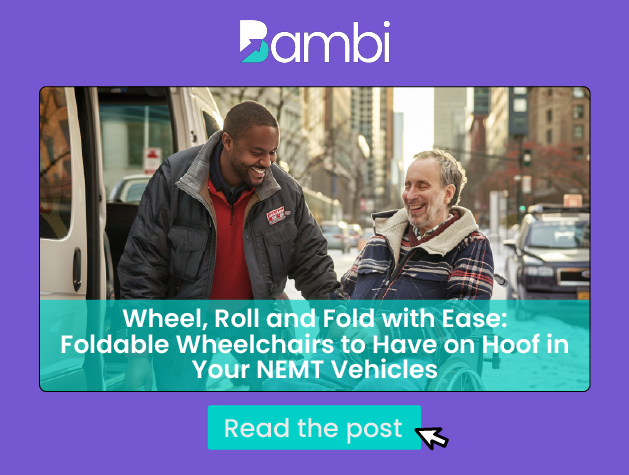
Mobility issues can transform simple tasks into daunting challenges, especially for those who rely on wheelchairs. This is where non-emergency medical transportation (NEMT) services come in like a reliable friend (like bushy-tailed Bambi!), providing rides that are not only convenient but also incredibly supportive. We all understand that constantly leaning on family and friends can lead to tension, and public transport isn't always an option — sometimes a timely ride with ample room for a foldable wheelchair is exactly what your riders need to reach their medical appointments. Having a foldable wheelchair already in the vehicle means your riders can leave their own wheelchair at home, ensuring a smoother, more flexible transportation experience.
Here’s why, as a NEMT broker or business owner, having folding wheelchairs in your fleet is a Bambi essential:
Folding wheelchairs are lightweight and designed for easy storage, making them perfect additions to your medical equipment in your NEMT vehicles. They can be swiftly folded and stowed away, saving valuable space and ensuring your vehicle is always prepared to accommodate multiple passengers or other essential equipment.
Equipping your fleet with folding wheelchairs means you're ready for any situation. Whether a rider forgets their wheelchair or faces an unexpected mobility challenge, you have the tools on hoof to ensure seamless service.
Folding wheelchairs are built to be flexible and cozy, with adjustable features that cater to different needs of its users. This makes sure your wheelchair bound riders get the support they need, increasing their overall experience and satisfaction with your service.
Having folding wheelchairs readily available underscores your commitment to providing a comprehensive, reliable service. It shows that you anticipate and address the varying needs of your rideres, building trust — like a dear friend like Bambi’s Thumper — and a reputation for excellence and care in the NEMT industry.
Remember, it’s all about creating an inviting environment, as that will bring you repeat customers and good word-of-mouth. By integrating folding wheelchairs into your NEMT operations, you can boost service quality, increase rider satisfaction and streamline your on and offboarding processes. It’s a small investment with big returns, ensuring that your business stands out as a dependable and caring NEMT provider.
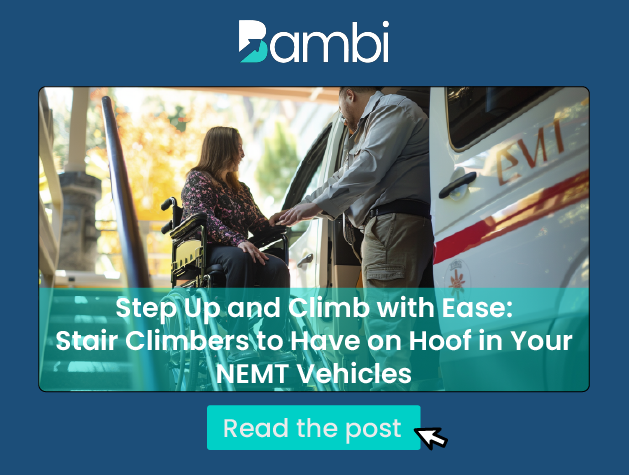
Step Up and Climb with Ease: Stair Climbers to Have on Hoof in Your NEMT Vehicles
Navigating staircases can be tricky, especially for those with severe mobility issues or older adults. The struggle becomes even more of a threat when dealing with steep, narrow or poorly maintained staircases. Fortunately, stair climbers were invented to help such folks ascend and descend those sometimes scary steps with ease and safety.
Most people don’t have the capability or space for a stair climber in their own vehicles for if and when they’re asked to take a loved one to and from their medical appointments. Ideally the family member in need of getting up and down stairs already has a means of doing so — be it a chair lift, elevator or helping hand — but this isn’t always the case.
This is why having non-emergency medical transportation (NEMT) vehicles with a stair climber already in tow comes in hand (or hoof). Because you never know when someone might need the extra support up and down a flight of stairs (be it inside or an outdoor porch) or elevated terrain in their hard or sidewalk.
Here’s why, as a NEMT broker or business owner, having stair climbers on hoof in your NEMT fleet is absolutely a Bambi must:
Prioritized safety
Stair climbers provide a stable and secure method for transporting patient riders up and down stairs, significantly reducing the likelihood of falls and injuries. This prioritizes the safety of both your riders and drivers, ensuring a safe journey every time. They are also designed to be secure and comfortable during transit, enhancing the riders overall comfort and well-being — giving them the dignity they deserve.
Increased efficiency and readiness
Equipping your NEMT fleet with stair climbers allows you to accommodate a wider range of medical needs and emergencies upon arrival and departure. They can be swiftly deployed when needed, ensuring readiness for those unexpected circumstances. Also, with stair climbers, your drivers can move riders as quick and nimble as Bambi frolicking through the forest. This not only speeds up the transportation process to/from your riders’ appointments, but also allows for better time management and scheduling within your NEMT services.
Versatility
Stair climbers — with their adjustable parts and rugged wheels — are adaptable to a variety of terrains and stair types, making them a versatile addition to any NEMT vehicle. Whether dealing with narrow, winding stairs or steep inclines, the right stair climber can hoof it up and down with Bambi gentleness.
Reliability and regulatory compliance
Including stair climbers in your NEMT vehicles ensures compliance with regulations and standards governing medical transportation. It demonstrates not only your commitment to meeting and exceeding industry requirements for patient transport but also your dedication to delivering high-quality, comprehensive care.
Side note, (and also note: this is not a promoted post), but in our research we’ve found that when it comes to easy-to-store stair climbers, we recommend the XSTO stair-climbing wheelchair TR140C. This innovative stair climber was specifically designed to help users navigate stairs and elevated platforms with ease. And you can see how easily it folds down to be able to store in those varying sizes of NEMT vehicles of yours.
All in all, stair climbers are a Bambi essential, making it a smart addition to any NEMT fleet, ensuring that your drivers can support your riders in navigating stairs safely during pick up and drop off. At Bambi, we understand the importance of reliable transportation solutions — our software is designed to help you manage your fleet effectively, ensuring that your patients receive the best possible care — which is why we highly recommend investing in equipping your NEMT vehicles with stair climbers. This will make beyond a Bambi difference from not only a safety standpoint, but an empathetic one, too. And we’re all about that at Bambi and know you are, too — you're caring folks that work in caregiving after all!

Frolicking Towards a Fuelless Future: Go Green with Your NEMT Fleet
As a care-tech company named after a famous deer, we’re all about frolicking lightly towards a brighter future — doing whatever it takes to lower our carbon footprints and heighten our sense of empathy for all. In the non-emergency medical transport (NEMT) industry, we’re committed to making sure our customers — NEMT business owners and brokers — are dispatching the most sustainable and efficient routes. This approach not only saves time, miles and money but also helps save the planet (and its people, too).
For instance, our "Run Bambi Run" feature embodies this commitment to Earth care. Bambi’s innovative algorithm calculates the best routes for your fleet, ensuring everyone benefits: fewer headaches for you, less drive time for your drivers, shorter journeys for patients and fewer carbon emissions on the roads and in the air. Beyond our calming tech stack, which supports your sustainability goals, there are additional steps you can take to make your business more eco-friendly, such as investing in clean vehicles.
Electric NEMT vehicles are a great choice, offering significant savings on mileage and money while nurturing our planet. Just like the gentle deer we all admire, your fleet of eco-friendly vehicles can be as kind to the environment as they are to the patients they serve. These vehicles aren't just an investment in the future of healthcare; they're a promise to prioritize both the planet and patient care.
So let’s explore some sustainable NEMT vehicle options out there that are already paving the way for a greener tomorrow, one mile at a time. But first, before we properly dive in, it’s necessary to note that choosing the best electric NEMT vehicles for your fleet depends on several factors such as range, seating capacity, accessibility features and, of course, your budget. It's also important to ensure that the vehicles meet ADA requirements and can be easily adapted to serve passengers with disabilities. Here are some options that are popular in the NEMT industry and well-regarded:
Ford Transit Electric, with an estimated range of up to 126 miles, is an excellent choice for NEMT brokers. Its spacious interior, ADA-compliant options and flexible seating configurations make it ideal for accommodating various patient needs, ensuring comfort and accessibility on every journey.
Mercedes-Benz eSprinter with an estimated range of up to 96 miles, is a top pick for NEMT brokers seeking a balance of luxury and practicality. Mercedes-Benz, a sustainably focused company committed to ESG goals, integrates their dedication to the environment into the eSprinter. Its high-end interior, various seating options and customizable accessibility features provide a comfortable and sophisticated transport experience for patients, aligning with Mercedes-Benz's ethos of sustainability and quality.
Nissan e-NV200 boasting an estimated range of up to 124 miles, is another great choice for NEMT brokers prioritizing efficiency and versatility. Nissan, known for its commitment to sustainability, integrates these principles into the e-NV200. Its compact size, good range and flexible cargo and seating arrangements make it a practical option for navigating urban environments while ensuring comfort and accessibility for passengers.
Chevrolet Bolt EV modified for NEMT purposes with a range of up to 259 miles, is a stellar option for NEMT business owners looking for extended range and flexibility. Its longer range and compact size make it well-suited for urban environments, while its ability to be modified for accessibility ensures it can meet the diverse needs of passengers. Chevrolet's commitment to sustainability is evident in the Bolt EV, making it a reliable option for environmentally conscious transportation solutions.
Tesla Model X can also be modified for NEMT purposes, boasts an impressive range of up to 360 miles, making it an exceptional choice for NEMT brokers seeking luxury and long-range capabilities. As an all-electric SUV, the Model X offers ample space and superior comfort for passengers. It can also be configured for accessibility, ensuring it meets the needs of all passengers. Tesla also has its own commitment to sustainability and innovation, which is evident in the Model X, making it a standout option for those looking to combine luxury with eco-friendly transportation solutions.
Now this is just the beginning of your sustainable 'new-steers' search. Our little deer will be proud when you find your favorite, fuel-less electric ride. With Bambi providing your sustainable software and helping create a green business for you, and your new wheels, you’ll be steering in style!
