
Equipped with insights into the Maine NEMT market, it’s time to develop a comprehensive business plan — an essential step for successfully launching your business and securing potential funding opportunities.
We recommend beginning by consulting resources such as the Maine Secretary of State’s office for guidance on the foundational steps required to start a business in Maine. These steps include choosing an appropriate business structure, completing registration, acquiring necessary licenses and permits and adhering to tax regulations.
The Maine Small Business Development Centers (SBDCs) offer valuable assistance and expertise for new ventures. This network provides training and support to entrepreneurs across the state.
Startup Maine is also a great place to look for camaraderie and support. They host events and have a plethora of resources for folks just getting started in biz in the state. Maine Center for Entrepreneurs is also another spot to check out for resources and support on the topic of just beginning. There’s really a rabbit — or Thumper — hole of help when you start digging.
Anyway, for a smooth start, follow this streamlined guide to navigate the process of establishing your business:
1 | Choose a Business Structure
Deciding on the legal structure of your business is a critical step in Maine. Your options typically include Sole Proprietorship, Partnership, Limited Liability Company (LLC), and Corporation (C-Corp or S-Corp). Each structure has unique legal and tax implications that should be evaluated carefully.
2 | Register Your Business Name and Entity
Once you've chosen your business structure, select a name that reflects your brand and register it with the Maine Secretary of State’s office. This step officially establishes your business and ensures compliance with state regulations.
3 | Obtain an Employer Identification Number (EIN)
If your business will have employees or operate as a corporation or partnership, you'll need to apply for an Employer Identification Number (EIN) from the IRS. This number is essential for tax reporting and managing employee records.
4 | Register for State Taxes
In Maine, you need to register for applicable state taxes and obtain the necessary permits through the Maine Revenue Services. This agency oversees tax registrations, including sales tax and provides information on the permits required for operating your business.
Ready to dive into Part 3, where we'll cover Maine’s specific regulations and insurance requirements? Click here to continue. For additional sections of this series, refer to the table of contents for further guidance.

Just like that classic Maine lobster roll, starting your NEMT business here promises a fresh and rewarding experience. So let’s get rollin’ why don’t we?
Before diving into the specifics of launching your venture, conducting comprehensive market research is essential. This lighthouse (see what we did there?) of a step will help you navigate Maine’s distinctive communities, from its maritime towns to its forested landscapes, allowing you to pinpoint underserved regions and avoid saturated markets.
1 | Identify Existing NEMT Providers in Your Area
MaineCare, the state’s Medicaid program, provides vital NEMT services to a large portion of its residents Health Care Assistance | Department of Health and Human Servicesutilizing brokers and providers. Key brokers, providers and resources include:
2 | Assess the Demand for NEMT Services
To leverage the opportunities in Maine’s diverse landscape, start by evaluating the local demand. Look into nearby hospitals, healthcare facilities, rehabilitation centers and senior living communities. Seek out unique opportunities to distinguish your business in a competitive market.
3 | Decide on a Target Market
After assessing the NEMT market and demand, define your target demographic. Whether focusing on the elderly, individuals with disabilities or a wider patient base, customizing your services and strategies to meet these needs will make your day-to-day business lives easier and marketing more effective.
4 | Choose Specific NEMT Services (or Offer Them All!)
Strategically navigate the Maine NEMT market by focusing on high-demand services. Establish a solid foundation by offering specialized services tailored to senior living communities, hospitals and other key healthcare facilities across the piny state.
5 | Understand Different Medicaid Delivery Models
MaineCare’s NEMT services are managed through a centralized model, with transportation services coordinated by regional brokers such as Modivcare. Providers collaborate with managed care organizations (MCOs) to deliver these services while adhering to Medicaid billing guidelines.
Previously managed at a local level, MaineCare’s NEMT program has transitioned to a centralized model, streamlining service delivery and reimbursement processes. Providers should stay updated on any changes to reimbursement structures and program requirements.
Here are some quick Maine facts related to NEMT:
6 | Getting Paid
Understanding payment methods for NEMT providers in Maine involves several approaches:
Providers must follow Medicaid billing guidelines and procedures when submitting claims. For specific requirements, consult the Maine Department of Health and Human Services or contracted MCOs.
Prepare to navigate Maine’s NEMT landscape with the precision of a lighthouse beacon! Stay tuned for Part 2, where we’ll guide you through crafting a business plan tailored to Maine’s unique regulations and market dynamics. Stick with us or Bambi leap ahead through the series' table of contents to plan your path to success!
Did you know that the story of Bambi, while set in a forest that could represent many places in the US, is often thought to be based on the forests of Maine? This is because it’s a state dense with woodlands and abundant wildlife — no wonder it’s called the Pine Tree State!
And so in this state series, we’re welcoming you to one of Bambi’s favorite places to frolic, Maine. From the rocky Atlantic coastline to lush pine forests and charming small towns, Maine offers a unique and serene environment. Whether you are drawn to the historic allure of Portland, the scenic charm of Bar Harbor, the fall foliage of Acadia National Park or the cultural hub of Bangor, Maine provides a picturesque backdrop for launching your non-emergency medical transportation (NEMT) business.
Maine's diverse communities are integral to its character — and many of these residents will soon rely on your services! With a population of almost 1.4 million, Maine boasts a considerable percentage of elderly residents. In fact, 23% of the population are aged 65 and older. This demographic includes thriving fishing communities along the coast, woodland folk working in forestry and numerous retirement communities scattered throughout the state. These groups, along with rural inhabitants and small-town residents, signify a strong demand for dependable NEMT services. Addressing these varied transportation needs is crucial to establishing a thriving NEMT business that supports the well-being and mobility of Maine residents.
Navigating Maine's regulatory landscape and leveraging local insights will be key to your business's success. Start your journey with our Bambi Knows Best series, tailored specifically for launching your NEMT business in the Pine Tree State. We cover everything from market research and business planning to compliance with state regulations, securing financing, building your fleet, hiring and training your team and integrating a suite of software solutions (like ours, of course!). Rest assured, we're with you every hoof of the way.
Connecting with local consultants and fellow NEMT professionals can greatly enhance your knowledge and community involvement, especially if you're new to Maine. Is your heart pining over the idea of being an entrepreneur in its pine-filled state? Then explore our guide to getting your NEMT business started in Maine:
Part 1: Researching the Maine NEMT market
Part 2: Developing a business plan and registering your business in Maine
Part 3: Understanding Maine's regulations and obtaining insurance
Part 4: Securing financing specific to Maine
Part 5: Building your NEMT fleet in Maine
Part 6: Recruiting and training your NEMT dream team
Part 7: Leveraging advanced technology solutions
What are you waiting for? Embrace the spirit of Maine and let its natural beauty inspire the launch of your NEMT business venture — you’ve got this!
You’re almost there, we promise! Like Thumper would tell Bambi, “You can do it, dear!” We just played with the spelling a bit! :)
Upon all that navigating of those previous biggie steps to launch your NEMT business in Maryland, now’s the time to talk about that BIG tech! This is what’s going to elevate your operations from good to the absolute Bambi best. Let’s go discover how cutting-edge software can enhance your service and efficiency across Maryland.
Unleash the Power of NEMT Software
Whether you're managing rides in Baltimore's bustling streets or coordinating transport across the tranquil Eastern Shore, Bambi’s advanced aiNEMT technology keeps you ahead of the curvy state- and shoreline, allowing you to focus on what matters most — nurturing patient and business relationships. Our comprehensive SaaS solution covers everything from scheduling and dispatching to care coordination and real-time GPS tracking.
Get Started with Bambi
Curious how our aiNEMT software can positively impact your Maryland NEMT business?Get in contact with us for a demo or personalized guidance tailored to your needs. Embrace the technology that will help you seamlessly manage Maryland’s diverse state and set your business up for success.
Here’s to delivering outstanding NEMT services across the stunning coastal state of Maryland!

Creating an outstanding NEMT team in Maryland involves finding and developing drivers and support staff — as capable and charming as Bambi’s woodland friends — who can handle everything from the bustling streets of Baltimore to the serene landscapes of Western Maryland.
Here’s how to build and train a team ready to take on Maryland’s diverse challenges with enthusiasm, patience for patients and care:
1 | Finding Your Dream Team
Like most places, local knowledge is a real asset. Seek individuals who understand the state’s vibrant mix of urban energy and rural charm. If you’ll be offering service across the state, it’s beneficial to find candidates familiar with lively areas like Baltimore, suburban settings like Silver Spring and peaceful towns in Southern Maryland. Utilize job platforms like Indeed, LinkedIn and local job fairs to discover your ideal team members. Consider innovative recruitment methods — such as hosting your own career event — to attract talented individuals who may be flying under the hood (or Bambi’s hooves)!
2 | Training for Success
Once you’ve assembled your team, make Bambi sure that you provide comprehensive training tailored to Maryland’s unique conditions. It’s crucial that your staff is well-versed in safety protocols, exceptional customer service and the specific needs of your NEMT passengers. Adapt your training to Maryland’s varying climate and diverse terrains. Effective training will prepare your team to deliver reliable and compassionate service, whether they’re driving urban streets or rural backroads.
3 | Cultivating a Positive Work Culture
A happy team is a productive team (we know this first hoof)! Creating a positive and supportive work environment keeps your staff engaged and motivated while fostering innovation. Encourage open communication, provide growth opportunities, and celebrate achievements (both big and small). A cheerful, well-supported team not only delivers outstanding service but also propels your NEMT business toward success. Foster a workplace where teamwork and fun are integral to daily operations, and watch your team thrive! Do all this, and you'll be Bambi sure you’ll be the cool employer everyone wants to work for!
You’re approaching the final step of our Bambi-guided series. Get ready for Part 7, where we’ll explore how technology can elevate your NEMT operations. Click here to continue, or check out the table of contents to refer back to more insights to guide your Maryland business journey!
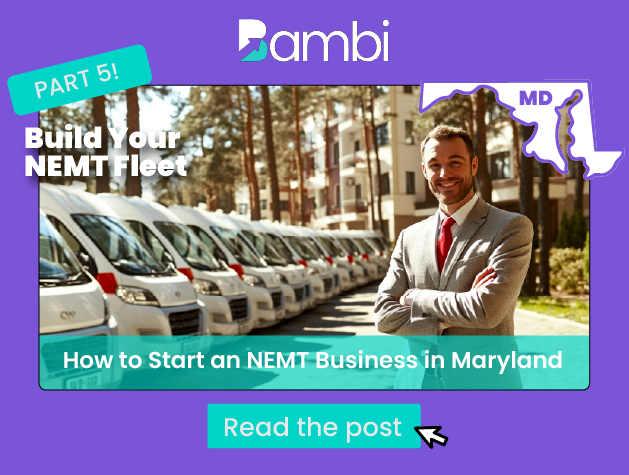
Launching an NEMT business in Maryland requires a fleet that’s ready to tackle the state’s diverse landscape, the big time Bambi buzz of Baltimore to the scenic and calmer routes of the Eastern Shore. Here’s how we suggest you start building a fleet tailored to Maryland’s unique needs:
1 | Select the Right Vehicles
Choose vehicles that can navigate Maryland’s varied terrain, accommodating both urban environments and rural routes. Ensure ADA compliance and wheelchair accessibility. Given Maryland’s seasonal climate — from chilly winters to hot and humid summers — opt for vehicles with efficient heating and cooling systems. For rural routes and areas with occasional rough roads, all-wheel drive vehicles may be a wise choice. On another note, hybrid or fuel-efficient models not only align with modern sustainability goals but also help reduce operational costs.
2 | Equip for Comfort and Safety
Outfit your fleet with essential amenities such as wheelchair lifts, first-aid kits and the latest safety technologies — after all, you’re providing medical transportation so you better be safe! For longer trips or areas with limited medical facilities, stock your vehicles with necessary medical supplies, emergency gear and comfort items (like books, magazines, card games and yummy snacks). These thoughtful additions can significantly enhance your customer service (and Google reviews)! Partnering with local suppliers for these extras, as well as for vehicle maintenance, supports the Maryland economy and fosters its community ties.
3 | Commit to Regular Maintenance
Implement a thorough maintenance schedule to keep your fleet in top condition. Regular inspections and servicing are crucial to prevent breakdowns and ensure compliance with all Maryland state regulations. Reliable maintenance not only enhances your reputation as a dependable NEMT provider but also guarantees safe and consistent service for your valued and cool as all heck patient passengers.
Ready to move forward? Click here to explore Part 6, where we'll cover strategies for recruiting and training your ideal NEMT team. Or, check the series table of contents for more resources to guide your Maryland business journey!

Finding the right funding (that feels all warm, fuzzy and Bambi secure) is necessary for establishing your NEMT business in Maryland. Whether you’re exploring federal loans, local programs, or grants, there are plenty of financial paths to consider. Our Bambi Knows Best guide will prance you through the financial options available to get your Maryland NEMT business off the ground with that Disney protagonist confidence!
1 | Explore Small Business Loans
Maryland offers various loan programs to give your new business a financial boost. The US Small Business Administration (SBA) is a great starting point, with options like the 7(a) loan program to cover startup costs and operating expenses. Additionally, local banks, credit unions, and the Maryland Small Business Development Center can provide guidance and resources to help you secure the funding you need.
2 | Tap into Maryland’s Financial Incentives
The Maryland Department of Commerce offers financial incentives to support new businesses and stimulate economic growth. From tax credits to low-interest loans, these programs can ease the financial burden of launching your NEMT business. Be sure to explore these opportunities — they’re the financial partners you need to help your business thrive.
3 | Seek Out Grants and Specialized Funding
Grants can be competitive but are a valuable source of funding, especially for healthcare and community-focused businesses. Look into grants available through the SBA and local opportunities provided by organizations like the Maryland Community Development Network. For NEMT services in rural or underserved areas, federal grants listed on Grants.gov can also offer potential financial support.
4 | Leverage Networking and Community Resources
Networking in Maryland can open many doors to funding opportunities. Engage with local chambers of commerce, business associations and entrepreneurial organizations to make connections that could lead to financial support. Attend workshops, pitch events, and community gatherings to promote your business — you never know who you might meet; your next investor, business partner or patient rider could be at a local Maryland event like a crab race!
By exploring these funding options and staying alert for new opportunities, you’ll be well-prepared to launch and grow your NEMT business in Maryland. Keep your enthusiasm high like Thumper and your approach proactive as Bambi — all the while you secure the resources needed to meet the transportation needs of communities across the state.
Keep up that Bambi momentum and move on to Part 5, where we’ll guide you through building a top-notch NEMT fleet in Maryland. For more tips and insights, check out the table of contents in this Bambi Knows Best series!

So, you’re ready to start your NEMT business in Maryland? That’s Bambi and friends fantastic! Before you hit the road or dip into Bambi’s forest of furry and feathered pals, it’s crucial to familiarize yourself with Maryland’s regulatory framework. Don’t worry; we’re here to guide you every step of the way — let’s ensure your NEMT venture gets off to a smooth start!
Here’s your Bambi Knows Best guide to navigating state rules, securing the right insurance and getting your business road-ready in the Old Line State:
1 | Understand Maryland’s NEMT Regulations
To operate your NEMT business in Maryland, you must comply with regulations set by the Maryland Public Service Commission (PSC) and the Maryland Department of Health. These rules cover driver qualifications, vehicle safety standards and operational protocols. Ensuring compliance will help your business run safely and efficiently while building trust with your clients.
2 | Follow Federal NEMT Standards
In addition to state regulations, you’ll need to adhere to federal standards set by the Centers for Medicare & Medicaid Services (CMS). If you’re providing Medicaid-funded rides, these guidelines ensure that your operations align with national standards, protecting both your business and your passengers.
3 | Secure the Right Insurance
Insurance isn’t just a box to check; it’s an important aspect of your business! Partner with insurance providers who specialize in NEMT to obtain coverage that meets both Maryland’s and federal requirements. Essential coverages include liability insurance, vehicle insurance and specialized protections for medical transport services. This will keep your business, your team and your passengers safe from unexpected and unnecessary events.
4 | Obtain Necessary Licenses and Permits
Make sure to acquire all required licenses and permits to operate legally in Maryland. The Maryland Public Service Commission handles transport permits, while local jurisdictions may have additional requirements specific to your NEMT operations. Staying compliant will help you avoid any regulatory hiccups down the road.
5 | Know Your Employer Responsibilities
As your business expands, it’s important to understand your responsibilities as an employer in Maryland. This includes workers' compensation insurance, unemployment insurance and compliance with those laborious labor laws. The Maryland Department of Labor and the Maryland State Department of Assessments and Taxation are excellent resources to help you navigate these obligations, ensuring your team is protected and that you maintain a supportive work environment.
By mastering Maryland’s regulatory landscape and securing the right insurance, you’ll be well-prepared for a successful NEMT business. Keep compliance top of mind, and you’ll be ready to serve communities across the state with confidence and care!
Ready for your next hoof in this guide’s steps? We think you are! So go on, jump to Part 4, where we’ll explore funding options for your NEMT business in Maryland. Or head back to our table of contents for more insights to guide your NEMT journey!
Okay, so you’ve mapped out the Maryland NEMT market and you’re starting to see where you might fit in. In this case, it’s time to set the stage with a solid business plan. Let’s get down to the essentials of securing funding, setting up shop, and navigating Maryland’s regulatory landscape!
First and foremost, we suggest consulting resources like the Maryland Secretary of State, Maryland Small Business Development Center, the Maryland Department of Business and Economic Development, and the Maryland State Department of Assessments and Taxation for tips on starting your business. Key steps include choosing the right business structure, completing registration, obtaining necessary licenses and permits and understanding Maryland’s tax regulations.
These resources are your partners in this process — or Bambi forest friends — offering advice, training and support for new businesses. Local chambers of commerce are also valuable for networking, resources and additional guidance.
Here’s how to make a Bambi leap through the business essentials of setting up your NEMT operations in Maryland:
1 | Choose a Business Structure
Common options in Maryland include Sole Proprietorship, Partnership, Limited Liability Company (LLC) and Corporation (C-Corp or S-Corp). Each has its own legal and tax benefits, so choose what aligns best with your business goals. We always think it’s a good idea to consult with a local to Maryland legal advisor or accountant to help clarify your options.
2 | Register Your Business Name and Entity
Upon picking out your chosen structure, it’s time to pick a name that reflects your brand’s personality and sticks — like a catchy Disney tune! Register your business name with the Maryland State Department of Assessments and Taxation to make it official and ensure compliance with state requirements.
3 | Obtain an Employer Identification Number (EIN)
Planning to hire employees or need to manage your business finances? You’ll need an Employer Identification Number (EIN) from the IRS. It’s super important for tax purposes and managing those growing employee records that you’ll have as you scale up.
4 | Register for State Taxes
Head to the Maryland Comptroller's Office to manage state taxes such as business taxes and sales tax. They’ll also help you understand the permits (and their nuances) required for your NEMT business.
5 | Acquire Necessary Licenses and Permits
Depending on your business location and services, you may need specific licenses and permits. Check with the Maryland Department of Health and other local agencies for the requirements tailored to the NEMT sector.
Ready to dive into the next steps? In Part 3, we’ll cover Maryland’s regulations and insurance requirements to keep your business operating smoothly. Click here to continue your journey, or explore our table of contents for more insights into setting up your NEMT business in the Old Line State!
