

By Nick Hoffmeyer, Head of Marketing at Bambi · Updated October 10, 2026 · 10 min read
Reviewed by Howard F. Berkowitz, a non-emergency medical transportation and paratransit expert with 30+ years in the industry (H&S Consulting).
A great NEMT driver shows up on time, treats riders with patience, and keeps a clean file. Finding one means recruiting past the usual job boards; keeping one means paying fairly, training well, and giving them a schedule that doesn't waste their day in the car empty. Most driver turnover traces back to one of those three.
What Does an NEMT Driver Do?
An NEMT driver picks up riders for non-emergency medical transportation (NEMT), meaning dialysis, chemotherapy, physical therapy, and routine doctor visits, and gets them there and home safely, often with a wheelchair, walker, or stretcher involved. A typical shift looks like four to eight trips: check the vehicle, confirm the day's manifest, drive to the pickup, help the rider in and out, document mileage and time at each stop, and stay in touch with dispatch when a pickup runs late or a rider no-shows.
The job is part driver, part caregiver. Riders are often older, managing a chronic condition, or anxious about the appointment itself, so patience and communication matter as much as a clean driving record. Dispatchers lean on drivers to flag problems in real time (a locked gate, a rider not ready, a facility running behind) because a five-minute delay on trip one cascades through the whole day's manifest.
Why Drivers Are Hard to Find Right Now
Every NEMT owner we talk to has the same complaint: the vans are ready, the trips are on the board, and there is nobody to drive them. A short-staffed fleet is not a hiring problem only. It is a service problem, a cash problem, and eventually a reputation problem.
The labor market you are competing in
You are not just competing with the NEMT company across town. You are competing with delivery, rideshare, home care, school transportation, and every warehouse that will hire a driver tomorrow and call them back the same afternoon. Many of those jobs need less training, carry less responsibility, and never ask a driver to secure a wheelchair in the rain. Your pitch has to be the schedule, the purpose of the work, and the way you treat people, because you rarely win on speed of hire alone.
The rural version of this is harder still. The National Rural Health Association's July 2026 policy paper on rural transportation notes that workforce shortages extend to transportation programs and that volunteer driver networks are declining. If you run in a rural county, see our guide to rural NEMT for how that plays out day to day.
What a short-staffed week does to on-time performance
When you are two drivers short, the schedule does not fail all at once. It frays. Early-morning dialysis runs get stacked onto the same van, hospital discharges wait, and Friday afternoon turns into a scramble. Dispatch spends the day on the phone filling gaps instead of planning tomorrow, and the drivers who did show up run back-to-back trips with no slack.
That is where the turnover spiral starts. Overloaded drivers get tired, tired drivers make mistakes and quit, and the remaining team gets even more overloaded. Meanwhile facilities and brokers notice the late pickups, and a provider that looks unreliable gets fewer referrals. Fixing hiring and fixing the daily schedule are the same project.
Where to Find NEMT Drivers to Hire
Post the job where NEMT-curious drivers already are: rideshare and delivery driver groups (many are looking for steadier, scheduled work), local senior centers and community colleges with CDL or healthcare-adjacent programs, veteran and military transition boards, and driving schools that train passenger-endorsement or medical transport drivers. Facebook driver groups and Indeed still convert, but referral bonuses from current drivers tend to bring in people who already understand the pace of the job.
Don't overlook people leaving home health aide, EMT-basic, or school bus roles. They already have the temperament for working with riders and often just need NEMT-specific onboarding, not a new career.
- Driver referral bonus: Low cost (bonus only, paid on retention). Best for fast hires who fit the culture.
- Local job boards / Indeed: Low to medium cost. Best for high volume and a general applicant pool.
- Driving schools / CDL programs: Medium cost. Best for newly licensed, trainable drivers.
- Community college healthcare programs: Medium cost. Best for candidates with patient-care instincts.
- Facebook rideshare and delivery driver groups: Low cost. Best for drivers who want steadier scheduled hours.
What a good hiring funnel looks like
On Episode 9 of the NEMT Experts Podcast, Jodie Lethgo of CareerDriver made the case that hiring is an "always on" activity, not something you start when someone quits. Treat it like a sales funnel: keep a steady flow of applicants coming in, screen them quickly, and move the good ones to an offer before a competitor calls them first. Track where your successful hires actually came from, then spend more there and less everywhere else. The episode also covers why company culture is the retention tool most owners underuse.
NEMT Driver Requirements and Qualifications
Every NEMT driver needs, at minimum, a valid driver's license appropriate to the vehicle (federal rules require a commercial driver's license only for vehicles designed to carry 16 or more people including the driver, so most sedans and wheelchair vans don't need one; check your state for anything stricter), a clean motor vehicle record, a passed background check, and a drug screen. Many states and brokers also require a DOT physical and passenger-assistance or wheelchair-securement training before a driver takes their first trip.
Every one of those documents, the application, MVR, medical certification, road test, and drug testing records, belongs in the driver's file before they're ever behind the wheel. Skipping that step is the single most common thing an auditor or an insurance carrier catches first.
Screening and background checks
In our episode on driver screening, Pamela Mack of Occuscreen walked through what a standard NEMT screen includes: a criminal background check, a motor vehicle report, and a drug screen. She stressed following the Fair Credit Reporting Act and EEOC guidance on background checks, because a sloppy process creates legal exposure even when the hire turns out fine.
Two practical takeaways. First, background checks are not instant: searches run by name, date of birth, and address history, sometimes through individual courthouses, so build a few business days into your hiring timeline. Second, pick a screening partner accredited by the Professional Background Screening Association that will actually answer your questions, and only use fingerprinting when a contract requires it.
Verifying employment history
A driver's past employers can tell you more than any interview. Our guide on how to verify driver employment history covers the FCRA and DOT rules and the questions to ask.
NEMT Driver Training
Good onboarding covers more than paperwork. New drivers need passenger assistance techniques (safely transferring a rider from wheelchair to seat), wheelchair and stretcher securement, defensive driving refreshers, basic HIPAA awareness (riders' medical details are not small talk), and whatever certification the brokers you work with require. Our full breakdown of what to include, and how NEMT training differs from a regular driving job, is in NEMT driver training requirements.
Training doesn't stop after week one. Fleets that run short refreshers twice a year, on securement, de-escalation, and dispatch communication, tend to see fewer complaints and fewer preventable incidents than fleets that train once and move on. Three free tools help you build the plan: the driver training scorecard, the driver training guide generator, and the staff training plan generator.
NEMT Driver Pay and Incentive Structures
Pay usually runs hourly, per-trip, or a blend of the two, with mileage or fuel stipends layered on top. Median pay for the closest published federal wage category, ambulance drivers and attendants (excluding EMTs), gives a rough benchmark (BLS occupation code 53-3011, published by state and metro area), but NEMT-specific pay varies by market and vehicle type. Incentive structures that work well in practice: a small bonus for zero no-shows in a pay period, a quality bonus tied to rider feedback, and a retention bonus paid at 90 and 180 days, when most new-driver turnover happens.
For more ideas, see our checklist for designing driver incentive programs, and use the driver shift estimator to see how many shifts your trip volume actually needs before you post the next job.
Reducing NEMT Driver Turnover
Turnover in NEMT rarely comes down to the driving itself. It comes down to deadhead miles (driving empty between trips), chaotic last-minute schedule changes, and constant back-and-forth with dispatch over the phone. Fix the route quality and the schedule, and a lot of the frustration that drives good drivers out the door goes away with it.
Do more trips with the drivers you have
When you can't hire fast enough, the next best move is to waste less of the driver time you already pay for. Three places to look:
- Empty miles. Every mile a van drives without a rider is paid time with no revenue. Group pickups by area and time, and see our breakdown of NEMT deadhead miles for how to measure and cut them.
- Multi-loading. Where your contracts allow shared rides, two riders headed to the same dialysis center at the same time belong in the same van.
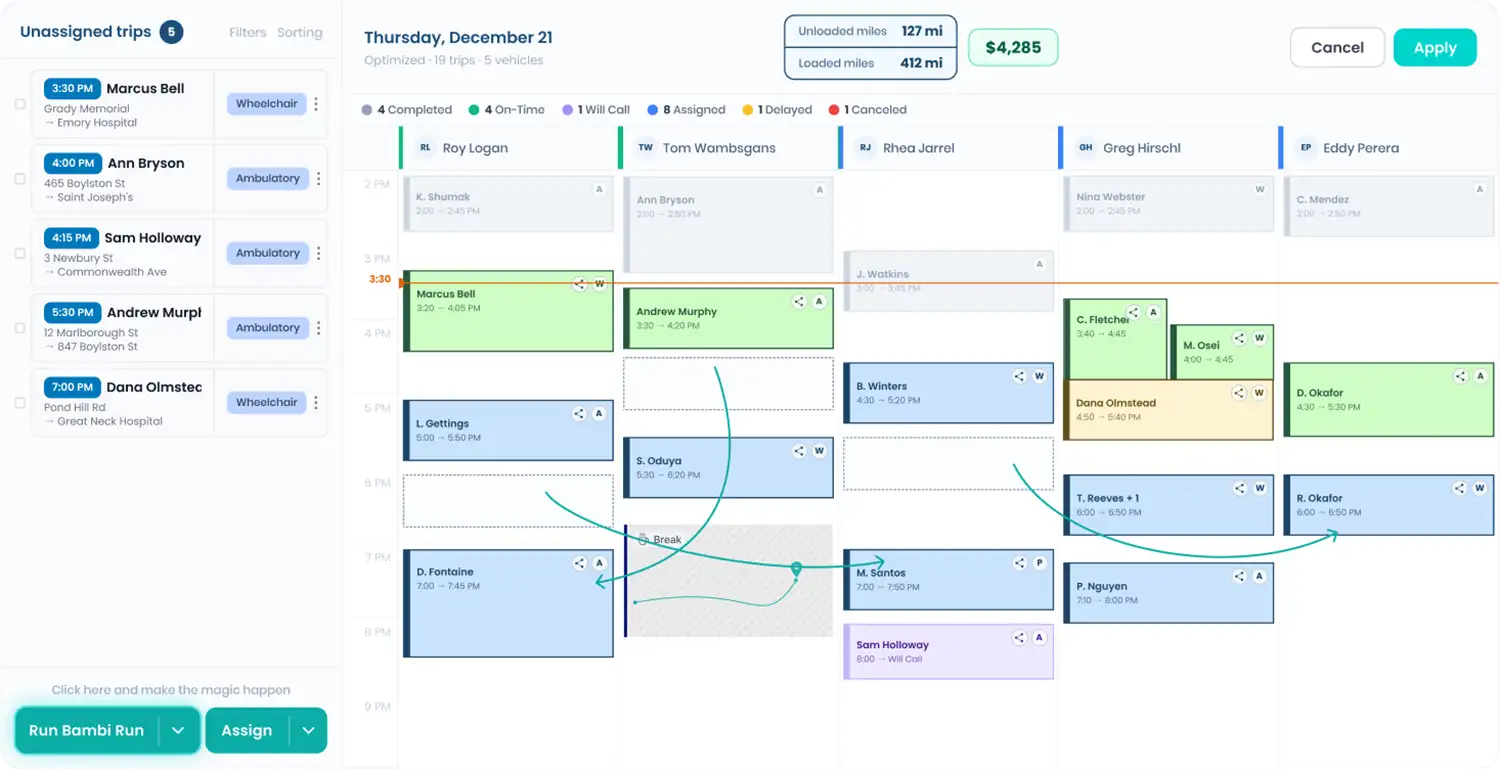
- Balanced workloads. Spreading trips evenly keeps one driver from running ten trips while another runs four. The overloaded one is the one who quits. The driver productivity analyzer shows where the imbalance is.
Communication matters just as much. When a driver can see the next pickup and message dispatch without waiting on hold, a late rider or a closed gate becomes a quick note instead of a 15-minute phone tag.
This is where software actually changes retention, not just efficiency. Bambi's Driver App gives every driver a clear manifest, the details for every pickup, and a direct messaging line to dispatch, so a driver isn't guessing about the next stop. Fewer surprises and less dead time between trips means a driver's day feels manageable instead of chaotic, and a driver who isn't burned out by 3pm is a driver who's still there next quarter.
As Julian Ssemalulu, owner of Bellshan Homecare, put it: "Bambi saves me about a whole days worth of time. Once I finished the dispatch I could go do other things and the system just does the work."
Quick onboarding checklist for a new NEMT driver
- Complete application, license check, and background screen
- Pass drug test and DOT physical (where required)
- Assemble the driver qualification file
- Complete passenger assistance and securement training
- Ride along on 2 to 3 live trips with an experienced driver
- Set up the Driver App and confirm dispatch communication works
- First solo shift with a check-in call at midday
Once a driver is on the road, our dos and don'ts for NEMT drivers make a good one-page refresher for the first week.
FAQs
Where is the best place to find NEMT drivers?
Start with referrals from your current drivers, then local job boards, driving schools, community college healthcare programs, and rideshare or delivery driver groups looking for steadier scheduled work. People leaving home health aide, EMT-basic, or school bus jobs are often a strong fit. Track which source your best hires came from and spend more there.
Do NEMT drivers need a CDL?
Most sedans and wheelchair vans don't require one. Federally, a CDL is only required for vehicles designed to carry 16 or more people including the driver. Check your state DMV and your broker contracts for anything stricter.
How do you keep NEMT drivers from quitting in the first 90 days?
Give them a real onboarding plan with ride-alongs, a predictable schedule, and a clear way to reach dispatch. Pay a retention bonus at 90 and 180 days, cut the deadhead miles that make the day feel wasted, and check in during the first solo shifts. Most early turnover comes from chaotic days, not from the driving itself.
Ready to give your drivers a day that actually runs on schedule?
Bambi's Driver App turns a chaotic manifest into a clear one, so drivers spend less time waiting on dispatch and more time on the road getting paid. Fewer headaches for your drivers means fewer good ones walking out the door. See Bambi's pricing: $69 per active vehicle per month, month to month, with no onboarding or setup fees.
Nick Hoffmeyer is Head of Marketing at Bambi, the AI-powered dispatch and scheduling platform for non-emergency medical transportation (NEMT) providers. He works with NEMT owner-operators every day on growth, SEO, and the operational systems that help fleets run more trips with less stress. More from Nick: LinkedIn