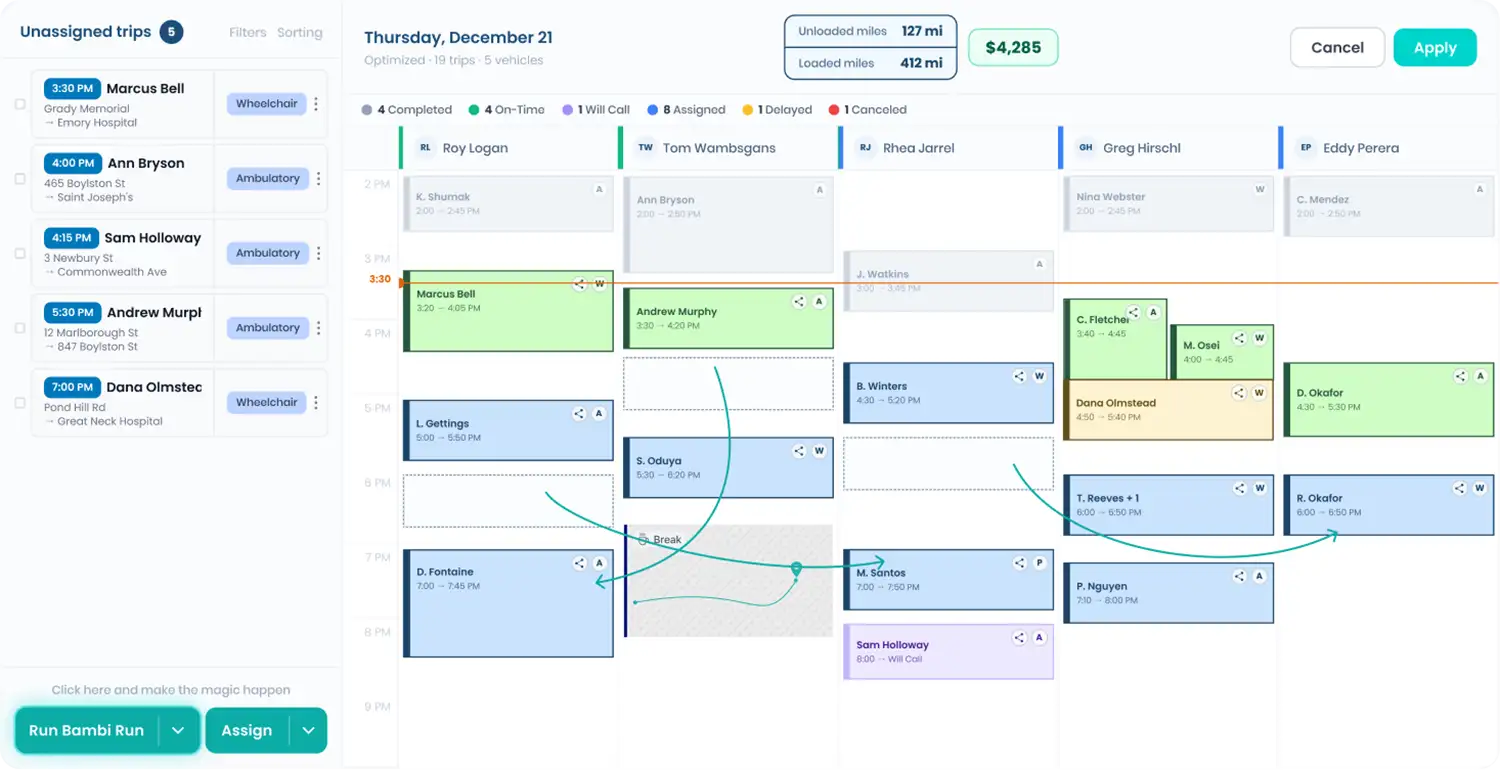

Managing a fleet requires careful planning to ensure safety, reliability, and cost efficiency. A vehicle replacement schedule helps you retire aging vehicles before they become liabilities. Here's how to create one:
- Track Key Data: Monitor each vehicle's mileage, age, and repair history. Vehicles typically need replacement after 100,000–150,000 miles or 7–10 years.
- Set Benchmarks: Establish replacement criteria based on mileage, repair costs, and safety standards. If repair costs exceed $0.10–$0.20 per mile, it might be time to replace the vehicle.
- Prioritize Replacements: Use a scoring system to rank vehicles by urgency, considering factors like mileage, age, and safety issues.
- Plan a Timeline: Develop a 12–24-month schedule, staggering replacements to balance costs and maintain fleet reliability.
- Use Software Tools: Fleet management platforms can automate tracking, send alerts, and simplify decision-making.
A structured approach minimizes downtime, ensures passenger safety, and keeps repair costs under control. By planning replacements in advance, you can maintain a dependable fleet while staying within budget.
Step 1: Gather Your Fleet Information
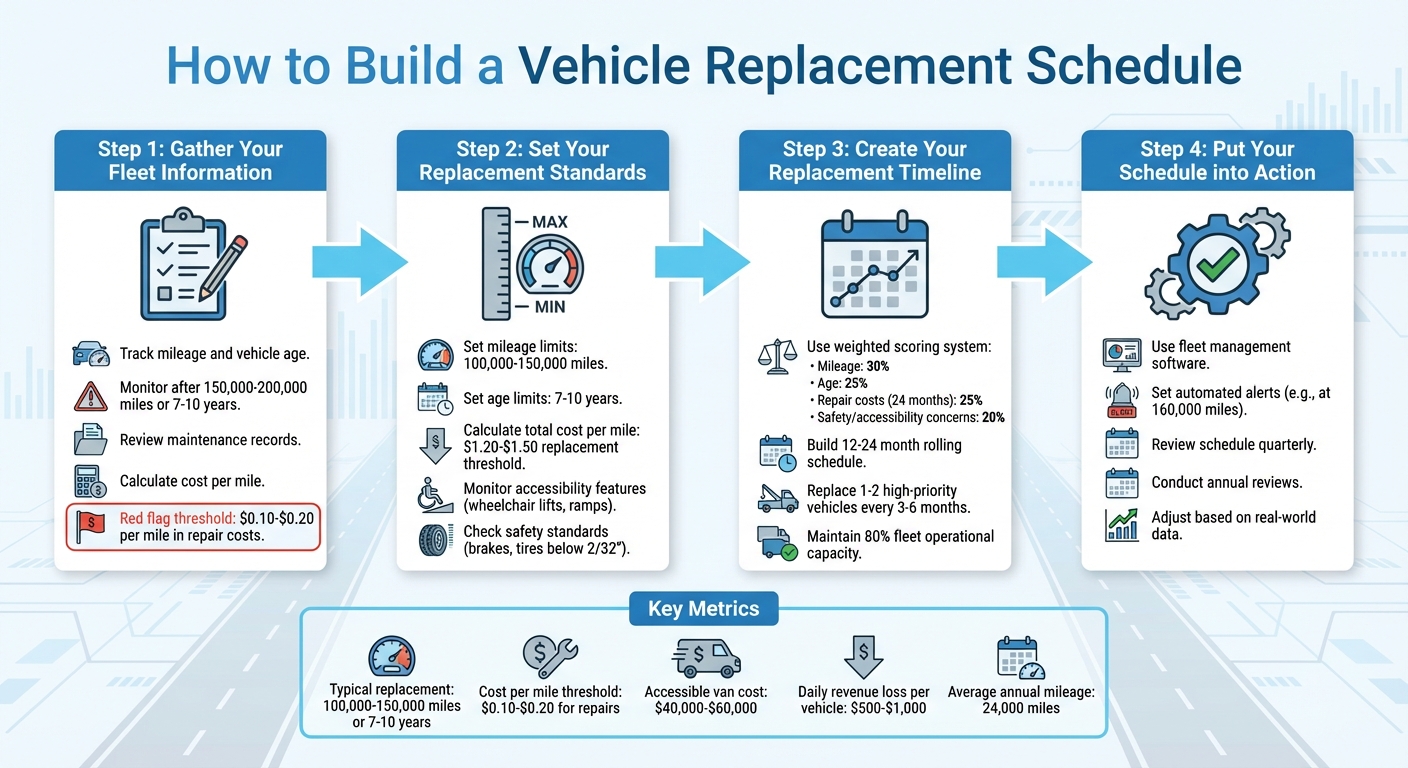
Start by collecting essential details about each vehicle, such as mileage, age, and the date it first went into service. Having accurate data is key to creating a replacement schedule that’s both efficient and cost-conscious. Check the odometer readings and note the exact date each vehicle began operating. This information helps identify which vehicles are nearing typical replacement milestones. Generally, vehicles should be closely monitored after 150,000–200,000 miles or 7–10 years of service, but these are guidelines, not strict rules.
Track Mileage and Vehicle Age
Keep a record of daily odometer readings. Whether you use fleet management software or a simple spreadsheet, make sure to include the vehicle ID, current mileage, and in-service date. If available, GPS tracking can make this process even easier. Update your records monthly or during major service checks. This consistent tracking provides the groundwork for setting practical replacement criteria.
Review Maintenance and Repair Records
Gather repair invoices for the past 12–24 months for each vehicle. Calculate the cost per mile by dividing total repair expenses by the miles driven. If this figure exceeds $0.10–$0.20 per mile, it might be time to consider replacing the vehicle. Pay special attention to non-emergency medical transport (NEMT) equipment. For example:
- Inspect wheelchair lifts monthly or after every 750–1,500 cycles.
- Lubricate ramps weekly.
- Test lifts, tie-downs, first-aid kits, and fire extinguishers daily.
Additionally, schedule semiannual inspections with NMEDA-certified technicians. If equipment fails these checks, it could signal the need for an earlier replacement. Use these maintenance insights to guide your vehicle replacement decisions as you move forward.
Step 2: Set Your Replacement Standards
Leverage your fleet data to establish clear replacement benchmarks. These benchmarks help maintain consistency across your fleet while avoiding both unnecessary early replacements and costly breakdowns. For Non-Emergency Medical Transportation (NEMT) vehicles, industry recommendations suggest replacing them after 100,000–150,000 miles or every 7–10 years. However, your specific thresholds should reflect how intensively the vehicles are used. With accurate data, these benchmarks turn raw statistics into actionable replacement decisions.
Set Mileage and Age Limits
Using your fleet records, create measurable criteria that signal when a vehicle should be replaced. Start with general replacement ranges and adjust based on how the vehicles are used. For instance, if your vans average 24,000 miles per year under heavy use, a 100,000-mile limit may help you avoid escalating repair costs. On the other hand, vehicles that receive consistent maintenance might last up to 150,000 miles. Even for well-maintained vehicles, reassess their viability at the 7-year mark, as they may no longer meet modern safety regulations or accessibility standards, which could lead to compliance issues.
Calculate Cost Per Mile
Track all operating expenses, such as fuel, regular maintenance, repairs, insurance, and servicing of accessibility equipment. Then, divide these costs by the total miles driven. For example, if a van costs $28,000 to operate over 25,000 miles, its cost per mile is approximately $1.12. Replace vehicles when their cost per mile exceeds your fleet’s average by 20–30% or falls within the range of $1.20–$1.50. This metric gives you a clear indicator of when a vehicle is becoming too expensive to keep.
Monitor Accessibility Features and Safety Standards
Accessibility equipment like wheelchair lifts, ramps, and securement systems tends to wear out faster in NEMT vehicles. Keeping detailed maintenance records helps you identify when these features are nearing the end of their useful life. Replace vehicles that consistently fail monthly accessibility inspections or semiannual safety checks. Frequent failures in accessibility inspections are a strong signal that it’s time to retire the vehicle. Similarly, ongoing issues with safety inspections - such as problems with brakes, tires (with tread below 2/32"), or electrical systems - often indicate that replacing the vehicle is more cost-effective than continuing repairs. Structural issues, like rust on the undercarriage, can also compromise the safe operation of lifts and restraints, further emphasizing the need for a replacement.
Step 3: Create Your Replacement Timeline
Turn your replacement standards into a manageable 12–24-month timeline by ranking vehicles based on urgency. A clear timeline ensures your fleet stays reliable while spreading expenses across multiple quarters, helping you avoid unexpected breakdowns and budget surprises.
To start, evaluate each vehicle's replacement need using a weighted scoring system.
Score Vehicles by Replacement Priority
A weighted scoring system helps you decide which vehicles should be replaced first. Assign scores based on these criteria: mileage (30%), age (25%), repair costs over the past 24 months (25%), and safety or accessibility concerns (20%). For example:
- A vehicle with over 100,000 miles might earn 10 points for mileage.
- If it’s more than 10 years old, it gets another 10 points for age.
- Repairs totaling over $5,000 add 10 points.
- Critical safety issues, like failed brake inspections or malfunctioning wheelchair lifts, add 10 points.
Here’s how this scoring might look in practice:
- Vehicle A: 120,000 miles, 12 years old, $6,200 in repairs, and two safety issues = 36/40 points (high priority).
- Vehicle B: 90,000 miles, 8 years old, $3,500 in repairs, and one safety issue = 24/40 points (medium priority).
- Vehicle C: 60,000 miles, 5 years old, $1,800 in repairs, and no safety issues = 12/40 points (low priority).
Focus on replacing high-priority vehicles, like Vehicle A, first. This approach minimizes costly downtime and compliance risks while balancing safety and budget considerations.
Once your vehicles are ranked, you can map out a replacement schedule.
Build a 12–24 Month Rolling Schedule
With your priorities set, create a rolling replacement plan that works within your budget and keeps your fleet running smoothly. Accessible vans often cost $40,000–$60,000 each, so calculate how many vehicles you can afford to replace annually. For instance, if you manage a 10-vehicle fleet with a $200,000 yearly budget, you could replace 4–5 vehicles per year, staggering them across quarters to avoid service interruptions.
Plan to replace 1–2 high-priority vehicles every 3–6 months. For example, you might schedule Vehicle A for replacement in Q1 and Vehicle B in Q3. Stagger replacements to ensure at least 80% of your fleet stays operational. This reduces the risk of lost revenue, which can range from $500 to $1,000 per day for each vehicle that’s out of service.
Revisit your schedule every quarter, updating it with the latest mileage, repair history, and safety data. If a vehicle experiences a major failure or fails an inspection, move it up the timeline. On the other hand, if a vehicle performs better than expected, you can adjust its position. This rolling method is especially useful for high-use fleets, like NEMT vehicles, which often accumulate around 24,000 miles annually.
Step 4: Put Your Schedule into Action
Once you've outlined your replacement timeline, it's time to integrate it into your daily operations. This step ensures your fleet keeps running smoothly without interruptions. Start by digitizing your schedule using a centralized system - whether that’s a spreadsheet, fleet management platform, or transportation software. Assign each vehicle a unique identifier, and tie replacement milestones to specific actions, such as retiring a vehicle, reassigning it, or scheduling a pre-sale inspection. Make the process seamless by defining clear roles: decide who will update mileage, who will review cost data monthly, and who will approve replacement decisions. You can also use major maintenance inspections as checkpoints to review and adjust your schedule.
Use Fleet Management Software
Automating your tracking process can save time and reduce errors. Set up a profile for each vehicle with essential details like its in-service date, current mileage, monthly mileage trends, and repair history. This allows the system to predict when a vehicle will hit its retirement age or mileage cap. Telematics can automatically update odometer readings, while linked maintenance records help you monitor rising repair costs. For fleets focused on Non-Emergency Medical Transportation (NEMT), you can add custom fields to track the status of ADA equipment - like lifts and ramps - and flag recurring issues that might require early replacement.
You can also set up mileage-based alerts to notify you when a vehicle approaches its retirement threshold. For instance, if your policy is to retire vehicles at 180,000 miles, an alert at 160,000 miles gives you enough time to plan for funding and procurement. Similarly, time-based alerts tied to a vehicle's in-service date (like six months before reaching an eight-year limit) can help you stay ahead of budgeting and ordering decisions.
AI-powered tools, such as Bambi's NEMT software, simplify this process even further. These tools can automate trip analysis and provide real-time journey data, eliminating the need for manual spreadsheets. Drivers can use mobile apps to report issues immediately, while route analysis and performance tracking can help identify vehicles that are inefficient or costly to maintain.
"Changing to Bambi it's the most impactful thing I did for my NEMT Business. Bambi's saving my staff hours of daily work and our team has much more time to focus on improvements." - Jeffrey Hoff, Reliant Transport
Collecting data automatically not only improves day-to-day operations but also provides valuable insights for your annual reviews, helping you keep your strategy relevant.
Review Your Schedule Annually
Even with a well-oiled system, annual reviews are essential. These reviews allow you to adapt your replacement schedule to the realities of your fleet. Each year, assess the specifications of your vehicles - like ADA compliance, seating configurations, and safety features - and compare them against current NEMT regulations and Medicaid transportation requirements. Vehicles that frequently fail inspections, lack critical safety equipment, or don’t meet updated accessibility or emissions standards should be prioritized for replacement, even if their mileage is relatively low.
If you notice that certain vehicles are hitting high mileage faster than expected - perhaps because of heavy urban use or increased trip loads - it may be time to shorten their expected service life and adjust your future purchasing plans. Similarly, if specific makes or models start racking up repair costs between 150,000 and 175,000 miles, consider retiring those vehicles earlier to avoid excessive expenses. Document these changes and the reasoning behind them, so your replacement schedule evolves into a flexible, data-driven strategy rather than a patchwork of one-off decisions.
Conclusion
Creating a vehicle replacement schedule involves four key steps: collecting precise fleet data, establishing clear replacement criteria, ranking vehicles using a scoring system, and executing the plan with the help of management software and regular reviews. Each step builds on the previous one, forming a well-rounded approach that keeps your NEMT operation efficient while staying within budget. Together, these steps help ensure your fleet remains safe, dependable, and cost-effective.
Replacing vehicles before major failures occur can significantly boost safety, lower emergency repair costs, and help you avoid expensive compliance penalties. By addressing aging vehicles proactively, you minimize the risk of unexpected breakdowns and reduce the likelihood of costly repairs. A well-planned replacement strategy ensures your fleet stays reliable and operates at its best, eliminating the chaos of last-minute fixes.
With a structured schedule in place, you shift from constantly reacting to problems to confidently planning for growth. Knowing exactly when each vehicle needs replacement allows you to budget more effectively, negotiate better deals with dealerships, and consistently provide the high-quality service your patients rely on.
Over time, your replacement schedule will adapt to the evolving needs of your fleet. By tracking data and fine-tuning your standards, you'll gain insights tailored to your operation - whether that means adjusting mileage limits for city routes or focusing on vehicles with heavily used accessibility features. These ongoing adjustments transform guesswork into a strategic edge, enhancing both profitability and patient care.
FAQs
What should I consider when deciding when to replace a vehicle?
When you're planning to replace vehicles in your fleet, it's important to weigh a few key factors: age, mileage, and maintenance costs. Older vehicles with higher mileage tend to need repairs more often, which can quickly eat into your budget and affect their reliability.
You should also factor in residual value - the longer you hold onto a vehicle, the more its resale value drops. On top of that, make safety and compliance with industry regulations a priority to keep your fleet up to operational standards. Lastly, think about how vehicle downtime or poor performance could impact your business's efficiency and customer satisfaction. A reliable fleet isn't just about getting from point A to point B; it's about keeping your operations running smoothly.
How can fleet management software help improve my vehicle replacement schedule?
Fleet management software takes the guesswork out of deciding when to replace vehicles by analyzing essential factors like mileage, vehicle age, and maintenance costs. Using real-time data, it suggests the ideal time for replacements, helping you avoid costly downtime and surprise expenses.
By simplifying this process, you can keep your fleet running smoothly and efficiently, so you can concentrate on providing top-notch service to your clients.
How can I tell when it's time to replace a vehicle in my fleet?
If you're wondering whether it's time to replace a vehicle, there are a few clear signs to watch for. High mileage, old age, and a string of frequent repairs often point to a decline in reliability. On top of that, increasing operational costs, worsening fuel efficiency, or trouble meeting safety and compliance standards are strong indicators that a replacement should be on your radar.
Taking action early can help keep your fleet running smoothly, saving you money and ensuring safety for everyone on the road.