

By Nick Hoffmeyer, Head of Marketing at Bambi · Updated September 28, 2026 · 7 min read
Reviewed by Howard F. Berkowitz, a non-emergency medical transportation and paratransit expert with 30+ years in the industry (H&S Consulting).
A preventive maintenance plan for non-emergency medical transportation (NEMT) vehicles combines a documented service schedule, a pre-trip and post-trip inspection checklist, and a replacement timeline based on mileage, age, and repair cost. Together they cut unscheduled breakdowns, keep your inspection and ADA accessibility records in order, and stretch every van's useful life.
What Counts as "Maintenance" for an NEMT Fleet
NEMT maintenance is bigger than an oil change. It's three connected systems: scheduled service (what a mechanic does on a calendar), daily inspection (what a driver checks before the ignition turns), and lifecycle planning (when a vehicle gets retired instead of repaired again). Skip any one of the three and the other two can't save you. A driver who skips the pre-trip check won't catch the slow brake fluid leak the shop missed three weeks ago.
Many NEMT vehicles also carry equipment a standard fleet doesn't: wheelchair lifts, four-point tie-downs, and in some markets stretcher rigging. Those parts fail differently than an engine does, and they fail in front of a rider who can't easily get out of the vehicle if something goes wrong. Federal ADA rules (49 CFR 37.161) also require transportation providers to keep accessibility features in operative condition and repair them promptly. That's the reason NEMT maintenance gets its own playbook instead of borrowing a generic fleet template.
How to Build a Preventive Maintenance Plan
Step 1: Audit Your Fleet
Start with a single record per vehicle: VIN, in-service date, current mileage, ADA equipment installed, and open repair history. You can't schedule what you haven't inventoried, and you can't defend an inspection or broker audit with maintenance memories instead of records.
Step 2: Set Your Maintenance Timeline
Match service intervals to manufacturer recommendations first, then layer in NEMT-specific items like lift cycles and securement checks. The schedule below is a starting framework, not a regulation: your vehicle and lift manuals, your state, and your broker contracts set the actual numbers.
- Daily (pre-trip): Task: Tires, lights, brakes, fluid levels, lift/ramp function, securement straps; Why it matters: Catches the failure before a rider is in the vehicle
- Weekly: Task: Tire pressure and tread, wiper blades, interior sanitation restock; Why it matters: Prevents the slow-building issues daily checks can miss
- Per the oil-life monitor or OEM severe-service schedule: Task: Oil and filter change (stop-and-go driving and long idling usually count as severe service); Why it matters: Engine longevity, warranty compliance
- Per lift manufacturer (BraunAbility recommends every 750 cycles): Task: Wheelchair lift service and inspection; Why it matters: ADA equipment failure is a liability and a safety issue, not just downtime
- At each tire rotation or per OEM schedule: Task: Brake inspection, tire rotation, fluid check; Why it matters: Brakes are the single most safety-critical system on a passenger vehicle
- Quarterly: Task: Full multi-point inspection and first-aid kit inventory; Why it matters: Regulatory compliance, insurance documentation
- Annually: Task: Periodic vehicle inspection, fire extinguisher maintenance, seatbelt and tie-down replacement as needed; Why it matters: Required for vehicles that qualify as commercial motor vehicles under FMCSA rules, and required by many states and broker contracts; check yours
Step 3: Track It in a System Instead of on a Clipboard
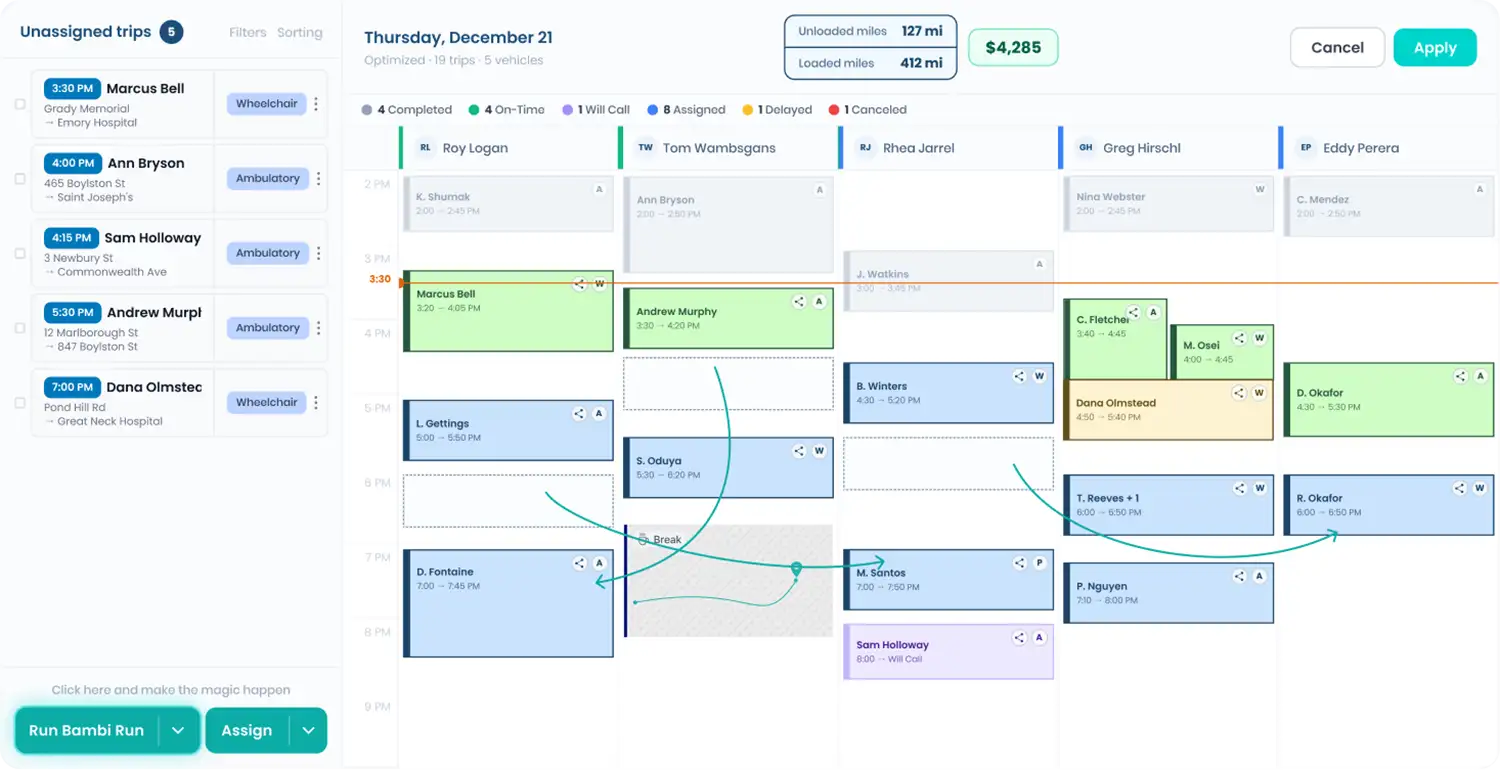
A spreadsheet works until vehicle six. Dedicated fleet maintenance tools can flag upcoming service by mileage or date automatically, so nothing rides on a dispatcher remembering. Pair that with live operations data: Bambi's Fleet HQ shows every vehicle on a live GPS map with driver status and performance dashboards, so you always know where each van is when you need to plan service around your routes.
Step 4: Train Drivers on the Inspection, Not Just the Route
A pre-trip checklist only works if drivers actually run it and know what a fail looks like. Five minutes of training on "here's what a bad brake pedal feels like" prevents a lot more than a memo ever will.
Step 5: Review the Plan Quarterly
Pull your repair cost and downtime data every quarter. If one vehicle model keeps generating the same repair, that's a signal to change the interval, the vendor, or the vehicle, not just keep paying for the fix.
The NEMT Vehicle Inspection Checklist
Run the pre-trip version before every shift and the post-trip version at the end of it. Keep both on file, digital or paper, since they're part of your compliance record if a regulator or insurer ever asks.
Pre-trip checklist
- Tires: correct pressure and adequate tread. 2/32 inch is the common legal floor, and federal rules for commercial motor vehicles require 4/32 inch on front tires, so many fleets replace well before 2/32. Check your state's rule.
- Brakes: pedal feel, no grinding or pulling
- Lights, signals, and mirrors functional
- Wheelchair lift or ramp cycles fully with no unusual noise
- Four-point tie-downs and seatbelts present and undamaged
- Fluid levels (oil, coolant, wiper fluid) visually normal
- Interior clean and sanitized, high-touch surfaces wiped down
- Fire extinguisher charged and in date, first-aid kit stocked
Post-trip checklist
- Note any new noise, warning light, or handling issue from the shift
- Re-sanitize high-touch surfaces and any soft seating
- Secure and inventory safety equipment
- Log mileage and any incident, even a minor one, in your maintenance records
Five Habits That Prevent Most Roadside Breakdowns
- Weekly tire pressure and tread checks. Underinflated tires wear unevenly and raise fuel costs, and a rider mid-transport is the worst place to discover a blowout.
- Oil changes on the OEM schedule, not a generic one. NEMT vehicles idle more and carry more stop-and-go miles than a personal car, which shortens oil life.
- Daily brake checks, not just annual service. Squealing, pulling, or a soft pedal is your cue to get it looked at that day, not that week.
- A real daily sanitation protocol. Riders are often immunocompromised or elderly. Disinfect high-touch surfaces every trip with an EPA-registered disinfectant, not just at end of shift.
- Safety equipment on a real inspection calendar. Under NFPA 10, the standard most fire codes adopt, extinguishers get a visual inspection at least monthly and maintenance at least once a year. First-aid kits need regular inventory checks for used and expired items.
When to Replace a Vehicle Instead of Repairing It Again
Every vehicle hits a point where the next repair costs more than it's worth. Track three numbers per vehicle: mileage, cost per mile in repairs, and age. The right thresholds depend on your vehicle type, duty cycle, and upfit, so set them from your own fleet's data rather than a generic number.
- Service life: compare each van against the mileage and age at which your older vehicles started needing major repairs.
- Repair cost per mile: flag any vehicle running well above your fleet average, especially if the gap is growing quarter over quarter.
- Replacement vs. repeated repair: compare a replacement van's cost (including accessibility upfit) against what the current vehicle is costing you in repairs plus lost trips while it sits in the shop.
Simple scoring model: rate each vehicle 1 to 10 on mileage, age, year-to-date repair cost, and open safety issues, then weight them 30%, 25%, 25%, and 20%. Anything scoring in the top third of your fleet goes on next quarter's replacement short list, not "we'll see."
Build the actual replacement timeline on a rolling 12–24 month basis so you're never budgeting for four vans in the same month. Buying the right vehicle in the first place matters here too, since the van you choose sets your maintenance costs for years.
Preventive vs. Reactive Maintenance
- Cost pattern: Preventive: Predictable, budgeted; Reactive: Spiky, with emergency repairs, towing, and missed trips costing more than the same work done on schedule
- Downtime: Preventive: Scheduled, planned around routes; Reactive: Unplanned, mid-route in the worst cases
- Compliance: Preventive: Documented, audit-ready; Reactive: Gaps show up exactly when an inspector asks
- Fleet lifespan: Preventive: Extended toward the upper end of service life; Reactive: Shortened, vehicles get retired early
FAQs
How often should NEMT vehicles get a full inspection beyond the daily pre-trip check? Most fleets run a full multi-point inspection quarterly, on top of daily pre-trip and post-trip checks and any annual inspection your state, broker, or FMCSA rules require. Requirements vary, so check your state and contracts.
What's the difference between a maintenance plan and an inspection checklist? A maintenance plan is the calendar: oil changes, brake service, and lift servicing on a schedule. An inspection checklist is what a driver physically checks before and after every shift. You need both, and neither replaces the other.
How do I know when to replace a vehicle instead of repairing it? Track mileage, age, and cost per mile in repairs. When a vehicle crosses your fleet's benchmark on two of the three, it's a replacement candidate, not another repair ticket.
Does fleet management software actually reduce maintenance costs? It reduces the cost of missed maintenance, mainly. Automated service reminders and digital inspection logs mean fewer skipped intervals and a cleaner compliance record, which is usually where the real savings show up.
What maintenance tasks are specific to ADA-compliant vehicles? Wheelchair lift or ramp cycling and servicing, four-point tie-down inspection, and securement hardware checks. These aren't optional add-ons, they're safety-critical for riders who can't self-evacuate quickly.
Do I need separate records for maintenance and inspections? Keep them logged together if your software allows it. Auditors and insurers want to see that a vehicle was both serviced on schedule and inspected daily. One without the other is an incomplete record.
Keep Every Vehicle in View
Fewer headaches, more revenue starts with a fleet that isn't breaking down mid-route. Fleet HQ gives you a live GPS map, real-time ETAs, and driver status across every vehicle, so you always know where every vehicle and driver is. See it in a live demo, or check what it costs at $69 per active vehicle per month, flat.
About the author: Nick Hoffmeyer is Head of Marketing at Bambi, the AI-powered dispatch and scheduling platform for non-emergency medical transportation (NEMT) providers. He leads Bambi's growth, SEO, and content strategy and works with NEMT owner-operators every day on the systems that help fleets run more trips with less stress. Connect with Nick on LinkedIn.