
One platform. Everything your operation runs on
Scheduling, routing, dispatch, billing, and a driver app. Bambi is built for NEMT and priced at one flat $69 per vehicle. No tools to stitch together, no modules to unlock.
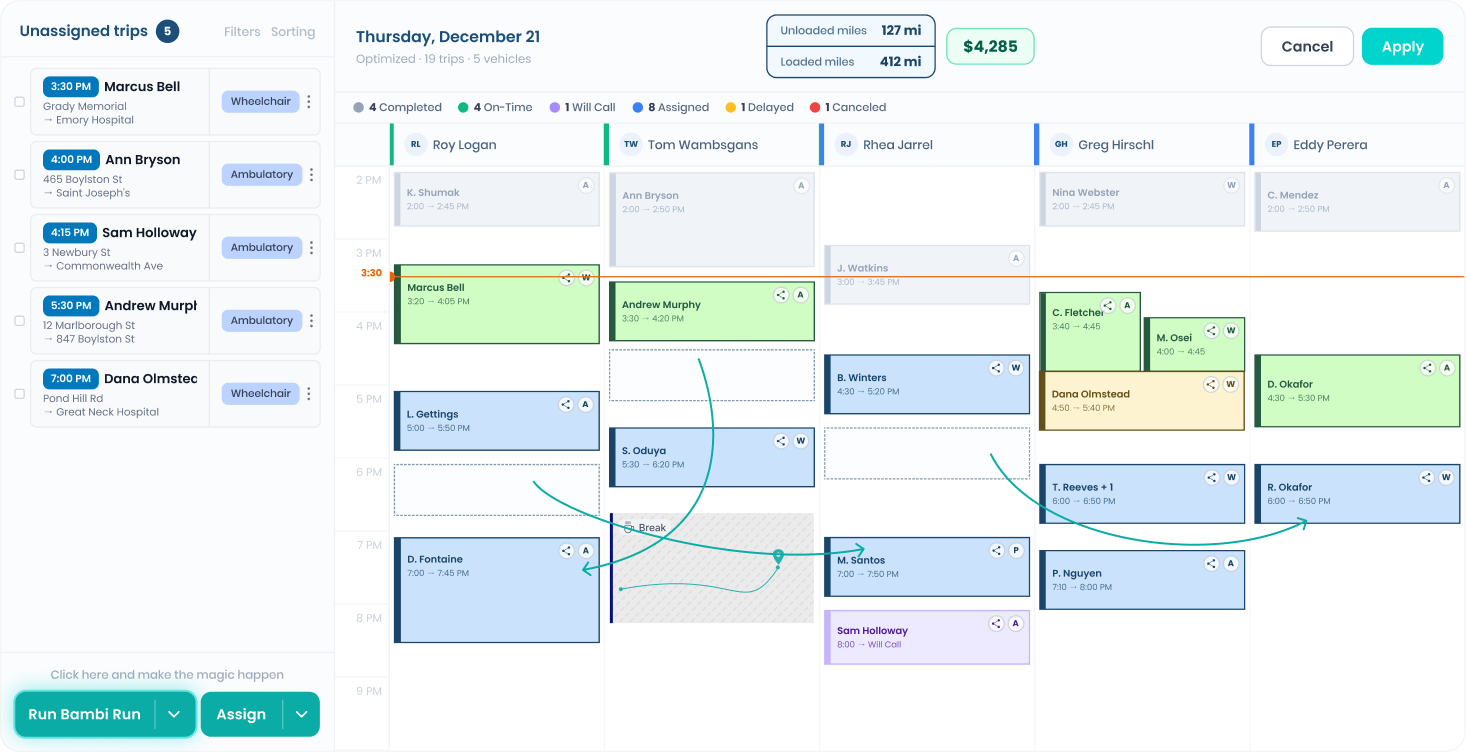
One Bambi. The whole operation.
Most transportation operators run a stack of half-connected tools. Bambi runs the whole operation from one place.


One sign in, one simple system
Stupid simple software all in one platform that syncs scheduling, routing, dispatch and real time driver actions. For real.

One flat price
$69 per vehicle, per month. Every product included. No tiers, no add-ons, no modules to unlock as you grow.

Built for NEMT
Not a generic fleet tool with NEMT bolted on. Every product is built for broker trips, Medicaid compliance, and the way NEMT actually runs.

Backed by real humans
A team that built Bambi from the passenger seat of NEMT vans, and that picks up the phone when you call.
But wait there's more.
And it all comes included.
These capabilities are built into every Bambi account, at no extra cost and we are building more features every day based on real world feedback from transportation pros like you.
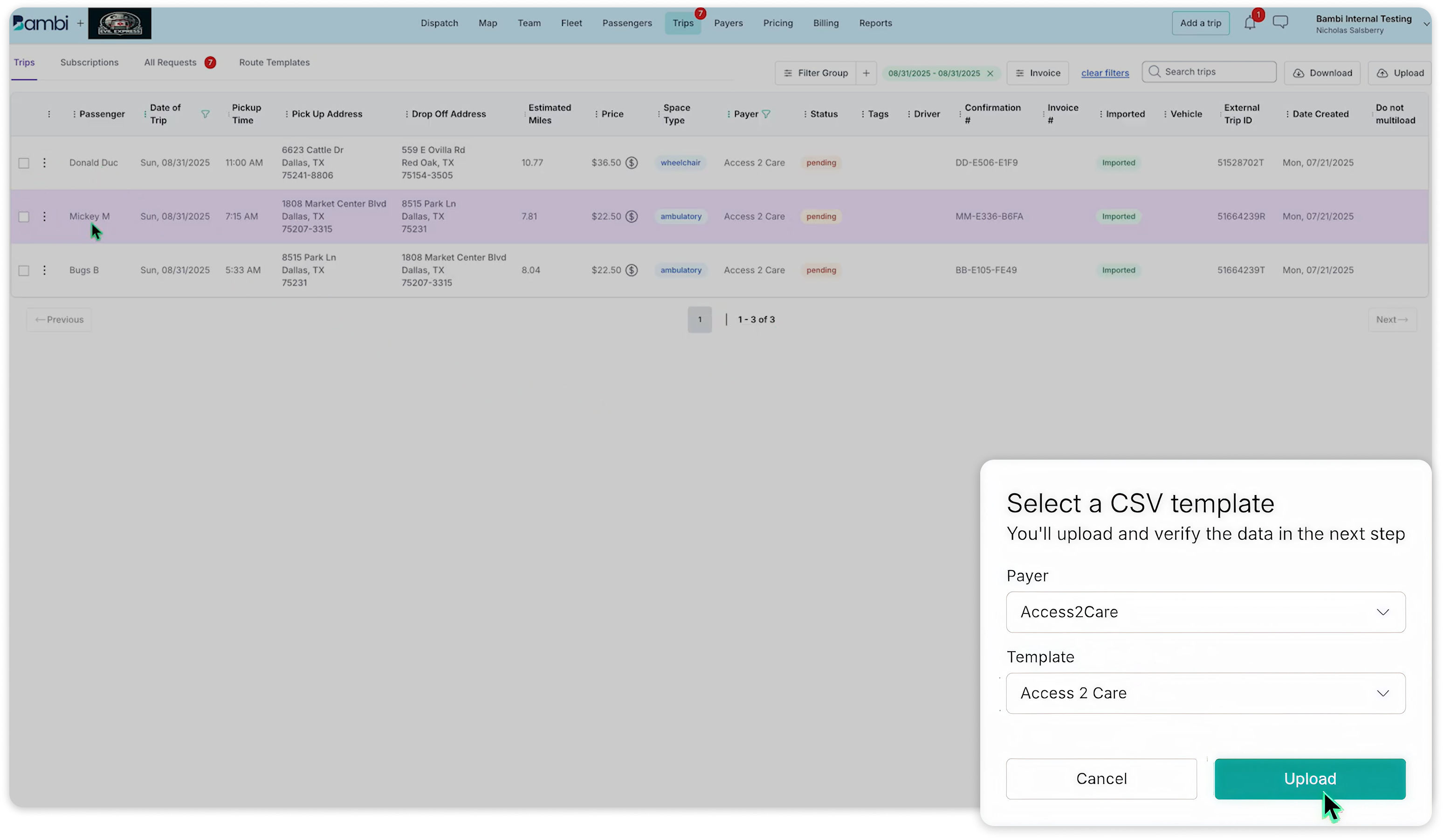
Broker integrations and trip import
Bambi connects directly with MTM, Modivcare, SafeRide, and more. Broker trips flow straight into your schedule with zero manual entry and zero room for error.
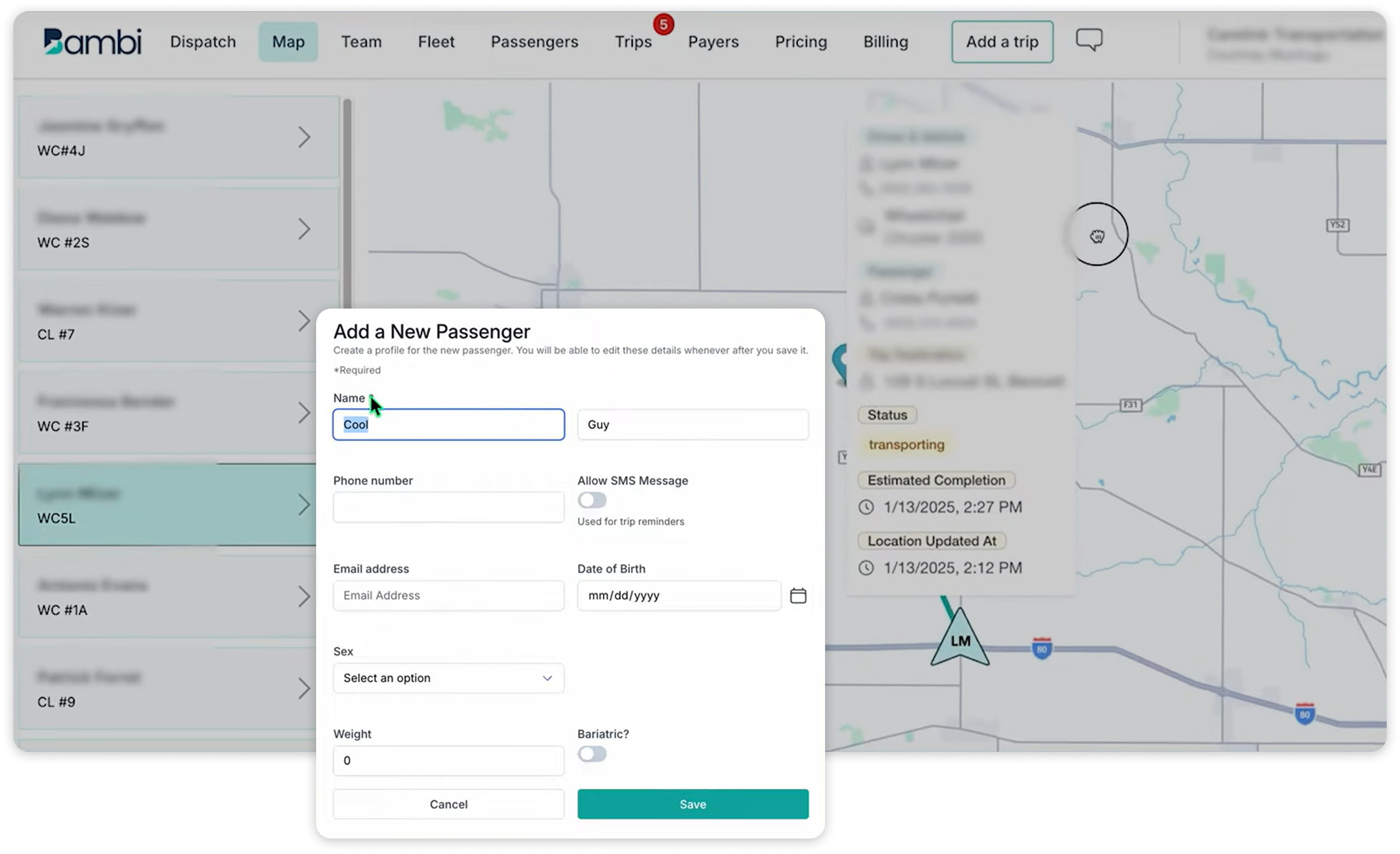
The Facility Trip Portal
Give your healthcare facility partners their own booking portal. Hospitals, dialysis centers, and nursing homes submit trip requests directly into Bambi. Win contracts your competitors cannot.
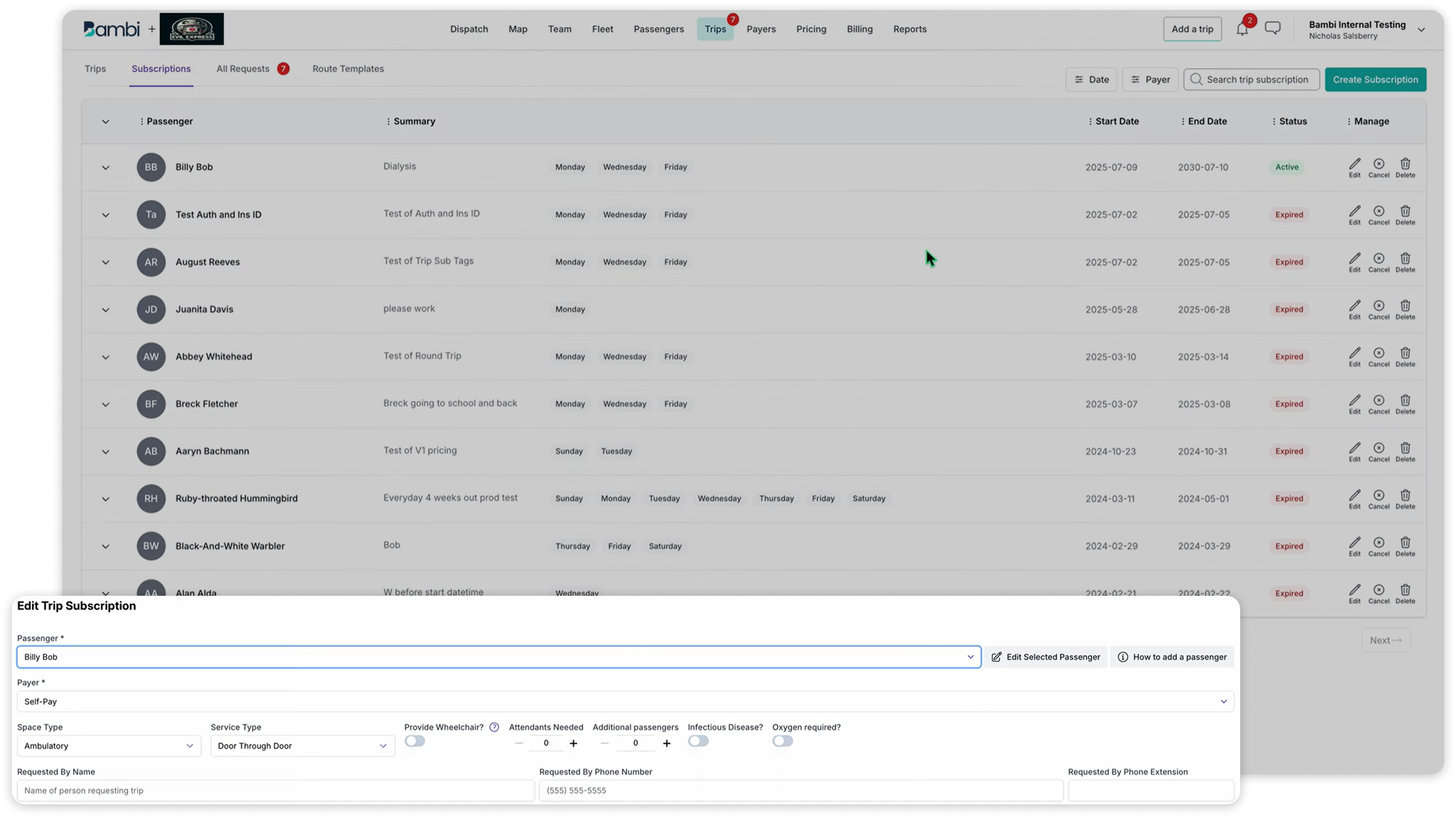
Trip subscriptions and multi-loading
Recurring dialysis and PACE runs populate the schedule automatically. And Bambi groups same direction riders into shared routes, so every vehicle earns more per mile, so we can see you smile.
Everything Your Fleet Needs. Nothing It Doesn't.
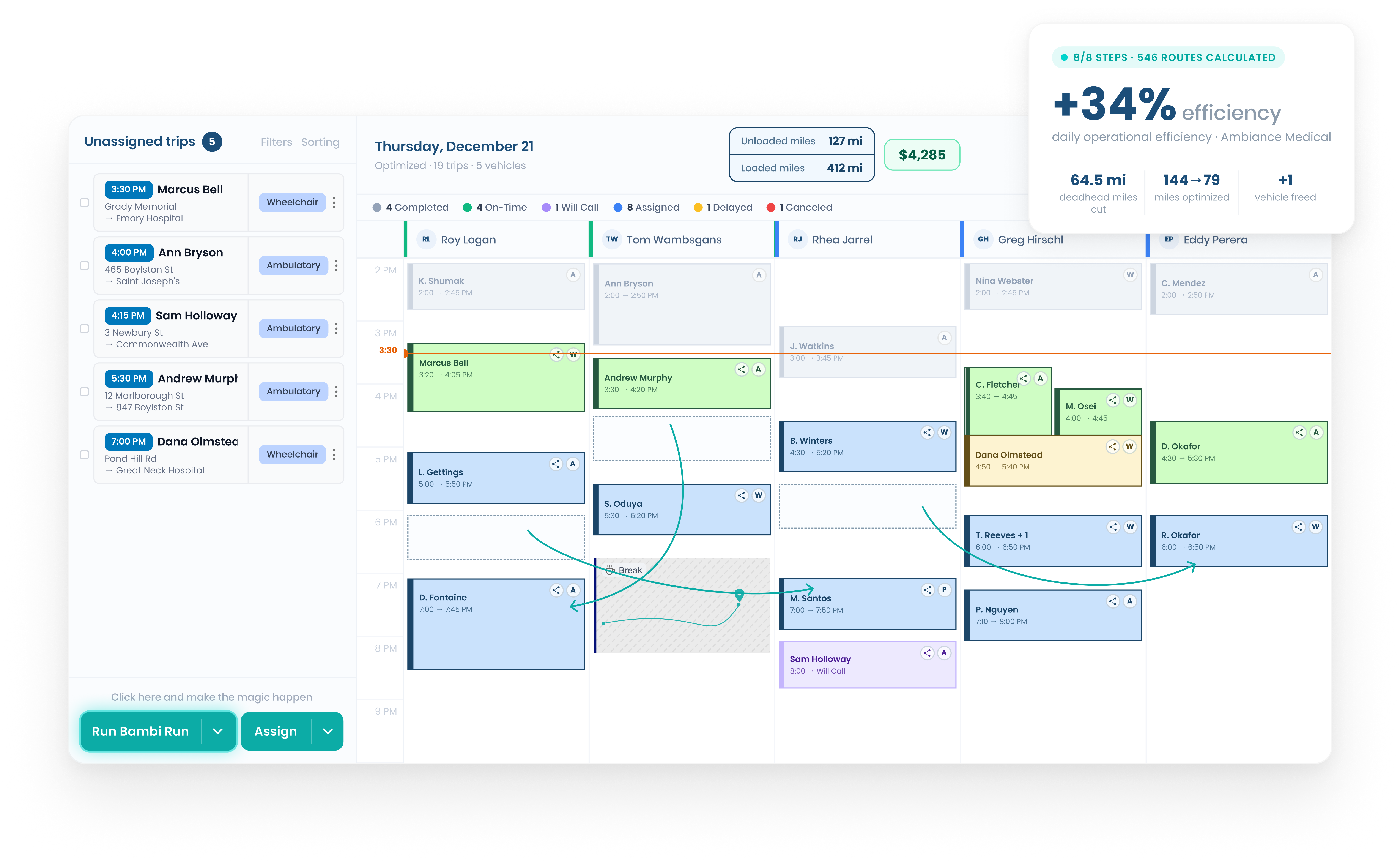
Run Bambi Run
AI-Powered Scheduling & Route Optimization
Hours of scheduling, solved in one click. Hit the "Run Bambi Run" button and watch Bambi's AI instantly analyze your trips, assign your drivers, and optimize every route for maximum efficiency. The scheduling workflow that used to eat your entire morning now takes less time than pouring your coffee.
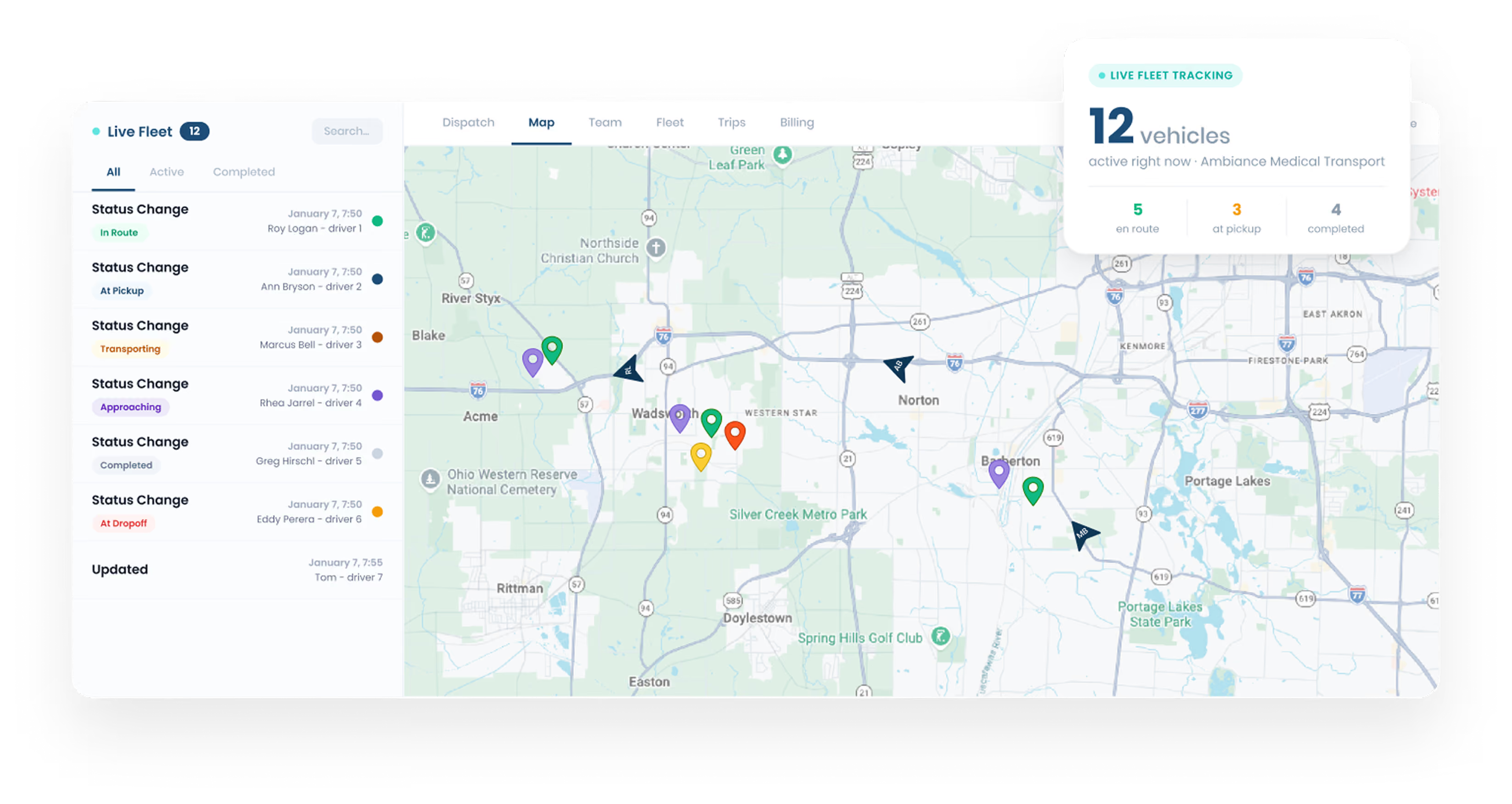
Fleet HQ — Real-Time Dispatch & Fleet Visibility
Real-Time Dispatch & Fleet Visibility
Know where every vehicle is. Always. The Command Center gives dispatchers live GPS tracking, real-time ETAs, drivemessaging, and performance dashboards in one view — so your entire operation stays visible, compliant, and in sync from first trip to last.
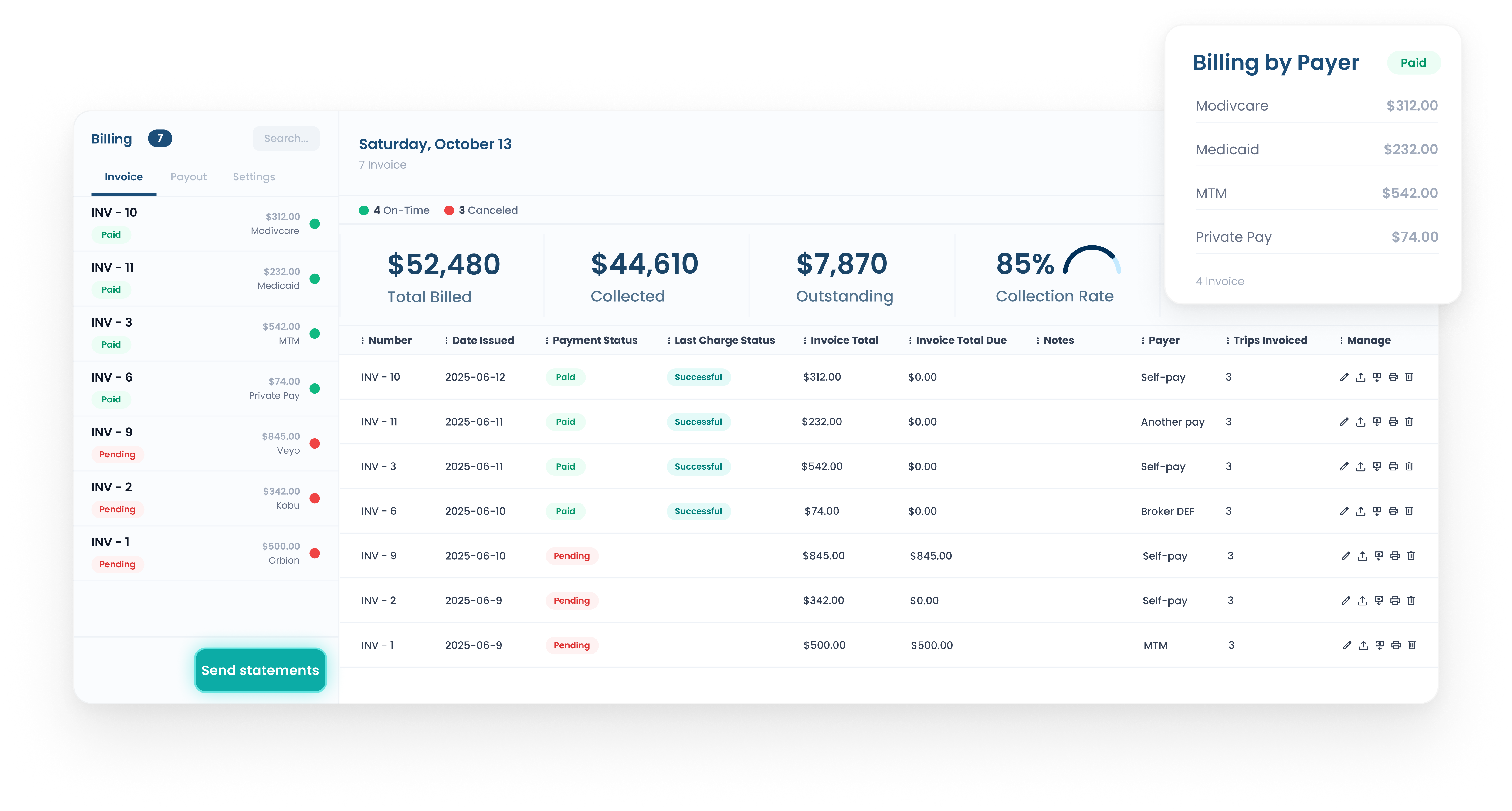
Get Paid — Billing & Compliance
Billing & Compliance
Bill faster. Get paid sooner. Bambi automates trip verification, generates broker and care program compliant invoices, and tracks every claim from submission to payment — so revenue flows in instead of leaking out. No more chasing paperwork. No more leaving money on the table.
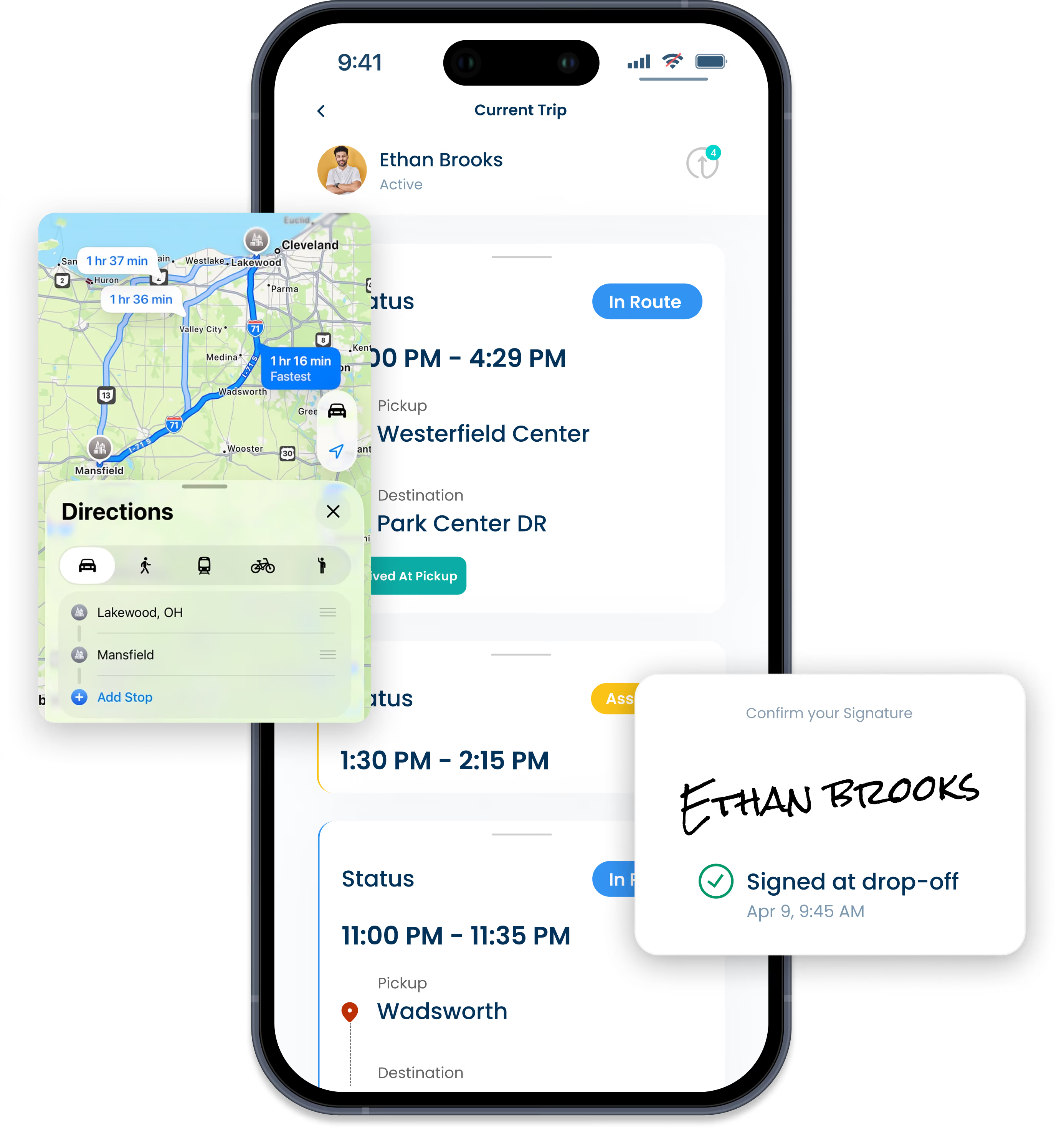
Road Co-Pilot — Bambi Driver App
AI-Powered Scheduling & Route Optimization
No more "Where are you?" texts. The Co-Pilot gives your drivers everything they need in one app — real-time GPS, trip details, turn-by-turn navigation, and offline sync for dead zones. An app drivers actually want to use, so dispatchers can stop babysitting and start scaling.
The Herd Has Spoken.
"Changing to Bambi it's the most impactful thing I did for my NEMT business. Bambi's saving my staff hours of daily work and our team has much more time to focus on improvements"
.png)
We were promised all this by another system... as soon as I got it, the drivers, everybody was ready to strangle me. They're like, 'We hate this system. It's nothing like Bambi.'... So we called you guys and we're back, and we're here to stay.


Run Bambi Run does the thinking for us. It routes automatically, multi-loads trips for efficiency, and maximizes our revenue. Accurate ETAs make planning easy, and setup was quick and smooth.

"Bambi gives us real-time visibility into every ride and keeps dispatch and drivers in sync. We stay on top of changes, adjust fast, and avoid delays. In a business where timing matters, that clarity makes a real difference."

I like that Bambi simplifies my day-to-day operations... and as a business owner, it allows me to oversee most of my business at the click of a button without confusion. Bambi is a far superior product compared to CTS Tripmaster.


Bambi allows us to schedule and adjust rides quickly and easily. We can easily communicate internally all the people involved and the special needs of the passengers. We are able to bill and update payment information very easily.


For an NEMT company, dependable scheduling and communication are everything. Bambi improved coordination between our drivers and dispatch and keeps up with the pace of our business.

How much time it saves me? It’s like a day’s worth of time. And sometimes the system just does the work, so I don’t have to sit on the computer all day trying to see where the driver is... I make the dispatch that night I’m good for the whole day

I fell in love with Bambi because I used MediRoutes at my last company... and when I got into Bambi I was like "OMG this is way more user friendly!” Bambi is great.


"I'm not very tech-savvy... that's why I like Bambi. Bambi dumbs it down for people who don't know how to use computers... but for people who do, it makes everything a lot faster."


.png)
"We’re all looking for something just like this… a system that took credit cards, we could monitor the drivers, we could do dispatch, pay per vehicle… Thank you so much!"
"The drivers seems to love it on their phone and their tablets, and it made our job a lot easier to enter the trips than what we had prior. You can book a trip within about two or three minutes. It cut my time in half."
.png)
.png)
"I was extremely skeptical that Bambi was going to work, but after getting in it and looking at everything and learning… I’m ready, I have no more doubts about it. Run Bambi Run and I’m running with it."
.png)
"Bambi has been able to kind of streamline that whole process...it just takes me half the time, or probably even less than that, to get everything kind of squared away."
.png)
.png)
.png)
"Bambi has a lot of features. The dispatch was so easy me and how I assigned the trips for the drivers. I was a driver at a different NEMT company and when I downloaded the Bambi Driver App I found it was easier than the other software."
.png)
"It's so easy to use, The team is so responsive and the 'Run Bambi Run' works great even with just 3 vehicles"

"Changing to Bambi it's the most impactful thing I did for my NEMT business. Bambi's saving my staff hours of daily work and our team has much more time to focus on improvements"
What mattered most to us wasn’t perfection, it was progress. Seeing consistent improvements and real support made us feel like we finally had a partner.
.png)

What stands out most is feeling valued as a human being, not rushed, not dismissed. With Bambi, I don’t feel like I’m talking to a system.
.png)
I'm loving the software. I've been excited to use it. I had questions that I found out just looking at just user interface is so simple. I go in, I click something, and I figure it out by myself…
.png)

"Changing to Bambi it's the most impactful thing I did for my NEMT Business. Bambi's saving my staff hours of daily work and our team has much more time to focus on improvements"
With Bambi, it was super. Everything was right there in front of you. And literally, my lead driver told me it's perfect, in comparison to the old software we used. They were able to just see everything, and then they can now make adjustments on their rout

We were promised all this by another system... as soon as I got it, the drivers, everybody was ready to strangle me. They're like, 'We hate this system. It's nothing like Bambi.'... So we called you guys and we're back, and we're here to stay.
Run Bambi Run does the thinking for us. It routes automatically, multi-loads trips for efficiency, and maximizes our revenue. Accurate ETAs make planning easy, and setup was quick and smooth.
"Bambi gives us real-time visibility into every ride and keeps dispatch and drivers in sync. We stay on top of changes, adjust fast, and avoid delays. In a business where timing matters, that clarity makes a real difference."
I like that Bambi simplifies my day-to-day operations... and as a business owner, it allows me to oversee most of my business at the click of a button without confusion. Bambi is a far superior product compared to CTS Tripmaster.
Bambi allows us to schedule and adjust rides quickly and easily. We can easily communicate internally all the people involved and the special needs of the passengers. We are able to bill and update payment information very easily.
For an NEMT company, dependable scheduling and communication are everything. Bambi improved coordination between our drivers and dispatch and keeps up with the pace of our business.
How much time it saves me? It’s like a day’s worth of time. And sometimes the system just does the work, so I don’t have to sit on the computer all day trying to see where the driver is... I make the dispatch that night I’m good for the whole day
I fell in love with Bambi because I used MediRoutes at my last company... and when I got into Bambi I was like "OMG this is way more user friendly!” Bambi is great.
"I'm not very tech-savvy... that's why I like Bambi. Bambi dumbs it down for people who don't know how to use computers... but for people who do, it makes everything a lot faster."
"We’re all looking for something just like this… a system that took credit cards, we could monitor the drivers, we could do dispatch, pay per vehicle… Thank you so much!"
"The drivers seems to love it on their phone and their tablets, and it made our job a lot easier to enter the trips than what we had prior. You can book a trip within about two or three minutes. It cut my time in half."
"I was extremely skeptical that Bambi was going to work, but after getting in it and looking at everything and learning… I’m ready, I have no more doubts about it. Run Bambi Run and I’m running with it."
"Bambi has been able to kind of streamline that whole process...it just takes me half the time, or probably even less than that, to get everything kind of squared away."
"Bambi has a lot of features. The dispatch was so easy me and how I assigned the trips for the drivers. I was a driver at a different NEMT company and when I downloaded the Bambi Driver App I found it was easier than the other software."
"It's so easy to use, The team is so responsive and the 'Run Bambi Run' works great even with just 3 vehicles"
"Changing to Bambi it's the most impactful thing I did for my NEMT business. Bambi's saving my staff hours of daily work and our team has much more time to focus on improvements"
What mattered most to us wasn’t perfection, it was progress. Seeing consistent improvements and real support made us feel like we finally had a partner.
What stands out most is feeling valued as a human being, not rushed, not dismissed. With Bambi, I don’t feel like I’m talking to a system.
I'm loving the software. I've been excited to use it. I had questions that I found out just looking at just user interface is so simple. I go in, I click something, and I figure it out by myself…
"Changing to Bambi it's the most impactful thing I did for my NEMT Business. Bambi's saving my staff hours of daily work and our team has much more time to focus on improvements"
With Bambi, it was super. Everything was right there in front of you. And literally, my lead driver told me it's perfect, in comparison to the old software we used. They were able to just see everything, and then they can now make adjustments on their rout
We were promised all this by another system... as soon as I got it, the drivers, everybody was ready to strangle me. They're like, 'We hate this system. It's nothing like Bambi.'... So we called you guys and we're back, and we're here to stay.
Run Bambi Run does the thinking for us. It routes automatically, multi-loads trips for efficiency, and maximizes our revenue. Accurate ETAs make planning easy, and setup was quick and smooth.
"Bambi gives us real-time visibility into every ride and keeps dispatch and drivers in sync. We stay on top of changes, adjust fast, and avoid delays. In a business where timing matters, that clarity makes a real difference."
I like that Bambi simplifies my day-to-day operations... and as a business owner, it allows me to oversee most of my business at the click of a button without confusion. Bambi is a far superior product compared to CTS Tripmaster.
Bambi allows us to schedule and adjust rides quickly and easily. We can easily communicate internally all the people involved and the special needs of the passengers. We are able to bill and update payment information very easily.
For an NEMT company, dependable scheduling and communication are everything. Bambi improved coordination between our drivers and dispatch and keeps up with the pace of our business.
How much time it saves me? It’s like a day’s worth of time. And sometimes the system just does the work, so I don’t have to sit on the computer all day trying to see where the driver is... I make the dispatch that night I’m good for the whole day
I fell in love with Bambi because I used MediRoutes at my last company... and when I got into Bambi I was like "OMG this is way more user friendly!” Bambi is great.
"I'm not very tech-savvy... that's why I like Bambi. Bambi dumbs it down for people who don't know how to use computers... but for people who do, it makes everything a lot faster."
"We’re all looking for something just like this… a system that took credit cards, we could monitor the drivers, we could do dispatch, pay per vehicle… Thank you so much!"
"The drivers seems to love it on their phone and their tablets, and it made our job a lot easier to enter the trips than what we had prior. You can book a trip within about two or three minutes. It cut my time in half."
"I was extremely skeptical that Bambi was going to work, but after getting in it and looking at everything and learning… I’m ready, I have no more doubts about it. Run Bambi Run and I’m running with it."
"Bambi has been able to kind of streamline that whole process...it just takes me half the time, or probably even less than that, to get everything kind of squared away."
"Bambi has a lot of features. The dispatch was so easy me and how I assigned the trips for the drivers. I was a driver at a different NEMT company and when I downloaded the Bambi Driver App I found it was easier than the other software."
"It's so easy to use, The team is so responsive and the 'Run Bambi Run' works great even with just 3 vehicles"
"Changing to Bambi it's the most impactful thing I did for my NEMT business. Bambi's saving my staff hours of daily work and our team has much more time to focus on improvements"
What mattered most to us wasn’t perfection, it was progress. Seeing consistent improvements and real support made us feel like we finally had a partner.
What stands out most is feeling valued as a human being, not rushed, not dismissed. With Bambi, I don’t feel like I’m talking to a system.
I'm loving the software. I've been excited to use it. I had questions that I found out just looking at just user interface is so simple. I go in, I click something, and I figure it out by myself…
"Changing to Bambi it's the most impactful thing I did for my NEMT Business. Bambi's saving my staff hours of daily work and our team has much more time to focus on improvements"
With Bambi, it was super. Everything was right there in front of you. And literally, my lead driver told me it's perfect, in comparison to the old software we used. They were able to just see everything, and then they can now make adjustments on their rout
We were promised all this by another system... as soon as I got it, the drivers, everybody was ready to strangle me. They're like, 'We hate this system. It's nothing like Bambi.'... So we called you guys and we're back, and we're here to stay.
Run Bambi Run does the thinking for us. It routes automatically, multi-loads trips for efficiency, and maximizes our revenue. Accurate ETAs make planning easy, and setup was quick and smooth.
"Bambi gives us real-time visibility into every ride and keeps dispatch and drivers in sync. We stay on top of changes, adjust fast, and avoid delays. In a business where timing matters, that clarity makes a real difference."
I like that Bambi simplifies my day-to-day operations... and as a business owner, it allows me to oversee most of my business at the click of a button without confusion. Bambi is a far superior product compared to CTS Tripmaster.
Bambi allows us to schedule and adjust rides quickly and easily. We can easily communicate internally all the people involved and the special needs of the passengers. We are able to bill and update payment information very easily.
For an NEMT company, dependable scheduling and communication are everything. Bambi improved coordination between our drivers and dispatch and keeps up with the pace of our business.
How much time it saves me? It’s like a day’s worth of time. And sometimes the system just does the work, so I don’t have to sit on the computer all day trying to see where the driver is... I make the dispatch that night I’m good for the whole day
I fell in love with Bambi because I used MediRoutes at my last company... and when I got into Bambi I was like "OMG this is way more user friendly!” Bambi is great.
"I'm not very tech-savvy... that's why I like Bambi. Bambi dumbs it down for people who don't know how to use computers... but for people who do, it makes everything a lot faster."
"We’re all looking for something just like this… a system that took credit cards, we could monitor the drivers, we could do dispatch, pay per vehicle… Thank you so much!"
"The drivers seems to love it on their phone and their tablets, and it made our job a lot easier to enter the trips than what we had prior. You can book a trip within about two or three minutes. It cut my time in half."
"I was extremely skeptical that Bambi was going to work, but after getting in it and looking at everything and learning… I’m ready, I have no more doubts about it. Run Bambi Run and I’m running with it."
"Bambi has been able to kind of streamline that whole process...it just takes me half the time, or probably even less than that, to get everything kind of squared away."
"Bambi has a lot of features. The dispatch was so easy me and how I assigned the trips for the drivers. I was a driver at a different NEMT company and when I downloaded the Bambi Driver App I found it was easier than the other software."
"It's so easy to use, The team is so responsive and the 'Run Bambi Run' works great even with just 3 vehicles"
"Changing to Bambi it's the most impactful thing I did for my NEMT business. Bambi's saving my staff hours of daily work and our team has much more time to focus on improvements"
What mattered most to us wasn’t perfection, it was progress. Seeing consistent improvements and real support made us feel like we finally had a partner.
What stands out most is feeling valued as a human being, not rushed, not dismissed. With Bambi, I don’t feel like I’m talking to a system.
I'm loving the software. I've been excited to use it. I had questions that I found out just looking at just user interface is so simple. I go in, I click something, and I figure it out by myself…
"Changing to Bambi it's the most impactful thing I did for my NEMT Business. Bambi's saving my staff hours of daily work and our team has much more time to focus on improvements"
With Bambi, it was super. Everything was right there in front of you. And literally, my lead driver told me it's perfect, in comparison to the old software we used. They were able to just see everything, and then they can now make adjustments on their rout

Ambiance Cut 64 Unpaid Miles a Day
Real numbers from a real provider: +34% daily efficiency, deadhead miles nearly halved, one vehicle freed up.


NEMT Business Startup Checklist: Essential Steps
Everything you need to get on the road, from licensing and vehicles to your first contracts.

Guide to Starting an NEMT Business in Your State
Licensing, vehicles, insurance, and Medicaid enrollment, step by step for your state.

What is Bambi NEMT?
The all-in-one platform built only for NEMT: scheduling, dispatch, billing, and the driver app in one place.
Frequently Asked Questions
Ready to Run with Bambi?