
NEMT Scheduling can be a difficult endeavor for even the most experienced NEMT owners, operators, or dispatcher. Every day can bring new challenges and ever changing variables. These problems can cause hours of headaches and efficient operations, especially for those using manual processes or clunky software tools.
NEMT trip requests can come in from many different sources creating confusion. A manual trip intake processes, often involving phone calls, text messages, or emails from care facilities, brokers, caregivers, and even customers themselves. With such a diversity of sources and without a standardized intake system any incomplete or inconsistent information can quickly snowball into problems with scheduling optimal routes, staffing, and the necessary vehicles and equipment for each upcoming trip. It is critical to develop standardized intake procedures and we recommend using digital tools and a platform like Bambi to streamline the process.
No-show customers can disrupt schedules and cause inefficiencies not to mention lost revenue. This is a chief worry for NEMTs especially those new to the industry or working with a new trip request source for the first time. In some cases a no-show can cause a snowball effect and Implementing confirmation procedures, offering incentives for on-time arrivals, and maintaining accurate customer profiles can help minimize no-shows. Additionally, building trust with the trip referral sources and maintaining open lines of communication are important to avoiding non-profitable down time.
Trip cancellations can disrupt schedules and affect revenue. Implementing clear cancellation policies, providing customers with alternative transportation options, and maintaining accurate records of cancellations can help alleviate the impact of any cancellations.
Last-minute trip changes, such as new destinations, pickup points, equipment needs, or additional passengers, can be disruptive. Establishing clear policies for handling changes and maintaining open communication with customers can help mitigate this challenge.
Trip delays caused by customer wait time, traffic, or weather can disrupt schedules and cause inconvenience to customers. Implementing real-time tracking systems, providing regular updates to customers, and establishing contingency plans can help manage delays.
Staff absences due to illness, vacation, or emergencies can disrupt operations. Maintaining a pool of backup drivers and cross-training staff can help ensure uninterrupted service.
Vehicle breakdowns can cause unexpected disruptions. Just like our personal vehicles NEMT vans and vehicles need regular maintenance and preventive inspections can help minimize the risk of breakdowns. These vehicles are even more pushed to the limit by the sheer number of miles, riders, and equipment that move in and out every day. It is important to stress with staff the importance of pre and post trip evaluations and regular preventative maintenance plan. Because without a van, potentially for weeks at a time for serious repairs, NEMT doesn’t run!
Equipment malfunctions can also disrupt operations. Van equipment like ramps or lifts are critical to getting riders safely in and out of the vehicle, especially if they are in a wheelchair or other mobility device. These can cause bottlenecks and safety risks if riders can not enter or leave the vans with assistance from these equipment.Wheelchairs, stretchers, stair climbers, and other mobility devices are also important links in the chain. If these devices malfunction or the safety tie-downs that secure the equipment to the floor while the van is in transit then likewise the van will be stopped and a scheduling delay can occur. It is critical that regular maintenance, and equipment checks are performed regularly and documented. Another step would be to have spare equipment on hand to address this challenge when they arise, and they will! Finally, staff education and training is an essential step in ensuring small malfunctions that could throw off the day are avoided, handled in the field, or quickly addressed to avoid further delays or injuries.
Customer injuries or adverse care events can be a major concern for NEMT providers. Proper training for staff, implementing safety protocols, and maintaining accurate records can help reduce the risk of such incidents.
Staff injuries or adverse care events can also disrupt operations. Ensuring that staff is adequately trained, providing proper safety equipment, and maintaining a supportive work environment can help prevent such incidents.
Addressing these challenges effectively requires a combination of operational strategies, technology solutions, and a commitment to customer satisfaction. By implementing efficient processes, using the right tools, and maintaining open communication with customers, NEMT providers can overcome these challenges and deliver reliable and high-quality transportation services.
The global non-emergency medical transport (NEMT) industry is driving the care-economy well into the future. Many factors come into play for this booming billion dollar business that sits at the crossroads of healthcare and transportation. We summarized three reasons, of what we believe to be the biggest for this boom.
Check out these four must-know NEMT stats to get a hand on the wheel of this four-letter acronym’s upward trajectory.
People — from at-home patients of medical practices to folks with one-off medical needs — need NEMT. Too many Americans do not receive the care required because they cannot make it to their medical appointments — and the reason being: they simply don’t have access to transportation that will get them from A to B. This not only affects their own health and well-being, but that of the entire healthcare system, too.
It’s not just Americans that need the help getting to/from their medical appointments. It’s a global issue, too. The worldwide NEMT market is expected to experience notable expansion, reaching an estimated value of USD 15.58 billion by 2028. Sadly, the demand for NEMT services is on the rise due to the increasing prevalence of chronic diseases and a growing geriatric population. (Source: GlobeNewswire, 2023). This underscores the need for additional NEMT providers and an increase in the quality of current NEMT trips to bridge the gap and prepare for this massive additional wave of demand. This is a massive need and opportunity for NEMT providers, governments, care providers, and citizens to unite and ensure this critical service for the next decade.
There are clearly demonstrated cost benefits linked with NEMT services (i.e. faster recovered and healthier patients, less hospital overhead and human resources to name a few). And soon enough, healthcare providers and policymakers will see that it makes sense to consider boosting investments in NEMT in order that providers, patients and the general population benefit wherever and whenever NEMT services are available.
From the healthcare system people and the planet — everyone benefits when NEMT services are provided. It really does increase well-being and accessibility for all. The investment and integration of NEMT service into the healthcare system not only saves lives and money, it makes money, too!
Insurers and governments are becoming more aware of the critical link that NEMT plays in the healthcare ecosystem. The awareness that Investing in quality transportation for citizens and patients continues to proliferate for public options like Medicare and Medicaid at the state level in the US, especially with Program of All-Inclusive Care for the Elderly (PACE). Rates for trips are set at the individual state and program level depending on several factors like distance, rural or non-rural, and equipment needs (wheelchair, stretcher, etc.).
Currently, unfortunately many states and regions are not providing adequate trip reimbursement rates to truly incentivize and reward NEMT providers for their efforts. However, we think that this is going to change, and forward-thinking NEMT providers and organizations like the Non-Emergency Medical Transportation Accreditation Commision (NEMTAC) and The Transportation Alliance are lobbying local, state, and federal governments to push for industry change.
As far as we can tell, the data above clearly showcases why continued and increased investment in NEMT service providers in 2024 and beyond are so crucial to not only the care economy, but the overall one, too.
Whether you’re a new or veteran NEMT business owner looking to streamline your service, we’ve got the scheduling and management-optimization software for you!
And if you’re keen to get into this lucrative caretaking business, it’s quite obvious that it’s one that’s going to keep driving the economy forward, always providing that job security while you provide security for the clients you take care of.
Starting a non-emergency medical transportation (NEMT) business can be a rewarding venture, especially with the growing demand for such services due to an aging population and increasing medical care needs. The following guide will compile key insights from various sources to give you a comprehensive roadmap for launching your successful NEMT business.
We hope this comprehensive guide empowers you to embark on your NEMT business venture with confidence. Remember, this is just a starting point, and further research tailored to your location and target market is essential.
This complete step-by-step guide covers the following:
Need Help? Bambi has you covered! Our comprehensive NEMT management software is tailor made for a new NEMT owner.Bambi is an AI-powered dispatch and scheduling platform for non-emergency medical transportation (NEMT) companies, that helps NEMT dispatchers and drivers communicate, optimize trips, and manage their routes and riders in real-time.
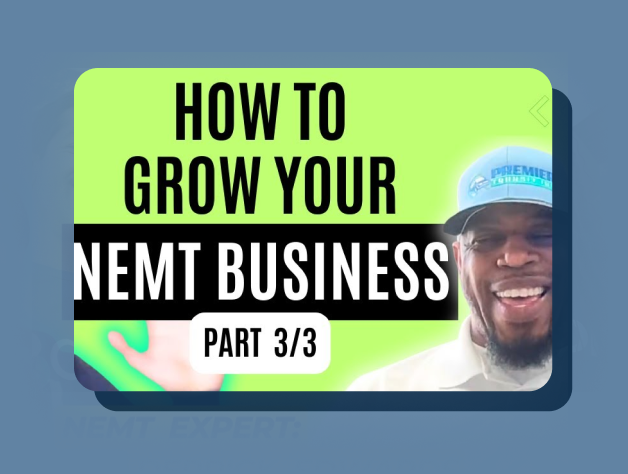
Nirav Chheda the CEO of Bambi continues the conversation with Derrick Edwards from Premier Transit on how as an NEMT owner he successfully grew his NEMT business in Mobile, AL and his plans for the future.
See the full interview at: https://youtu.be/DMrCxL1Yb9Q
Missed Part 1, no worries! Go back and see Part 1: https://youtu.be/E2AewXjxJQ4
And then Check out Part 2: https://youtu.be/0pOXrJSSeJA
Please don't forget to subscribe and like NEMT Experts Podcast: https://www.youtube.com/@bambihealth
Learn more about Premier Transit in Mobile, AL: https://www.thepremiertransit.com/
The podcast episode is a two part interview with Derek, the owner of Premier Transit, a non-emergency medical transportation (NEMT) company. In this part of the interview, Derek talks about his experience growing his business from 1 to 8 vehicles and his plans for the future.
Here are some of the key points from the podcast episode:
00:00 Introduction
00:21 Winning with stretchers
02:51 Organic growth
06:15 Compensate staff right
07:38 Helping other NEMT providers
10:23 Negotiating rates
11:35 Bambi software is needed
16:14 "Run Bambi Run" auto-scheduler
21:30 Bambi is the one

Bambi CEO Nirav Chheda talks with Cris Sierra, VP at ComfortCare Transportation, about how NEMT operators of all sizes can use data & analytics to increase operational efficiency, increase safety, reduce cost, and drive revenue.
See the full interview on YouTube:https://youtu.be/r_06MX-ufBg
Please don't forget to subscribe and like NEMT Experts Podcast on YouTube: https://www.youtube.com/@bambihealth
Also, available to watch on Spotify: https://podcasters.spotify.com/pod/show/bambi-nemt/episodes/NEMT-Experts-Podcast-Episode-16-Using-Data-to-Drive-Profit-e2grkpv
And listen only on your other favorite podcast platforms Apple, Sticher, and Google Play.
Chris shared a compelling story about the significant reduction in accidents after implementing fleet telematics to monitor driving behavior. By educating drivers on the benefits, their company saw an increase from 94/95% to 99% of transports completed without safety incidents. This highlights the power of data analytics to identify areas of improvement and drive impactful safety and cost-reduction initiatives. Chris encourages NEMT operators to start small by identifying one specific area to focus on with their data analysis (example: on-time percentage). Commit to tracking that metric for a dedicated period of time (like 30 days) to unlock actionable insights for operational improvement.
Key Takeaways
Interesting Quotes
Here are some time-stamped show notes:

Bambi CEO Nirav Chheda rides along with Roslyn Taggart, the owner of B811 Medical Transportation in Fairfield, California, chatting about how she's successfully grown her NEMT business to 4 vehicles in less than a year.
See the full interview on YouTube: https://youtu.be/eAkEFNPs024
Please don't forget to subscribe and like NEMT Experts Podcast on YouTube: https://www.youtube.com/@bambihealth
Also, available to watch on Spotify: https://podcasters.spotify.com/pod/show/bambi-nemt/episodes/NEMT-Experts-Podcast-Episode-15-Ride-with-Roslyn-e2gmprg
And listen only on your other favorite podcast platforms Apple, Sticher, and Google Play.
Learn more about B811 Medical Transportation and reach out at https://www.b811medtrans.com/
Rosalyn Taggart, founder of B811 Transport, shares her inspiring journey in the non-emergency medical transportation (NEMT) industry. She discusses launching her business to honor her brother, quickly scaling up to four vehicles, and the importance of networking and empathy in building successful NEMT operations.
Key Takeaways
Interesting Quotes
Here are some time-stamped show notes:
Derrick Edwards never imagined that his background in military transportation would propel him to become a leader in Non-Emergency Medical Transportation (NEMT). Yet, a conversation with a friend in the industry and astute market observations ignited his entrepreneurial drive. Founded in March of 2022, Derrick's company, Premier Transit, now boasts six vehicles and provides top-tier medical transport services in Mobile, Alabama.
Derrick attributes his swift success to several key factors:
Derrick highlights valuable insights for those considering an NEMT venture or looking to improve their existing business:
After relying on Excel spreadsheets and juggling operational complexities, Derrick discovered
Bambi NEMT scheduling software. He found the platform simple to learn and implement, praising its user-friendly interface, which has drastically reduced administrative burdens and streamlined tasks for dispatchers and drivers alike. Derrick recommends Bambi enthusiastically for other NEMT providers.
Always thinking strategically, Derrick outlines his five-year plan for Premier Transit:
Derrick's path clearly shows that dedication and smart business practices are a recipe for success in NEMT. Premier Transit embodies a refreshing approach built on professionalism, cleanliness, and genuine care for its community. The next phase of this dynamic company is shaping up to be equally impressive.
Bambi CEO Nirav Chheda sits down and interviews Derrick Edwards, the owner of Premier Transit in Mobile, Alabama, on how he has successfully grown his NEMT business to 7 vehicles in 22 months.
See the full interview at: https://youtu.be/E2AewXjxJQ4
When you are done check out Part 2: https://youtu.be/0pOXrJSSeJA
and Part 3: https://youtu.be/DMrCxL1Yb9Q
Bambi CEO Nirav Chheda interviews Sharnese Johnson, CEO of Optimal Reliability Transportation and the "Secret Sauce" NEMT Coach on becoming a NEMT coach and shifting her focus from NEMT to Student transport.
See the full interview at: https://youtu.be/rex2Eff9eVg
Please don't forget to subscribe and like NEMT Experts Podcast: https://www.youtube.com/@bambihealth
Learn more about Sharnese and reach out at: https://www.teambusiness.org/
Sharnese Johnson shifted her focus from NEMT to student transportation.
Key takeaways:
Reason for the shift:
Experience in NEMT:
Success stories:
Benefits of student transportation:

Bambi CEO Nirav Chheda interviews Stephanie Harmon, the "NEMT Guru", on how she started her NEMT broker business.
See the full interview at: https://youtu.be/iD54RttMjQ4
Please don't forget to subscribe and like NEMT Experts Podcast: https://www.youtube.com/@bambihealth
To learn more about Stephanie Harmon's NEMT courses and consulting and to book an appointment, go to https://www.stunninglystephanie.com/
Key Takeaways
