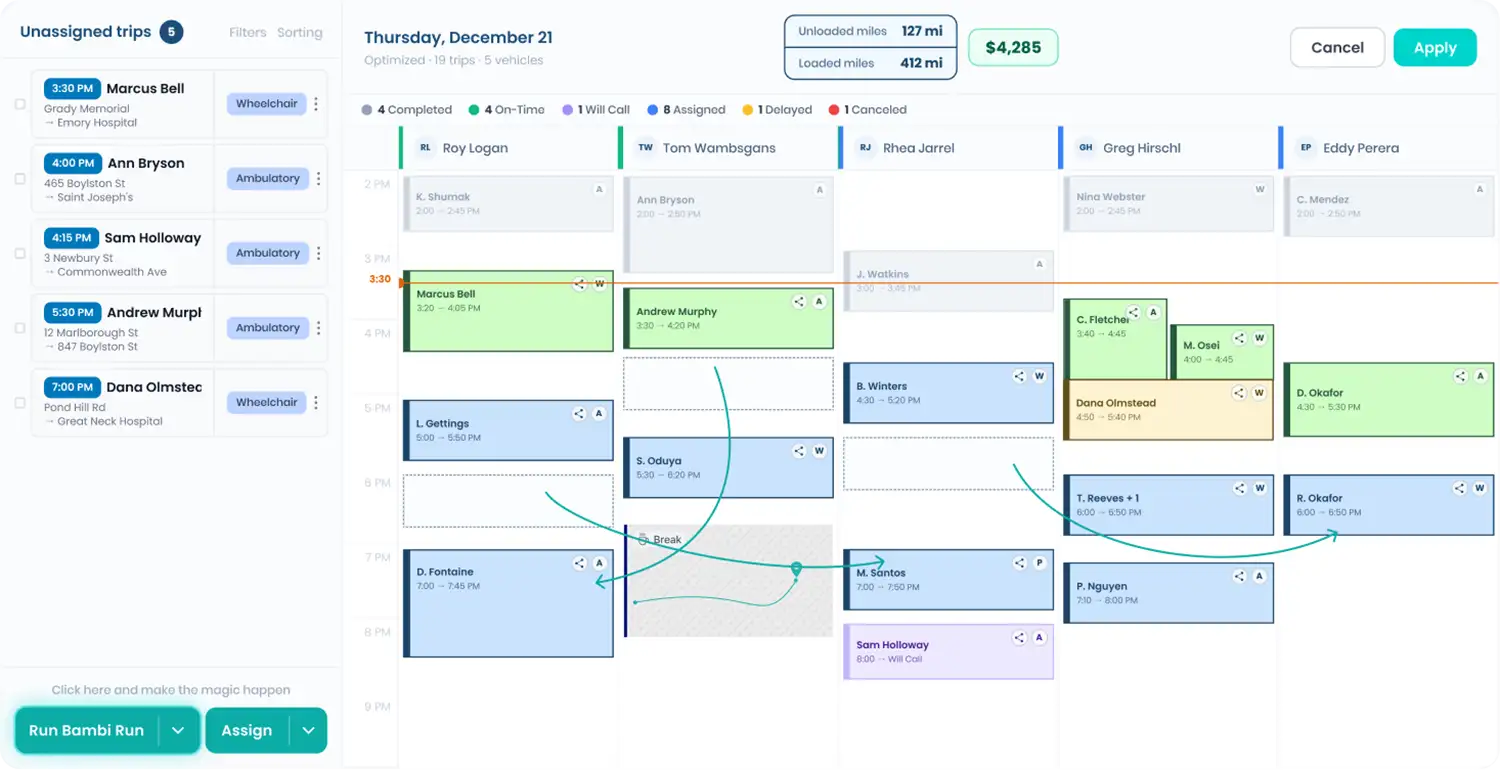

NEMT providers can use analytics to improve efficiency, reduce costs, and enhance service quality. By shifting from manual processes to data-driven tools, providers can optimize routes, track key metrics, and better allocate resources. Here's what you need to know:
- Route Optimization: Automated systems cut costs by 20%-30% and reduce fuel expenses by 15%-25%, while improving on-time arrivals by up to 50%.
- Key Metrics: Focus on on-time performance (target: 90%-94%), fleet utilization (aim for 75%+), driver idle time (keep below 10%), and cost per trip.
- Demand Forecasting: Predict trip demand with 95% accuracy using historical data, allowing smarter staffing and fleet allocation.
- Dashboards: Real-time tracking tools provide visibility into trips, delays, and vehicle usage, enabling quick adjustments and fewer disruptions.
- Training and Tools: Equip staff with analytics platforms that integrate with existing systems and comply with HIPAA regulations.
Providers who embrace analytics can scale operations efficiently, improve patient care, and boost profitability. Start by identifying your key metrics, implementing the right tools, and training your team to act on data insights.
Key Performance Metrics to Track
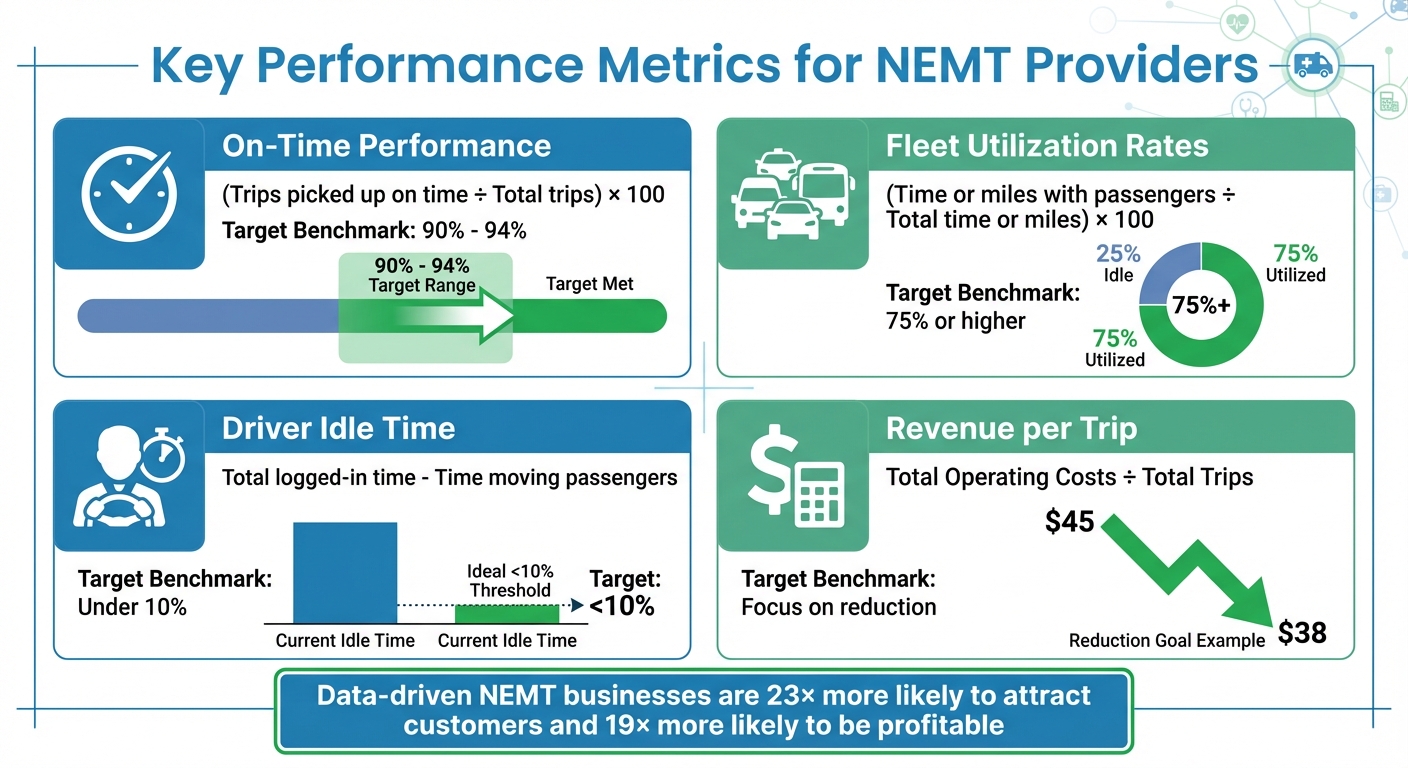
Tracking the right metrics is essential for NEMT providers to stay efficient and competitive. Without measurable goals, it's easy to lose direction. In fact, data-driven businesses are 23 times more likely to attract customers and 19 times more likely to turn a profit compared to those that don't use analytics. Here are four key metrics every NEMT provider should focus on to maintain operational success.
On-Time Performance
On-time performance (OTP) measures how often pickups occur within the promised time window. This metric directly influences client trust, reduces missed medical appointments, and shapes your reputation with brokers. For example, one NEMT provider improved its OTP from 84% to 94% by tweaking driver schedules and leveraging automatic dispatch alerts. The industry benchmark for OTP is 90% to 94%, and setting alerts for dips below 90% can help you act quickly.
Low OTP often points to issues like traffic delays, unrealistic schedules, or poor communication with facilities. Use analytics tools to identify problem routes or times, then adjust schedules or assign drivers strategically. Adding small buffer times at the start of shifts and using live GPS updates to manage delays can help prevent cascading issues throughout the day.
Fleet Utilization Rates
Fleet utilization measures how much of your fleet's time or mileage is spent transporting passengers versus sitting idle. If only 60% of your fleet is actively in use, you're leaving 40% of your capacity untapped. A fleet of 20 vehicles increased its utilization from 60% to 80% by reallocating low-demand vehicles to busier zones, cutting down on wasted resources. The goal is to achieve at least 75% active use during peak hours.
Review fleet performance weekly to identify underutilized vehicles. Reassign them to areas with higher demand or evaluate whether your current staffing levels align with actual needs. Reducing idle time isn't just about keeping vehicles moving - it's about optimizing revenue from your existing assets before considering fleet expansion.
Driver Performance Metrics
Driver performance focuses on two key areas: idle time (time logged in but not transporting passengers) and productivity (trips completed per shift). Reducing idle time from 25% to 12% can boost completed trips per driver by 15%. The target for idle time is below 10%.
High idle time often signals inefficiencies, like drivers waiting too long between trips or being stationed in low-demand areas. Assigning drivers to nearby zones during downtime can help. Additionally, monitoring trips per shift allows you to balance efficient scheduling with quality service. Use these metrics to guide regular coaching sessions - not as a punitive measure, but as a way to identify training needs and celebrate top performers.
Revenue per Trip
Revenue per trip evaluates whether individual trips are profitable after accounting for expenses like fuel, wages, maintenance, and insurance. For instance, by cutting the average cost per trip from $45 to $38 through better route planning and reducing deadhead miles, one NEMT provider increased its monthly profits without adding new vehicles. This metric helps you assess pricing strategies and pinpoint cost-saving opportunities.
Keep a close eye on fuel and maintenance costs to address sudden spikes. If certain routes consistently underperform, consider combining trips, renegotiating pricing with brokers, or minimizing empty miles. Use the formula Total Operating Costs ÷ Total Trips to calculate this metric and track it weekly to catch issues early.
MetricFormulaTarget BenchmarkOn-Time Pickup(Trips picked up on time ÷ Total trips) × 10090% - 94% Vehicle Utilization(Time or miles with passengers ÷ Total time or miles) × 10075% or higher Driver Idle TimeTotal logged-in time - Time moving passengersUnder 10% Cost per TripTotal Operating Costs ÷ Total TripsTarget reduction
Using Analytics for Route Optimization
Route optimization algorithms have revolutionized the way routes are planned by replacing manual processes with advanced calculations. These systems analyze countless combinations of pickup and drop-off points, appointment schedules, vehicle capacities, and driver availability to determine the most efficient routes. Instead of relying on a dispatcher to sift through spreadsheets and make educated guesses, the software delivers the optimal sequence in seconds. It even considers factors like wheelchair accessibility and driver shift limits.
Real-time adjustments take this efficiency to the next level. Modern tools use live traffic and weather data to reroute drivers on the fly when accidents or construction cause delays. If a patient cancels or an urgent trip is added, the system updates the schedule instantly and sends the revised route straight to the driver’s device.
A major advantage is multi-stop trip stacking, where passengers are grouped by location and appointment time to maximize vehicle capacity. This reduces the number of vehicles on the road, saving fuel and cutting down on fleet wear and tear. With this groundwork, it’s easier to understand the inner workings of these algorithms.
How Route Optimization Algorithms Work
The process begins with key data inputs: live GPS tracking, current traffic and weather conditions, and driver availability. Patient-specific needs, such as wheelchair or stretcher requirements, vehicle capacities, and priority appointments, are also factored in.
The system then evaluates thousands of route combinations to minimize travel time and distance. But it’s not just about finding the shortest route - it’s about balancing efficiency with service quality. Operational constraints like driver shift limits, vehicle maintenance schedules, and fuel consumption are all taken into account. Additionally, cloud-based platforms centralize trip management, storing data securely in HIPAA-compliant environments with automated logging for audits. These capabilities lead to tangible benefits, as shown in the examples below.
Examples of Improved Routing Results
Real-world applications of route optimization reveal clear benefits in both cost savings and service quality. Driver utilization rates, for example, often climb from below 60% with manual routing to over 85% with automated systems. This allows fleets to handle more trips per driver without adding resources. Similarly, deadhead miles - empty miles driven without passengers - can drop by up to 30%. For a fleet that covers 10,000 miles monthly, this translates to 3,000 fewer wasted miles, reducing fuel costs and vehicle wear.
Travel times can decrease by up to 40%, thanks to smarter routing and scheduling optimization tools. When patients consistently arrive on time for appointments, adherence to treatment improves significantly. Research links reliable NEMT services to a 40% increase in treatment adherence. These improvements not only cut costs but also enhance service reliability, aligning with broader operational goals.
Metric CategoryKey Performance Indicator (KPI)Impact of OptimizationFleet EfficiencyDeadhead MilesUp to 30% reduction Fleet EfficiencyDriver UtilizationIncrease from <60% to >85% FinancialsFuel Expenses15% to 25% reduction FinancialsOperational Costs20% to 30% reduction Service QualityOn-Time PerformanceUp to 50% improvement Service QualityTravel TimesUp to 40% reduction
Demand Forecasting and Resource Allocation
Using Historical Data to Predict Demand
By analyzing historical trip data, AI-driven systems can predict future demand with impressive precision. These systems dig into past trip records, patient appointment trends, seasonal fluctuations, and recurring medical needs, achieving accuracy rates above 95%. For example, dialysis patients, who make up nearly 30% of the NEMT market, require 156 trips annually - three times a week - providing a reliable foundation for planning.
External factors like weather conditions, traffic patterns, and road closures are also considered to fine-tune trip duration estimates. Machine learning models even predict patient no-shows based on past trends. This allows providers to strategically overbook, ensuring vehicles remain in use without unnecessary downtime. As Bob Martin from NEMT Cloud Dispatch highlights, AI-driven systems leverage historical data, seasonal trends, and external factors to significantly improve forecasting accuracy.
Geographic analysis plays a key role in identifying demand hotspots. By pinpointing high-demand areas and peak timeframes, providers can position vehicles more effectively, cutting down on wasted miles before trips begin. For example, the rapidly growing mental health transportation segment, with a projected 10.11% CAGR, often involves weekly or monthly appointments. This consistency enables providers to establish predictable staffing and fleet patterns. These forecasts directly influence decisions on staffing and fleet allocation.
Adjusting Staffing and Fleet Availability
Armed with predictive insights, NEMT providers can fine-tune their staffing and fleet distribution to align with expected demand. This approach builds on earlier routing and performance strategies, ensuring resources are deployed where and when they’re needed most. Since driver wages typically account for 35-45% of a provider's revenue, accurate demand forecasts allow for staggered driver shifts. This ensures maximum vehicle availability during peak times while avoiding overstaffing during slower periods.
Analytics also help match the right vehicles - whether ambulatory, wheelchair, or stretcher-equipped - with the specific mobility needs of patients. Automated scheduling based on these forecasts has already delivered noticeable results, including a 45% drop in booking errors and a 30% reduction in call center volume. The outcome? A fleet that proactively adapts to demand, maintaining vehicle utilization rates of at least 75% during core operating hours.
Performance Dashboards for Real-Time Monitoring
Key Features of Effective Dashboards
A performance dashboard acts as a one-stop hub for monitoring operations. Dispatchers can view scheduled trips, active rides, driver assignments, and unassigned trips all in one place, making it easier to manage logistics efficiently. With live GPS tracking, managers can oversee vehicle movements in real time, spotting problems like wrong turns or traffic delays as they happen.
To streamline operations, automated alerts notify dispatchers of potential issues - like when on-time pickups fall below 90% or driver idle time exceeds 10%. This "manage by exception" system allows teams to focus on problem areas, such as late trips or unassigned rides, without manually tracking every successful trip.
Dashboards also monitor vehicle utilization, showing which vehicles are actively transporting passengers versus those sitting idle. If idle times spike, managers can quickly reassign vehicles to busier areas or tweak driver schedules to maximize efficiency. These tools enable teams to respond swiftly to operational hiccups, ensuring smoother daily performance.
How Dashboards Improve Daily Operations
Like route optimization and demand forecasting, real-time dashboards provide actionable insights that enhance decision-making. If a vehicle breaks down or a driver calls in sick, dispatchers can instantly locate the nearest available driver on the dashboard and optimize driver assignments and reassign the trip in seconds, minimizing disruptions. This flexibility helps maintain service reliability and prevents missed appointments.
Dashboards also highlight recurring issues. By analyzing data on wait times and trip cancellations, managers can identify patterns - such as routes prone to traffic delays at specific times. Real-time tracking systems have been shown to reduce late arrivals by 25–40%, improving client satisfaction and cutting down on missed medical appointments. Additionally, sharing accurate estimated times of arrival with patients and healthcare facilities eases administrative workloads and strengthens trust with clients.
Integrating Analytics Tools Into Daily Operations
Choosing the Right Analytics Tools
Start by reviewing your current performance data and setting clear, measurable goals. When selecting analytics tools, prioritize platforms that include features like automated scheduling, real-time GPS tracking, multi-stop planning, and smooth integration with your existing billing or electronic health record systems. Since drivers often rely on mobile devices, mobile accessibility is a must. Additionally, ensure that any tool handling patient data complies with HIPAA regulations to maintain data privacy.
To boost efficiency, aim for specific benchmarks: strive for at least 75% vehicle utilization during peak hours and keep driver idle time below 10% of their working hours. These tools can significantly enhance vehicle usage rates and improve on-time performance. Once the right tools are in place, focus on equipping your team to use them effectively.
Training Staff on Data-Driven Practices
Tailor training sessions to match the needs of dispatchers, drivers, and fleet managers, ensuring they understand the key insights relevant to their roles. It's not just about learning how to operate the software; staff also need to interpret the data for smarter decision-making. Roll out the tools gradually to make the transition smoother. Including key team members in the tool selection process can help reduce resistance and encourage a mindset open to new ideas.
Take advantage of vendor-provided resources like guided walkthroughs and video tutorials to simplify training. Also, make sure your team is well-versed in proper data handling protocols. With a trained staff, it becomes much easier to measure the impact of these analytics tools.
Measuring the Impact of Analytics Adoption
Once the tools are in use, track progress using the benchmarks you established earlier. Real-time dashboards and system alerts can help you monitor key performance indicators, such as on-time pickups and driver idle time, on a weekly basis. Another useful metric is the cost per trip, which you can calculate by dividing total operating costs by the total number of trips. Monitoring this figure over time will reveal whether your costs are trending downward. Regular reviews of these metrics ensure that your analytics tools are delivering the expected benefits.
Conclusion
Analytics transforms NEMT operations from guesswork into precise, data-driven management. By monitoring key metrics like vehicle utilization, on-time performance, driver idle time, and cost per trip, providers can spot inefficiencies and act quickly to address them. This approach not only cuts operational costs but also reduces deadhead miles and idle time, while improving on-time arrivals and patient satisfaction.
Moving from manual spreadsheets to integrated analytics platforms offers measurable advantages. For instance, these platforms can lower deadhead miles by up to 30% and trim fuel costs by 15% to 25%. Real-time dashboards bring instant visibility, allowing for quick adjustments - whether rerouting drivers to avoid traffic or reallocating vehicles using dynamic scheduling tools to meet unexpected demand spikes. Tools like route optimization and demand forecasting make these changes seamless and effective.
To start reaping these benefits, begin with a baseline assessment of your current operations. Set clear goals, such as achieving 75% vehicle utilization during peak hours and maintaining on-time pickup rates above 90%. Opt for analytics tools that integrate smoothly with your existing systems and adhere to HIPAA standards to ensure patient data security. Training your team to interpret and act on data insights is equally important for making smarter, real-time decisions.
The advantages go beyond immediate cost savings. Analytics helps forecast demand surges, like during flu season, enabling proactive staffing and service adjustments without adding more vehicles. For example, reducing the cost per trip from $45 to $38 can significantly improve monthly profits while maintaining the same fleet size. With strategic planning and a commitment to analytics, these improvements pave the way for sustainable growth.
Take a close look at your performance data and choose one or two key metrics to improve right away. Transitioning to a data-driven model requires effort, but the increased efficiency and competitive edge make it well worth it. Most importantly, these operational improvements enhance patient care by ensuring reliable, timely transportation, ultimately supporting better health outcomes.
FAQs
What data should I collect first to start using analytics?
To start integrating analytics into your NEMT operations, begin by gathering essential operational data. Pay close attention to vehicle utilization, such as the ratio of active transport time to idle time. This helps pinpoint inefficiencies and better allocate resources. Also, keep track of on-time pickups and trip costs - these metrics are key for evaluating service reliability and cost efficiency. Together, these data points create a solid baseline for assessing performance, resolving bottlenecks, and making informed decisions to enhance your operations.
How do I pick analytics software that fits my NEMT operation?
When picking analytics software for your Non-Emergency Medical Transportation (NEMT) business, prioritize tools designed specifically for transportation needs. Look for features like detailed performance analytics, route optimization, and real-time data tracking. These capabilities will help you monitor and improve your operations effectively.
It’s also essential to select platforms that work seamlessly with broker systems such as ModivCare or MTM. This integration ensures smooth data sharing and better coordination. Additionally, focus on software that tracks critical metrics like vehicle utilization, on-time pickups, and driver performance. These insights can make a big difference in boosting efficiency, cutting costs, and delivering more reliable service to your clients.
How can I prove analytics is lowering cost per trip and improving on-time pickups?
Tracking key metrics such as vehicle utilization and cost per trip is a practical way to highlight the impact of analytics. By using tools like route optimization and AI-driven ETA predictions, you can cut down on fuel expenses and minimize delays, leading to improved punctuality.
Regularly reviewing dashboards and reports allows you to monitor performance trends over time. This not only reveals cost savings but also showcases better on-time rates. Plus, real-time tracking and adjustments provide additional proof of how analytics-driven strategies lead to measurable improvements.