
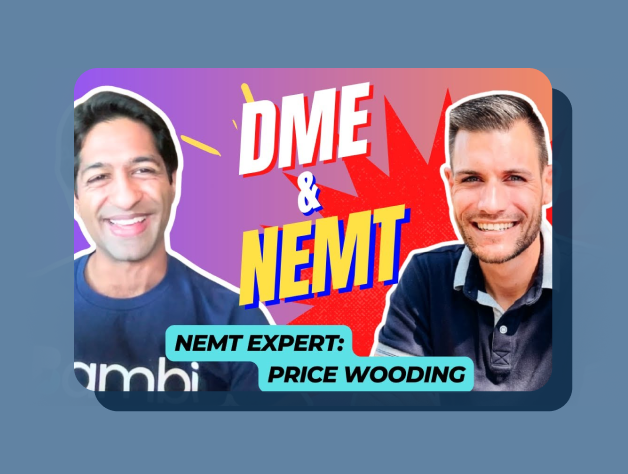
See the full interview on YouTube.
Please don't forget to subscribe and like NEMT Experts Podcast on YouTube.
Also, available to watch on Spotify
And listen (audio only) on your other favorite podcast platforms Apple and Pandora.
Bambi CEO Nirav Chheda talks with Price Wooding, Owner of "DME for Me Consulting", about how NEMT business can diversify into doing DME (Durable Medical Equipment) work.
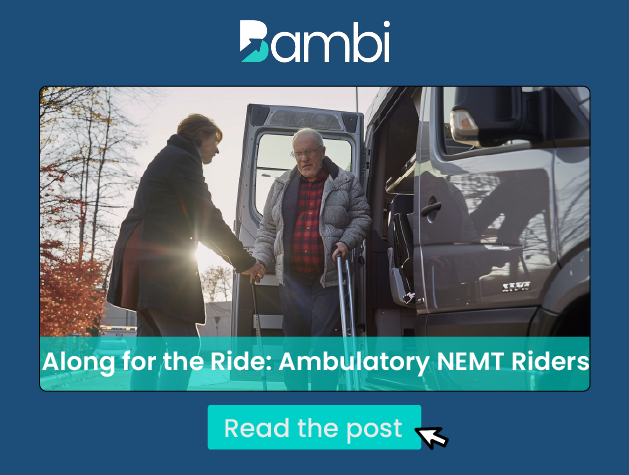
We’re back to meet more of the marvelous mix of NEMT passengers in our Bambi Knows Best three-part series, Along for the Ride, dedicated to exploring the intricate world of those who rely on non-emergency medical transportation.
In this second installment of Along for the Ride, we turn our attention to ambulatory riders, those folks who possess the ability to walk and move independently or with minimal assistance of a helping hoof. While they may not require wheelchairs or other mobility aids, ambulatory passengers still rely on NEMT services to access vital healthcare appointments and services.
And just like their wheelchair-bound counterparts, ambulatory riders bring their own unique set of needs and experiences to the journey. From individuals recovering from minor to invasive surgeries to those managing chronic conditions, ambulatory passengers require the same level of care, consideration and empathy when it comes to their transportation.
As we continue to iterate to improve our aiNEMT software — care-tech for those who caretake — it's essential to understand the journey from the perspective of NEMT brokers and drivers. And because ensuring a safe and sound trip for every passenger remains our ultimate priority, we turn again to Bambi to shed some light on what you may encounter during your travels with ambulatory riders.
Caring for ambulatory passengers requires more than just providing transportation — it involves thoughtful consideration of accessibility, communication and emergency preparedness. Are pickup and drop-off locations easily accessible to individuals who might have even the slightest of mobility challenges? What condition are these riders in — even though they’re not with a wheelchair, they might need support with a walker, crutches or cane. Do you have the sufficient space in your NEMT vehicle or fleets for the extra support items an ambulatory rider might need?
Here are a few other necessary things to keep in mind when taking care of ambulatory passengers:Communication is gold: Effective communication between drivers, brokers and passengers is essential for a successful NEMT experience, and drivers should be trained to communicate clearly with ambulatory passengers to ensure their particular needs are met throughout the entire ride to their appointments. Do they need a helping hoof to embark and disembark? Will they be bringing extra equipment on (i.e. oxygen tanks, IV bags, walkers)? Will they be riding solo or with an accompanying friend like a Thumper — but rather with someone from their actual neck of the woods, not Bambi’s? Accessibility goes beyond the wheels: Accessibility doesn't end with the ride itself. It's important for NEMT providers to consider the accessibility of pickup and drop-off locations at the different medical places their passengers need lifts to.Emergency preparedness: NEMT providers should have protocols in place for handling emergencies, including medical emergencies that might arise during transport. Drivers should be trained to respond effectively to emergencies and to coordinate with specialized medical professionals when needed. Think about those folks carrying on extras like oxygen tanks and IV bags. Do your drivers know how to handle those items? They better!Always improving: The NEMT industry is constantly evolving, and brokers and providers should always make time for improving their services for everyone. Soliciting feedback from ambulatory passengers and implementing changes based on it will only enhance the overall experience for these riders.And, yep, you guessed it! There’s even more where this came from! Keep an eye out for the next installment of Along for the Ride, where we'll explore the experiences of passengers who need stretcher support — and the intricacies of providing NEMT services to this particular group of riders ready to stretch your services from A to B.
In many industries, brokers act as bridges — though one might wonder why they're not just called bridges instead! They serve as intermediaries between parties, sometimes two, sometimes several. In the non-emergency medical transportation (NEMT) sector, these professionals or entities play an important role. They act as connectors between healthcare providers, patients, and transportation services, taking care of the arrangement and coordination of transportation for individuals with medical needs to reach their necessary destinations — typically medical appointments, rehabilitation centers or other appointments vital for their well-being.
Here at Bambi, we believe NEMT brokers or business owners to be the true Bambis of this field. Mainly because they’re taking a lot of empathetic care, not just in one aspect of healthcare, but multiple. It’s a lot to juggle in one's own entrepreneurial set of hooves and Bambi heart. They're not just taking care of business; they're ensuring that patients (their clients), especially those with disabilities, chronic illnesses or mobility limitations, have access to safe and dignified rides.
NEMT brokers are also taking care of their contractors and/or employees. These folks can range from drivers to an in-house operations team. As easy and streamlined as our fun-in-one aiNEMT software is, someone needs to be nimble like Bambi, managing the backend and clicking that Run Bambi Run button when necessary. It doesn’t just run itself (yet, at least). These dear drivers and operators are the backbone of any NEMT biz, often going above and beyond to ensure that patients receive the care and attention they deserve. They’re like Bambi guiding friends through the forest of healthcare safely, ensuring kindness in care of their well-being but also the sustainability of the ecosystem in which they operate.
NEMT brokers who understand the importance of supporting their team members thrive Bambily (yeah we just made up an adverb) beyond others. Whether it's ensuring fair compensation, offering opportunities for professional development or simply fostering a psychological safe work environment, NEMT brokers prioritize the well-being of their workforce.
Additionally, NEMT brokers are nurturing relationships — not just their internal teams and contractors or returning Miss Daiseys, but also those who provide services to them, like software providers like ours or other third parties who support their NEMT services better. There’s that one big wheel of caregiving again!
By cultivating strong partnerships with software platforms, technology providers and community health centers, NEMT brokers expand their Bambi hooves’ reach and enhance the quality of care they can offer to patients. It's through these collaborations and connections that the true impact of their empathetic approach to business shines through, making them the real Bambis of the industry — ensuring not just the safe passage of their patients but also the sustainability of our planet and vitality of our wider healthcare ecosystem.
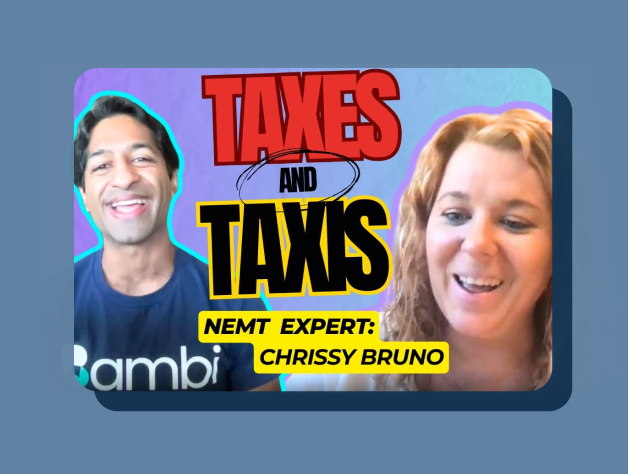
See the full interview on YouTube.
Please don't forget to subscribe and like NEMT Experts Podcast on YouTube.
Also, available to watch on Spotify
And listen (audio only) on your other favorite podcast platforms Apple and Pandora.
In this episode of the NEMT Experts Podcast, Nirav Chheda and Chrissy Bruno explore the intricacies of managing both taxi and ambulatory rides within a transportation business. They address challenges like long wait times and discuss strategic planning to improve customer satisfaction. The conversation also covers essential aspects of legal and financial management for small businesses, stressing the need for legal protection, efficient accounting and bookkeeping tools, and meticulous daily expense tracking to maintain financial health and profitability.
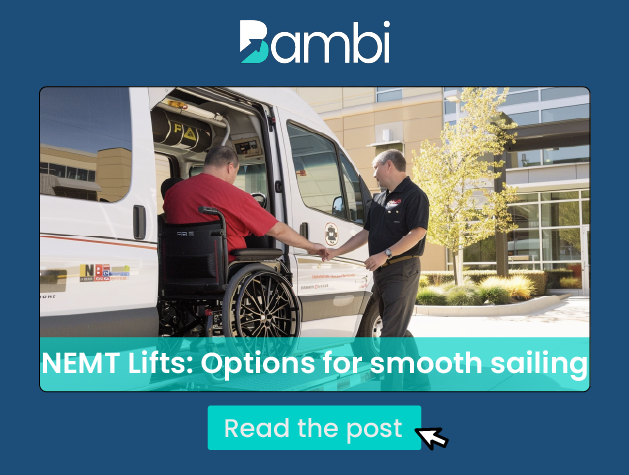
NEMT Lifts: Raising On Up and In for Smooth Sailing
In a past article, we dove into the Bambi essentials in terms of equipment for non-emergency medical transportation (NEMT). And even more recently, we rolled through the options when it comes to the particulars of wheelchair ramps in order to ensure smooth on- and off-boarding of customers into your NEMT vehicles, as well as their safe sailing during their journeys to and from their medical appointments.
In this piece, we’ll delve into the particulars of electronic wheelchair lifts. Think of these NEMT lifts as the electric sibling of wheelchair ramps, of which require a bit more of a manual maneuver. Whether you go electric or manual all depends on the size of your vehicle, the passengers you plan to bring aboard and the wheelchairs you expect they bring with them.
In this Bambi guide, we'll explore different NEMT electronic lift products out there, including various brands and other things to consider in order to help you feel well-informed, empowered and uplifted (see what we did there?) in your decision making process.
Of course, we’ll always recommend investigating products and brands within your own neck of the woods, as Bambi would do. And as we all know by now, the more sustainable choice is always to source and support your local brands and businesses. And hey, what goes around comes around; they just might support yours, too! Side note: This is one way of establishing a strategic business partnership in the NEMT realm. But we’re not talking biz dev here today, we’re revving up those e-lifts!
Electric NEMT lifts come in various types to accommodate different needs. Here are some of the most common types:
The most popular electric lift brands:
Other important things to consider:
Maintain that regulatory compliance:
As evident here, selecting the right NEMT lift is necessary for guaranteeing safe and accessible transportation for customers with mobility limitations. By taking into account factors such as lift type, brand reputation, essential safety features and compliance with regulations, NEMT providers can opt for the most (literally) fitting lift solution that caters to their riders’ needs with empathy and careful consideration.
Whether it's for vertical, under-vehicle or rear-entry applications, investing in top-quality electric lifts from reputable brands not only ensures their reliable performance but also instills peace of mind for both passengers and providers. And peace is what we’re after people — that’s all Bambi wanted in his forest after all.
Today, we’ll journey through the enchanted forest of the rules and regulations of what we’re calling Legal Land to ensure you’re being compliant in your non-emergency medical transportation (NEMT) operations. And what an adventure it is to navigate such a rule-filled route! (We say in all seriousness, jokingly).
But fear not, dear Bambi NEMT Brokers, as we'll help you frolic through this forest of regulations as nimbly and graceful as Bambi would his own backyard. To start, imagine Legal Land crossing paths with Disney’s Bambi, where wise old owls perch high in the branches, watching over the land with keen, meticulous rule-making eyes. From HIPAA regulations to ADA compliance, they are the keepers of order in the NEMT world.
And as a care-tech company crafting software for caretakers, we understand the challenges of compliance. We don't want healthcare regulations to dampen your softie spirits — you already have enough on your heart running an NEMT business.
As Thumper taught us, "if you can't say something nice, don't say nothing at all,” it’s best if we navigate the thicket of legal jargon with open minds — to what may not feel like the most digestible and understandable lingo — with creativity and charm.
So you ask, then how do we navigate this labyrinth of legality without losing our Bambi way? Well, here are a few tips to keep in mind so you can stay legal in Legal Land:
Stay informed and ahead: Just like a vigilant squirrel gathers acorns for winter, you should stay ahead of changes in laws and regulations. Join NEMT industry forums (like NEMT Talk), attend webinars and keep your big Bambi ears perked for any whispers from your fellow friends in the industry regarding new guidelines.
Build a trusty, tough team: We know we’re going off Disney here, but remember the tale of the Three Little Pigs? Surround yourself with a team of experts who can fortify your NEMT enterprise against legal huffs and puffs. Lawyers, compliance officers and NEMT consultants will be your saving grace in tricky times.
Be transparent: Honesty is the best policy, especially in Legal Land. Be transparent with your customers, contractors, partners and, yes, especially with those regulation auditors. Openness can go a long way in building that Bambi trust and goodwill.
Foster a culture of compliance: Just as the forest thrives when every creature plays its part, cultivate a culture of compliance within your organization. Train your team, establish clear protocols and instill a sense of responsibility in every team member of your NEMT tribe.
Never forget to frolic: Last but certainly not least, don't forget to have fun! While the journey through legal and regulatory terrain may seem daunting at times, remember to embrace the joys of overcoming bureaucracy and the wonder of this thriving NEMT industry.
And there you have it, dear Bambi Brokers! With these tips and tricks up your hooves’ sleeves, you’ll be able to navigate the twists and turns of legal and regulatory issues within the NEMT industry calmly with class and care.
Running a successful non-emergency medical transportation (NEMT) business requires more than just reliable vehicles, skilled drivers and loyal customers. It's about effectively managing every aspect of the journey, from dispatch to patient pick up, to ensure a seamless and sustainable experience for your contracting caregivers and those clients receiving their care. In this “Bambi Knows Best” guide, we'll explore three key Ds — or elements, rather — that are essential for NEMT business owners, be them new to the biz or seasoned pros: dispatch, dashboards and driving.
Dispatch (a.k.a. managing the journey)
At the heart of any NEMT operation lies the dispatch system. This is where rides are scheduled, routes are planned and vehicles (and their dear drivers) of the NEMT fleet are allocated. Efficient dispatch processes are crucial for maximizing productivity and minimizing delays. By leveraging technology (like Bambi’s) that allows for automated scheduling and real-time tracking, NEMT businesses can streamline (and even scale) their operations, improving overall customer satisfaction.
Did we mention that all the emerging NEMT tech like ours is supporting streamlined dispatching capabilities to create cleaner routes that ultimately drive the NEMT industry’s sustainability efforts in a positive direction? That’s pretty Bambi rad, right?
Quick and clear communication channels — within these dispatch systems — between dispatchers, drivers and riders are also imperative for handling emergencies, managing delays and addressing special requests. It goes without mentioning, but we always got to mention it: staying compliant with regulatory requirements, including driver qualifications and HIPAA standards, is also paramount to ensure the safety and security of these patient passengers.
Dash (a.k.a. making nimble data-driven decisions)
Data is a powerful tool for NEMT business owners, providing valuable insights into performance metrics, resource management and customer satisfaction. Dashboards and analytics tools in the different options for NEMT software enable owners to track key performance indicators (KPIs) such as on-time arrivals, vehicle use and customer feedback. By analyzing this data, NEMT brokers can identify areas for improvement, optimize route planning and forecast customer demand ever more accurately.
Bambi’s dashboard is clean and simple, allowing for easy-to-deduct data to make decisions calmly. And in doing so, business owners can think clearly and creatively — and even have some fun in brainstorming ways to improve customer satisfaction (if that’s the data set they’re looking at). In their proactive problem-solving that might even come up with some ideas for playful themed rides and other rewards programs in order to reduce no-shows and increase retention.
Drive (a.k.a. delivering high caliber customer service)
Ultimately, the success of an NEMT business hinges on the quality of its drivers. Comprehensive training programs covering safety protocols, customer service skills and team cultural competency are essential for ensuring that drivers can meet the diverse needs of their passengers. Providing ongoing support and resources is also needed for empowering drivers to excel in their roles and deliver exceptional service.
Fostering a positive work culture that values diversity, inclusion and professionalism is key to attracting and retaining top talent. Additionally, engaging with local communities and healthcare providers helps to build trust and foster partnerships, ultimately enhancing the reputation and credibility of the NEMT business.
By investing in efficient dispatch systems, leveraging data-driven decision-making, and fostering a team culture of caretakers that really strive for excellent care among their drivers, NEMT businesses can differentiate themselves and deliver a superior level of service to their customers and dear employees and/or contractors.
In the world of non-emergency medical transportation (NEMT), every journey matters, and so does its impact on our planet. Being named after Disney’s most endearing deer, Bambi, of course we're all about that sustainability — for the trees in his forest and ours. And as we’re a care-tech company that cares about the quality of our NEMT technology, we know it isn't just about moving healthcare patients from point A to B; it's about doing so efficiently, cost-effectively and with a good environmental conscience.
In this article, we’ll delve into how NEMT technology, like ours at Bambi, drives sustainability by saving time, money and trees — making our planet greener and your pockets, too.
Optimized routes reduce emissions
NEMT software like ours continues to transform transportation logistics by optimizing routes and minimizing unnecessary mileage. By dispatching shorter, more efficient routes, NEMT services reduce fuel consumption and vehicle emissions, leading to cleaner air that Bambi and all his friends (including us) are keen to breathe — meaning we’re making a smaller carbon footprint or, rather, hoofprint.
With fewer miles traveled, we're not just saving time and money; we're also preserving the health of our planet for future generations. It's a win-win for patients and the environment alike, ensuring that the forest Bambi calls home — and our real forests — remain lush and thriving for years to come.
Cut costs and conserve resources
Just as Bambi nimbly navigates through the forest with precision and purpose, NEMT technology enables NEMT brokers to embrace efficiency wholeheartedly. By streamlining scheduling, dispatching and tracking, NEMT providers save valuable time and resources.
These savings translate into tangible benefits, allowing for a more sustainable allocation of funds towards patient care and community initiatives to sustain the overall healthcare ecosystem. Also, by reducing wear and tear on roads and vehicles, NEMT technology also ends up helping conserve natural resources, ultimately, extending the lifespan of transportation infrastructure.
A greener future
Every mile saved is a leap towards a greener, more sustainable future, reminiscent of Bambi bounding through the forest with grace. With NEMT technology leading the charge, we have the opportunity to leave a lasting hoofprint on our environment while simultaneously enhancing access to vital healthcare services. By embracing innovation and harnessing the power of artificial intelligence, we cultivate a transportation system that not only tends to the health needs of patients but also nurtures the well-being of our beloved planet.
All in all, in the journey towards sustainability, NEMT technology not only acts as a driving force for positive change, it is the change. By optimizing routes, reducing emissions and conserving resources, NEMT services safeguard our most precious resources: time and trees — all the while patients receive the care they need. And as we continue to iterate and improve our technology together, we pave the way for a greener, healthier future for all.
If all of this sounds good to your softie hearts, we’ve got the NEMT software for you! When you’re ready, just place that hoof of yours on our Run Bambi Run button and watch Bambi save not only your day via time and money, but our planet, too.
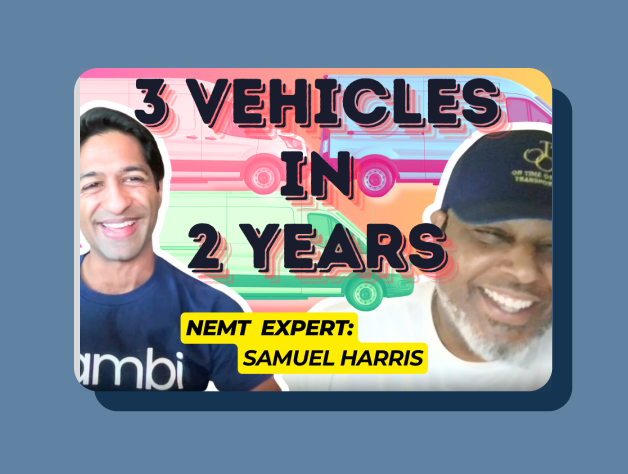
See the full interview on YouTube.
Please don't forget to subscribe and like NEMT Experts Podcast on YouTube.
Also, available to watch on Spotify
And listen (audio only) on your other favorite podcast platforms Apple and Pandora.
In this insightful interview, Sam Harris, an NEMT business owner in Richmond, Virginia, shares his journey of starting and scaling his company. He discusses the challenges of finding reliable drivers, the importance of choosing the right vehicles to meet customer needs, and how Bambi's software has streamlined his operations, saving him valuable time and money.
