Want to improve on-time performance for your NEMT services? Automation tools are the answer. Here's how they help:
AI Scheduling : Matches drivers and trips in seconds, reducing errors and delays.GPS Route Optimization Automated Notifications : Sends reminders and real-time ETAs to reduce no-shows by 40%.Performance Analytics : Tracks delays, no-shows, and costs to identify and fix inefficiencies.
Automation not only keeps rides punctual but also reduces costs, improves client satisfaction, and supports business growth. Providers using tools like Bambi Software report a 50% improvement in on-time arrivals while cutting operational costs by up to 30%.
If you're struggling with outdated processes like manual vs. automated scheduling or inefficient dispatching, automation can transform your operations and help you stay competitive in a growing $15.57 billion industry.
NEMT Automation Impact: Key Performance Metrics and Cost Savings
AI-Powered Scheduling for Better Trip Assignments
How AI Handles Scheduling Tasks
AI scheduling tools work at lightning speed, analyzing factors like driver proximity, vehicle type, and certifications in mere seconds - tasks that could take human dispatchers hours to complete.
When a ride request comes in, the AI dives into the details: client needs like mobility requirements, preferred pickup windows, and even medical notes. Then, it cross-references this information with real-time GPS data and traffic conditions, factoring in congestion, accidents, or road closures. This ensures that the right driver, with the right vehicle, gets to the right client on time.
But it doesn’t stop there. AI also uses historical data to forecast busy periods and potential cancellations. This predictive edge allows dispatchers to plan ahead, focusing on exceptions or strategic decisions instead of getting bogged down in routine scheduling. By matching drivers and trips with pinpoint accuracy, AI boosts on-time arrivals - an essential metric for running smooth NEMT services.
Benefits of Automated Trip Assignments
Manual scheduling comes with its share of headaches - human errors cause up to 23% of NEMT no-shows. Automated systems tackle these issues head-on, eliminating problems like double bookings or miscommunication. The result? Faster responses, fewer conflicts, and better use of resources, which leads to more dependable service and happier clients.
These improvements in scheduling pave the way for further advancements, like route optimization and streamlined communication, creating a stronger foundation for NEMT operations.
sbb-itb-6bd01f8 GPS and Traffic-Aware Route Optimization
Using Real-Time Traffic Data
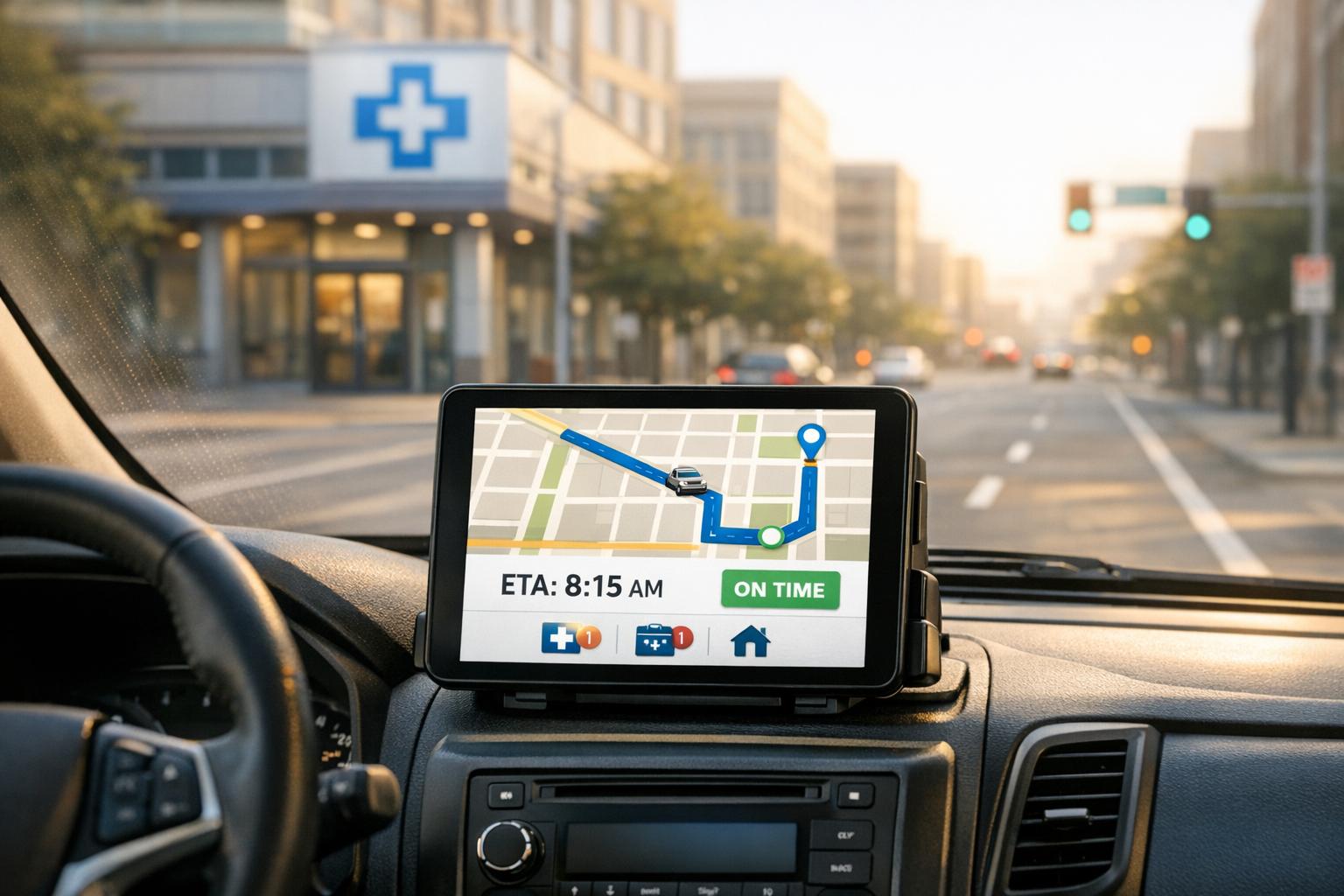
GPS route optimization software taps into live traffic feeds, giving dispatchers real-time updates on accidents, construction zones, and congestion across the service area. If a driver runs into unexpected delays, the system recalculates the route instantly, steering them away from problem areas.
This isn’t just about rerouting - it’s smarter than that. By incorporating weather data, the software helps drivers avoid hazardous conditions during storms. It also uses predictive analytics to account for recurring traffic patterns. For instance, if a route is typically slower during the morning rush, the system factors in extra travel time to keep schedules running smoothly. These fine-tuned adjustments not only improve punctuality but also help cut costs significantly.
The results speak for themselves. Providers using automated route optimization see on-time pickup rates climb to 99%, while travel times are slashed by 25% to 40% compared to manual planning . Even when unexpected issues arise - like vehicle breakdowns or last-minute cancellations - real-time tracking lets dispatchers quickly reassign trips to nearby drivers, keeping operations on track.
Lower Fuel Costs and Shorter Travel Times
Real-time route adjustments don’t just save time - they save money too. By cutting out unnecessary detours and reducing idle time, automated routing lowers fuel costs by 15% to 25%. The software also finds ways to combine trips, making the most of vehicle capacity while ensuring passengers reach their destinations on time. This approach reduces "deadhead miles " (miles driven without passengers) by 30%, directly trimming operational expenses.
Driver productivity also gets a major boost. With manual routing, utilization rates often hover below 60%, but automation pushes that figure above 85%. These efficiency gains translate to a 20% to 30% drop in overall operational costs, freeing up resources to improve services or upgrade fleets. Plus, shorter travel times and dependable arrivals lead to a 40% increase in patient treatment adherence, highlighting the broader benefits of optimized routing.
Automated Notifications for Better Communication
Real-Time Updates for Clients
Automated notifications tackle one of the biggest issues in NEMT: no-shows. Across the industry, 10% to 20% of scheduled trips are missed because patients forget appointments, aren’t ready when the driver arrives, or experience last-minute changes in their plans. A notification system that sends reminders 24 hours, 1 hour, and 15 minutes before pickup has been shown to reduce no-shows by 40% .
By linking these notifications to live GPS data, providers can send real-time ETAs that account for traffic, accidents, and weather conditions. Instead of vague alerts, patients receive accurate arrival times that adjust dynamically. This level of precision helps reduce stress and ensures patients are ready at the right location. Automated confirmation calls also verify critical details like wheelchair or stretcher requirements, minimizing the risk of dispatch errors.
Two-way communication further enhances the system’s effectiveness. Patients can cancel rides with the press of a button or by replying to a text, instantly alerting the system. This allows the driver to be reassigned immediately, reducing downtime and improving fleet efficiency. For providers handling around 200 trips daily, cutting no-shows from 15% to 9% could recover approximately $9,200 in monthly revenue .
These notifications work hand-in-hand with integrated scheduling and route optimization , ensuring smooth and transparent communication throughout every trip.
Benefits for Drivers and Dispatchers
Automated notifications don’t just help patients - they also simplify life for drivers and dispatchers. By automating routine updates, dispatchers can concentrate on more critical tasks, like addressing vehicle breakdowns or managing emergency rerouting. AI systems handle about 60% of patient calls , significantly reducing repetitive questions and leaving dispatchers to manage exceptions.
Drivers also benefit from instant push notifications for cancellations or route adjustments, eliminating the need for constant check-ins. Additionally, time-stamped logs create a clear audit trail for compliance and billing purposes, ensuring smoother operations for everyone involved.
Automation tools provide real-time data that helps pinpoint where delays happen and why. Key metrics to monitor include actual pick-up and drop-off times versus scheduled times, wait times at facilities, and trip completion rates. It's also essential to track no-show rates , cancellation trends, and driver punctuality to better understand overall operations.
Beyond time-based metrics, keeping an eye on deadhead miles, driver habits (like speeding or harsh braking), and financial data can highlight inefficiencies, safety concerns, and billing inaccuracies.
Centralized dashboards bring all this information together, offering dispatchers a clear view of late arrivals and route problems as they arise. Automated trip logs, which capture timestamps and GPS data, make performance reviews more accurate and straightforward.
This wealth of data empowers teams to make smarter, faster decisions.
Making Decisions Based on Data
Historical trip data uncovers patterns that manual tracking might miss. For instance, providers can identify facilities that regularly cause long wait times, routes prone to delays during peak hours, or drivers who frequently fall behind. These insights can drive meaningful changes, such as adjusting pickup windows for challenging locations, rerouting to avoid bottlenecks, or coaching drivers who need improvement.
Predictive analytics takes things a step further, using past trends to forecast busy periods or high-risk no-show times. Some systems even leverage machine learning to analyze weather-related delays and suggest alternative routes before problems arise. This shift from reacting to issues to preventing them helps minimize disruptions and improve service reliability.
Regularly reviewing trip costs - factoring in fuel and maintenance - also helps identify underperforming vehicles that consume resources without delivering enough value.
Key Features of Bambi Software
Bambi Software aims to tackle on-time performance challenges in Non-Emergency Medical Transportation (NEMT) operations by offering a fully automated solution. It combines AI-powered scheduling, real-time dispatching, GPS-based optimization, and automated communication tools into one platform. Its standout feature, the "Run Bambi Run" tool, uses machine learning to instantly create optimized schedules.
The platform supports bulk uploads for anywhere from 10 to 10,000 trips, making it suitable for small operations and large fleets alike. It automatically pairs passengers with the right vehicles and certified crews, streamlining operations. The NEMT Driver App, available for both iOS and Android, connects drivers and dispatchers in real time. With features like live vehicle tracking , instant updates on pickup locations, and direct messaging, it ensures smooth communication and allows for on-the-go adjustments.
Even in areas with poor connectivity, GPS-stamped events and offline tracking ensure accurate trip records. Notifications are fully integrated with the scheduling and dispatch tools , keeping riders updated on their trip status and reducing no-shows. The system also calculates mileage and travel times to provide reliable ETAs and handles last-minute changes without disrupting schedules. Additionally, Bambi simplifies backend processes by integrating billing, invoice generation, and payroll tracking. All of this is done while adhering to strict HIPAA-compliant data protection standards.
How Bambi Improves Daily Operations
Bambi doesn't just streamline scheduling; it transforms day-to-day operations. By leveraging AI, the software boosts operational efficiency by 34%. The pricing is straightforward at $69 per vehicle per month, with no hidden fees, onboarding costs, or extra charges for features. With a perfect 5.0-star rating across major review platforms, Bambi has also earned the NEMTAC Innovation in NEMT Award 2025.
"Switching over to Bambi is the most impactful thing I've done for my NEMT business. Bambi's AI is literally saving my staff hours of daily work."Reliant Transport
"Bambi's been a game changer for us, especially with the scheduler optimizer. Beforehand, assigning the trips to the drivers was very time consuming and now with Bambi it's as easy as clicking Run Bambi Run!"PrimeCare Patient Transport
Customizable dashboards allow managers to monitor fleet status and trip progress in real time. The audit history feature tracks who made changes to trips and when, helping identify and resolve delays quickly. Providers can also use the repeat trip scheduling feature to manage standing orders automatically. The bulk data input tool integrates smoothly with broker requests from Modivcare and SafeRide , further simplifying operations. With 24/7 access to a dedicated support team, Bambi ensures providers have assistance whenever needed, minimizing disruptions and delays. These features work together to enhance daily operations and move NEMT providers closer to full automation.
Conclusion
Automation has become a game-changer for ensuring timely and reliable NEMT services. With AI-powered scheduling and dispatching , trips are matched with drivers in seconds, eliminating manual errors. GPS-enabled route optimization uses real-time traffic data to avoid delays, while automated notifications keep patients updated and reduce no-show rates. On top of that, performance analytics allow managers to pinpoint inefficiencies and make smarter decisions. Together, these tools transform every aspect of NEMT operations, paving the way for better financial and operational outcomes.
The financial advantages speak for themselves. For example, J&Tig Transportation in Virginia leveraged these efficiencies to grow from a single vehicle to a fleet of 42, generating $4.8 million by 2025. By integrating scheduling, navigation, and communication, providers can improve on-time performance while cutting operational costs. This approach saves time, reduces fuel expenses, enhances driver safety, and ensures compliance with broker expectations.
"The integration of AI will not be an optional luxury, but a fundamental requirement for success." - NEMT Platform
Automation also reshapes how teams operate. Dispatchers shift from putting out fires to focusing on strategic management, while staff can dedicate more time to customer service and resolving complex issues. For providers grappling with rising fuel costs and shrinking reimbursements, automation isn't just about staying competitive - it's about long-term survival. The tools are already available, cost-effective, and capable of meeting the demands of today's healthcare transportation landscape.
FAQs
What’s the fastest way to start automating dispatch without disrupting service?
The fastest way to streamline dispatch operations without interrupting service is to ease into using AI-driven scheduling and dispatch tools. Begin with simple features like smart route planning and ETA predictions that can blend effortlessly with your existing processes. Opting for a demo or trial version helps you evaluate its effectiveness while giving your team time to adapt gradually. This approach ensures a smooth shift while keeping your service dependable.
How do I choose which trips or routes to automate first?
To make the biggest impact, start by zeroing in on trips that offer the best opportunities to improve timeliness and efficiency. Focus on routes with tight pickup schedules, frequent no-shows, or those involving critical patient care. Leverage real-time tools like GPS tracking and AI-based ETA predictions to pinpoint where automation can cut delays and better allocate drivers. Tackling these high-priority trips first sets the stage for smoother operations and better results.
To show how automation improves on-time performance in NEMT (Non-Emergency Medical Transportation) operations, focus on tracking essential metrics. Keep an eye on live ETAs , actual pickup and drop-off times , and how often delays or missed pickups occur. It's also important to monitor proactive alerts , route adjustments , and accuracy in billing . By analyzing this data over time, you'll gain clear evidence of how automation tools streamline operations and boost timeliness.
Related Blog Posts 


Comments
Lorem ipsum dolor sit amet, consectetur adipiscing elit. Suspendisse varius enim in eros elementum tristique. Duis cursus, mi quis viverra ornare, eros dolor interdum nulla, ut commodo diam libero vitae erat. Aenean faucibus nibh et justo cursus id rutrum lorem imperdiet. Nunc ut sem vitae risus tristique posuere.