
Stop letting legacy software dictate your margins. Bambi is the command center built to scale your NEMT business, backed by radically transparent pricing and a team that actually knows the work. You carry the risk. We help you make it pay off.

Flat pricing, real humans, compliance that holds up, growth without renegotiation.
$69 per active vehicle, per month. No onboarding fees, no annual contracts, no surprise upcharges when you grow. Your busiest day last month sets the bill, so unused vans cost nothing.
You are not buying a faceless algorithm. You are partnering with care-transport people who work with NEMT operators every day, led by CEO Nirav Chheda.
Clean, broker-ready trip records and faster claims. Bambi closes the gaps where revenue quietly leaks out, so you get paid for the work you already did.
Add vehicles, win contracts, expand zones. Bambi scales with you on the same flat price, so growth never triggers a renegotiation or a paywall.


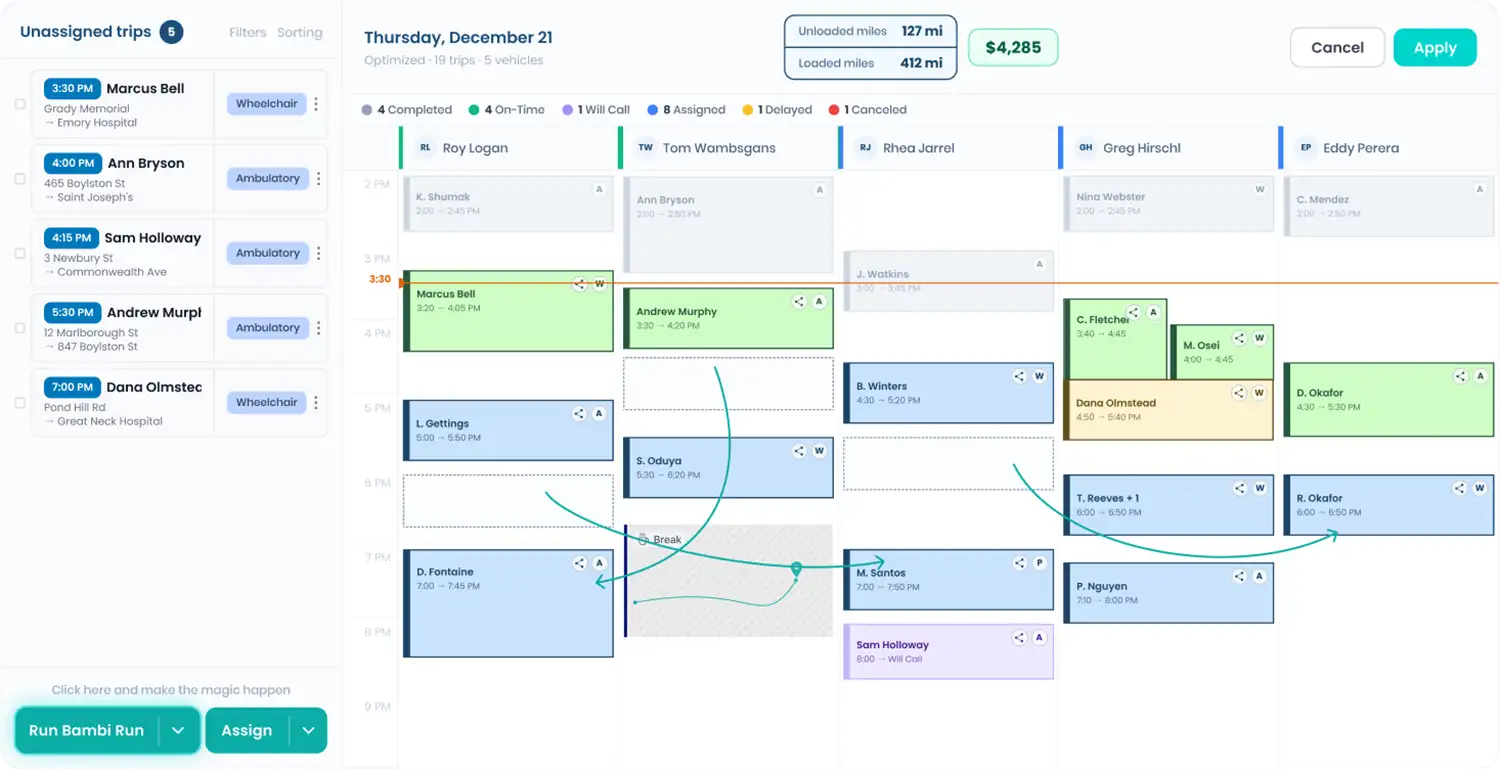
Run Bambi Run turns hours of scheduling into one button press. For an owner-operator who also dispatches and drives, that is the difference between starting the day behind and starting it ahead.
Get Paid helps you verify trips and produce broker-ready invoices, so fewer claims stall. Billing disputes shrink. Cash flow gets predictable enough to plan around.
Fleet HQ puts live GPS, ETAs, and performance dashboards in one view. Know the fleet is running right without being chained to the radio.
"Where have you been all my life?!"
.png)
.png)
You get your morning back, and you stop leaking revenue you already earned.
If you are the owner who also dispatches and also drives, the scheduling hours are the binding constraint on everything else. Run Bambi Run turns that into one press and an approval. That is the difference between starting the day behind and starting it ahead.
On the money side, Get Paid verifies trips, builds broker-ready invoices and tracks each one until it is paid. The revenue that disappears in NEMT is rarely one big loss. It is trips that were run and never cleanly billed, or billed and never followed up.
And the rate does not change as you grow. Every active vehicle is $69 a month, whether you run 2 or 200, so a new contract is a growth decision rather than a procurement conversation.
It is a fair worry and the answer is no, for a specific reason: the complexity in Bambi is in the optimization, not in the interface you touch.
A large fleet and a two-van operation press the same button. Run Bambi Run is doing more work on the large board, but the dispatcher's job is the same job. There is no enterprise configuration phase you have to survive before the software becomes useful.
The pricing works the same way. You pay only for active vehicles, meaning the most vehicles you had out on trips on any single day last month. Two active vans cost $138 a month, and every feature is switched on, including the ones you will not need until you have twenty.
The real question for a small operation is not whether the system is too big. It is whether the hours you currently spend scheduling are worth more than $69 per active vehicle.
Count the most vehicles you had out on trips on your busiest single day last month, then multiply by $69. Two active vans is $138 a month. Eight is $552. Twenty-five is $1,725.
That number includes every feature, every broker integration and support. Vans that sat unused all month cost nothing.
Get Paid verifies each trip, builds broker-ready invoices and tracks every invoice until it is paid, so nothing you ran slips through. When you close the month, export a QuickBooks-ready file for your books.
For most owners the win is not a new revenue stream. It is collecting all of the revenue you already earned.


Enrollment grows faster than the dispatch team. Here is what Bambi takes off their plate.
myPlace Health, a Los Angeles PACE program, cut transportation cost per member per month by 65% with Bambi, and cost per trip by about 68%, while the fleet grew to 26 vans with no dispatchers added.Program-reported. Not a guarantee of results for other programs.
Read their story →