

By Nick Hoffmeyer, Head of Marketing at Bambi · Updated September 28, 2026 · 7 min read
Reviewed by Howard F. Berkowitz, a non-emergency medical transportation and paratransit expert with 30+ years in the industry (H&S Consulting).
The five biggest barriers to starting a non-emergency medical transportation (NEMT) business are regulatory complexity, high startup costs, a competitive Medicaid contract market, manual operational overhead, and driver staffing. None of them are disqualifying, but each one trips up owners who underestimate it. Here's what each barrier actually looks like and the practical fix for it.
What Are the Biggest Barriers to Starting an NEMT Business?
- Regulatory complexity: What it looks like in practice: Federal, state, and local requirements overlap and vary by jurisdiction; Practical fix: Build a compliance calendar early; treat licensing timelines as part of your launch plan, not an afterthought
- High startup costs: What it looks like in practice: A new converted minivan can top $85,000 (BraunAbility's 2026 example lists $88,685 MSRP); used units cost less but vary widely; Practical fix: Consider leasing to reduce upfront cash need; budget separately for the vehicle and for 60-90 days of operating cushion
- Competitive market for contracts: What it looks like in practice: Many providers chase the same limited Medicaid broker volume; Practical fix: Target underserved routes or niches (dialysis, rural counties) instead of competing head-on in saturated metro areas
- Manual operational overhead: What it looks like in practice: Whiteboard scheduling and phone-tag dispatch don't scale past one or two vehicles; Practical fix: Set up scheduling software before you need it, not after your first missed pickup
- Driver staffing and retention: What it looks like in practice: Qualified drivers are hard to find and harder to keep in a demanding, lower-wage role; Practical fix: Build real onboarding and pay competitively; treat retention as a cost-saving investment, not overhead
1. Regulatory Complexity
Regulatory complexity is the barrier that surprises new owners most, because NEMT rules stack at three levels at once: federal (CMS and Medicaid guidelines), state (licensing, Medicaid transportation provider enrollment, vehicle standards), and local (city or county permits). None of it is impossible to navigate, but doing it in the wrong order, buying vehicles before confirming ADA specs, for example, wastes real money.
Fix: Build a compliance checklist and calendar before you spend on vehicles or staff. Our NEMT business startup checklist lays out the licensing and enrollment steps in the order that avoids rework.
2. High Startup Costs
Wheelchair-accessible vehicles are the single biggest upfront cost, and ADA-compliant features (lifts, securement systems, proper doorway heights) add real expense on top of the base vehicle price. Check current pricing before you budget, since vehicle markets shift.
Fix: Leasing reduces the upfront cash need substantially compared with buying outright, though it typically costs more over the vehicle's full life. Whichever you choose, budget separately for the vehicle and for a 60- to 90-day operating cushion, insurance and driver pay start on day one, while broker payments take weeks to ramp up.
- Upfront cost: Leasing: Lower; Purchasing: Higher
- Monthly cost: Leasing: Fixed lease payment; Purchasing: Loan payment (if financed) or none (if cash)
- Maintenance: Leasing: Often included or lower owner burden; Purchasing: Owner's full responsibility
- Customization: Leasing: Limited; Purchasing: Full control
- Long-term ownership: Leasing: None; return or renew at term end; Purchasing: Builds equity
3. A Competitive Market for Contracts
Many providers compete for the same limited pool of Medicaid broker volume and healthcare facility partnerships, especially in dense metro areas where established fleets already have relationships.
Fix: Target underserved areas or specialized service niches, rural routes with fewer providers, dialysis-heavy patient populations, or specific facility types, rather than competing head-on where the market is saturated. Building direct relationships with facilities matters as much as broker credentialing here.
4. Manual Operational Overhead
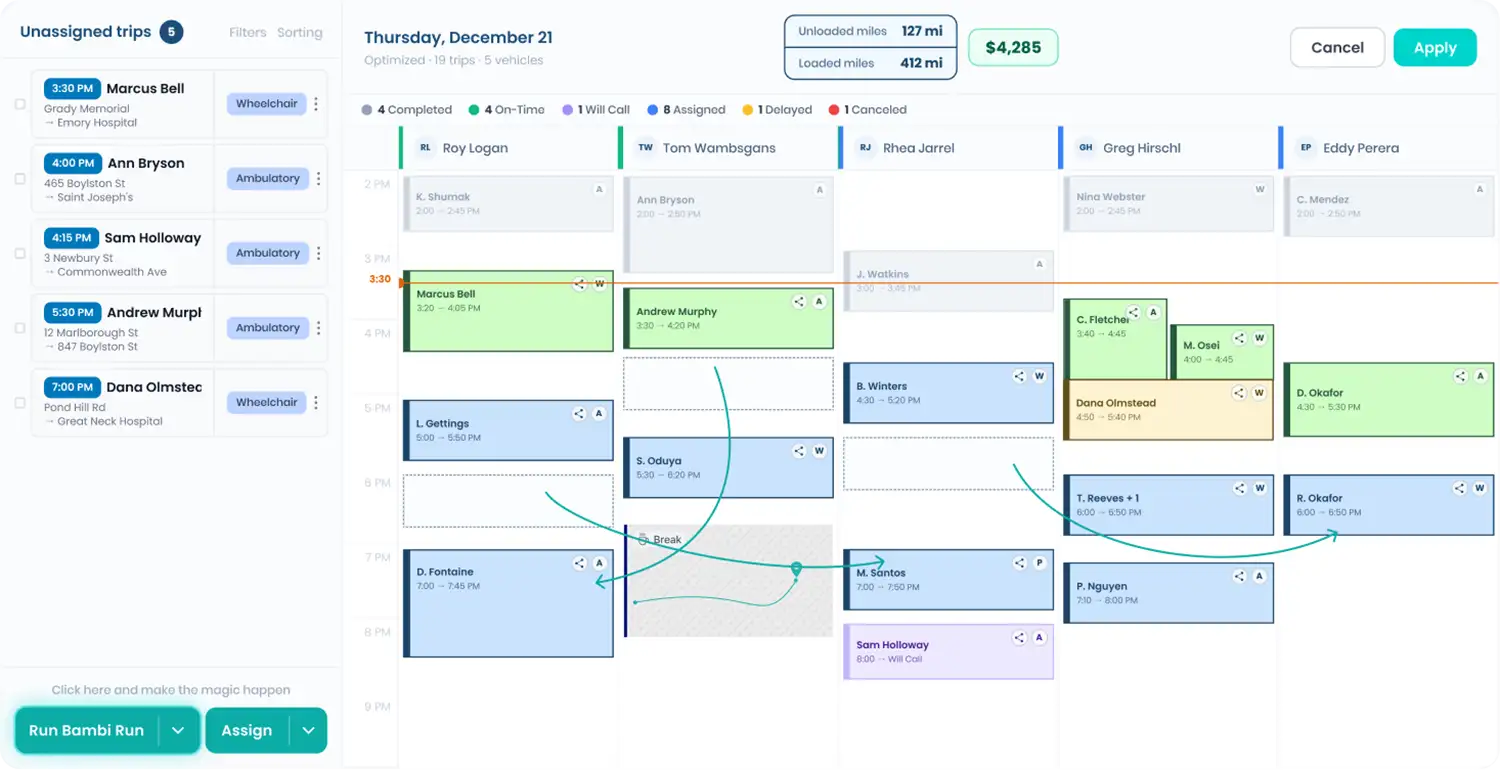
Manual scheduling, dispatching, and billing create inefficiencies and compliance risk that compound as trip volume grows. A missed pickup because of a whiteboard scheduling error costs you more than the trip, it costs broker trust.
Fix: Set up scheduling software before you need it, not after your first missed pickup. AI-powered scheduling takes most of the manual route-building off your plate, which matters most in your first months, when you're also handling licensing and hiring. See how Run Bambi Run handles this for fleets of any size.
5. Driver Staffing and Retention
Finding drivers who clear background checks, drug screening, and certification requirements is difficult on its own. Keeping them is harder, NEMT driving is demanding, schedules are irregular, and pay often competes with less physically and emotionally taxing driving jobs.
Fix: Competitive pay and real training investment reduce turnover more reliably than recruiting harder. Treat retention as a cost-saving move: replacing a driver costs more in recruiting, training, and lost productivity than most owners budget for upfront.
FAQ
Is it hard to start an NEMT business? It's more paperwork-heavy and capital-intensive than many small businesses, mainly because of vehicle costs and regulatory requirements, but none of the five barriers above are disqualifying with the right planning.
What's the biggest startup cost barrier for a new NEMT business? Wheelchair-accessible vehicles, which can cost $80,000 or more new at manufacturer list prices. Leasing is a common way to reduce the upfront cash need.
How competitive is the NEMT market for new providers? It varies heavily by region. Dense metro areas with established providers are more competitive; rural areas and specialized niches (dialysis, developmental disability transport) are often underserved.
Can NEMT scheduling software really solve operational overhead? Yes, for the manual-process piece of it specifically. Software won't fix a licensing delay or a driver shortage, but it removes the scheduling and dispatch bottleneck that manual processes create as trip volume grows.
Do I need a large fleet to overcome these barriers? No. Many successful NEMT operators start with a single vehicle and scale deliberately once utilization and cash flow support it. See our guide on when and how to scale an NEMT business.
About the Author
Nick Hoffmeyer is Head of Marketing at Bambi, the AI-powered dispatch and scheduling platform for non-emergency medical transportation (NEMT) providers. He works with NEMT owner-operators every day on growth, SEO, and the operational systems that help fleets run more trips with less stress. More from Nick: LinkedIn
One Barrier You Don't Have to Face
Manual scheduling shouldn't be one of your five barriers. Run Bambi Run automates dispatch from day one, at a flat $69 per vehicle per month with no contracts, so you can spend your energy on licensing, vehicles, and staffing instead.