How myPlace Health saves more than $1,200 per member, every month, with Bambi
A fast-growing Los Angeles PACE program brought rides in-house, outgrew spreadsheets and two software platforms, and now runs every trip on Bambi. Cost per trip fell from about $150 to $53. Trips grew. Staff and fleet did not.


Figures reported by myPlace Health. Results are specific to myPlace Health and are not a guarantee of results for other programs.
The front door to the whole care model
Wirter Mangrum has spent twenty years moving people. He started in airport transfers, where a late van means a missed flight. For nearly three years he has run transportation for myPlace Health, a PACE program in Los Angeles, where a late van means a participant misses dialysis, a specialist visit, or a day at the center with people who know their name.
That is what outsiders miss about PACE transportation. It is not a shuttle. Every PACE participant is 55 or older, lives in the community, and is sick enough to qualify for nursing home care. Many live with several chronic conditions at once: diabetes, dementia, COPD, heart failure. If the ride does not happen, the clinic visit does not happen, the meal does not happen, and the whole point of PACE, keeping older adults healthy and at home, starts to slip.
The stakes are financial too. myPlace Health is a prepaid plan that takes full financial risk for its participants, paid a fixed amount each month by Medicare and Medi-Cal. Every dollar spent on a ride is a dollar that does not go to care. Transportation is one of the largest lines a PACE program can actually control.
A program built to grow fast
myPlace Health was launched by two nonprofit health plans, SCAN Group and Commonwealth Care Alliance, and opened its first PACE center near downtown Los Angeles in February 2024. SCAN Group took full ownership in 2025. A second center, a 33,000-square-foot building in Compton serving South Los Angeles, followed later that year.
By June 2026 the program had passed 300 participants across the two centers, which myPlace describes as one of the fastest growth rates per center of any PACE organization in California. Every one of those participants gets door-to-door rides to the center and to authorized medical appointments across Los Angeles County, at no cost, in vans equipped for walkers and wheelchairs.
From two contracted drivers to a fleet of their own
myPlace Health launched transportation in February 2024 the way many new programs do: a contracted vendor and two dedicated drivers. It worked until enrollment grew. The program brought transportation in-house to control drivers, vehicles and the participant experience, and inherited a new problem.
Dispatchers coordinated the week largely by spreadsheet and phone. More participants meant more trips, more same-day changes, more vehicles to track and more calls to make it all line up. Wirter calls it the breaking point: rising enrollment made manual coordination unsustainable.
- City routes. Los Angeles traffic complicates every pickup and drop-off.
- Last-minute changes. Appointments move, and participants feel unwell. Same-day changes are the norm.
- Two centers, many destinations. Appointments are spread across provider offices all over the county.
- Blind spots. Little insight into vehicle use, miles driven or driver performance.
- Paperwork. Every request passed through phone calls and spreadsheets before it reached a driver.
Third time's a charm
Bambi was not myPlace Health's first transportation software. It was the third. The first lacked the functionality the team needed. The second was too complicated for a dispatch desk that has to move fast when three participants change appointments before 8 a.m. Wirter's verdict on the third: easy to use, and it performs on every front.
Bambi sits alongside two other tools in the program's stack: dash cameras and telematics on one side, vehicle maintenance on the other. Bambi runs the part that touches participants every day: scheduling, dispatch and routing.
"In 1969, we landed on the moon with computing power weaker than a modern smartphone. Today, with more resources than ever, we're still struggling to solve problems that have existed for decades." Wirter Mangrum, Director of Transportation, myPlace Health
What changed day to day
Run Bambi Run plans the day in one click
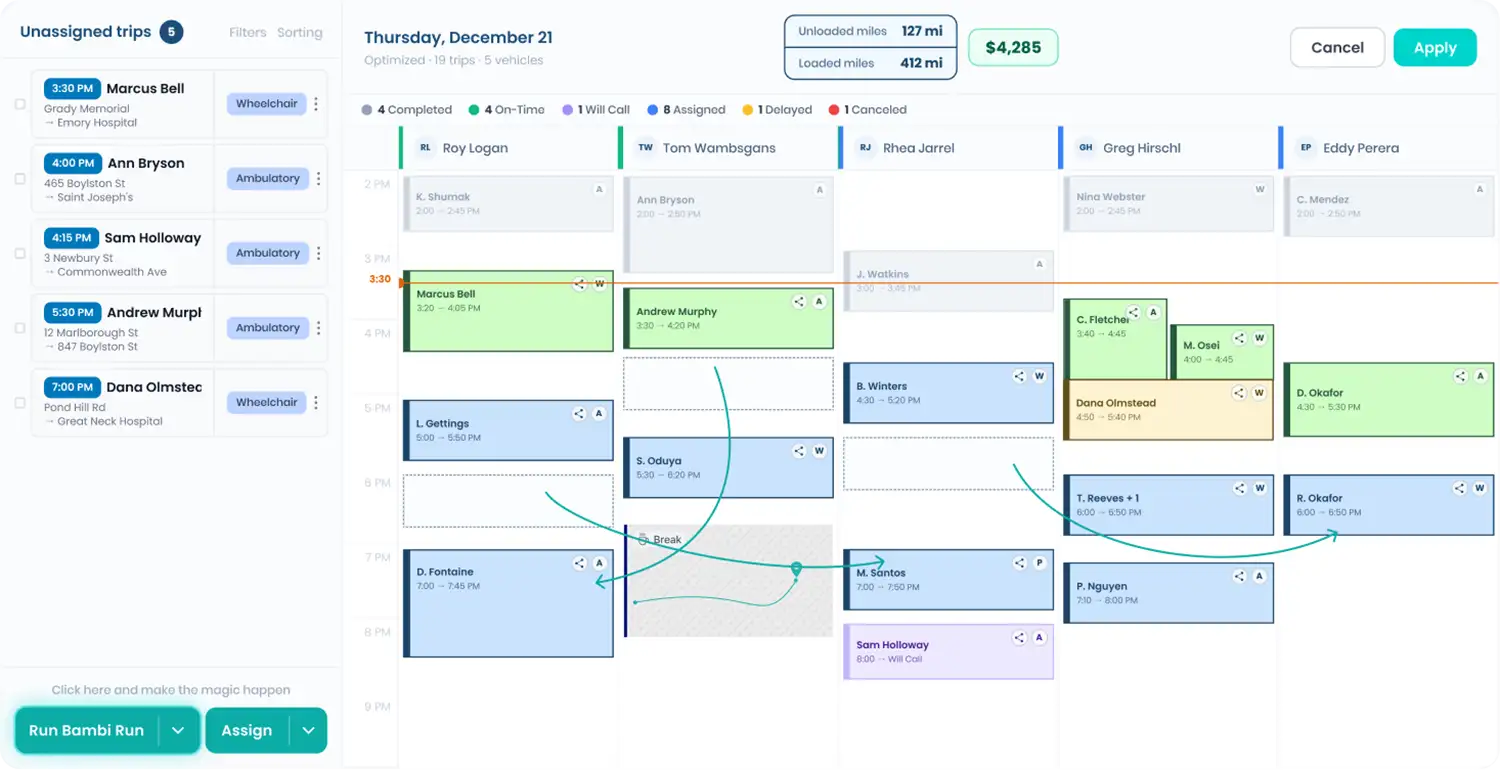
Instead of building routes by hand, dispatchers load the day's trips and hit Run Bambi Run. It builds routes across the whole fleet, cuts unnecessary miles, fills seats more efficiently, and re-plans in seconds when a participant's appointment changes. The result: more trips without more staff or more vans.
Departments request rides directly
Clinic and center staff used to send transportation requests through spreadsheets, and every handoff was a chance for a delay or a mistake. Now departments submit requests through Bambi's Facility Portal. Dispatch accepts, schedules and routes them right away. No re-keying, no lost requests.
Everyone can see the ride
With Fleet HQ, live trip status is no longer something only dispatch can see. Transport staff, departments, clinicians and caregivers can all see where the van is. Fewer "where is the van?" calls, and more confidence from the families who depend on it.
The results
Transportation cost fell from about $2,000 to under $800 per member per month, a saving of more than $1,200 per participant every month. Cost per trip dropped from about $150 to $53. Trip volume grew while the program added no staff and no vehicles.
The operational wins matter as much as the dollars. Optimized scheduling and real-time monitoring cut wait times. Leadership can now make fleet, staffing and growth decisions with data instead of instinct. And for participants that means more reliable pickups, shorter rides and better communication, which the program says translates directly into better access to care and community.
Why it matters for every PACE program
Every PACE program has to provide transportation, and every one is paid a fixed amount per participant. That makes the ride one of the few large costs a program can actually manage down without touching clinical care. myPlace Health's numbers show how big that lever is: at more than $1,200 per participant per month, savings on a 300-participant census add up to millions of dollars a year that can go back into care. That figure is our arithmetic from the program's reported numbers, and it depends on census and trip volume.
The road ahead
Wirter is presenting the program's story to fellow PACE leaders at the 2026 National PACE Association Annual Conference in Denver in a session titled "Smarter Rides, Better Outcomes: How One PACE Program Transformed Its Transportation Operations." His message is the one his numbers make: when transportation works better, the whole PACE model works better.
Run your PACE transportation on Bambi
In-house fleet, contracted providers, or both. Scheduling, dispatch, routing and live tracking in one system, at $69 per active vehicle per month with no annual contracts. See how it works on our PACE programs page, or book a demo built around your own routes.
.png)
What mattered most to us wasn't perfection, it was progress. Seeing consistent improvements and real support made us feel like we finally had a partner.
myPlace Health is a PACE (Program of All-Inclusive Care for the Elderly) organization serving older adults in Los Angeles. Its interdisciplinary teams of physicians, nurses, therapists, social workers, dietitians and drivers coordinate medical care, in-home support, meals, social activities and transportation so participants can keep living safely at home.
- Centers: Greater LA (near downtown) and South LA (Compton)
- Participants: 300+ as of June 2026
- Founded by: SCAN Group and Commonwealth Care Alliance. A SCAN Group organization since 2025.
- Model: Prepaid, full-risk PACE plan funded by Medicare and Medi-Cal
myPlace reports hospital admission rates 52% below and emergency department use 33% below national PACE benchmarks (internal analysis, February 2024 to December 2025, not independently validated).
Frequently asked questions
How did myPlace Health reduce its PACE transportation cost?
myPlace Health brought transportation in-house, then replaced spreadsheet and phone coordination with Bambi for scheduling, dispatch and routing. The program reports transportation cost fell from about $2,000 to under $800 per member per month, and cost per trip from about $150 to $53, while trip volume grew without added staff or vehicles.
What is Bambi?
Bambi is scheduling, dispatch, routing and billing software for organizations that move riders, including NEMT providers and PACE programs. It includes Run Bambi Run for one-click route optimization, Fleet HQ for live fleet visibility, a Facility Portal for ride requests, and a driver app. Pricing is $69 per active vehicle per month with no annual contracts.
Can a PACE program use Bambi with contracted transportation providers?
Yes. A program can run its own fleet in Bambi and work with contracted providers, so every participant ride is tracked in one place. See the PACE programs page for details.
What does PACE transportation typically cost per member per month?
It varies widely by geography, transportation model and participant needs. myPlace Health reported about $2,000 per member per month before its changes and under $800 after. The biggest drivers are trips per member, cost per trip and how efficiently vehicles and drivers are routed.
Is it hard to switch to Bambi from other transportation software?
myPlace Health had tried two other platforms before Bambi. One lacked functionality and one was too complicated. Bambi has no annual contracts and no onboarding fees, so switching carries little risk.