[0:00] Nirav Chheda: You got this nice beautiful elephant behind you, you got this smiley face, you got a good attitude. You just make it sound too easy. Give me the hard stuff. Let's start. How much time do you have? Welcome back to NEMT Experts. I've got one of my favorite customers with me. It's Aly Taylor, the owner of Make A Way Transport in Tennessee. Aly, how you doing?
[0:30] Aly Taylor: I'm doing well. Thank you so much for having me on.
[0:36] Nirav Chheda: Tell me how you got started with Make A Way Transport.
[0:36] Aly Taylor: My background is in public health and I was working for an organization that supported pregnant women that struggled with substance use and my particular role was to connect providers with our program and get these women involved into wraparound services and one thing including transportation. So that was a hot topic because everyone was excited about transportation being offered to the moms that they served, but what I was finding out really quickly was that our company would pay for the transportation, but there were no vendors in a lot of these rural areas that we served. I just started to kind of volunteer in my time to help some of the moms get to different appointments and before I knew it, people had my cell phone who I had no clue who they were and so I realized that this was a much bigger issue than I realized and so I decided to go ahead and start Make A Way Transport and jump right on in and we've been rocking and rolling ever since.
[1:38] Nirav Chheda: When was that?
[1:38] Aly Taylor: That was in 2019, a long time ago, so it's been a journey. We started up in the northeast area of Tennessee and just kind of trickle down over the years still in that area and down to Knox County and surrounding and then middle Tennessee as well. So yeah, it's been a fun ride. Literally. No pun intended.
[2:02] Nirav Chheda: What number of vehicles have you operated with at a time? I know your fleet fluctuates, right?
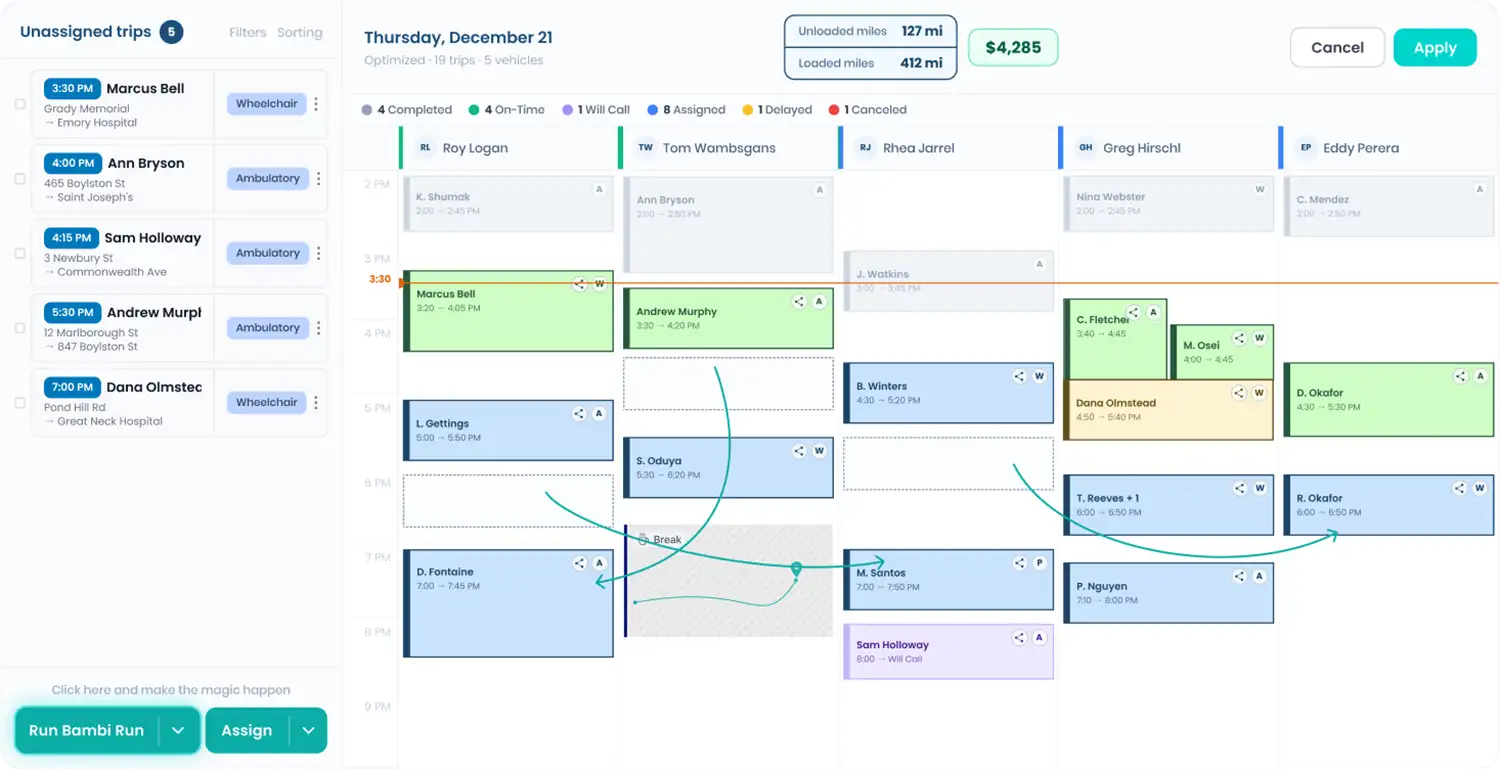
[2:12] Aly Taylor: Sure, sure. I would say the most that we've operated at a time has been about about 20 at a time and so when you are operating that many vehicles on the road, you definitely need something that's going to be able to route as efficiently as possible but also quickly, because that's a lot of cars moving all that one time. And with the old software, we'd be all day all night, you know, getting these routes together. So it was very challenging. So this definitely streamlined things for us.
[2:42] Nirav Chheda: Walk me through the landscape of the different organizations that you've worked with over the years.
[2:50] Aly Taylor: So you know, we started off really small, we're just really volunteering and then I decided to get in network with Medicaid and working with the brokers. And that was something that I don't think that I was prepared for. There's so many different rules and different hoops and different challenges that go along with that. Tennessee Carriers here in Tennessee, they are the primary broker for our Medicaid clients. They're the biggest here. We've worked with Verida, we've worked with MTM, we've worked with ModivCare. And as far as the private sector is just building relationships, connecting in, you know, your health councils that might be in your community and understanding what the needs are before just kind of jumping in and doing something. See what it is that they actually need and get connected and know the more that happens you get support and transportation is a need everywhere, but also expanding outside of Tennessee. So that's one of our goals for next year.
[3:54] Nirav Chheda: Ooh, very expanding too.
[3:57] Aly Taylor: Louisiana is one of the first places that we're looking to expand to and eventually one area that I'm looking forward to coming to is California because I am a California native. And so I'm excited to be able to transition to that space and do time.
[4:12] Nirav Chheda: How did you know it was time? Okay, we got to get more vehicles. It's time.
[4:18] Aly Taylor: Oh, that's a great question. And I think the answer is because I got tired of driving. So when I started again, I was new to the industry, so it was, you know, kind of a one-man band type thing and I'm planning routes, I'm driving, I'm doing all of the paperwork and all the things. And then suddenly I started getting more help to getting more drivers, but also getting more admin staff as well. And so we were seeing that, well, there's a lot of trips that we are turning away. And so therefore we need to get more drivers, you know, on board to help us out with this.
[4:49] Nirav Chheda: Who was it that you were turning trips away from? Who was sending you trips that you had to reject?
[4:54] Aly Taylor: From our brokers. Our brokers. They were sending over a lot of trips, you know, expecting us to do... more, and we just couldn't with, you know, with the being, you know, just me as the driver to start. And so then we started adding on more and we would get more trips into us that we'd have to send back. And so, you know, then we realized that OK, we have to really amp up our workforce.
[5:30] Nirav Chheda: So you get your next vehicle?
[5:32] Aly Taylor: Pretty much, pretty much. So the more vehicles that you have in your fleet in the program, the more, you know, you're signaling to the brokers to say, I can take on more trips. And so they'll send you what they have because, again, it's a need. We have a shortage of drivers everywhere. And so they see that, oh, you've got more vehicles. We're going to send you more trips.
[5:52] Nirav Chheda: The ride volume that you do now, day to day, is it more rides for brokers or more rides for other kind of organizations?
[6:02] Aly Taylor: More rides for brokers, but something that I want to make sure is clear for anybody who's getting into this space and want to work with brokers. I definitely say that being with the brokers, as well as having your private market is important because with the broker rides again, you do have to filter through those. So you might get a hundred trips sent to you for the day. But out of those hundred trip trips, there may be only 30 quality trips. So you don't want to just be solely reliant upon the broker trips. You want to definitely still have that space for private. Now, and then private, of course, you're going to be getting paid more per trip versus with the broker. You know, you get a percentage of that because that money, you know, also they may be, you know, a portion of that to run their operation as well. But it's pretty, what it is is that you're getting consistent trips that are kind of funneled over to you and then it's up to you to decide and choose what's the best trip for you to take.
[7:06] Nirav Chheda: For sure, even now, are you rejecting more than half the broker trips that are sent to you
[7:06] Aly Taylor: 30% of the trips that we do send back because it's just more than what we can handle. And so what we're looking to do is really focus on workforce development, you know, being able to acquire more quality drivers and being able to just promote, you know, who we are and what we do.
[7:30] Nirav Chheda: You started out even with one vehicle doing broker work and the brokers were sort of the ones that sort of made you expand your fleet right? When did you start getting more consistent private pay work and how?
[7:30] Aly Taylor: Great question. So we actually spend a long time operating in the shadows. No one knew that we existed. We were, you know, new to the industry, learning the broker space, getting again more work than we could handle. We were turning away a lot of things and then we started adding on more drivers, more team members and so on. And so when we felt that we had a good handle on what we were doing, we started just connecting in the community and telling people that we existed. So we would go to our community health meetings and the different counties that we served. And that word of mouth spreads like wildfire. And so before we knew it, we had tripled in revenue. Just because we started telling people what we did and people needed the help and that is what opened us up to the private space. So we've been able to contract with some healthcare systems, contract with some communities that receive some grant funding and wanted us to provide the transportation. And it just kind of blossomed from there.
[8:51] Nirav Chheda: I love it. You know, this is a very different approach to getting private pay rides than you typically hear out in the NEMT industry. A lot of people, they'll do Google ads to find private pay rides, right? They'll, you know, do different kinds of advertising. But you went to your community centers, you know, your community meetings and just physical in-person groups where community members meet to discuss the community. And that's pretty much how you've gotten all your private pay rides.
[9:20] Aly Taylor: Yes, yes. And word of mouth happens. And so people will just kind of call may not necessarily be connected to those groups and say, hey, I need a ride. And so, and we'll, you know, we'll transport them in different things. And so it really is just community partnership is what we have been able to allow us to break into the private space.
[9:41] Nirav Chheda: Aly, you make it sound so fluid and easy. I'm sure it's very difficult. Give me the hard stuff. Let's go.
[9:41] Aly Taylor: Sure.
[9:41] Nirav Chheda: Give me the lessons learned the hard way.
[9:41] Aly Taylor: Oh goodness. Oh goodness. I would say the hardest part is finding drivers. That's always, hands down, the hardest part.
[9:41] Nirav Chheda: I would imagine that. Most services companies say the same thing.
[10:00] Aly Taylor: I really think that since the pandemic, everybody has been in this space of, I want to do my own thing. I want the freedom and the flexibility to do my own thing. So when we first started, I felt like we were operating in this way, and our expectations was more conducive to how things were pre-pandemic. People were looking for jobs and needing to have something secure, and all about the nine to five. But when we shifted to this space of people working from home, people wanting to explore their own interests, make money doing the things that they love, they want the flexibility, we had to shift as well to letting people have a life like that. They started to realize, well, work is not the most important thing. We've got to make a living. Don't get me wrong. We also want to have time for our families and to vacation and to, again, explore our own interests. And so that definitely changed the volume of potential workers that will come, you know, our way. And so that's a really, really hard part. And I don't think that we have, you know, cracked the code yet to be able to have just this free-flowing, you know, workforce. But it's something that we're, again, working with our community to find out how can we make this opportunity more attractive, most attractive, so that we can have drivers that are willing, willing to show up, willing to work, and really seriously commit it to the mission of what we're looking to do. I would say that's probably the hardest part.
[11:43] Nirav Chheda: Any tips that you could share about things you tried that worked, didn't work? How have you been able to get good drivers?
[11:49] Aly Taylor: So definitely be kind to your drivers is a tip, you know, that I, you know, would share with anybody. And really get out there in the community to let people know that you exist. And that includes on the driver side. We, there's an event that goes on every year through the Urban League that is called Shoes for School. And so we went out there one day and we set up tables. A really great event drew a wonderful crowd. And got a lot of interest in drivers, you know, coming out and we were able to onboard some. So that was a great experience. But getting out there in the community, I will always suggest that to anyone.
[12:30] Nirav Chheda: What else? What else has been tough for you?
[12:33] Aly Taylor: What's been tough for me? I'm going to talk about the financial piece with the brokers, you know, because everyone is going to be different. But some brokers, they have, you know, most contracts they have about 30 days to pay. That's contractual. Most of them say 30 to 45 days. But sometimes, if you're a new business, that can be really tough to spend a lot of this money and not be getting it back in 30 days. So definitely before breaking into the industry, having your plan for that, and that was something that I wasn't prepared for. Some of the brokers would say, hey, yeah, you, you know, worked, you know, this, you worked this amount, made this amount of money for this period of time. You know, then the next two weeks, we're going to pay you that. But others say, well, you made this amount of money. And depending on what we feel like giving you, we're going to give you. So maybe you make $20,000 in the two week period, maybe. But you may only get $1,000 of that. And then you might get another $5,000 next week. And the rest, you know, at that 30 day mark. So, you know, being prepared, that you're going to have to be waiting to get paid. So, you know, having a line of credit or just being prepared for whatever that is. I think that that was a really hard lesson for me to learn in the beginning. And I had to quickly adjust to make sure that I was still able to, you know, make my payroll and pay my bills and pay myself, you know, all of those things. That was a hard lesson.
[14:03] Nirav Chheda: I am so glad you brought this up because this affects so many NEMT providers everywhere who works with a broker. You've got to know that you do a broker trip. You're not getting paid instantly. So there's always this little bit of time where you need working capital to keep the lights on and keep things running. And so I'm so glad you brought this up because very few people do. Did you work with banks to provide sort of working capital loans to cover those 30 to 45 day time periods on a regular basis every month?
[14:40] Aly Taylor: Yes, yes. And so in the beginning, you know, it was using my own funding, you know, that I had invested into the business. But then, you know, transitioning into getting a line of credit just to be able to, you know, hold standing into you were able to get, you know, paid whenever that is.
[14:57] Nirav Chheda: Aly, what role do you play in the company now? You have drivers, you have a dispatching team. What do you do on a day-to-day basis at this point?
[15:00] Aly Taylor: Yeah, leadership and a visionary leadership. And so I am the visionary that moves things forward and say, hey, these are the spaces that we need to go. Here are the goals that we need to set. And then being able to find the talent who's going to make that happen. Again, I came from being a one-man show. I was the marketing person. I was the dispatcher. The driver, the customer service, all of those things. But with time, we've been fortunate to be able to build a really strong team. And so I shepherd my team.
[15:35] Nirav Chheda: You're probably one of the people who gets into your community more so than any other kind of NEMT business owner. For the benefit of everyone out there watching, what kind of community events and organizations are you going to regularly to promote your NEMT business and get these private pay rides?
[15:57] Aly Taylor: Yeah. Well, connecting with the state, getting connected to those community health councils for different industries, whether, you know, we're talking about adults, whether we're talking about kids, the underserved, whatever. Get connected. I also, of course, within my background, worked in substance use and recovery. And so that's a great community to work with because the need is there. And they're looking for answers and need support. Any, you know, big events that tend to go on around health. So any health fairs connecting with our senior community, those are all great areas to be able to promote. The service is yes, but also be promoting to look for drivers. That's a really great way to start. Another group that I'm very proud that we were able to help is a women's drug treatment group. Transportation was a barrier, you know, it's out in the rural community. And the owner of the organization had said that, you know, we have to get these girls over to court and things like that, you know, as they're getting on their feet and they're, you know, having to get their life back in order. And the judges had asked, how do you get your girls here on time? And they're consistent. And when they have to show up, they show up. And they said, oh, we use Make A Way. And so that was, that just warmed my heart because I said, this is why we do this because we are not just, it's not about just getting people from point A to point B. It's about creating the access, and it's about getting people to the places that matter the most. And so that was really awesome, you know, to hear that we've been able to help these women get their lives on track for something that seems so simple as transportation, but so necessary.
[17:30] Nirav Chheda: So you know, it's not all just NEMT. It's not all just medical transport. Wherever there's a need for transport in your community, you've got your pulse on your whole community. So anyone needs transport. You can help out.
[18:00] Aly Taylor: Yes, absolutely. And I would say as far as what's next as well is that I really want to serve the youth. So I've shared this with you that I am a single mother. I'm a widow. So it's me and my boys. And the hardest time in my life transportation was the hardest thing for me is getting my boys all over the place. And I've got kids on two different spectrums. I've got a senior in high school, and I've got a middle schooler, and they both have their own busy lives. And so I thought, you know, there are so many other moms just like me, you know, whether they're a widow or not or just busy moms and needing that extra support. So we're having some conversations with different youth organizations that need transportation to get kids and underserved areas to after-school programs or summer related programs. And so that's something that I'm excited about looking forward to just helping and doing our part with whatever that looks like because it's necessary. And yes, we wherever people need us to take them is where we need to go. We just want to create overall access.
[19:13] Nirav Chheda: I love everything you stand for and that you do.
[19:15] Aly Taylor: So it's been quite the journey of, you know, going from a one man band to primarily doing your routes by hand and then discovering that, oh, there's a software to do that. And you know, eventually finding Bambi and feeling like things just start leveling out and definitely was a game changer for us.
[19:34] Nirav Chheda: You guys got on to Bambi. It's been maybe one and a half years now, right?
[19:39] Aly Taylor: Yes.
[19:40] Nirav Chheda: Yeah, I mean, before that, all that time, what were you doing?
[19:45] Aly Taylor: Yeah, great question. So we were using another software that, you know, at that time, I thought, oh, wow, like this software is really great. But when I found out about Bambi, I thought, oh. look at what Bambi can do so much more all in one place. And so what we had to do with that other software, I mean, you really had to build the routes in this very convoluted way and almost one at a time. And it wasn't, it wasn't what we needed for the landscape that we were covering and it has allowed us to serve more people in the different regions that we worked in. So it was just really great to have everything all in one place.
[20:30] Nirav Chheda: And at the end of these interviews, it's story time.
[20:30] Aly Taylor: I can do that. So I told the story multiple times because it is precious on my heart. But I remember one day, the day I happened to have been driving. And like I said, I don't drive much anymore, but at that time, the broker reached out to me and they had a habit of, you know, calling me when something fell through. So they know Aly is more likely to say yes, because I don't like to be told no. So I don't like to tell people, no, I always say, well, how can we? Sometimes I have to say no. But this particular time, I was driving, I think I was actually driving to go, you know, pick up one of my kids or something. And, you know, the, I was, I had built a great rapport with one of the directors with one of the brokers. And so he had called me, you know, on myself, it was just like, hey, I've got this trip of this guy, you know, the other transportation company. They had to back out, they can't, they brought them down to Knoxville from Johnson City, but they can't take them home. Can you do it? And I thought, no, that was my first thought. No, I'm off work. I'm tired. I need to go run errands. I'll get my kids, and I want to go home. And, you know, it was pressed on my heart to say, go pick him up. That's OK. So I went to go pick him up from a cancer treatment center. And he was sweet guy. And when I picked him up, I got to pick him up, you know, you can tell he was very jaundice, just, you know, yellow in the face. And, you know, he had just had his treatment. So got him in the car and, you know, we're driving this two hour drive. And, you know, we're talking, I'm trying to make him feel comfortable and, you know, I'm very tired, but I want to have a good experience. So, you know, I stopped and got gas and everything and let him use the restroom and all the stuff. and so we're talking he you know he says you know this might be the last time that you see me and I say oh really I said are you starting to get your treatments up in Johnson City and he said no I've only got a few days to live and in that moment I like just broke down you know he couldn't see me because of course he's in the back seat and I'm just crying crying crying crying and so so I wiped my face and I said okay and I said well I said we gonna make this the last few days that you have the best few days that you have so I stopped and I got him something to eat and then we laughed, we joked and he you know told me about his family about the little family that he had that was not even local so when he when we got to Johnson City you know he lived in you can tell he had nobody and he lived in a like an efficiency and so I you know walk them inside his house got him settled make sure he had you know what he needed and I prayed over him and then I left and I left and then you know not too long after he passed away so I'm glad that I I said yes when I was asked to do it even though I wanted to say no and that was a reminder that this is why we do the work that we do you know it's not just about the money it's about the service it's about the heart and that always is at the forefront of my mind but when I'm doing the work that I do.
[23:55] Nirav Chheda: God bless you
[23:55] Aly Taylor: thank you thank you it's been a blessing it's definitely been a blessing to help people and I want somebody to do the same for me so I'm grateful to do it. Run Bambi Run. So for anybody who is needing to get started with you they better hop on board because it's a great ride I have sung the praises of Bambi since I've started and I'm grateful for the team
[24:21] Nirav Chheda: well I'm looking forward to the many years of working with you
[24:21] Aly Taylor: right back at you