About this episode
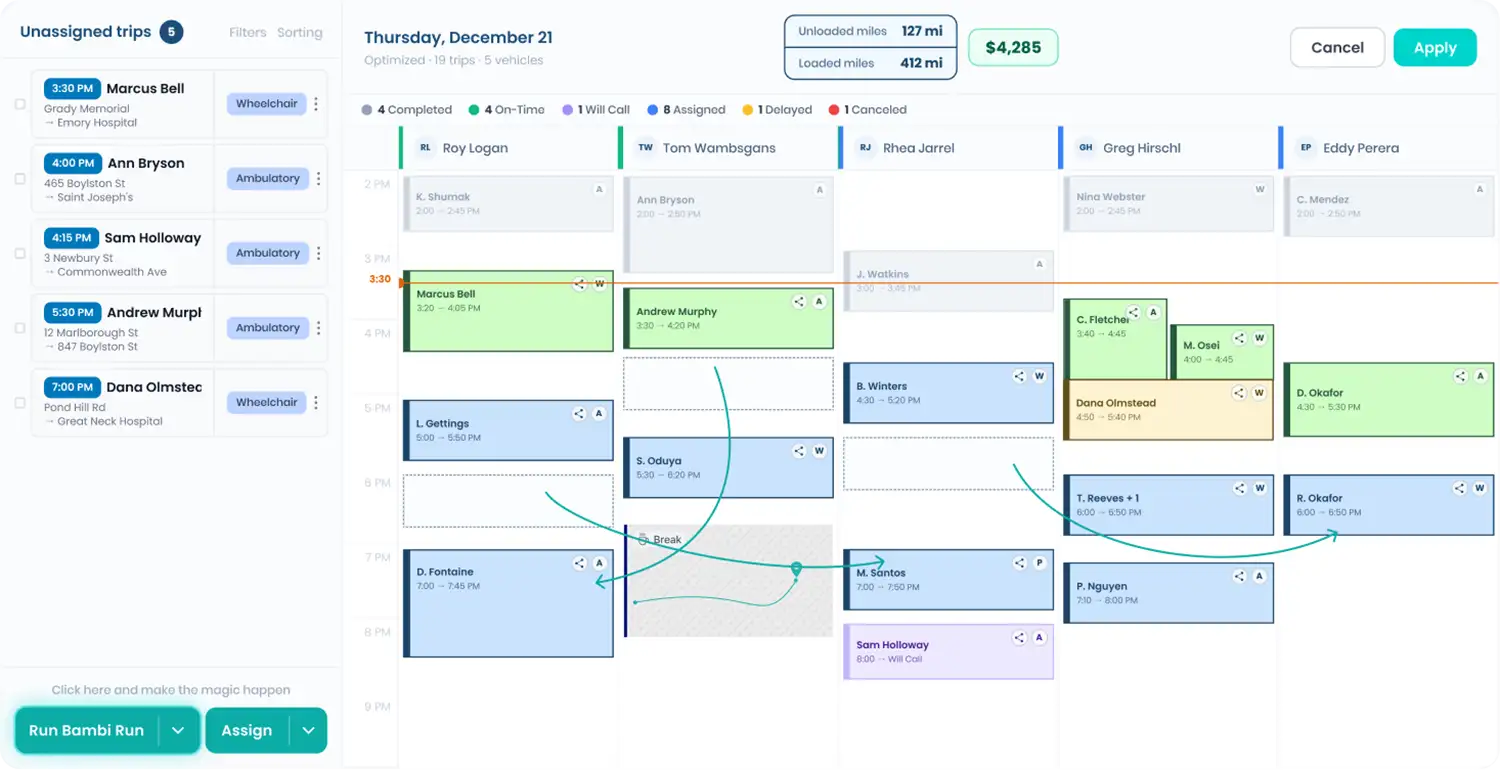
Jesse Shanker, owner of NorCal Transit in Northern California, went from moving 10 to 15 members a day to 50 to 60 across three years in business. The jump followed his move off manual dispatch, where he was hand-fitting a 10 a.m. request between an 8 a.m. pickup and an 11 a.m. discharge, onto software integrated with Partnership, the regional health plan that now sends most of his volume. Because Partnership sees each trip as he assigns a driver, it keeps raising his allocation, and he has grown from five vehicles toward a target of 10.
Key takeaways
- Daily volume moved from 10 to 15 members to roughly 50 to 60 after Shanker left manual scheduling for Bambi, adding drivers and vehicles as the trip counts climbed.
- Partnership, the Northern California health plan that referred him to Bambi, is his single biggest source of work and dwarfs the facility and hospital business he started with.
- The plan's integration shows Shanker's driver assignments in real time, so when it can see him clearing 50 trips a day it raises what it sends him.
- He chose his service lines by local demand rather than by rate, found wheelchair work was the heaviest need in his area, then bought equipment to match.
- On an early gurney trip the cot would not unlatch and he held a patient's full weight for about 20 minutes, having learned ramps and equipment from YouTube.
Chapters
- 0:00 Introduction
- 0:29 How and why Jesse started a NEMT business
- 3:52 Scaling with insurance clients
- 5:27 Identifying NEMT demands
- 6:35 Growing with Bambi
- 12:37 Numbers and future goals
- 13:41 Interesting NEMT stories
- 14:53 Lessons for budding NEMT entrepreneurs
- 16:04 RUN BAMBI RUN!!