[0:00] Nirav Chheda: You won't take any bullshit from anyone.
[0:02] Erin Wakefield: No, because it's my banana. Did I tell you the banana story?
[0:06] Nirav Chheda: The banana story you posted on Facebook. I love that. I took a screenshot of that. Welcome back to NEMT Experts. I've got Erin Wakefield, the owner of Yellow Cab Medical Transport in Oregon, and also one of the most badass NEMT business owners I know. Erin, how long you been doing this? 10 years?
[0:37] Erin Wakefield: I have, in January it'll be 14 years. And I was going to school at the time to be, uh, in marketing and data research, and, um, had no intention of taking over a business at all. But I was going to school and I was like, "I'll just take summer term off and get the taxi business fixed for my dad," and because it was still in his name technically, and now here I am all these years later. I got out of the tax- kinda closed the taxi company and just kept on doing medical transport. Um, and when I started the company there was 5 cars and 8 very angry drivers, and they were just grumpy because of all the turnover and all of the changes. And I came in and I was like, "This is gonna change. You're gonna have a policy book. You're gonna have cameras on you in the office. You're gonna have a start time of this time," and I came in with, like, this, like, mentality of, like, everything needs to change. And so they didn't like me at first. And I remember my dispatcher was like, "Listen, you just need to calm down. Spend 6 months here and just get to know us. And if you can do that, spend 6 months just getting to know us and getting to know this industry," 'cause I had no experience with it at all. So I kinda got to know what people needed for transportation. And I got into medical transport because I was talking to this one lady, and she was just like, "You know, if we can't get to healthcare, then there is no healthcare." And with the other company that was in town, there was only one other company in town, and, um, their rates were so high that they would only have, like, back at the time, they would only have, like, a limit of certain amount of rides that they would allow them to do per month. And so that meant that they could only go to dialysis 5 times a month, and they were doing that. So the, um, company that had the contract at the time reached out to us and asked us if we could do medical transport, and then we got a check like 2 weeks later and it was like $2,000. And I was like, "Whoa, that's our biggest check ever. That's so cool." There was only 5 cars at the very beginning, and today's count I have 44. So, um, and only 4 of those are ambulatory vehicles. Um, the rest are all wheelchair and stretcher vans. Um, I had like 60 cars at 1 point, and I loved that. I thought that was great, like, oh, bigger is better, but it's not true. Um, we had to kinda go back down. And I closed the taxi company and sold, like, 20 cars because I was just like, we don't You cannot make money on ambulatory rides. Um, but we have to do them. We have to have that availability because I always tell people, like, if you go to a Mexican food restaurant, they have a cheeseburger on every menu. And the reason they do is because nobody wants to go, like, not everybody likes Mexican food, and you might have a kid with you or a family member that doesn't want any of that, and so they have to have that there, and that's the same for our business. You're not gonna have contracts if they can't call you for everything. Not big contracts. You might have a facility here or there, but you're gonna have the bigger contracts if you can do it all. That means oxygen, that means stretcher, that means bariatric, that means extra, extra bariatric. That means in the middle of the night. It means 4:00 AM. It means that they can call you and send you 6-hour trip with no notice. Um, same-day availability. You've gotta be able to have all of that in order to, to accommodate all of your customers and contracts. Private pay is great, but you probably do have to have some broker work as well, in my opinion, having this many cars, because the checks from the brokers come in every other week, whereas the checks from private pay might take 30 to 90 days, sometimes even longer. Some of our state accounts are over a year old, um, past due. And yeah, I mean, you can bug 'em, but it's not gonna help you get paid faster. And I do bug 'em, but you just kinda gotta be patient. And it's really important to kinda have, uh, availability for all of the different levels of service and, and all that stuff. So we have a couple of vans that fit, um, wheelchairs that I call golf carts. They're pretty big. Um, golf cart size. And so those ones are, like, our really, really bigger vans and, um, that's our cheeseburger on the menu.
[4:58] Nirav Chheda: The, the thing I especially love about you, Erin, is that you won't take any bullshit from anyone.
[5:03] Erin Wakefield: No, because it's my banana. Did I tell you the banana story?
[5:08] Nirav Chheda: I was about to say the banana thing. The banana story you posted on Facebook. I love that. I took a screenshot of that, actually.
[5:14] Erin Wakefield: Yes. So if you go into a store, I always tell people, if you go into a store and you pick up a banana and you walk up to the cashier and you hand them 10 cents for it, they're gonna say, "Oh, no, no, no, you gotta weigh it, and then I tell you how much it is. Because you're my customer. You walked into my store. You picked up a banana on my shelf. You walked up to pay for it. Thank you, by the way. However, welcome to my store. It is now 35 cents for that banana. So here's, give me 35 cents." And if I say, "I'm sorry. I'm a brokerage. I'm a broker. We don't pay 35 cents per banana. We only pay 10 cents," and then I say back to them as a store owner, "But that's my banana. Please leave the store. Thank you for coming. Have a wonderful day. You can go over to Bob's over there. He has 10 cent bananas. Because he will be out of business in a few months, and that's his bananas, not mine. My bananas over here- Are 35 cents. So-
[6:11] Nirav Chheda: And this, this banana store ideology, I mean, you apply it to not only your private paying facilities, you also do this to the brokers, right?
[6:20] Erin Wakefield: I do, yeah. I- You have to. Because if you don't and you let them pay 10 cents for your bananas, they, y- and you cannot afford to do it at that. I mean, I'm not here making millions of dollars. I'm here because I've been here for 14 years and I wanna almost 14, and I would like to be here for another 20 years. Because this is an industry that people will always need. Even with cars that drive themselves, you're still going to need humans that take care of humans. And healthcare is always going to be something that we need. And, like, there's not computers coming to our houses to take care of people, not yet. I don't think that's something in my lifetime I'm gonna see. But even when you have cars that are driving each other and stuff like that, you're still going to need the human part of it, and I would like to be here for it. I want my business to stay in business. I want my drivers' paychecks when they go to, to cash them or their direct deposits not to bounce. I know what it costs to do this business. I have tons of data from my bank, from my checks, from my bills, from my invoices, from all of it, all of it, all over the place. I have data showing how much it costs to do this business. I don't need a fancy spreadsheet made by somebody on AI. I don't need any of that. I know what it costs because I have a bank account. And so I tell them, "I cannot operate at 10 cents for my banana. I literally have to have this much." And then there are times when my prices have to go up, because right now gas prices are crazy. In addition to gas prices being crazy, the cost of a tire went from $87 to $140 from February to June for no reason. The same tire. I got tires in January on CNS. They were $87 each. Now they're $147 in June. So I don't get to call, I don't get to call Firestone and say, "Hey, wait, wait, wait. I want that 87 tire price back, that $87 price back," right? No, they raised their rates. This is what it is. I don't I'm their customer. But yet, I am their customer, who is my customer? Unfortunately, that is literally how business goes. I have to pass that cost on to my customers because I have to make enough money so that my checks don't bounce when I post them. So that's just how it is, and if you cannot be firm with your price, what you need to be paid, it doesn't matter. If you can operate and sell 10 cent bananas and make money for it, then do it. But if you don't know how much it costs for you to be operating, then you shouldn't be doing it until you figure that out, because you will go upside down real quick, and you'll be calling your mom for money and mortgaging your home, and your wife's gonna leave you. So husband, whatever. It's, it's gonna get real bad real quick. Because you gotta know how much it costs to do this business. It just keeps going up and up. For example, we got new camera system this year. It was a surprise to us. We've always had cameras in our cars way back since, like, 2016. Um, but we used to just use Car Toys cameras with a flash drive. And this year, uh, well, last December we had a renewal and they said, "Hey, you need to have our cameras. Our insurance is requiring you to have our cameras." I love our camera system, but I was not excited about the fact that it was required and that our insurance was now making us not only pay for them, but, like, um, having access to all of that data every day. I was really nervous about it. I was like, "Oh my gosh, I'm gonna lose my whole fleet of drivers." Like, I have some people that really love the curb. Like, this is gonna be really bad. You know? Not only am I gonna have to pay for new tires, but now I'm gonna have to get rid of my driver. Um, with that being said, we have a super good score now. Our score is, like, at over 90. When we started, we couldn't get past 50. Um-
[10:17] Nirav Chheda: But you're talking about your driver safety scores.
[10:19] Erin Wakefield: Camera score. Safety scores.
[10:20] Nirav Chheda: Your Motive camera score. Yeah.
[10:21] Erin Wakefield: Yes. Our Motive cameras tell us our safety scores, and now it's at, like, a 92 or something. I just looked last week, and I was like, "That is amazing." I never thought we would get there. I was very overwhelmed with the cost, so it was like, "Surprise, you need to pay, like, an extra $17,000 on your policy at renewal time, and all of that comes out- out up front, and we're gonna need that " This is on December 12th. "We're gonna need that by the 14th, and, um, so we can have your policy active by Monday." And I was just like, "Oh, cool. Sure, I'll just check my bank account and see if Modivcare paid me enough for my bananas so I can pay that." And so, of course, we didn't have the money, and, um, we don't ever have, you know, $17,000 sitting around, especially at insurance renewal time. So it was a little overwhelming to go through all that and to have to figure out, like, what are you gonna have to do? Like, how do you Um, I have savings that I save up every year for our insurance renewal in December, but it just gets harder and harder and harder every year. It really does. Insurance went up 22%. That 17%, or $17,000, was additional money that I needed to come up with on top of the insurance renewal and the deposit that I needed. Uh, our workers' compensation, because we had to give raises last July, so our workers' compensation went up by about, um, about $2,000 a month, which was a lot. Um, during COVID, there was a few years where, like, unemployment rates were lower. They kind of, like, helped everybody out and made unemployment rates lower. That ended in 2025. Um, so those rates went up, but yet our prices with some of the brokers stayed the same, and they didn't wanna raise our rates, and that's been quite a battle. Um, so you just have to kind of stay firm and say, "Well, then we can't do the rides. Like, we'll just sit here and call me when you want, you know, when you need a ride." 'Cause they do. They will eventually call. We have 44 cars. They're gonna call. Um, and they do, and then they're like, "Well, how much for this ride?" And you just tell them the price for every single one. And it really gets annoying, because you might only have 10 rides for the following day, but you have 26 drivers on the road, but you put those 26 drivers on the road because you know that you're gonna fill them up all day. I mean, just today, for example, I think I only started with 73 rides for the day, and that's nothing for us. We usually do, like, around 200, 250. We only started with 73 today. But w- before I started this podcast at, like, 9:50, I saw that almost all of our drivers are completely booked up already for the day. Um, and that-
[13:04] Nirav Chheda: And where did those trips come from?
[13:07] Erin Wakefield: Um, private pay facilities and Modivcare calling in for rides, um, that they scheduled on other companies for 10 cents, but then couldn't figure, figured out they couldn't do them, so they called us after all. So that happens every day. I'd say 90% of our rides from them are like, "Hey, this is a recovery trip," because they can't do it. Because I'm sorry, but if you're operating rides at 10 cents for your banana, you're going to end up not being able to pay silly things like your paychecks and your tires and your car maintenance and all that kind of stuff, so-
[13:32] Nirav Chheda: But how is this-
[13:32] Erin Wakefield: Yeah
[13:46] Nirav Chheda: happening every day? Like, after a while, wouldn't they figure out, "Hey, I need to use this NEMT business, not the one that's cheaper, and I need to do that in advance rather than keep figuring out day of, every day"?
[14:00] Erin Wakefield: I think the real problem is accountability. I don't think that they truly, um, have that, like, mindset of like, do we really care about the headache that it is every day? Because we can just call them, you know? We can just We have to have our bo- our, our We have to have our bottom line at this, so we're gonna send as many as we can to all these other companies, and then the ones that get kicked back, we will then send over to them, to us, because no one else can do them, so we have no other choice but to send them to the higher price brokerage or, uh, provider. So then they send them to us. I don't really think that they It doesn't bother them that then I'm having to hustle to call in a driver to make sure he can come in 20 minutes early, or calling in, uh, calling people and saying, "Hey, we just got this trip. We will be there as soon as we can. It literally just came through our portal. It looks like your ride was 20 minutes ago. Do you still wanna go?" Like, that's so much of what we do, because giving them to us to the fact, or, like, almost already late, or giving us an hour to get somewhere that's an hour away. Those kinds of things. But that doesn't matter to a call center. It doesn't. You can't force anybody else to be who, what, to be who you want them to be, right? Like, I always tell people, "You are the professional. This is your job. You do the best that you do at what you do. So this is, this is your company." Like, my, my drivers go into facilities, and sometimes nurses are mean. I tell them, like, "Nurses are mad. They're grumpy. They're dealing with all kinds of different stuff, you know? We get really nice nurses, but we get some that are unhappy." And I tell my drivers, "You don't get to snap back at them. No. You have the easy job. You get to get out there and meet all these new people, and you get to drive around, and you have me as a boss. Like, you got this. You'll be okay. So you are the professional. You do not snap back. You don't flip them off. You don't talk back to them. You don't tell them how to do their job or argue with them, because that's the quickest way to get fired here." I almost never fire people. I let them leave, and then beg to come back. That's my strategy. So I treat 'em really good, and then, I mean, I can't even tell you how many people literally are always constantly trying to come back because they're like, "You treat people right." And I do, because I treat my employees like they matter because I want them to treat their customers like they matter. Because people are a product of their environment, so if you get into a situation to where you don't feel, like, heard or le- listened to or validated or ignored out there on the road, like, you're just, like, a paycheck, or you're just doing it for a paycheck, and then feeling like y- that's all that everybody's here for, that's how you're gonna treat your customers, you know? And then that's how it's gonna feel. And I don't know, it just is a ugly feeling when people are like that. You ever go to a grocery store and just have someone sitting there just ringing you up and not even saying hi? Like, that's It's not fun. I don't know. I went to Costco yesterday, and my daughter spilled a whole thing of soup all over the thing, and I kept apologizing to the lady, and she just kept rolling her eyes at me. And I was like, "I obviously feel really bad that my daughter spilled a whole thing of soup, but, like, she's 5. It happens, and it's gonna be okay, and I cleaned it up the best that I could, and you rolling your eyes at me is really making this an awkward situation," you know? So, but it is what it is. I don't control her. I don't get to talk back to her or snap back at her or any of that. You get fired if you treat people bad around here, You know, and I always tell people, I'm not here to make money. We provide jobs. We provide jobs about which, you know, that this is where you can come work if you don't If you're retired or if you are looking for a better job or if you're looking You know, you might not have a degree, um, but you're a great driver, or you used to drive truck and you don't wanna be on the, on the road anymore doing that kinda stuff. Or you care about people, or you're going to school to be a paramedic, um, or you're done being a paramedic, but you still wanna be in the, in that world. Or you care about people in the hospice, uh, realm, and you wanna be in that world. So that's this, that's what this job is for. We pay a living wage. I wouldn't say any of us make a lot of money. My paychecks are very, very, very similar to all of my employees. I don't like I don't even like it when people call me boss. I'm always like, "I'm your coworker. Like, it's okay," you know? Um, because I work just as hard if not maybe sometimes a lot harder than a lot of the drivers here, um, because a lot of the, the people that work here 'Cause I work all day, and then I go home, put my kids to bed, and then I work all night. And I'm very, very hands-on because I wanna know what everybody's going through, and I wanna know what's going on at all times. I don't think anybody You can't really pay people or find people that really, really care like you, as the owner, having the weight of the world on your back. Like, you know that, like, if you don't get these invoices out or you don't get this stuff done, that their paychecks are gonna bou- are gonna bounce, or they're not gonna be able to make enough money to pay their rent, and that's on your shoulders. And that's really scary, you know? As a business owner, that's really, really scary knowing that you have all these people's bills, you know, to, to think about, not just your own, but everybody else's. So it's a lot, but it's worth it. And, um, I think that, um, the other reason that people quit is, like, I'm sure every industry, I know every industry has it, but you have the people that like to call out a lot. And so you're like, "Oh, I'm gonna call in sick because it's a really beautiful day, and I don't wanna go to work." So we, um, I give 'em what I call paycheck appreciation days, so if they call in sick too much, then I just start giving 'em paycheck appreciation weeks where they don't get paid, so you get to appreciate your next paycheck or your last one or whatnot. So people will quit because they get sick of me not scheduling them, but if I can't rely on them, then I can't schedule them, you know? If I have a person who's calling in all the time, and I just know that, like, then I just won't schedule 'em anymore, just, you know? And so, or I'll give 'em, like, 3 days off. I'll say, "This is your paycheck appreciation week. It's 3 days off, and next week, next time you have a paycheck, you'll learn to appreciate it," you know? They work 4 10-hour days. You have 3 days off to do whatever you want. And, like, I'm really, really fair about days off. If you want time off, you wanna go to a concert and you just got the tickets yesterday, call me. Let's work it out. You know what I mean? But don't just call in sick, because I know you don't have food poisoning, you know? I was gonna say, I saw someone asking on the Facebook page one time about how to get facility contracts. I think if you have to ask for facility contracts, then you're not doing your job. Do a really good job and they're gonna see you, and then the person in the chair is gonna say, "Hey, I want that company again, because they treated me really nice, and they showed up on time and whatnot." And so that's what's important. That's how you get your contracts. Let them see you. Let your cars have more than a magnetic placard on the side of it, because you can take that magnet off and put it anywhere, and nobody pays attention to those. They're outdated. You don't need to wrap it. You don't need to spend $10,000, but make them all look the same, and put your logo on there. I don't care if it's a heart you sew off of a word. It doesn't matter. Find something and make it yours, and stick with that. And, um, let people recognize you over time, but your Make sure your drivers look nice, that they wear an ID badge, that they have a shirt that matches. It doesn't have to be a super nice shirt. You can get Walmart polos for $15. Have them embroidered for 8. Put your name out there. You let people recognize you, and then that's the p- that's how you get your contracts.
[21:50] Nirav Chheda: So, so what you're saying is just do a great job and let your customers speak for you, and that drives your sales.
[21:57] Erin Wakefield: Yeah. Yeah, you don't need to buy a bunch of-
[21:58] Nirav Chheda: Familiar strategy
[21:59] Erin Wakefield: ads.
[21:59] Nirav Chheda: Familiar strategy, Erin.
[22:01] Erin Wakefield: Yeah, yeah. Yes, exactly.
[22:03] Nirav Chheda: Wink.
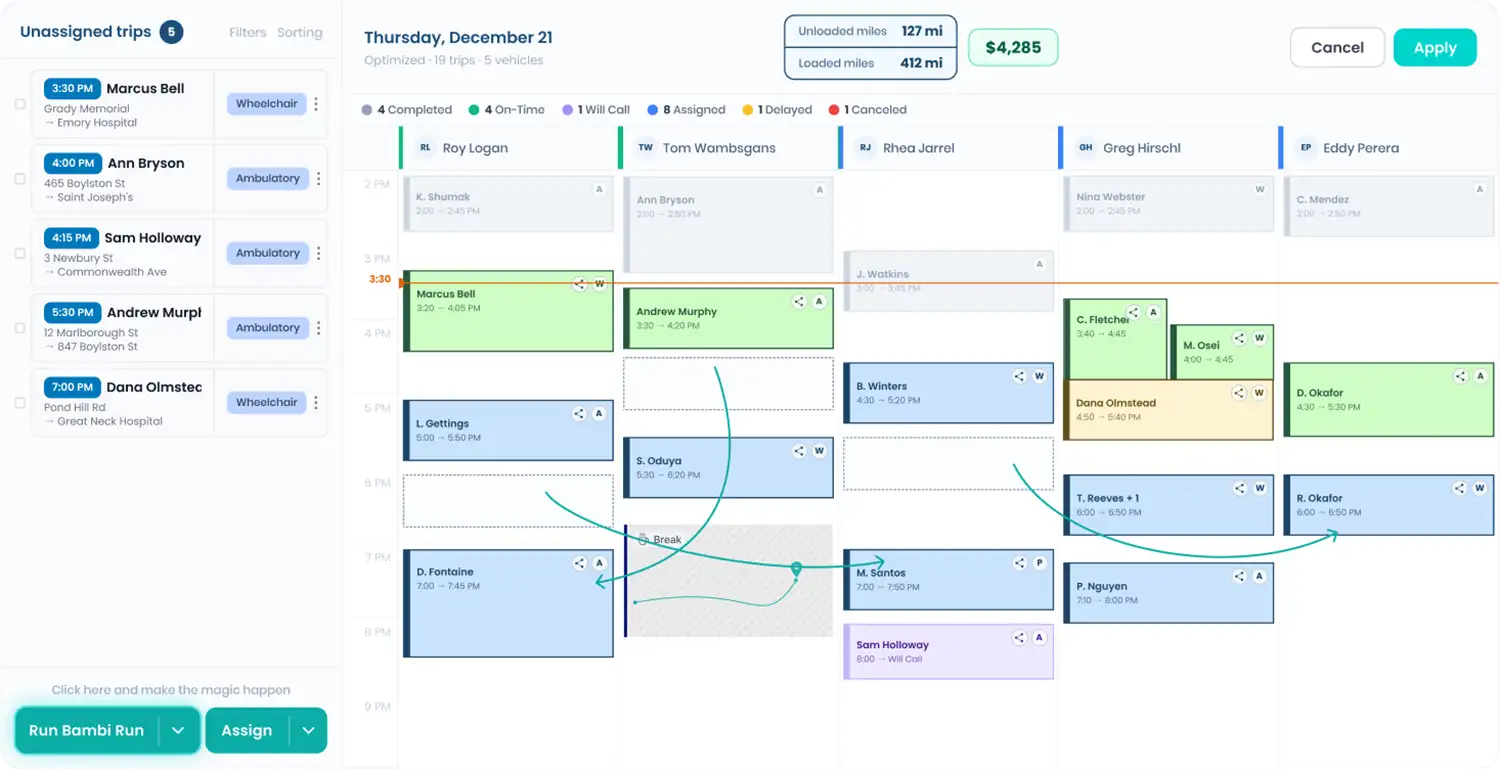
[22:04] Erin Wakefield: Wink, wink. Yes. That's so true, though. I mean, like here I am like trying to refer Bambi to other people, and we used a lot of different programs. Like, I'm talking at least We used one for a very long time, but we used one for many years, and we've probably tried out like over 10 different programs, like the bigger ones, you know? And, um, there's some that are really good, and then there's some that are just like kinda crazy, and you're just like, Bambi kind of simplifies it by making it easier and, and then, yeah, it just makes it streamlined, but not overcomplicated. It's really been nice to have. Run, Bambi, run.