

By Nick Hoffmeyer, Head of Marketing at Bambi · Updated September 28, 2026 · 7 min read
Reviewed by Howard F. Berkowitz, a non-emergency medical transportation and paratransit expert with 30+ years in the industry (H&S Consulting).
Essential NEMT equipment covers six categories: ADA-compliant vehicles with a lift or ramp, mobility and securement gear (wheelchairs, gurneys, tie-downs), safety and emergency supplies, communication and navigation tools, sanitation supplies, and driver/administrative essentials. Every non-emergency medical transportation (NEMT) provider needs some version of all six, the specific items just scale with your fleet size and rider mix.
Skip a category and it shows up later as a denied claim, a failed inspection, or a rider who can't safely get in the van. This checklist covers what belongs in each category, the specs that actually matter, and where one purchase decision (like a specialized transport chair) can change your whole cost structure.
NEMT Vehicles: The Equipment That Holds All the Other Equipment
A vehicle only counts as NEMT-ready once it's fitted for the riders you actually serve, not just licensed to drive. Most fleets run a mix of three vehicle types.
- Ambulatory sedans and minivans for riders who can walk to the vehicle and transfer into a standard seat unassisted.
- Wheelchair-accessible vans, shuttles, or buses with a ramp or powered lift, built to ADA specifications in 49 CFR Part 38: at least 56 inches of overhead clearance at the lift or ramp door on vehicles 22 feet long or shorter (68 inches on longer vehicles), and a lift platform with a clear width of at least 28.5 inches at the platform surface and 30 inches above it, a clear length of at least 48 inches, and a design load of at least 600 pounds.
- Stretcher vans for riders who must remain supine, with a securement rail system rated for the stretcher manufacturer's full load spec.
Mobility & Securement Equipment
Mobility equipment gets the rider into the vehicle. Securement equipment is what keeps them safe once they're in it, and it's the category regulators and insurers scrutinize hardest.
Mobility equipment: wheelchairs (manual and power), gurneys, walkers, canes, and stair chairs for buildings without ramp access.
Securement equipment: four-point wheelchair tie-down systems strong enough to meet 49 CFR 38.23 (in vehicles under 30,000 pounds GVWR, a forward force of up to 2,500 pounds per securement leg and at least 5,000 pounds per wheelchair), plus a separate lap and shoulder occupant restraint belt for the rider, distinct from the tie-down that holds the wheelchair frame itself. The two systems are not interchangeable and both are required. For the full breakdown of which certification (WC18, WC19, WC20) covers which part of that setup, see our wheelchair securement standards guide.
Specialized Equipment: When a Chair Replaces a Stretcher Trip
Some equipment decisions change more than comfort, they change your cost structure. The clearest example is a transport chair built to eliminate unnecessary stretcher runs.
The Broda Traversa chair is a tilt-and-recline transport chair designed for riders who'd otherwise need a stretcher, WC19 crash-tested for use as a vehicle seat. Broda's team made the operational case for it on NEMT Experts Podcast Episode 37, arguing that many stretcher trips involve riders who could travel seated in a chair like the Traversa instead, which removes the need for a second attendant on that trip. That's the pattern worth applying broadly: before defaulting to the highest-acuity equipment tier for a trip, check whether a crash-tested transport chair covers it at lower cost, within what the rider's condition and the payer's authorized level of service allow. Read the full Broda Traversa chair breakdown for the ROI discussion.
Safety & Emergency Equipment
Every vehicle needs equipment for the moment something goes wrong, not just the moment everything goes right.
- Fire extinguisher, charged and in date
- Emergency lighting and reflective triangles or flares
- First-aid kit stocked with sterile gauze, adhesive tape, bandages, antiseptic wipes, tweezers, non-latex gloves, and a thermometer
- If you transport riders who use supplemental oxygen, a way to secure their portable oxygen cylinder in the vehicle, following your state, payer, and broker rules on transporting oxygen
- Automated external defibrillator (AED), where required or elected as a fleet standard
Communication & Navigation Equipment
Dispatch can't manage what it can't see. Every vehicle needs a reliable way to reach the driver and a reliable way for the driver to reach dispatch, plus routing that accounts for wheelchair loading time, not just drive time. A two-way radio or dedicated mobile device covers the connection; GPS navigation and a dispatch platform cover the routing and real-time visibility. This is the layer most fleets under-invest in relative to the physical equipment, and it's usually the fastest fix.
Sanitation Supplies
NEMT riders are disproportionately elderly, immunocompromised, or recovering from a procedure, so sanitation isn't optional housekeeping. Stock EPA-registered disinfectant wipes or spray, hand sanitizer, disposable gloves and masks, and a trash receptacle with liner in every vehicle, and wipe down high-touch surfaces between every trip, not just at the end of a shift.
Administrative & Driver Equipment
- Driver uniform and visible ID badge
- Accessible copies of the driver's certification, vehicle insurance, and registration
- A driver essentials kit: gloves, masks, hand sanitizer, and a pen and trip log or tablet
- Clipboard or tablet for pre-trip and post-trip inspection records
The Complete NEMT Equipment Checklist
- Vehicle: Equipment: ADA-compliant lift or ramp, 56 in. min. door clearance on vehicles 22 ft or shorter; Why it's required: Legal accessibility requirement for wheelchair riders
- Mobility: Equipment: Wheelchairs, gurneys, walkers, stair chairs; Why it's required: Gets riders safely from door to seat
- Securement: Equipment: 4-point tie-down meeting 49 CFR 38.23 strength rules + separate lap and shoulder belt; Why it's required: Prevents wheelchair and rider movement in transit
- Specialized: Equipment: WC19-certified transport chair (e.g., Broda Traversa); Why it's required: Replaces unnecessary stretcher trips at lower cost
- Safety: Equipment: First-aid kit, fire extinguisher, AED where required, oxygen securement if needed; Why it's required: Emergency response before EMS arrives
- Communication: Equipment: Two-way radio or mobile device, GPS/dispatch software; Why it's required: Keeps dispatch and driver connected in real time
- Sanitation: Equipment: EPA-registered disinfectant, gloves, masks; Why it's required: Protects a rider population with elevated health risk
- Administrative: Equipment: Uniform, ID badge, insurance/certification copies; Why it's required: Compliance and audit readiness
Why This Equipment List Affects Your Bottom Line
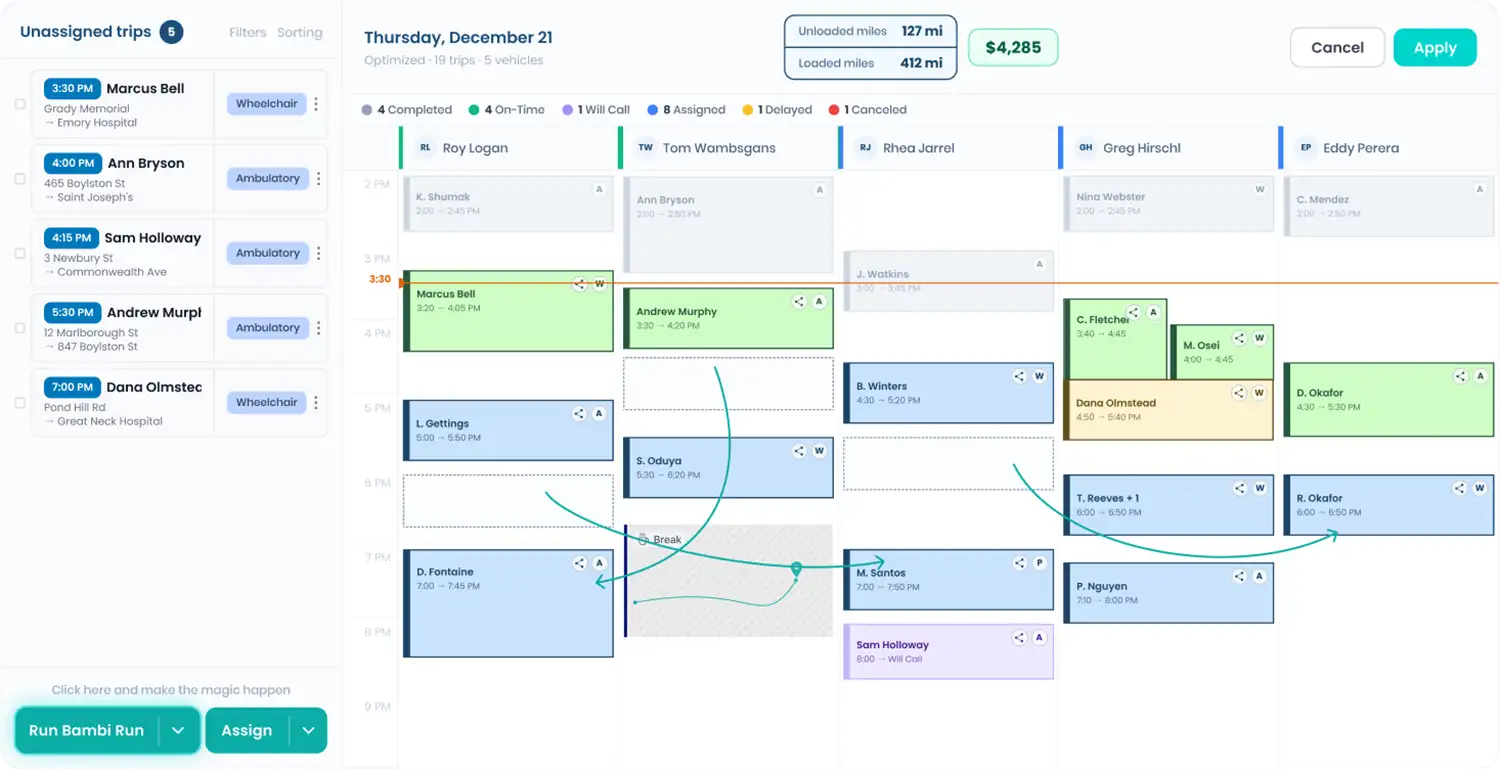
Every category above is also a cost lever. The right vehicle mix keeps you from running an expensive stretcher van on a trip a sedan could've handled. The right transport chair can turn a two-person stretcher trip into a one-driver seated trip. And once the equipment is right, the software layer decides whether you actually capture that efficiency. Run Bambi Run assigns and schedules trips with one click, so a dispatcher isn't building the day by hand. See it in a live demo, or check what it costs at $69 per active vehicle per month, flat, no contracts.
FAQ
What equipment is legally required for NEMT vehicles? For wheelchair-accessible vehicles, federal ADA rules (49 CFR Part 38) require a lift or ramp that meets set dimensions, a wheelchair securement system, and a lap belt and shoulder harness for each securement position. Items like first-aid kits and fire extinguishers are usually required by state licensing, Medicaid, or broker rules, which vary, so check the rules that apply to you.
What's the difference between a ramp and a lift? A ramp is a fixed or fold-out incline a wheelchair rolls up; a lift is a powered platform that raises the rider to the vehicle floor. Ramps suit lowered-floor minivans with a low step-in height; lifts handle the taller floor heights common on full-size vans and shuttle-style vehicles.
Do NEMT vehicles need oxygen equipment? Oxygen isn't standard vehicle equipment. Riders who use supplemental oxygen generally travel with their own portable supply, so what you need is a safe way to secure it in the vehicle and drivers trained to handle it. Rules on transporting oxygen, and on what drivers may do with it, vary by state, payer, and broker, so check yours before writing oxygen into your vehicle spec.
What is the Broda Traversa chair and do I need one? It's a WC19-compliant tilt-recline transport chair built to move riders who'd otherwise need a stretcher. It's worth evaluating if a meaningful share of your stretcher trips involve riders who could travel seated instead, since it can cut the need for a second attendant. See the full Broda Traversa chair writeup for the operational detail.
How much force must a wheelchair securement system hold? Under 49 CFR 38.23, securement systems in vehicles under 30,000 pounds GVWR must restrain a forward force of up to 2,500 pounds per securement leg and at least 5,000 pounds per wheelchair (2,000 and 4,000 pounds in heavier vehicles). Systems tested to the voluntary WC18 standard are also crash-tested with a 187-pound surrogate wheelchair, so check the manufacturer's guidance for heavier power chairs.
What communication equipment does an NEMT fleet actually need? A reliable way to reach every driver (radio or mobile device), GPS navigation, and dispatch software that shows real-time vehicle location and trip status. The equipment matters less than whether dispatch can see and reach every vehicle instantly.
About the author: Nick Hoffmeyer is Head of Marketing at Bambi, the dispatch and scheduling platform for non-emergency medical transportation (NEMT) providers. He leads Bambi's growth, SEO, and content strategy and works with NEMT owner-operators every day on the systems that help fleets run more trips with less stress. Connect with Nick on LinkedIn.