

This is the British Columbia chapter of Bambi's guide to starting a non-emergency medical transportation business, and it opens with the same warning every Canadian chapter does. There is no Medicaid here, and there is no transportation broker.
BC Emergency Health Services states plainly that ambulance is not an insured benefit under the BC Medical Services Plan or the Canada Health Act. Provincial health insurance does not cover it. Getting a patient to a medical appointment in a wheelchair van or a stretcher van is not an insured service, and no province has ever tendered a transportation brokerage contract. Modivcare, MTM and Verida have no Canadian operations. BC is unusual in two ways: health authorities already fund contracted transport providers, and there is an unresolved legal tension over who may carry patients at all.
So the question is not "how do I credential with the broker." It is "who actually pays, and how do I get in front of them." That is what this guide covers.
Part 1: Who Actually Pays
Part 2: Licensing and Regulation
Part 3: Registering the Business
Part 4: Vehicles, Drivers and Insurance
Part 5: Who Buys, and the Market
Part 6: Technology
This is the British Columbia chapter of Bambi's complete guide to starting a NEMT business. For the national picture, start with our guides to the NIHB Medical Transportation Benefit and winning health authority transport contracts.
In This Guide
- Part 1: Who Actually Pays
- Part 2: Licensing and Regulation
- Part 3: Registering the Business
- Part 4: Vehicles, Drivers and Insurance
- Part 5: Who Buys, and the Market
- Part 6: Technology
Part 1: Who Actually Pays
- Health Connections is the channel that already pays operators. Island Health distributes its funding to eight contracted transportation providers, and Northern Health retains a bus contractor. This is a working, funded programme with named vendors, which makes it the most concrete door in the province.
- PHSA contract 10894, Patient Transfer Services, runs February 2024 to January 2032 with options, and is non-exclusive. Non-exclusive matters: it means the contract does not lock everyone else out.
- Island Health BC2024-1638 was a request for supplier qualifications creating a qualified call-out list rather than a single award. Getting on a call-out list is a lower bar than winning a contract.
- BC Employment and Assistance issues a Purchase Authorization directly to the taxi company, so money reaches the operator rather than reimbursing the client.
- WorkSafeBC is the single clearest workers' compensation door in Canada. Its own guidance: to provide taxi services to injured workers you need a payee number, and you get one by contacting Procurement Services. That is a published, self-serve path, which is rare.
- ICBC is closed. BC's public auto insurer covers transportation under the Insurance (Vehicle) Act and pre-approves taxi through a Recovery Specialist, but its direct-billing system's eligible-discipline list contains no transportation category. Do not plan on billing ICBC directly.
- NIHB works differently here. BC's benefits transferred to the First Nations Health Authority in 2013, so BC does not appear in ISC's regional spending tables. Travel is arranged by Community Patient Travel Clerks employed by individual First Nations, or by FNHB Medical Transportation Operations for communities without one.
Part 2: Licensing and Regulation
You are licensed as a commercial passenger vehicle, not as a health service.
Authority comes from the Passenger Transportation Board as a commercial passenger-directed vehicle. Two 2026 PTB decisions have licensed stretcher and wheelchair operators, so the path exists and is being used.
But flag the unresolved tension honestly. The Emergency Health Services Act grants BCEHS a monopoly on certain patient transport. How that squares with PTB licensing of stretcher operators has not been adjudicated. We could not find a case resolving it. If you intend to run stretcher service in BC, get legal advice specific to your operation before you buy vehicles.
Part 3: Registering the Business
- Incorporation: $350 plus $30 for the name approval.
- Sole proprietorship: $40 plus $30 name approval.
- Employer Health Tax: exemption on the first $1,000,000 of BC payroll, same as Ontario.
- WorkSafeBC: register before you start. Their guidance recommends 30 days ahead.
- GST applies and BC has a separate PST. Check whether your specific services are taxable before you assume.
Part 4: Vehicles, Drivers and Insurance
- Driver licence: Class 4 Restricted for a wheelchair-accessible van carrying ten or fewer. This is a real difference from Ontario, where the same vehicle needs no commercial class. Budget the licensing time for every driver you hire.
- Criminal record check and vulnerable sector check are mandatory and annual. BC is stricter than most provinces here.
- Inspections: every six months under the Motor Vehicle Act Regulations.
- BC is the only province that mandates CSA D409, the national standard for vehicles transporting persons with disabilities, through Division 44 of the Motor Vehicle Act Regulations. If you are buying converted vehicles, confirm D409 compliance in writing before purchase.
- Insurance: ICBC is the sole provider of basic coverage, which carries $1,000,000 third-party liability. There is no separately stated statutory minimum for this vehicle class, so treat $1M as the practical floor and buy excess above it.
Part 5: Who Buys, and the Market
How to get in. BC is procurement-led and the instruments are unusually accessible. Register on BC Bid, watch PHSA and the regional health authorities, and target the qualified-supplier lists rather than the flagship contracts. Island Health's eight funded providers and the non-exclusive PHSA contract both suggest a market that adds vendors rather than consolidating to one.
A real operator to benchmark against: SN Transport, trading as Hospital Transfers, has served BC health authorities since 2003 with more than 250 employees, at a $50 subsidized fee per health-authority-arranged trip.
Market size. About 2,652 in-centre haemodialysis patients and a 65-plus share of 20.5%. Geography is the operational challenge: a province this large with dispersed communities makes northern and island routes structurally different businesses from Lower Mainland work.
Run the numbers: the free NEMT startup cost calculator adds up the cash you need to open: vehicles, licenses, the insurance down payment, driver onboarding and months of operating runway.
Part 6: Technology
Get started with Bambi
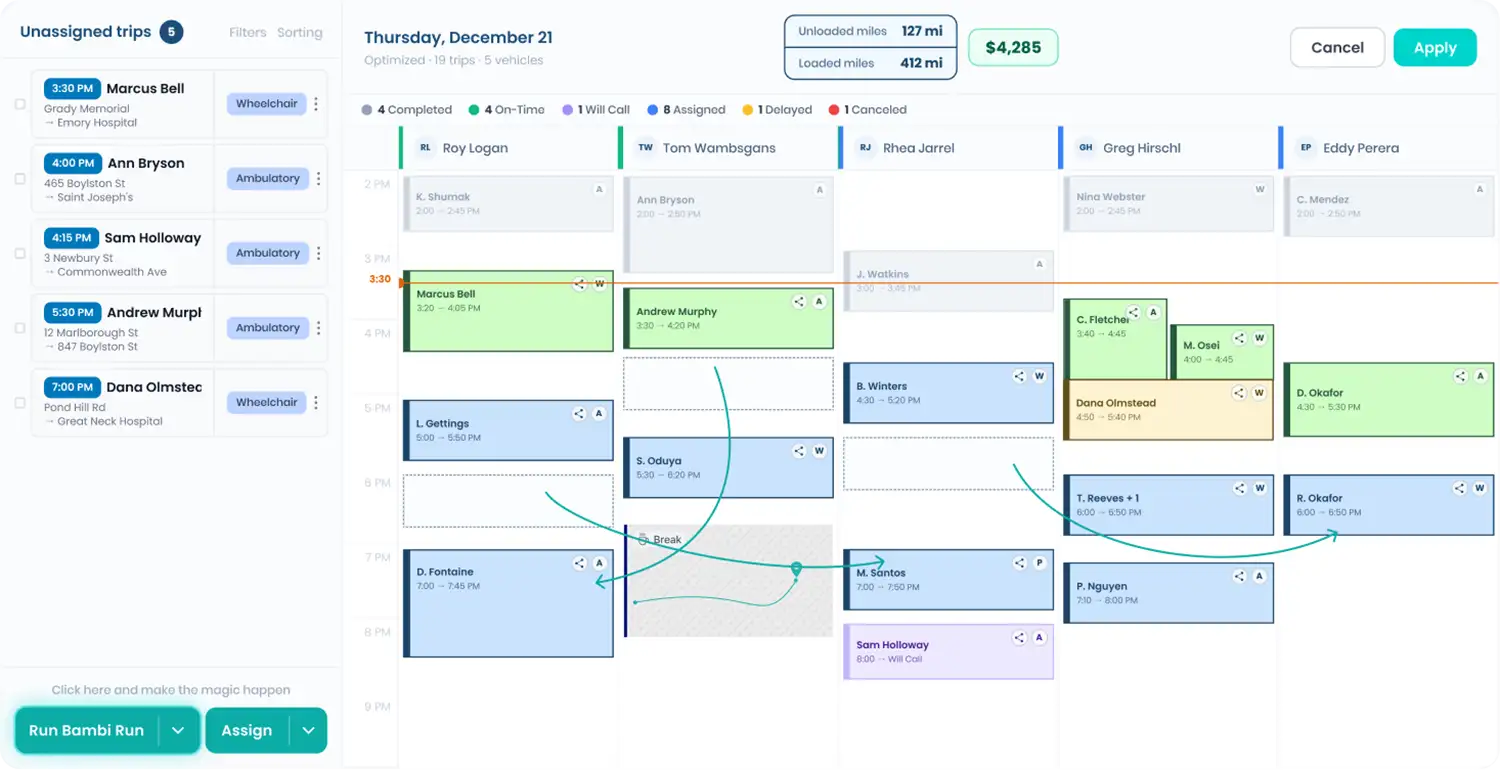
Our aiNEMT software handles scheduling, dispatching, care coordination and real-time tracking. In a market with no broker feeding you trips, the admin all lands on you, which is exactly where software earns its keep. Get in touch for a demo.