This is the New Brunswick chapter of Bambi's guide to starting a non-emergency medical transportation business, and it opens with the same warning every Canadian chapter does. There is no Medicaid here, and there is no transportation broker.
New Brunswick Medicare states that ambulance services are not an insured service. Provincial health insurance does not cover it. Getting a patient to a medical appointment in a wheelchair van or a stretcher van is not an insured service, and no province has ever tendered a transportation brokerage contract. Modivcare, MTM and Verida have no Canadian operations. New Brunswick also has no medical travel programme of any kind, which leaves a genuinely unserved population in one of the oldest provinces in the country.
So the question is not "how do I credential with the broker." It is "who actually pays, and how do I get in front of them." That is what this guide covers.
Part 1: Who Actually Pays
Part 2: Licensing and Regulation
Part 3: Registering the Business
Part 4: Vehicles, Drivers and Insurance
Part 5: Who Buys, and the Market
Part 6: Technology
This is the New Brunswick chapter of Bambi's complete guide to starting a NEMT business. For the national picture, start with our guides to the NIHB Medical Transportation Benefit and winning health authority transport contracts.
In This Guide
- Part 1: Who Actually Pays
- Part 2: Licensing and Regulation
- Part 3: Registering the Business
- Part 4: Vehicles, Drivers and Insurance
- Part 5: Who Buys, and the Market
- Part 6: Technology
Part 1: Who Actually Pays
- There is no provincial medical travel programme. None. New Brunswick and Alberta are the only two provinces with nothing at all. For a rural patient travelling to Saint John or Moncton for care, there is no grant, no warrant and no reimbursement.
- Social Development pays mileage at $0.58/km, but it is reimbursement-shaped, meaning the money reaches the client rather than the operator. Plan accordingly.
- The ambulance fee structure is unusually simple and tells you a lot. $130.60 for a resident with no per-kilometre component at all, $650 for a non-resident, and $0 for inter-facility and air ambulance. Fees are waived for Guaranteed Income Supplement recipients, Social Development clients, Extra-Mural patients and transport for medical assistance in dying.
- One provision worth knowing well: for Extra-Mural programme clients, home counts as a facility, so home to hospital and back is billed at $0. That removes a slice of demand you might otherwise have counted on, and it tells you which patient populations are already covered.
- NIHB Atlantic is $18.3M across the four provinces, mostly via contribution agreements.
Part 2: Licensing and Regulation
New Brunswick licenses you, and the requirement is clear.
You need an operator's licence from the Director of Ambulance Services under the Ambulance Services Act. The Act's definition captures stretcher vans, so this is not optional if you carry stretcher patients.
That puts New Brunswick in the minority of provinces with an actual, identifiable licensing authority for this work. It is a lower bar than Manitoba's public need test, but it is a real process with a real regulator, which is useful when a hospital asks what authorises you to operate.
Part 3: Registering the Business
- Incorporation: $262 e-filed, $312 paper, $362 expedited, including a mandatory $12 Royal Gazette fee. Expedited is two business days, normal is ten working days.
- Annual return: $60 e-filed, due within 30 days after the anniversary date.
- Business name: $112 to register, $62 to renew. Two deadlines matter: you must register within two months of commencing business, and renew every five years. Failure bars you from enforcing contracts by action and is an offence in itself.
- NUANS is mandatory for a named corporation, from a private search firm, within 90 days.
- HST is 15%, CRA-administered, with no separate provincial sales tax registration.
- WorkSafeNB has a three-worker threshold. You are excluded unless you have at least three workers usually employed at the same time. But note the separate 15-day duty to notify after commencing business. Non-compliance draws a penalty, and an accident before registration can be charged to you at full cost.
- Watch the rate classification, because the spread is six-fold. Ambulance except air sits in Rate Group 1 at $0.27 per $100. Other transit and ground passenger transportation sits in Rate Group 35 at $1.60, as do taxi, limousine and all bus codes. Which code WorkSafeNB assigns you is not something we could verify in advance, so ask them directly and get it in writing. The 2026 average rate is $1.10 with maximum assessable earnings of $85,800.
- Unregistered subcontractors become your assessable payroll. Verify every subcontractor's registration.
Part 4: Vehicles, Drivers and Insurance
- "For compensation" triggers Class 4 regardless of seat count. That is the New Brunswick rule, and it is stricter than Manitoba or Ontario. Even a small wheelchair van carrying passengers for money needs a Class 4 driver.
- Budget the licensing runway for every driver you hire, because you cannot use a Class 5 workaround here.
- Insurance: confirm current for-hire minimums with the Director of Ambulance Services and your broker.
Part 5: Who Buys, and the Market
How to get in. New Brunswick has two regional health authorities, Horizon and Vitalité, and Vitalité operates in French, which is a real service requirement rather than a nicety. Bilingual capability is close to mandatory for the northern and eastern parts of the province.
The absence of any provincial travel programme means private pay and facility contracts carry more of the load here than almost anywhere. That is harder to build but it is also uncontested by a public programme.
Market size. Population about 866,000 with a 65-plus share of 23.3%, the second oldest in Canada, and 49.1% rural. An old, rural population with no travel programme and no insured benefit is a real unmet need. The question is whether those patients can pay, which is why the facility and institutional channels matter more here than the consumer one.
Part 6: Technology
Get started with Bambi
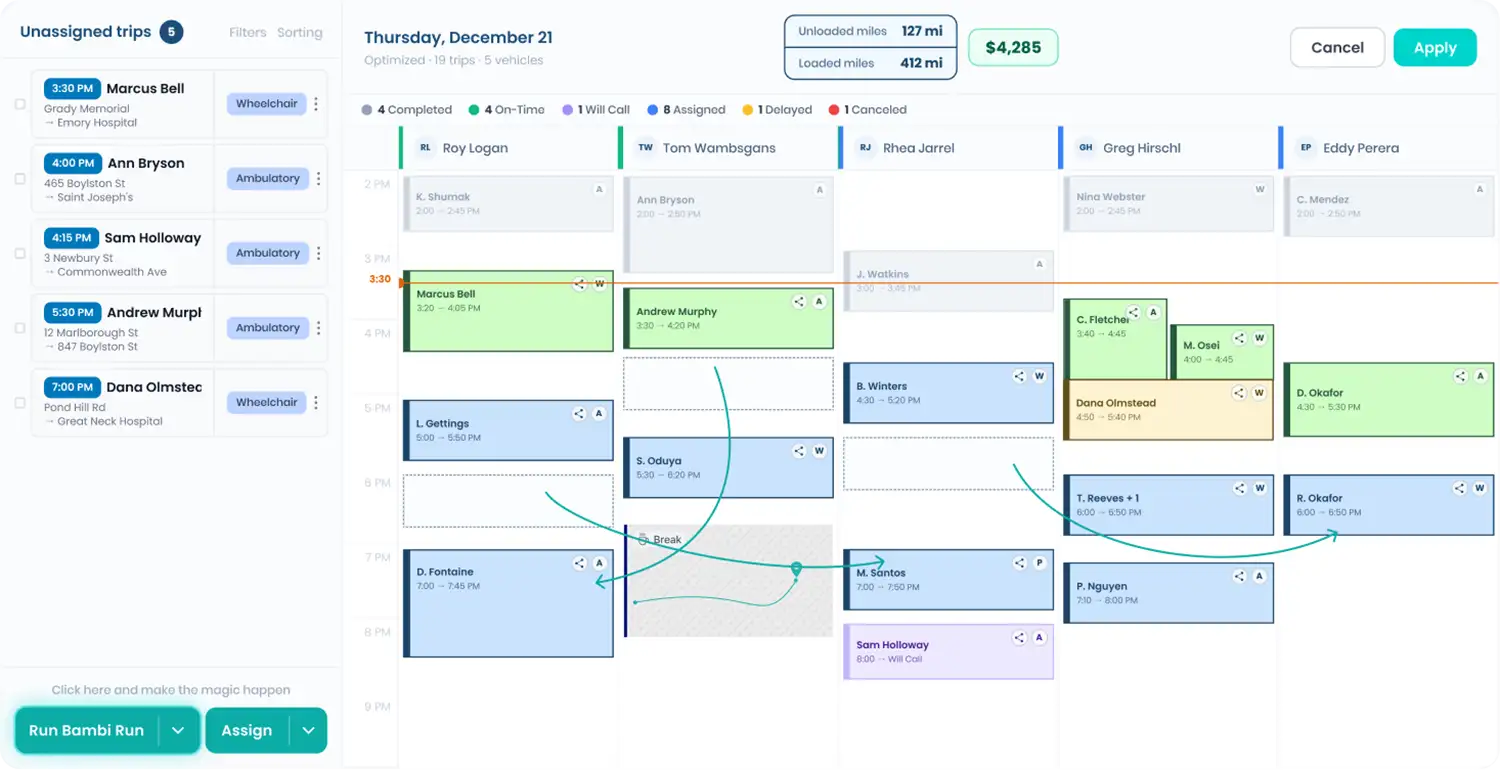
Our aiNEMT software handles scheduling, dispatching, care coordination and real-time tracking. In a market with no broker feeding you trips, the admin all lands on you, which is exactly where software earns its keep. Get in touch for a demo.