
This is the Prince Edward Island chapter of Bambi's guide to starting a non-emergency medical transportation business, and it opens with the same warning every Canadian chapter does. There is no Medicaid here, and there is no transportation broker.
Health PEI is direct about it: privately booked transport is billed to the patient, and when you are discharged from hospital you are responsible for your own transportation. Provincial health insurance does not cover it. Getting a patient to a medical appointment in a wheelchair van or a stretcher van is not an insured service, and no province has ever tendered a transportation brokerage contract. Modivcare, MTM and Verida have no Canadian operations. PEI is the smallest market in this series and the most rural province in Canada.
So the question is not "how do I credential with the broker." It is "who actually pays, and how do I get in front of them." That is what this guide covers.
Part 1: Who Actually Pays
Part 2: Licensing and Regulation
Part 3: Registering the Business
Part 4: Vehicles, Drivers and Insurance
Part 5: Who Buys, and the Market
Part 6: Technology
This is the Prince Edward Island chapter of Bambi's complete guide to starting a NEMT business. For the national picture, start with our guides to the NIHB Medical Transportation Benefit and winning health authority transport contracts.
In This Guide
- Part 1: Who Actually Pays
- Part 2: Licensing and Regulation
- Part 3: Registering the Business
- Part 4: Vehicles, Drivers and Insurance
- Part 5: Who Buys, and the Market
- Part 6: Technology
Part 1: Who Actually Pays
- Discharge is explicitly the patient's problem, stated in Health PEI's own words. That is the single clearest service gap on the Island.
- The ambulance co-pay is $150 flat, and it explicitly applies when transported to or from a medical appointment by ambulance. Seniors 65 and over are exempt for emergency department transport only, so the $150 still applies to appointments and to discharge. Inter-facility is $0 on physician referral.
- The Out-of-Province Travel Support programme has an unusual and instructive mechanic: Health PEI notifies Maritime Bus, which deducts the subsidy at point of sale. That is a rare direct-to-operator fare subsidy, and it is worth understanding as a template for how the province is willing to pay a carrier.
- Island EMS, a Medavie subsidiary, holds the contract, and that contract explicitly includes non-emergency inter-facility transfers. Know your competition.
- NIHB is small here, reflecting a 2.2% Indigenous population share.
Part 2: Licensing and Regulation
There is no separate patient transfer licence, because PEI runs a contract monopoly.
Island EMS holds the provincial contract. But the regulations do define vehicle classes, and Class 2 is a stretcher transport vehicle, so the category exists in law even without an open licensing regime. PEI has two ambulance classes, not three.
Be clear-eyed about the competitive position. A single contracted provider whose contract explicitly covers non-emergency inter-facility work occupies most of the institutional space. The realistic private market is what falls outside that contract: discharge home, appointment transport where the $150 ambulance fee is unattractive, long-term care movement, and private pay for an older rural population.
Part 3: Registering the Business
- Incorporation: $200 for a certificate of incorporation. Annual return $30. Certificate of amendment $200.
- Name search: $40 for Atlantic and federal, $50 Canada-wide.
- Sole proprietorship registration fee: we could not verify one. The registry moved to the Online Corporate and Business Registry and no fee appears on reachable public pages. Call Financial and Consumer Services at 902-368-4550.
- GST/HST small supplier threshold is $30,000. We could not verify PEI's HST rate from a CRA primary page during research, so confirm the current rate with your accountant rather than taking a number from a blog.
- WCB PEI has no employee-count threshold. If you operate in PEI with at least one regular or part-time worker, you register. Out-of-province employers must register if they employ PEI residents for any period, or non-residents working ten or more days in PEI in a calendar year. We could not verify the rate classification for passenger transport.
Part 4: Vehicles, Drivers and Insurance
- Driver licence: Class 4 covers taxis, ambulances, vans, and buses seating 24 or fewer. Class 4 Restricted covers a taxicab or ride-sharing vehicle seating fewer than ten. A wheelchair-accessible van used as a taxi or ambulance-type vehicle falls in Class 4, though the government page does not draw an explicit wheelchair-van line and that mapping is inference.
- Class 4 requires meeting Class 4 medical standards. We could not verify the exact examination frequency, so confirm with Highway Safety.
- Insurance: confirm current for-hire minimums with your broker.
Part 5: Who Buys, and the Market
How to get in. Health PEI is the single health authority and Island EMS is the incumbent. Realistically, a new PEI operator builds from private pay, long-term care relationships and discharge transport rather than from a provincial contract. The Maritime Bus subsidy mechanic shows the province will pay a carrier directly when the structure suits it, which is worth raising in any conversation with Health PEI.
Market size. Population about 182,000, a 65-plus share of 20.9%, and 54.0% rural, the most rural province in Canada against a national figure of 17.8%. This is a small market. It is also a market where the province has told patients in writing that discharge transport is their own responsibility, on an Island where more than half the population lives rurally. Small does not mean unserved.
Part 6: Technology
Get started with Bambi
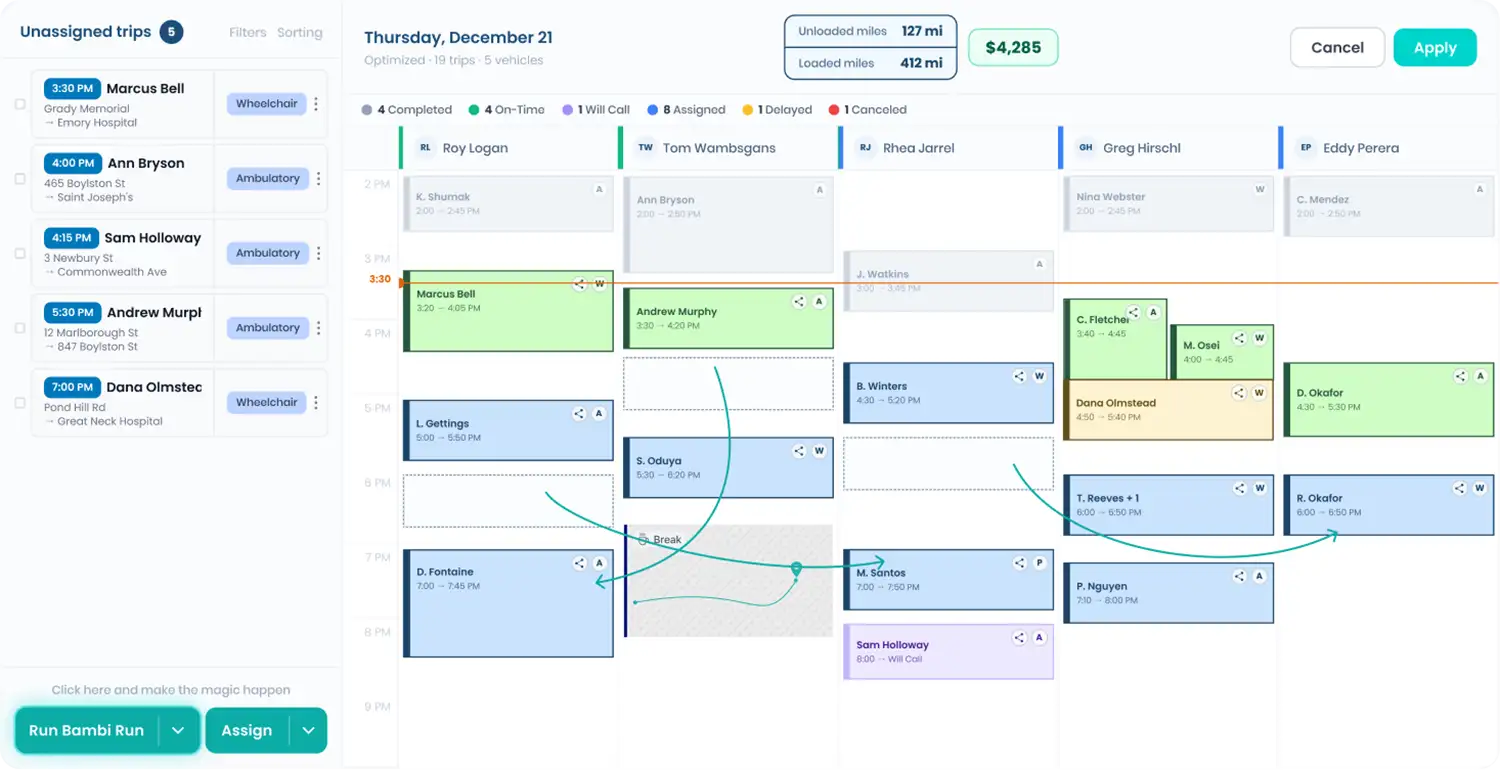
Our aiNEMT software handles scheduling, dispatching, care coordination and real-time tracking. In a market with no broker feeding you trips, the admin all lands on you, which is exactly where software earns its keep. Get in touch for a demo.