
This is the Quebec chapter of Bambi's guide to starting a non-emergency medical transportation business, and it opens with the same warning every Canadian chapter does. There is no Medicaid here, and there is no transportation broker.
RAMQ is explicit: it does not cover the cost of ambulance transport. Provincial health insurance does not cover it. Getting a patient to a medical appointment in a wheelchair van or a stretcher van is not an insured service, and no province has ever tendered a transportation brokerage contract. Modivcare, MTM and Verida have no Canadian operations. Quebec compensates with the most active institutional buying market in the country, and the cleanest insurer onboarding.
So the question is not "how do I credential with the broker." It is "who actually pays, and how do I get in front of them." That is what this guide covers.
Part 1: Who Actually Pays
Part 2: Licensing and Regulation
Part 3: Registering the Business
Part 4: Vehicles, Drivers and Insurance
Part 5: Who Buys, and the Market
Part 6: Technology
This is the Quebec chapter of Bambi's complete guide to starting a NEMT business. For the national picture, start with our guides to the NIHB Medical Transportation Benefit and winning health authority transport contracts.
In This Guide
- Part 1: Who Actually Pays
- Part 2: Licensing and Regulation
- Part 3: Registering the Business
- Part 4: Vehicles, Drivers and Insurance
- Part 5: Who Buys, and the Market
- Part 6: Technology
Part 1: Who Actually Pays
- Institutional contracts are the main event. Quebec health institutions posted 83 distinct patient-transport procurement records on SEAO between January 2025 and June 2026. Named incumbents include Dessercom, Med-Express and VPS Service de Santé. Awards run into seven figures, for example CISSS des Laurentides at $949,830 for adapted medical transport and CIUSSS Centre-Sud at $1,664,361 for taxi dispatch.
- SAAQ is the cleanest insurer door in Canada. Quebec's public auto insurer covers transportation to receive care, covers taxi where the victim's condition prevents transit use, and allows expenses to be paid directly to suppliers at the victim's request. You enrol through the SAAQclic Intervenants externes portal and receive an eight-digit supplier number. Critically, there is no 50 km deductible, unlike Ontario.
- Ambulance co-pay structure creates a niche. Quebec charges $125 base plus $1.75/km plus $35 per additional patient, but for patients 65 and over the hospital pays subject to physician approval, and inter-institution transfers are paid by the two institutions. Social assistance recipients are covered by MTESS.
- NIHB spent $28.6M in Quebec in FY2023-24. The Cree Board of Health (Wiichihiituwin) and Nunavik's NRBHSS run full in-house travel logistics rather than buying brokered service.
- CNESST pays the worker, not you. Quebec's workers' compensation regulation covers costs the worker incurs. There is no vendor door here.
Part 2: Licensing and Regulation
Quebec splits the licence by whether there is a stretcher, and the split is absolute.
- Seated and wheelchair transport falls under the taxi regime, governed by the Act respecting remunerated passenger transportation by automobile.
- Stretcher transport is ambulance work, full stop. It falls under the Act respecting pre-hospital emergency services, and permits are now issued by Santé Québec rather than the Minister, a change effective December 1, 2024.
If you want to carry stretcher patients in Quebec you are entering the ambulance industry, with everything that implies. Most new operators should build a seated and wheelchair business and leave stretcher work alone.
Quebec also mandates training, which almost no other province does. Drivers need a base course of 15 hours, plus either 7 or 18 additional hours for accessible transport depending on the vehicle. Criminal record checks are required every two years, not once. Budget the time and the money.
Part 3: Registering the Business
- Incorporation: $397, plus $30 for a name reservation.
- Sole proprietorship registration: $41.
- Payroll: Quebec has no health-tax exemption. The Fonds des services de santé applies from the first dollar of payroll at 1.65%. This is a real cost difference against Ontario and it surprises people.
- CNESST registration: within 60 days.
- GST and QST both apply. Register for both.
Part 4: Vehicles, Drivers and Insurance
- Driver licence: a wheelchair-accessible van seating ten or fewer needs a Class 5 plus the driver authorization for remunerated passenger transport, not a heavy commercial class.
- Inspections: annual, tightening to every six months once the vehicle is 8 to 10 years old.
- Insurance is the highest in this comparison group. Quebec requires $1,000,000 liability for a wheelchair-equipped vehicle. The requirement is easy to miss because it is assembled from a chain of statutes rather than stated in one place, running from the Automobile Insurance Act through the Highway Safety Code to the remunerated-transport legislation and the definition of a minibus. Assume $1M and budget for it.
- SAAQ covers bodily injury only as the public insurer, so you buy property and liability commercially.
Part 5: Who Buys, and the Market
How to get in. Quebec buys through SEAO, the provincial tender system, and larger contracts require an AMP authorization to contract, an integrity clearance from the Autorité des marchés publics. That authorization takes time to obtain and is the closest thing Canada has to a formal vendor gate, so start it early if you intend to bid on real institutional volume.
A warning sign worth reading. Transdev's Voyago Santé ceased operations in Quebec in June 2026, having won CISSS contracts in 2022. A national operator winning public contracts and then exiting the province within four years says something about Quebec unit economics. Price carefully.
Market size. Quebec has about 5,102 in-centre haemodialysis patients and a 65-plus share of 21.7%, higher than Ontario. Combined with the most active public procurement pipeline in the country, that makes Quebec attractive on paper. The Voyago exit is the counterweight.
Run the numbers: the free NEMT startup cost calculator adds up the cash you need to open: vehicles, licenses, the insurance down payment, driver onboarding and months of operating runway.
Part 6: Technology
Get started with Bambi
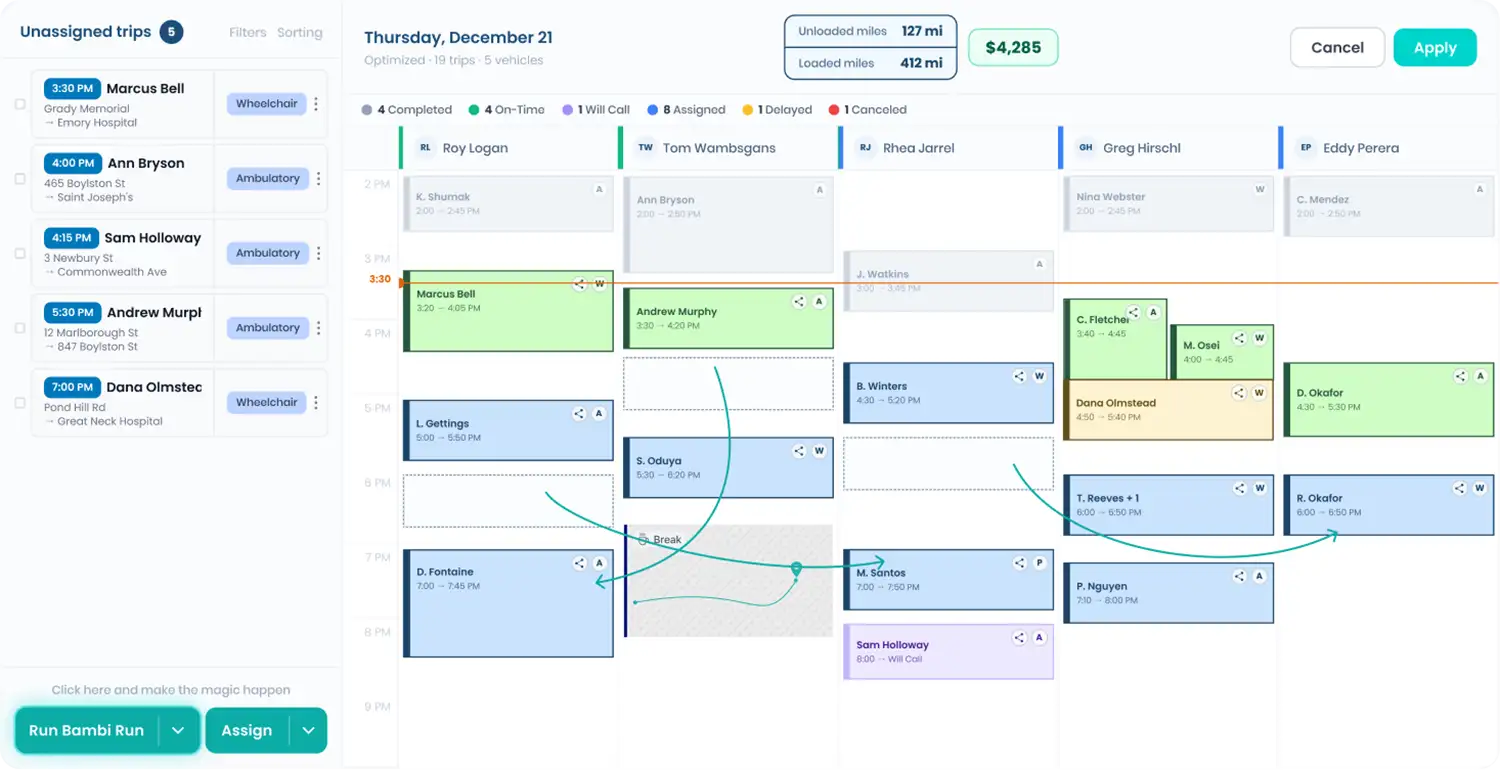
Our aiNEMT software handles scheduling, dispatching, care coordination and real-time tracking. In a market with no broker feeding you trips, the admin all lands on you, which is exactly where software earns its keep. Get in touch for a demo.