

By Nick Hoffmeyer, Head of Marketing at Bambi · Updated September 28, 2026 · 8 min read
Reviewed by Howard F. Berkowitz, a non-emergency medical transportation and paratransit expert with 30+ years in the industry (H&S Consulting).
Non-emergency medical transportation (NEMT) for dialysis patients means the same ride, on the same days, for months or years, because most in-center hemodialysis patients need treatment three times a week. That repetition is exactly what makes dialysis the hardest trip type in NEMT dispatch: there's no such thing as "close enough" on pickup time, and the fix is a properly built standing order, not a fresh booking every week.
Why Is Dialysis the Hardest Trip Type to Schedule?
Dialysis is the hardest trip type to schedule because it combines a fixed, non-negotiable timeline with a schedule that repeats for the life of the patient's treatment. According to the National Kidney Foundation, standard in-center hemodialysis is done three times a week, with each session running three to four hours. Home hemodialysis and peritoneal dialysis follow their own rhythms, but the in-center schedule is what most NEMT providers move every week. (Source: National Kidney Foundation)
A late pickup to a routine appointment is an inconvenience. A late pickup to dialysis can mean a shortened or missed treatment, and missed sessions are a real clinical risk for patients with end-stage renal disease. That's not a scheduling nuance dispatchers can shrug off. It's the reason dialysis trips get treated differently than a one-off trip to a specialist or a same-day discharge.
What Is a Standing Order, and Why Does Every Dialysis Patient Need One?
A standing order is a trip that's set up once and repeats automatically on a fixed schedule, instead of being booked fresh every week. In NEMT dispatch, a standing order is the tool that turns "pick up Mrs. Alvarez every Monday, Wednesday, and Friday at 7:15 a.m." into a permanent fixture on the schedule board rather than something a dispatcher has to remember to re-enter.
Dialysis patients need one because manually re-booking the same trip 150-plus times a year is where things fall through the cracks: a dispatcher misses a date, a new hire doesn't know the patient's history, or a one-off schedule change never gets reversed. A standing order removes the trip from the pile of things a human has to remember and turns it into a default that has to be actively changed, not actively created.
How Do You Set Up a Standing Order for a New Dialysis Patient?
Setting up a standing order correctly the first time is what keeps it from breaking later. Before the first trip runs, a dispatcher or intake coordinator should work through the same checklist every time:
- Confirm the treatment schedule directly with the dialysis center, days, start time, and typical session length, not just what the patient remembers.
- Verify payer authorization for recurring trips before the first ride, since Medicaid, a Medicare Advantage plan, or private insurance may require standing pre-approval rather than per-trip sign-off.
- Record the patient's mobility level and equipment (ambulatory, wheelchair, stretcher) so every driver in the rotation shows up with the right vehicle.
- Assign a preferred driver and vehicle pairing wherever the fleet allows it, instead of leaving the trip open to whoever's free that day.
- Build in a buffer for post-treatment effects. Patients can leave dialysis fatigued or with low blood pressure, so return-trip windows need more flex than a standard appointment.
- Set the trip to auto-recur in the scheduling system rather than re-entering it week to week.
- Establish a backup driver and vehicle specifically for that standing order, since a single point of failure isn't acceptable on a trip this time-sensitive.
- Confirm a change-management channel with the patient and the facility, so holidays, shift changes, or a skipped session get updated before the van shows up to an empty curb.
Why Does the Same Driver and Vehicle Matter So Much for Dialysis Riders?
Consistency matters on dialysis trips because the driver often becomes the most familiar face in a patient's week outside the clinic itself. A patient going through dialysis three times a week for years builds a routine around that ride: the same driver knows their transfer needs, their typical post-treatment fatigue, and whether they usually need a few extra minutes at the curb. A rotating cast of unfamiliar drivers turns a routine trip back into something a fatigued patient has to re-explain every time.
It also matters operationally. Dispatchers who can see which vehicles are wheelchair-equipped and which drivers are already tied to standing orders can protect those pairings instead of breaking them up to cover a same-day gap. Bambi's Fleet HQ gives dispatchers that live view of driver and vehicle assignments, so a standing order doesn't get quietly reshuffled every time the schedule gets tight.
What Goes Wrong With Recurring Dialysis Trips, and How Do You Prevent It?
Most dialysis trip failures come from treating a recurring trip like a one-off, either by re-booking it manually every week or by letting anyone in the driver pool pick it up. The table below covers the patterns that show up most often in dispatch and how a standing-order workflow prevents each one.
- Driver arrives late or misses the pickup window: Why It Happens: Trip is re-entered manually each week and gets buried under same-day bookings; How to Prevent It: Standing order auto-populates the schedule so it can't be forgotten or deprioritized
- A different driver shows up almost every session: Why It Happens: Fleet doesn't flag the rider as a recurring patient needing a consistent pairing; How to Prevent It: Tag the trip as a standing order and assign a small, preferred driver pool
- Return trip is booked too early or too late: Why It Happens: Session length is treated as a fixed 3-4 hours when actual time varies by patient; How to Prevent It: Build flexible pickup windows around the facility's typical discharge pattern
- Trip silently falls off the schedule on a holiday or facility closure: Why It Happens: No process for confirming schedule changes ahead of time; How to Prevent It: Standing change-management check-in with patient and facility before any shift
- No coverage when the assigned driver calls in sick: Why It Happens: Recurring trip depends on one driver with no backup plan; How to Prevent It: Backup driver and vehicle assigned to the standing order in advance
Who Pays for Dialysis Transportation?
Dialysis transportation is typically paid for through Medicaid, and less consistently through Medicare or private insurance, depending on the patient's coverage and the level of transport needed. Medicaid is required under federal rule to "assure necessary transportation" so enrollees can reach covered services, which is why it functions as the backbone of recurring NEMT funding for many dialysis patients. (Source: Medicaid.gov, Assurance of Transportation)
Original Medicare's coverage is narrower than most families expect. Medicare.gov describes coverage for "medically necessary, non-emergency ambulance transportation" when a doctor documents medical necessity, using dialysis as its own example, but that's ambulance-level transport, not routine wheelchair van or ambulatory NEMT. Medicare Advantage plans sometimes add broader transportation benefits, but that varies by plan and isn't guaranteed. (Source: Medicare.gov, Ambulance Services Coverage)
Because payer rules shift by state and by plan, and because dialysis's fixed schedule raises its own authorization questions, see our full breakdown in who pays for NEMT trips for the Medicaid, Medicare, and private insurance detail that applies across every trip type.
Frequently Asked Questions
How often do dialysis patients need NEMT transportation? Most in-center hemodialysis patients need transportation three times a week, with each session running three to four hours, according to the National Kidney Foundation. Home hemodialysis and peritoneal dialysis follow different schedules. That fixed weekly cadence is why dialysis trips are usually set up as standing orders rather than booked individually.
What is a standing order in NEMT scheduling? A standing order is a trip set up once that repeats automatically on a fixed schedule until someone cancels or changes it, instead of being manually booked each time. It's the standard way NEMT providers handle recurring riders like dialysis patients, since it removes the trip from a dispatcher's weekly to-do list.
Why is punctuality so critical for dialysis transport? A missed or shortened dialysis session is a real clinical risk for patients with end-stage renal disease, not just an inconvenience. That's why dialysis trips get zero tolerance for lateness compared to most other NEMT trip types, and why backup driver and vehicle plans matter more here than almost anywhere else in dispatch.
Does Medicaid or Medicare pay for dialysis transportation? Medicaid is required to assure transportation to covered services and is the primary payer for many recurring dialysis trips. Original Medicare's coverage is narrower, generally limited to medically necessary ambulance transport rather than routine NEMT vans. Medicare Advantage plans vary. See our who pays for NEMT guide for the full breakdown.
Can a dialysis patient request the same driver every time? Many providers try to assign a consistent driver and vehicle to recurring dialysis riders, since familiarity helps with transfers, routine, and comfort. Whether it's guaranteed depends on the fleet's size and driver availability, but it's a standard goal when setting up a standing order.
What happens if a scheduled dialysis ride falls through? Providers should have a backup driver and vehicle plan built into every dialysis standing order before it's ever needed, precisely because a missed pickup carries real medical risk. If a trip does fall through, the facility and patient should be notified immediately so alternate transportation can be arranged without delay.
Setting Up Standing Orders Shouldn't Be the Hard Part
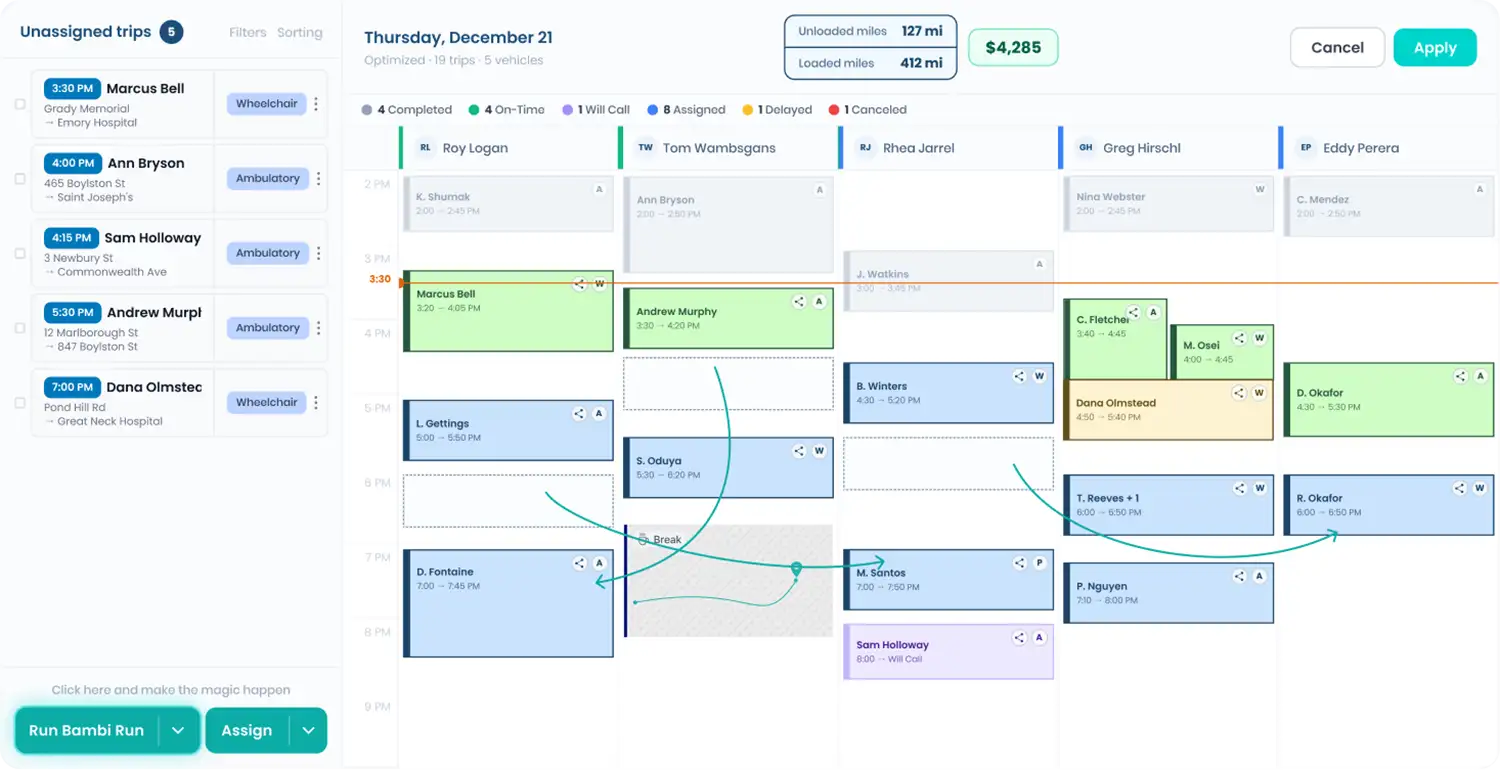
Building and protecting a dialysis patient's standing order by hand, across dozens of riders and a rotating driver pool, is exactly the kind of scheduling grind that eats a dispatcher's week. With Run Bambi Run, you set the recurring trip once and Bambi's AI scheduling keeps slotting it into the right driver and vehicle every week, instead of leaving it to whoever remembers to re-book it. One click, trips assigned, even the ones that repeat 150 times a year. See it on our pricing page, $69 per active vehicle per month, flat, no annual contracts.
About the author Nick Hoffmeyer is Head of Marketing at Bambi, the AI-powered dispatch and scheduling platform for non-emergency medical transportation (NEMT) providers. He works with NEMT owner-operators every day on growth, SEO, and the operational systems that help fleets run more trips with less stress. More from Nick: LinkedIn